

Yes, you can microwave a sweet potato, and for one or two potatoes it is one of the fastest ways to get a soft, sweet side dish on the table. Scrub a medium sweet potato clean, pierce the skin 6 to 8 times with a fork, set it on a microwave safe plate, and microwave on high for 5 to 7 minutes in a 1000 watt oven, flipping it once halfway through. Let it rest for 3 minutes before you cut into it. It is ready when a fork slides into the thickest part with almost no resistance and the flesh gives slightly when you squeeze it gently with an oven mitt. The skin stays tender, the inside turns fluffy and sweet, and the whole job takes about 10 minutes from sink to plate.
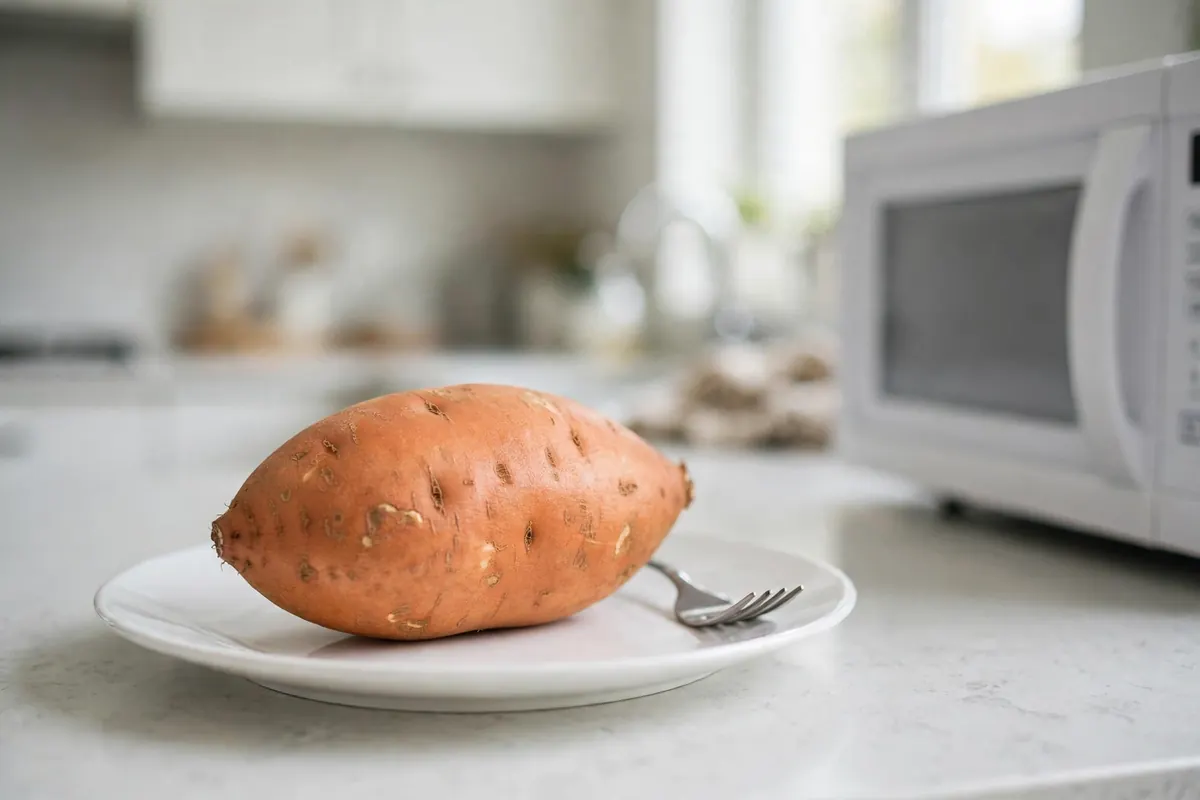
Sweet potatoes suit the microwave for a simple reason. They are dense, moist, and full of natural sugars, so the heat turns the water inside them to steam and cooks them from the inside out. That same steam is also the reason microwaved sweet potatoes go wrong so often. Skip the piercing step and the steam has nowhere to go, so the potato can burst inside the oven. Cook it too long and the edges dry out while the middle turns stringy. Cut into it the moment the timer beeps and the center can still be firm, because the heat needs a few minutes of rest to finish spreading. None of those problems means the microwave is the wrong tool. They mean the method matters more than the timer, and the method in this guide is built around the four things that actually decide the result: piercing deep enough, even size, stopping early, and resting before you cut.
This guide gives you the method that works for the sweet potatoes most people buy, the times for small, medium, large, and extra large potatoes, and honest answers to the questions that confuse people most. That includes how long to microwave a sweet potato when the guides disagree, whether you can microwave more than one at a time, what to do with cubes, slices, and frozen sweet potatoes, why microwaved sweet potatoes turn soggy, dry, or rubbery, whether the skin is safe to eat, and when the oven or the stove is the better tool. If you only need the quick answer, the short answer section and the step list are enough. If you want a sweet potato that tastes like you meant it, read the sections on piercing, timing, and resting. For the wider picture of what microwaves well and what does not, see the complete microwave guide on this site.
Short answer: can you microwave sweet potatoes?
Yes. Microwave a scrubbed, pierced sweet potato on high on a microwave safe plate, flipping it halfway through, and let it rest for 3 minutes before serving. A medium sweet potato of 5 to 7 ounces takes 5 to 7 minutes in a 1000 watt microwave. A small one of 4 to 5 ounces takes 4 to 5 minutes. A large one of 8 to 10 ounces takes 8 to 10 minutes. An extra large one over 10 ounces takes 10 to 12 minutes. Those times are starting points, not promises. Sweet potatoes vary in shape and density, and microwaves vary in power, so always check with a fork and add time in 30 to 60 second bursts if the center is still firm. Piercing is the one step you must never skip. An unpierced sweet potato can explode from steam pressure, and that is a real mess and a real burn risk, not a myth. Never wrap a sweet potato in foil, and never microwave it in a container that is not labeled microwave safe.
The result is closest to a steamed sweet potato, not a roasted one. The skin turns soft rather than crisp, and the flesh turns creamy rather than caramelized. That is fine for most uses. A microwaved sweet potato works well split open with butter, mashed, cubed into a salad, or sliced into a grain bowl. It does not work well when you want crispy skin or the deep roasted flavor that only a hot oven builds. If crisp skin is the point of the dish, use the oven, or microwave the potato most of the way and finish it in a hot oven for 10 minutes. The microwave does the slow work in minutes, and the oven adds the finish.
How to microwave a sweet potato step by step
Start with a sweet potato that feels heavy for its size and has no soft spots, mold, or deep cracks. A firm potato with smooth, unbroken skin cooks evenly. A potato with a soft patch or a sour smell has started to spoil, and no cooking method fixes that, so throw it out. Rinse it under cold running water and scrub the skin with a vegetable brush or your fingers. Sweet potato skin is edible, and you will probably eat some of it, so wash it properly even if you plan to peel it later. Pat it dry with a clean towel. A wet skin is not dangerous, but drying it helps the skin stay tender rather than soggy.
Next, pierce the skin deeply with a fork. Push the tines about half an inch into the flesh, and make 6 to 8 holes spread around the whole potato, top, bottom, and sides. Shallow pricks do not count. The holes need to reach the flesh so steam can escape from inside the potato, not just from the surface. Some guides say 4 to 5 holes are enough, and others say 8 to 10. Six to 8 deep holes is the safe middle ground for a medium potato, and for a large potato go closer to 10. This takes about 10 seconds and it is the single most important step in the whole process.
Place the potato on a microwave safe plate or a paper towel, not directly on the turntable and not in a metal dish. Do not wrap it in foil, and do not wrap it tightly in plastic wrap. A loose damp paper towel is optional and can help keep the skin from drying out, but it is not required. If you use one, leave it loose so steam can escape. Set the microwave to high power and cook for half the time in the table below. When the timer stops, flip the potato with tongs or an oven mitt, because it will be hot, and cook for the remaining time. Flipping matters because microwaves heat unevenly, and the side facing the turntable cooks faster than the side facing up.
When the timer finishes, do not cut the potato open yet. Leave it on the plate for 3 minutes. This rest, which food safety guides call standing time, is when the heat evens out and the center finishes cooking. A potato that feels firm the moment the microwave stops often turns perfectly tender after 3 minutes of rest. Cutting it open too soon also lets out a rush of steam that can burn your hands, and it stops the center from finishing. After the rest, squeeze the potato gently through an oven mitt. If it gives easily, it is done. If the middle still feels hard, put it back for 30 to 60 seconds and rest it again. Split it open, add butter or your topping, and serve while it is hot.
Microwave times for sweet potatoes by size
The guides disagree on exact times, and that disagreement is honest. A medium sweet potato is listed as 5 to 7 minutes in some guides, 5 to 8 minutes in others, and 7 to 9 minutes in a few more. The differences come from potato density, starting temperature, and microwave power. Other cooking guides, such as the sweet potato microwave guide on KitchPrep, give similar ranges and the same core advice: pierce well, flip halfway, and check with a fork. The table below gives the ranges that most guides agree on for a 1000 watt microwave, and the safest habit is to start at the low end of the range and add short bursts. You can always add 30 seconds. You cannot undo an overcooked potato.
| Sweet potato size | Weight | Time on high (1000W) | Rest time |
|---|---|---|---|
| Small | 4 to 5 ounces | 4 to 5 minutes | 2 minutes |
| Medium | 5 to 7 ounces | 5 to 7 minutes | 3 minutes |
| Large | 8 to 10 ounces | 8 to 10 minutes | 3 to 5 minutes |
| Extra large | Over 10 ounces | 10 to 12 minutes | 5 minutes |
Weigh the potato if you can, because size by eye is unreliable. A long thin potato cooks faster than a short fat one of the same weight, because the heat has less distance to travel to the center. A very thick potato can need an extra minute even at the same weight as a thinner one. If you buy sweet potatoes loose and they are all different shapes, pick potatoes of similar size and shape when you cook more than one, so they finish at the same time. If one potato in the batch is much bigger than the others, cook it alone or give it a head start of 1 to 2 minutes before you add the smaller ones.
The fork test is more reliable than the timer. Push a fork or a thin knife into the thickest part of the potato. It should slide in with almost no resistance, the way it would slide into a baked potato from the oven. If you have to push, the center is still firm, so add 30 to 60 seconds and test again. If the fork slides in and the flesh feels wet or the skin splits and leaks liquid, the potato is slightly overcooked. It is still fine to eat, just softer than ideal, and it works well mashed. The goal is a potato that is soft all the way through but still holds its shape when you split it open.
How much water should you add?
A whole sweet potato needs no added water. The potato itself is about 70 to 80 percent water, and that internal moisture turns to steam and cooks the flesh from the inside. Adding water to the plate does not help a whole potato and can make the skin soggy, because the potato sits in a puddle while it cooks. Cook a whole sweet potato dry on a plate, with nothing but the fork holes and the flip halfway through. If the skin looks dry after cooking, that is usually a sign of overcooking, not a lack of water, and the fix is a shorter cook time next time, not a wetter plate.
Cubed or sliced sweet potato is different, because the pieces have far more exposed surface and dry out fast. For cubes, add 2 to 3 tablespoons of water to the dish and cover it loosely with a microwave safe plate or a vented lid, so the water turns to steam and cooks the pieces evenly. Drain off any leftover water after cooking, because cubes left sitting in water turn mushy within a minute. For a damp paper towel wrap around a whole potato, opinions differ. Some cooks swear by it for a softer skin, and others find it makes the skin wet and wrinkled. If you try it, use one damp paper towel, wrap it loosely, and remove it as soon as the potato comes out, so the skin does not steam itself soggy during the rest.
Adjusting for your microwave wattage
Most timing guides assume a 1000 watt microwave, which is the common size in the United States. If your microwave is weaker, the same potato takes longer, and if it is stronger, it takes less time. A 700 watt microwave needs roughly 25 to 30 percent more time than the table above, so a medium potato that takes 5 to 7 minutes at 1000 watts takes about 7 to 9 minutes at 700 watts. A 1200 watt microwave needs roughly 15 to 20 percent less time, so that same medium potato takes about 4 to 6 minutes. These are rough adjustments, not exact math, because potato shape and starting temperature also change the result.
If you do not know your microwave wattage, look for the label inside the door frame or on the back of the oven. If you cannot find it, assume it is a standard 1000 watt model and start at the low end of the time range, then check with a fork. The first time you microwave a sweet potato in a new oven, treat it as a test. Cook for 5 minutes, check, and add time in short bursts. Write down the time that worked for your oven and your usual potato size, because that number will be right every time after that. Microwaves also develop hot spots as they age, and a turntable that no longer turns makes uneven cooking worse, so if your potato is always hard on one side, rotate it by hand halfway through even if the turntable is working.
Power level matters too. High power is right for a whole sweet potato, because you want strong heat to push steam through the dense flesh. For reheating a cooked sweet potato, or for finishing a potato that is almost done but has a firm center, 50 to 70 percent power is better. Lower power heats more gently and gives the heat time to spread to the center without drying out the edges. If your potato always comes out with dry, leathery edges and a hard center, try cooking at 70 percent power for a longer time instead of full power for a shorter time. The total cooking time goes up by a minute or two, but the result is far more even.
Microwaving two or more sweet potatoes at once
You can microwave more than one sweet potato at a time, and the method is the same, with two changes. First, arrange the potatoes in a circle with space between them, like spokes on a wheel, not stacked and not touching. Microwaves heat the outside of a pile faster than the middle, so a stack cooks unevenly and the potato in the center stays hard while the ones on the outside dry out. Second, add time. Two medium potatoes take about 8 to 10 minutes instead of 5 to 7, which is roughly 1 to 2 minutes extra per additional potato. Three potatoes take about 10 to 12 minutes. Four is the practical limit for one batch, and beyond that you are better off cooking in two batches or using the oven.
Flip and rotate the potatoes halfway through, and swap their positions if you can, so the potato that started near the edge moves toward the center and the one in the center moves out. Check each potato separately with a fork, because even potatoes of the same size can finish at slightly different times. Take out the ones that are done and give the firm ones another 30 to 60 seconds. Let the whole batch rest for 3 to 5 minutes before cutting, because a pile of hot potatoes holds heat and the rest evens them out. If you are meal prepping for the week, cook the potatoes in the morning, let them cool completely, and store them in the fridge in an airtight container. They reheat well and keep for 3 to 4 days.
Sweet potato cubes and slices in the microwave
Cubed sweet potato cooks faster than a whole potato and works well when you need pieces for a salad, a grain bowl, or a quick side dish. Peel the potato, cut it into even cubes of about 1 inch, and spread them in a single layer in a microwave safe dish. Even size matters more here than with a whole potato, because small cubes turn to mush while big cubes are still hard. Add 2 to 3 tablespoons of water, cover the dish loosely with a microwave safe plate or a vented lid, and microwave on high for 5 to 7 minutes for 2 cups of cubes, stirring once halfway through. Check a thick cube with a fork. If it is still firm, add 1 minute at a time until it is tender but still holds its shape.
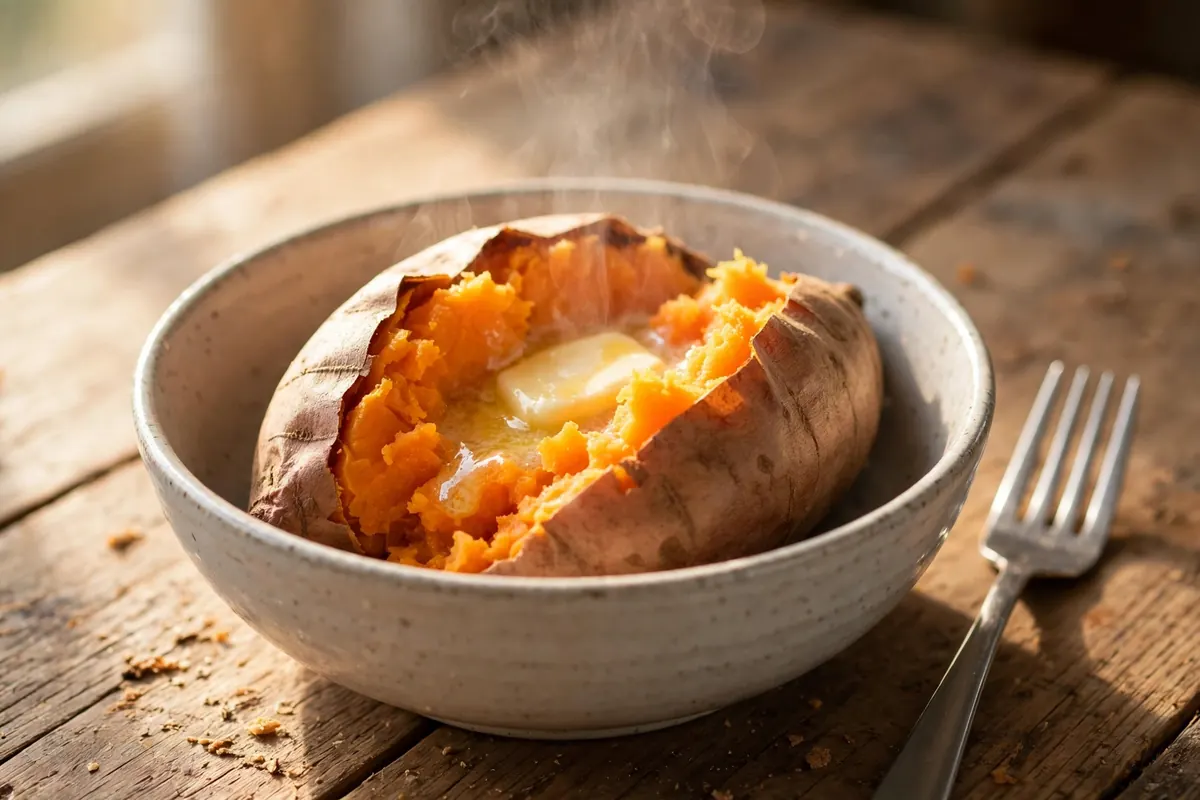
Slices behave the same way but cook a little faster, because they are thinner. Cut slices about half an inch thick, lay them in a single layer if you can, add 2 tablespoons of water, cover loosely, and microwave for 4 to 6 minutes for 2 cups, stirring once halfway through. Do not pile slices more than two layers deep, because the pieces in the middle steam while the pieces on top dry out. Cubes and slices are the best form for the microwave if you want to season the potato, because the seasoning reaches every piece. Toss the hot cubes with olive oil, salt, smoked paprika, or cumin, and they are ready to eat. Whole potatoes are better when you want a simple baked potato style serving, and cubes are better when the potato is an ingredient rather than the main event.
One mistake to avoid with cubes is using too much water. Two to 3 tablespoons is enough to make steam. Half a cup turns the dish into a pot of boiling water, and the cubes come out waterlogged and bland, with their flavor and some of their nutrients poured away with the liquid. If you drain off a lot of water after cooking, you used too much. Another mistake is covering the dish tightly with no vent. A sealed lid traps steam until the pressure pops the lid off or the dish cracks, so always leave a small gap or use a vented lid. A microwave safe plate set slightly askew over the bowl is the simplest cover, and it works well.
Frozen sweet potatoes in the microwave
Frozen sweet potato cubes and slices are sold in bags in most supermarkets, and the microwave handles them well. They need no thawing. Put the frozen pieces in a microwave safe dish, add 1 to 2 tablespoons of water, cover loosely, and microwave on high for 5 to 7 minutes for 2 cups, stirring once halfway through. Frozen pieces carry their own ice, which melts into water and makes steam, so they need less added water than fresh cubes. If the bag is a steam bag, follow the directions printed on it and do not add water at all. Check the thickest piece with a fork before serving, and drain off any liquid so the pieces do not go soggy while they sit.
A whole frozen sweet potato is a different story. Do not microwave a whole frozen sweet potato. The outside thaws and cooks while the center stays frozen, and the temperature difference can crack the skin and leave the middle raw. If you have a whole frozen sweet potato, thaw it in the fridge overnight first, then microwave it like a fresh one, adding 1 to 2 minutes to the usual time. The same caution applies to any dense frozen vegetable. Small pieces thaw and cook evenly, and large solid pieces do not. Frozen sweet potato fries from a bag are also better in the oven or an air fryer than in the microwave, because the microwave makes them soft instead of crisp, and crispness is the whole point of a fry.
Why microwaved sweet potatoes turn soggy, dry, or rubbery
A soggy sweet potato is almost always an overcooking problem or a water problem. Too much time in the microwave breaks down the starch completely and the flesh turns wet and sloppy. Too much added water, a tight plastic wrap that traps steam, or a damp paper towel left on during the rest all add moisture to the skin and the surface. The fix is to start at the low end of the time range, cook the potato dry on a plate with no wrap, and rest it uncovered. If a potato comes out soggy, you can still save it. Split it open, scoop out the flesh, and mash it, or slice it and crisp the slices under a hot broiler for 2 to 3 minutes. Soggy flesh makes good mash, so nothing is wasted.
A dry sweet potato is the opposite failure. It happens when the potato cooks too long, when the microwave is too powerful for the potato size, or when a small potato is cooked for the time a large one needs. The edges dry out first and turn leathery, and the flesh near the skin feels stringy. The fix is a shorter cook time, lower power, or both. Try 70 percent power for a minute or two longer instead of full power, and check with a fork earlier than you think you need to. A dry potato can be rescued with butter, olive oil, or a spoonful of yogurt, which adds back the moisture and fat that the long cook drove out.
A rubbery sweet potato usually means it was cut open too soon, reheated at full power, or cooked in short bursts with long gaps between them. Cutting too soon stops the resting process, so the starch does not finish setting and the texture stays gummy. Reheating at full power heats the outside fast while the inside lags, and the outside turns tough. Reheat a cooked sweet potato at 50 percent power for 1 to 2 minutes instead, and let it rest for 1 minute before eating. If the potato went rubbery because it was overcooked, mashing is again the rescue. A rubbery whole potato is a poor baked potato but a fine mash.
Why did my sweet potato explode in the microwave?
A sweet potato explodes in the microwave because steam builds up inside it faster than it can escape. The skin is thick and strong, and the flesh inside is full of water. As the microwave heats that water, it turns to steam and the pressure rises. If there is no hole for the steam to leave through, the pressure keeps rising until the skin gives way all at once, and the potato bursts. It is loud, it makes a mess, and it can spray hot flesh across the oven. The fix is simple and it works every time: pierce the skin deeply before you cook. Six to 8 deep fork holes, each about half an inch into the flesh, give the steam enough escape routes that pressure never builds to the bursting point.
Shallow pricks are the most common reason a pierced potato still explodes. A fork pressed lightly against the skin makes a mark on the surface but does not reach the flesh, and the hole seals itself shut as the skin softens, so the steam is trapped again. Push the fork in firmly until the tines sink into the flesh. A knife can make deeper slits, and some guides prefer it, but a knife is also easier to slip with, so a fork is the safer tool for most people. If your potato exploded even though you pierced it, the holes were almost certainly too shallow, too few, or both. Next time, make more holes and push deeper. Also check that the potato had no tight wrap trapping steam. A potato wrapped tightly in plastic wrap can build pressure even with holes in the skin, because the wrap seals the steam in. Cook the potato uncovered on a plate, or under a loose damp paper towel at most.
If a potato does explode, turn the microwave off, wait a minute for the steam to settle, and wipe the inside with a damp cloth. Check the turntable and the door seal for stuck pieces. The potato is usually still edible if the pieces are clean, but if pieces landed on the floor or touched a dirty surface, throw those pieces away. Do not keep cooking a burst potato at full power, because the torn skin dries out fast. If it is mostly cooked, finish it in short bursts at 50 percent power and rest it before eating. Explosions sound dramatic, and they are a genuine burn risk if you open the door at the wrong moment, which is why piercing is a safety rule and not a cooking tip. The United States Department of Agriculture guidance on microwave cooking says to pierce the skins of potatoes, apples, squash, and similar foods so steam can escape, and that advice exists because this exact accident is common.
Should you wrap a sweet potato in foil, plastic wrap, or a paper towel?
Never wrap a sweet potato in foil for the microwave. Metal reflects microwaves, and foil in a microwave oven can spark, damage the oven, and start a fire. Foil belongs in a regular oven or on a grill, not in a microwave. The same rule applies to any metal dish, metal trim on a plate, or a container with a metallic rim. If a plate has a gold or silver pattern around the edge, do not use it in the microwave. Use plain glass, ceramic, or plastic that is labeled microwave safe.
Plastic wrap is more complicated, because some plastic wrap is labeled microwave safe and some is not. Wrap that is not labeled microwave safe can melt onto the food or release chemicals when it heats up, so never use it unless the box says it is safe for microwave use. Even microwave safe wrap should never touch the food directly, and it should never be pulled tight around a potato, because it traps steam and raises the bursting risk. A loose cover with a vent is fine, but for a whole sweet potato the simplest and safest choice is no wrap at all. A damp paper towel is the middle option. It is safe, it adds a little moisture to the skin, and it breathes, so steam escapes. Wrap it loosely, not tightly, and take it off as soon as the potato comes out so the skin does not sit in steam during the rest. For cubes in a dish, a microwave safe plate or a vented lid is a better cover than any wrap, because it traps enough steam to cook the pieces without sealing the dish shut.
Can you eat the skin after microwaving?
Yes, the skin of a microwaved sweet potato is safe to eat when the potato has been washed well. The skin is tender after microwaving, and it carries fiber and nutrients, so eating it is a good choice. Wash the potato under cold running water and scrub it with a vegetable brush before cooking, because the skin grows in soil and can carry dirt and bacteria. The microwave does not clean the outside of the potato, so washing is your job. If the skin has a green patch, a deep cut, or a moldy spot, cut that part away before cooking, because those areas can taste bitter or carry spoilage.
Some people peel sweet potatoes out of habit, and that is fine too. Peeling is the right choice if the skin is damaged, if the potato was waxed for storage and the wax bothers you, or if the recipe needs a smooth texture. For a simple baked style serving, eat the skin. For mash or cubes, peel first if you prefer, because the skin can turn papery in small pieces. Sweet potatoes are not the same as regular potatoes, and the skin of a sweet potato is thinner and softer than the skin of a baking potato, so it is easier to eat and less likely to feel tough. If you are serving a sweet potato to a small child, peel it or mash the flesh, because the skin can be hard for a child to chew.
Microwaved sweet potatoes and nutrition
Sweet potatoes are a strong source of vitamin A in the form of beta carotene, which gives the flesh its orange color, and they also provide fiber, potassium, vitamin C, and manganese. A medium sweet potato covers a large share of the daily vitamin A most adults need, and the fiber helps the potato feel filling for its size. The exact numbers vary by variety and size, so treat any single figure you see online with care, and check the United States Department of Agriculture FoodData Central entry if you want the precise values for the variety you bought. The important point for this guide is that microwaving is a good way to keep those nutrients in the food.
Microwaving preserves nutrients well for two reasons. It cooks fast, so heat sensitive vitamins spend less time exposed to heat, and it uses little or no added water, so water soluble vitamins do not leach out into cooking water that gets poured away. Boiling a sweet potato in a large pot loses more vitamin C and B vitamins to the water, because the vitamins dissolve and leave with the liquid. Steaming and microwaving both avoid that loss. That does not make a microwaved sweet potato a health food by magic, and the toppings matter more than the cooking method. A plain microwaved sweet potato with a little olive oil is a nutritious side dish. The same potato loaded with brown sugar, marshmallows, and butter is a dessert, and the cooking method does not change that.
There is no good evidence that microwaves themselves damage nutrients in any special way. Microwaves heat food by making water molecules move, and the heat does the cooking, just like the heat in an oven or a pot. The nutrient losses in microwave cooking come from time, temperature, and water, the same three things that cause nutrient losses in every other cooking method. Short cooking, little water, and no long soak after cooking are what protect nutrients, and the microwave is good at all three. If you want the most nutrition from a sweet potato, cook it whole with the skin on, because peeling and cutting expose more surface and lose more vitamins, and eat it soon after cooking rather than letting it sit in water.
Microwave safety for sweet potatoes
The safety rules for microwaving a sweet potato are the same rules that apply to microwave cooking in general, and they come from the United States Department of Agriculture Food Safety and Inspection Service guidance on microwave ovens. First, pierce the skin so steam can escape. Second, use only containers labeled microwave safe, and keep metal and foil out of the oven. Third, cover food loosely when you want steam, stir or rotate it during cooking when the shape allows it, and let it stand after cooking so the heat spreads and the cooking finishes. Microwaves heat unevenly and can leave cold spots, and the standing time is what evens those spots out. The USDA guidance also says to check the temperature in several places with a food thermometer when safety matters, because the surface can feel hot while the center is still cool.
For a fresh sweet potato, doneness is a texture question, not a temperature question. The potato is done when a fork slides into the thickest part easily, and that happens well above the temperature where ordinary food safety worries apply to a plain vegetable. The 165 degrees Fahrenheit (74 degrees Celsius) figure you will see in microwave safety guides is the USDA safe minimum for reheated leftovers, poultry, and similar foods, not a target for a fresh vegetable. For reheated sweet potato leftovers, that figure does apply. Reheat leftovers until they are steaming hot all the way through, at least 165 degrees Fahrenheit in the thickest part, and never reheat them more than once. The Clemson University Cooperative Extension fact sheet on microwave food safety gives the same advice in plain terms, and the USDA fact sheet on cooking safely in the microwave is the source to read if you want the full guidance.
Two more safety points are worth stating plainly. The inside of a microwaved sweet potato can be far hotter than the outside feels, so always use an oven mitt and keep your face away from the steam when you cut it open. A potato can reach over 200 degrees Fahrenheit inside while the skin feels only warm, and that steam can burn. And never run a microwave empty, because the energy has nowhere to go and can damage the oven. That rule has nothing to do with sweet potatoes, but it is the most common way people damage a microwave by accident, and a damaged microwave heats unevenly, which makes every later meal less safe.
Seasoning and serving ideas
A microwaved sweet potato needs very little to taste good. Split it open, add a knob of butter, a pinch of salt, and a grind of black pepper, and it is ready. The natural sweetness of the flesh does most of the work. If you want more flavor, the potato takes seasoning well because the flesh is soft and absorbs what you put on it. Try olive oil with smoked paprika and a squeeze of lime, or butter with cinnamon and a drizzle of honey, or Greek yogurt with chives for a savory version. For a fuller meal, fill the split potato with black beans, corn, and salsa, or with chickpeas, tahini, and lemon, or with pulled chicken and barbecue sauce. The potato is a base, and the filling is the meal.
Cubed microwaved sweet potato works in more dishes than a whole potato does. Toss hot cubes with olive oil, salt, and cumin for a side dish, add them to a grain bowl with rice, greens, and a tahini dressing, or fold them into a salad with kale, feta, and toasted seeds. They also work in a breakfast hash with eggs, or mashed with a little butter and milk as a quick alternative to mashed regular potatoes. For children, mash the flesh with a little butter and let it cool to a safe temperature before serving, and skip the skin if the child finds it hard to chew. Sweet potato mash freezes well too, so a batch cooked on Sunday can become three quick side dishes during the week.
When the microwave is not the best tool
The microwave is the wrong tool when the dish depends on texture that only dry heat can build. Crispy skin is the clearest example. A microwaved sweet potato has soft skin, and no amount of extra time in the microwave will crisp it, because the microwave steams the skin instead of drying it. If you want crispy skin, use the oven, or microwave the potato until it is almost done and finish it in a hot oven at 425 degrees Fahrenheit for 10 minutes. The same applies to sweet potato fries. The microwave makes fries soft, and fries need dry heat and space to crisp. Use the oven or an air fryer for fries, and use the microwave for the quick cook that comes before it if you like.
The microwave is also the wrong tool for a large batch. Four potatoes is the practical limit in one batch, and beyond that the cooking time climbs and the results get uneven. If you are cooking for a crowd, the oven takes a tray of eight or ten potatoes at once and cooks them all evenly, and the extra 30 minutes is worth it. The microwave is also not the best tool for a very large potato. A potato over 12 ounces can take 12 to 15 minutes in the microwave, and by then the outside is often dry while the center is still firm. Cut a very large potato in half lengthwise before microwaving, or cook it in the oven. Finally, the microwave cannot fix a poor potato. A sweet potato that is old, sprouted, or stored badly will taste starchy and dull however you cook it, so buy firm potatoes with smooth skin and cook them within a week or two.
Microwave versus stove versus oven
Each cooking method gives you a different sweet potato, and the right choice depends on what you want from the dish. The microwave is fastest, taking 5 to 12 minutes, and it gives you a soft, steamed result with tender skin and creamy flesh. It uses the least energy and makes the least mess, and it is the best choice for one or two potatoes on a busy evening. The oven is slowest, taking 45 to 60 minutes at 400 degrees Fahrenheit, and it gives you the best flavor, with caramelized edges, a sweet concentrated flesh, and crispy skin. It is the best choice when flavor is the point and you have the time. The stove, in the form of boiling or steaming, sits in the middle at 15 to 25 minutes, and it gives you a soft result that is closer to the microwave than to the oven, with more nutrient loss to the water if you boil rather than steam.
| Method | Time | Texture | Best for |
|---|---|---|---|
| Microwave | 5 to 12 minutes | Soft, steamed, tender skin | One or two potatoes, fast meals |
| Oven | 45 to 60 minutes | Caramelized, crispy skin | Best flavor, large batches |
| Steaming | 20 to 30 minutes | Soft, moist, no crisp skin | Cubes for salads and bowls |
| Boiling | 15 to 25 minutes | Soft, can turn watery | Mash, when speed is not the goal |
The microwave wins on speed and convenience, the oven wins on flavor, and steaming wins when you need even cubes without drying them out. Boiling is the weakest method for a whole sweet potato, because the potato sits in water and loses flavor and nutrients to the pot, and the flesh can turn watery. If you do boil sweet potatoes, keep the pieces large, use as little water as you need to cover them, and drain them the moment they are tender. For most weeknight cooking, the honest answer is to microwave the potato and spend the saved 40 minutes on the rest of the meal. The flavor difference between a microwaved sweet potato and an oven baked one is real, but it is small, and a good topping closes most of the gap.
Storage and reheating
A cooked sweet potato keeps in the fridge for 3 to 4 days in an airtight container. Let it cool completely before you put the lid on, because a warm potato in a sealed container makes condensation, and condensation makes the skin soggy and speeds up spoilage. Store whole potatoes and cubes the same way, and keep the skin on a whole potato during storage, because the skin protects the flesh and slows drying. Do not leave a cooked sweet potato at room temperature for more than 2 hours. Bacteria grow fast in warm, moist food, and a potato left on the counter overnight is not safe to eat, even if it looks and smells fine.
To reheat a cooked sweet potato, split it open or cut it into pieces, add a teaspoon of water or a small knob of butter, cover it loosely, and microwave at 50 percent power for 1 to 2 minutes. Low power matters here, because full power reheats the outside fast and turns it leathery while the center stays cool. Let it rest for 1 minute after reheating, and check that it is steaming hot all the way through. The USDA safe minimum for reheated leftovers is 165 degrees Fahrenheit (74 degrees Celsius) in the thickest part, so use a food thermometer if you are unsure. Reheat a sweet potato only once. If you have leftovers after reheating, throw them away rather than reheating them again. Mashed sweet potato freezes well for up to 3 months in a freezer safe container, and a whole cooked potato does not freeze well, because the texture turns watery when it thaws.
Mistakes to avoid
The most common mistakes with microwaved sweet potatoes are all easy to avoid once you know them. Skipping the piercing step is the most dangerous, because it is the one that causes explosions. Cooking at full power for the maximum time on the first try is the most common, because it turns the edges dry and the center stringy, when starting low and adding short bursts would have given a perfect potato. Cutting the potato open the moment the timer beeps is the most wasteful, because it stops the resting process that finishes the center. Wrapping the potato in foil is the most damaging to the oven, because it can spark and start a fire. Using too much water on cubes is the most common reason for soggy results, and piling cubes more than two layers deep is the most common reason for uneven cooking.
Two more mistakes are worth naming. The first is trusting the timer instead of the fork. Every microwave and every potato is different, and the fork test is the only check that tells you the truth about the potato in front of you. The second is cooking a potato you have not inspected. A sweet potato with a soft spot, a moldy patch, or a sour smell has started to spoil, and cooking it does not make it safe. Throw it out and start with a fresh one. If you avoid these mistakes, a microwaved sweet potato is one of the most reliable quick side dishes you can make, and it takes less attention than almost anything else you cook in a week. For more on how the microwave handles other vegetables, see our guides to microwaving carrots, microwaving regular potatoes, and microwaving frozen vegetables.
Frequently asked questions
The questions below are the ones people ask most about microwaving sweet potatoes, and each answer starts with the direct answer before the detail. If your question is not here, the step by step section and the timing table above cover the method, and the safety section covers the rules that keep the process safe.
Can you microwave sweet potatoes?
Yes, you can microwave sweet potatoes. Scrub the potato, pierce the skin 6 to 8 times with a fork, place it on a microwave safe plate, and microwave on high for 5 to 7 minutes for a medium potato, flipping it halfway through. Let it rest for 3 minutes before cutting it open. The result is a soft, steamed sweet potato with tender skin and creamy flesh.
How long do you microwave a sweet potato?
A medium sweet potato of 5 to 7 ounces takes 5 to 7 minutes on high in a 1000 watt microwave. A small potato of 4 to 5 ounces takes 4 to 5 minutes, a large potato of 8 to 10 ounces takes 8 to 10 minutes, and an extra large potato over 10 ounces takes 10 to 12 minutes. Start at the low end of the range and add 30 to 60 second bursts if the center is still firm. Always rest the potato for 3 minutes after cooking, because the center finishes during the rest.
Can you microwave a sweet potato without piercing it?
No, never microwave a sweet potato without piercing it. The skin traps steam as the water inside the potato heats, and without holes for the steam to escape, the pressure builds until the potato bursts. Make 6 to 8 deep holes with a fork, pushing the tines about half an inch into the flesh, spread around the whole potato. Shallow pricks do not count, because they seal shut as the skin softens.
Why did my sweet potato explode in the microwave?
Your sweet potato exploded because steam built up inside it faster than it could escape. The usual causes are no piercing at all, holes that were too shallow to reach the flesh, or a tight wrap that sealed the steam in. Next time, pierce the skin 6 to 8 times with a fork, push the tines deep into the flesh, and cook the potato uncovered on a plate. If a potato explodes, turn the microwave off, wait a minute, and wipe the inside clean with a damp cloth.
Can you microwave two sweet potatoes at the same time?
Yes, you can microwave two sweet potatoes at the same time. Arrange them in a circle with space between them, not stacked or touching, and add 1 to 2 minutes per extra potato. Two medium potatoes take about 8 to 10 minutes. Flip and swap their positions halfway through, check each potato separately with a fork, and rest the batch for 3 to 5 minutes before cutting. Four potatoes is the practical limit for one batch.
Can you microwave sweet potato cubes?
Yes, you can microwave sweet potato cubes. Peel the potato, cut it into even 1 inch cubes, and spread them in a single layer in a microwave safe dish. Add 2 to 3 tablespoons of water, cover loosely with a microwave safe plate or vented lid, and microwave on high for 5 to 7 minutes for 2 cups, stirring once halfway through. Drain off any leftover water right away so the cubes do not turn mushy.
Can you microwave frozen sweet potatoes?
Yes, you can microwave frozen sweet potato cubes and slices without thawing them. Put them in a microwave safe dish, add 1 to 2 tablespoons of water, cover loosely, and microwave on high for 5 to 7 minutes for 2 cups, stirring once halfway through. Do not microwave a whole frozen sweet potato, because the outside cooks while the center stays frozen. Thaw a whole frozen sweet potato in the fridge overnight first, then microwave it like a fresh one.
Do you add water when microwaving a sweet potato?
No, a whole sweet potato needs no added water, because the potato itself is mostly water and that moisture turns to steam and cooks the flesh. Adding water to the plate can make the skin soggy. Cubed or sliced sweet potato is different, because the pieces dry out fast, so add 2 to 3 tablespoons of water to the dish and cover it loosely. A loose damp paper towel around a whole potato is optional and can help the skin stay tender, but it is not required.
Can you microwave a sweet potato in foil?
No, never microwave a sweet potato in foil. Metal reflects microwaves, and foil in a microwave oven can spark, damage the oven, and start a fire. Foil belongs in a regular oven or on a grill. The same rule applies to metal dishes and plates with metallic trim. Cook a sweet potato on a plain microwave safe plate, and if you want crispy skin, finish it in a hot oven instead.
Can you microwave a sweet potato in plastic wrap?
Only use plastic wrap that is labeled microwave safe, and never pull it tight around the potato or let it touch the food. Wrap that is not labeled microwave safe can melt or release chemicals when it heats, and a tight wrap traps steam and raises the bursting risk. For a whole sweet potato, the simplest and safest choice is no wrap at all. A loose damp paper towel or a microwave safe plate set slightly askew over a dish of cubes works better and carries no risk.
Is it safe to eat sweet potato skin after microwaving?
Yes, the skin of a microwaved sweet potato is safe to eat when the potato has been washed well. The skin is tender after microwaving and carries fiber and nutrients. Scrub the potato under cold running water with a vegetable brush before cooking, because the skin grows in soil and can carry dirt and bacteria. Cut away any green patch, deep cut, or moldy spot before cooking, and peel the potato if you prefer a smooth texture.
Why is my microwaved sweet potato soggy?
A microwaved sweet potato turns soggy when it is overcooked, when too much water was added, or when it was wrapped tightly so steam could not escape. Start at the low end of the time range, cook a whole potato dry on a plate with no wrap, and rest it uncovered. If a potato comes out soggy, split it open and mash the flesh, or slice it and crisp the slices under a hot broiler for 2 to 3 minutes. Soggy flesh makes good mash, so nothing is wasted.
How do you reheat a cooked sweet potato in the microwave?
Split the cooked sweet potato open or cut it into pieces, add a teaspoon of water or a small knob of butter, cover it loosely, and microwave at 50 percent power for 1 to 2 minutes. Let it rest for 1 minute, and check that it is steaming hot all the way through. The USDA safe minimum for reheated leftovers is 165 degrees Fahrenheit (74 degrees Celsius) in the thickest part. Reheat a sweet potato only once, and throw away any leftovers after reheating.
Are microwaved sweet potatoes as healthy as oven baked sweet potatoes?
A microwaved sweet potato is about as nutritious as an oven baked one, and in some ways it keeps nutrients better, because it cooks fast and uses little or no added water, so fewer water soluble vitamins leach away. The oven gives a better flavor and crispy skin, and the microwave gives a faster result with a softer skin, but the potato itself carries the same fiber, vitamin A, potassium, and vitamin C either way. The toppings matter far more than the cooking method. A plain potato with a little olive oil is a nutritious side dish, and the same potato loaded with sugar and butter is a dessert.

1 Comment
Pingback: Can You Microwave Corn on the Cob? Times and Safety