

It is 7:15 on a weeknight, dinner needs to happen, and the thought of waiting an hour for the oven to bake a potato feels like a personal insult. The microwave is right there, and you have heard that it can do the job in under ten minutes. It can. A microwaved potato will never have the crackling skin of an oven-baked one, but inside it turns out soft, steamy, and fluffy, ready for butter and whatever else you like, in a fraction of the time.
There are exactly two rules that matter, and everything in this guide hangs on them. Rule one: poke holes in the potato before it goes in, or steam pressure can make it burst. Rule two: never wrap it in foil, because foil and microwaves are enemies, and foil-wrapped potatoes carry a food-safety risk even after cooking. Get those two right and the rest is just timing. This guide gives you the step-by-step method, exact times by potato size, the science behind the fork holes, the CDC’s warning about foil and botulism, an honest microwave-versus-oven comparison, and the hybrid trick that gives you microwave speed with oven-crisp skin.
The Short Answer
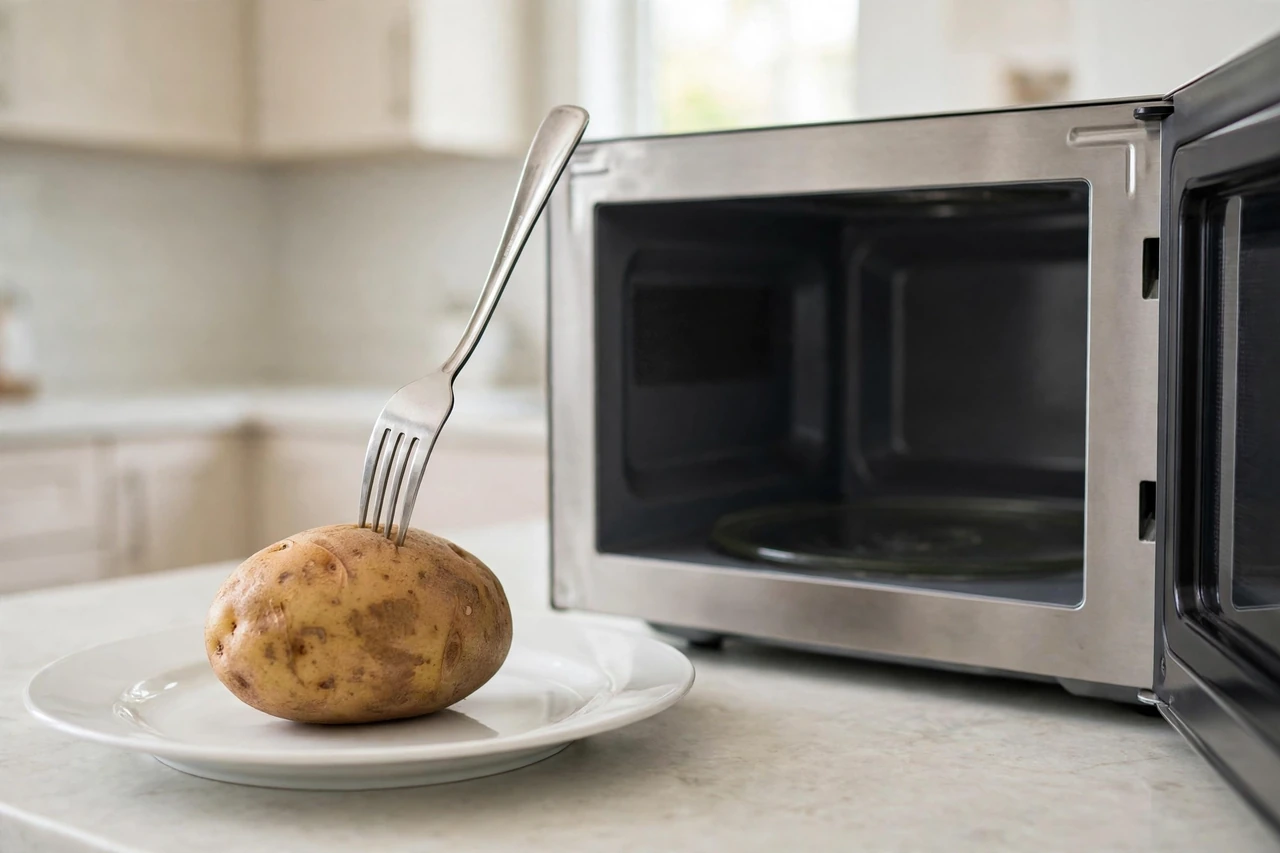
Yes, you can microwave a potato, and it makes a perfectly good baked potato in about 7 to 10 minutes. Scrub the potato, poke it deeply with a fork 8 to 10 times all over, place it on a microwave-safe plate with no foil and no plastic wrap, and microwave on high for 5 minutes, then flip it and microwave 3 to 5 more minutes until a fork slides easily into the center.
The two non-negotiable rules: always pierce the skin so steam can escape, because an unpierced potato can burst from internal pressure; and never use aluminum foil, because metal causes arcing and sparks in a microwave. If you want the full rundown of which materials are microwave friends and which are not, see Can You Microwave It? The Complete Safety Chart.
How to Microwave a Baked Potato: Step by Step
This is the complete method. It works for russets, Yukon Golds, and sweet potatoes, with small timing tweaks covered later.
Start by choosing a good potato. Pick one that feels firm and heavy for its size, with no green patches, no deep sprouts, and no soft spots. Medium potatoes, roughly 8 ounces, are the sweet spot for the microwave: they cook through evenly in a reasonable time. Very large potatoes work too, they just need more minutes.
Scrub the potato thoroughly under running water. Potatoes grow underground, so the skin carries soil, and you will be eating that skin, so give it a proper wash with a brush or your hands. Pat it completely dry with a clean towel or paper towel afterward. A dry surface heats more evenly and will not steam up the microwave.
Now the critical step: pierce the potato deeply with a fork, 8 to 10 times, all around. Push the tines in about half an inch. These holes are steam vents. As the inside of the potato heats, water in the flesh turns to steam, and the skin is tough enough to trap it. Without vents, pressure builds until the skin fails all at once. With vents, the steam hisses out harmlessly and your potato cooks calmly.
Rub the potato lightly with olive oil and sprinkle it with salt if you like. This is optional and mostly about flavor; the oil does not make the skin crispy in the microwave the way it does in the oven, but it does season the skin nicely. Then place the potato directly on the microwave turntable or on a microwave-safe plate. Do not wrap it in anything. No foil, no plastic wrap, no damp towel needed for a basic baked potato.
Microwave on high (100 percent power) for 5 minutes. Using tongs or a fork, flip the potato over, because microwaves heat unevenly and the flip evens things out. Microwave for another 3 to 5 minutes depending on size. Then check for doneness: the potato should give easily when you squeeze it gently through an oven mitt, and a fork or paring knife should slide into the center with no resistance. If the center is still firm, keep going in 1-minute bursts, checking each time.
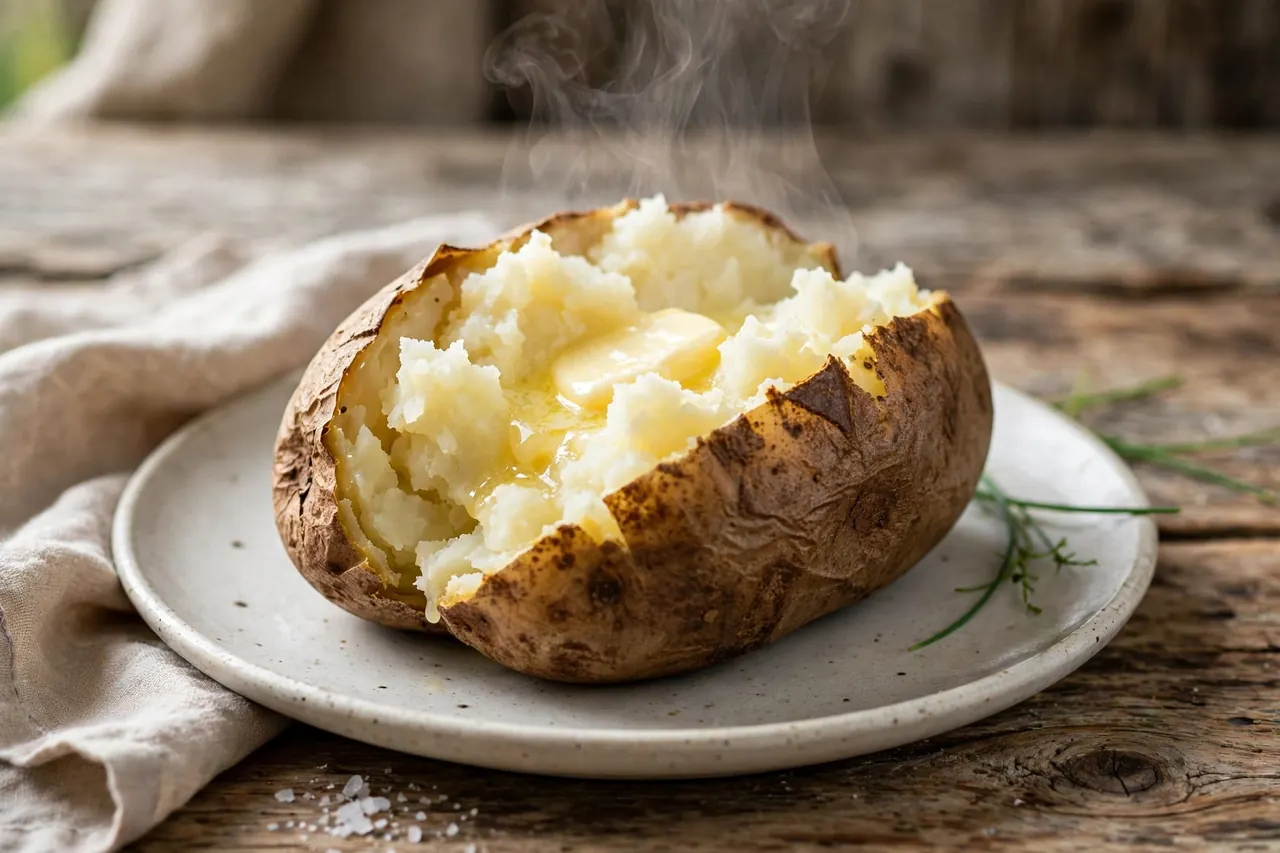
Let the potato rest for 1 to 2 minutes after microwaving. The internal heat keeps distributing during the rest, finishing the center gently. Then cut it open, fluff the flesh with a fork, add your toppings, and eat. From scrub to plate, a medium potato takes about 12 minutes total, and most of that is hands-off.
How Long to Microwave a Potato
Timing is the question everyone asks, and the honest answer is that it depends on size, starting temperature, and your microwave’s wattage. The table below is for a standard 1,000-watt microwave with a room-temperature potato. Add a minute or two for lower-wattage models or potatoes straight from the fridge.
| Potato size | Weight | Microwave time on high |
|---|---|---|
| Small | About 6 oz | 5 to 7 minutes total |
| Medium | About 8 oz | 7 to 9 minutes total |
| Large | About 10 oz or more | 10 to 12 minutes total |
| Two medium potatoes | About 16 oz combined | 10 to 12 minutes total |
| Sweet potato (medium) | About 8 oz | 7 to 9 minutes total |
The method behind the numbers: microwave for 5 minutes first, flip, then continue in the remaining time, checking with a fork as you go. For two or more potatoes, The Kitchn’s tested method recommends 5 minutes, flip, then another 5 minutes, which lines up well with the table.
Two variables trip people up. First, microwave wattage varies enormously: a compact 700-watt dorm microwave can need almost double the time of a 1,200-watt full-size one. If your potato is still hard after the table’s time, your microwave is probably low-wattage, not broken; just add minutes. Second, size matters more than you think. One huge potato takes longer than two medium ones of the same total weight, because microwaves penetrate from the outside in and a thick potato has a long way to go to the center.
Why You Have to Poke Holes in a Potato Before Microwaving
This is the rule people are most tempted to skip, and it is the one that causes the famous microwave potato explosion. Here is the physics in plain language.
A potato is about 80 percent water. When microwaves agitate those water molecules, the water heats fast and turns to steam. Steam takes up far more space than liquid water, roughly 1,600 times the volume, so the inside of the potato becomes a pressure vessel. The skin of a potato is strong, leathery, and nearly airtight, which is great for holding in moisture and terrible for releasing pressure.
Without vents, the pressure keeps building as more water turns to steam. Eventually something has to give, and what gives is the skin, all at once, with a loud bang that coats the inside of your microwave in hot potato shrapnel. It is messy, it is startling, and the flying hot flesh can burn you. With fork holes, the steam escapes continuously through the vents as it forms, pressure never builds, and the potato cooks peacefully.
How deep and how many? Push the fork in about half an inch, and make 8 to 10 holes distributed all around the potato, top, bottom, and sides. Shallow scratches do not count; the vent needs to reach through the skin into the flesh where the steam is forming. A knife slit works too, but a fork is faster and gives you multiple vents per press. This takes fifteen seconds and it is the difference between dinner and a cleanup project.
Can a Potato Explode in the Microwave?
Yes, an unpierced potato can genuinely burst in the microwave, and it is one of the most common microwave messes there is. It is not an urban legend; the steam-pressure physics above guarantees it if you heat a sealed potato long enough. The explosion is not dangerous the way a metal fire is, but it is violent enough to be startling, and the hot potato debris can cause minor burns.
If it happens to you, here is the recovery. Turn the microwave off and let everything sit for a minute, because the inside is coated in very hot potato. Wipe out the loose pieces with a damp cloth or paper towel, then clean the walls with a bowl of water microwaved for a few minutes (the steam loosens stuck-on bits) followed by another wipe. Check the turntable and the roller ring underneath for trapped pieces. The potato itself is usually still edible if you can salvage clean pieces, but most people just start over, this time with the fork.
The lesson is worth repeating because it is the entire safety story for this topic: the explosion is 100 percent preventable. Fifteen seconds with a fork removes the risk completely. There is no other way to make a potato explode in a microwave, no power setting or timing trick overrides the need for vents.
The Foil Rule: Never Wrap a Potato in Foil for the Microwave
In a conventional oven, wrapping a potato in foil is a normal technique. In a microwave, it is a hard no, for two separate reasons.
Reason one is immediate and dramatic: aluminum foil is metal, and metal in a microwave causes arcing, those blue-white sparks that can damage the oven and start a fire. The complete guide to microwaving aluminum foil explains the physics, but the short version is that microwaves induce electric currents in metal, and thin crinkled foil concentrates those currents at its edges until the air itself sparks. Never put foil-wrapped anything in the microwave, potatoes included. For the broader metal question, see Can You Microwave Metal?.
Reason two is slower and more serious, and it applies after cooking too. Foil-wrapped baked potatoes have a documented food-safety risk: the foil creates a low-oxygen environment around the warm, moist potato, which is exactly the condition where Clostridium botulinum spores can germinate and produce toxin. The CDC lists baked potatoes wrapped in foil among the foods linked to botulism, and its prevention guidance is specific: keep foil-wrapped potatoes at 140 degrees Fahrenheit or hotter until served, or refrigerate them with the foil loosened so air can reach the potato. This matters most for potatoes baked in foil in an oven and then left sitting around, but the principle is worth knowing for every potato you cook.
So the microwave rule is simple and absolute: no foil in the microwave, ever, and if you ever bake potatoes in foil in the oven, do not leave them sitting in their foil at room temperature.
Microwave vs Oven Baked Potato: Which Is Better?
This is the honest comparison, because each method wins different categories and pretending otherwise would be dishonest.
| Category | Microwave | Conventional oven |
|---|---|---|
| Total time | 7 to 12 minutes | 45 to 60 minutes |
| Skin texture | Soft, slightly chewy | Crisp, crackly, seasoned |
| Inside texture | Soft, steamy, fluffy | Fluffy with drier, flakier edges |
| Energy use | Much less | Much more |
| Effort | Minimal, mostly waiting | Minimal, mostly waiting |
| Best for | Weeknights, meal prep, speed | Weekends, guests, maximum quality |
The texture difference comes down to how each method handles moisture. A microwave steams the potato from the inside out, so the skin stays soft and the flesh stays moist. An oven surrounds the potato with dry hot air for an hour, which dehydrates the skin into a crisp shell and dries the outer layer of flesh into that classic fluffy baked-potato texture. Neither is wrong; they are different dishes that happen to share a name.
For most weeknight purposes, the microwave wins on the only metric that matters, which is that you will actually make it. An oven potato you do not have time for is worth less than a microwave potato on your plate in twelve minutes. And if you want the best of both, the hybrid method below exists precisely for you.
The Hybrid Trick: Microwave Speed With Oven-Crisp Skin
Here is the method that regular baked-potato makers swear by, and it is the best answer to the microwave-versus-oven debate. Microwave the potato most of the way, then finish it with dry high heat to crisp the skin.
Microwave your pierced, oiled, salted potato for about 5 to 6 minutes, until it is cooked through but the skin is still soft. Meanwhile, heat your oven to 425 degrees Fahrenheit, or heat a dry skillet or air fryer. Transfer the potato to the hot oven for 10 to 15 minutes, until the skin dries out and crisps. The inside is already cooked, so the oven’s only job is the skin.
The result is genuinely close to a full oven-baked potato in about 20 minutes total instead of an hour. The air fryer version is even faster, about 5 minutes at 400 degrees Fahrenheit after microwaving, and it crisps beautifully because the circulating air is so efficient at drying the skin. If you only remember one technique from this guide, make it this one.
Which Potatoes Work Best in the Microwave
Russets are the classic baking potato for good reason: high starch, thick skin, and flesh that goes fluffy when cooked. They are the best choice for a microwave baked potato and the variety behind every timing table in this guide, including the timing breakdown at AEANET, which is organized by potato size.
Yukon Golds and other waxy potatoes also microwave well, but they come out creamier and denser rather than fluffy, because their lower starch content sets differently. They are excellent for smashing or for potato salads, just do not expect the russet cloud.
Sweet potatoes are a great microwave candidate and follow the same rules: scrub, pierce deeply, no foil, about 7 to 9 minutes for a medium one. Their higher sugar content means they can ooze a little syrup through the fork holes, so put them on a plate rather than directly on the turntable. Red potatoes and fingerlings work too; just scale the time down for their smaller size and check early.
Whatever variety you choose, the selection rules are the same: firm, heavy for its size, no green skin (green means solanine, a bitter compound you should cut away generously), and no large sprouts. And one storage note that matters for safety: keep raw potatoes in a cool, dark place, not the fridge, because cold storage converts starches to sugars in ways that change cooking behavior.
Frequently Asked Questions
Real questions from search results, cooking forums, and recipe comment sections, answered directly first.
Can you microwave a baked potato?
Yes. Scrub it, pierce it 8 to 10 times with a fork, put it on a microwave-safe plate with no foil, and microwave on high for 5 minutes, flip, then 3 to 5 more minutes until a fork slides into the center easily. A medium potato takes 7 to 9 minutes total. The inside comes out soft and fluffy; the skin stays soft rather than crisp, which is the main difference from oven baking.
How long do you microwave a potato?
A small potato (about 6 ounces) needs 5 to 7 minutes, a medium potato (about 8 ounces) needs 7 to 9 minutes, and a large potato (10 ounces or more) needs 10 to 12 minutes, all on high in a 1,000-watt microwave. Two medium potatoes need about 10 to 12 minutes together. Always microwave 5 minutes first, flip, then continue and check with a fork, adding 1-minute bursts as needed. Lower-wattage microwaves need extra time.
Why do you have to poke holes in a potato before microwaving?
Because the potato is 80 percent water, and microwaves turn that water to steam fast. The skin is nearly airtight, so without vents the steam pressure builds until the potato bursts. Fork holes give the steam escape routes, so pressure never builds. Push the fork half an inch deep, 8 to 10 holes all around, and the explosion risk drops to zero. Shallow scratches do not count.
Can a potato explode in the microwave?
Yes, if you skip the fork holes. An unpierced potato heated long enough will burst from internal steam pressure, coating the microwave in hot potato pieces with a loud bang. It is messy and startling rather than truly dangerous, but the hot debris can cause minor burns. It is completely preventable: 15 seconds of fork-poking removes the risk entirely.
Microwave vs oven baked potato, which is better?
The microwave wins on time (10 minutes versus an hour) and energy use; the oven wins on skin (crisp and crackly versus soft) and slightly fluffier flesh. For weeknight speed, the microwave is the practical winner. For the best texture, the oven wins. The hybrid method, microwave 5 to 6 minutes then finish 10 to 15 minutes in a 425 degree oven, gives you nearly oven quality in about 20 minutes total.
Can you microwave a potato in foil?
No, never. Aluminum foil is metal and causes arcing and sparks in a microwave, which can damage the oven or start a fire. Beyond the microwave, foil-wrapped potatoes carry a botulism risk if left at room temperature, because the CDC warns that the airless environment under the foil lets Clostridium botulinum spores germinate. Microwave your potato naked on a plate, and if you ever oven-bake in foil, refrigerate leftovers with the foil loosened.
Can you microwave a sweet potato?
Yes, with the same method: scrub, pierce deeply 8 to 10 times, no foil, microwave on high about 7 to 9 minutes for a medium sweet potato, flipping halfway. Sweet potatoes have more sugar, so they may ooze syrup through the fork holes; put them on a plate to catch it. They come out soft and caramel-sweet, and they are one of the best things you can microwave.
Do you need to flip the potato halfway?
Yes, flip it. Microwaves heat in uneven patterns with hot and cold spots, and the side facing down cooks differently from the side facing up. Flipping halfway through evens out the cooking so you do not end up with one raw side and one overdone side. Use tongs or a fork to flip it, because it will be hot, and this is also a good moment to check how it is progressing.
How do you know when a microwaved potato is done?
Squeeze it gently through an oven mitt; it should give easily all over with no hard spots. Then push a fork or paring knife into the center; it should slide in with zero resistance. If you feel firmness in the middle, it needs more time in 1-minute bursts. Do not cut it open to check and then keep microwaving the halves; just trust the squeeze and the fork test.
Can you microwave more than one potato at a time?
Yes. Arrange them in a circle on the turntable with space between them so microwaves reach all sides, and add time: two medium potatoes need about 10 to 12 minutes total instead of 7 to 9. Flip each one halfway. Try to pick potatoes of similar size so they finish together; one giant and one tiny potato will never cook evenly as a pair.
Is it safe to eat a baked potato left out overnight?
No. A cooked potato is a perishable food, and like all perishable foods it should not sit at room temperature for more than two hours. The risk is worse if it was wrapped in foil, because the CDC specifically flags foil-wrapped baked potatoes held at room temperature as a botulism risk. Refrigerate leftover baked potatoes within two hours, with any foil loosened or removed, and reheat them to steaming hot before eating.
Does microwaving destroy a potato’s nutrients?
No more than other cooking methods, and in some ways less. Potatoes keep their potassium, vitamin C, and fiber well in the microwave, because the short cooking time and minimal water mean fewer nutrients leach out or break down compared to boiling. Some research on microwaved vegetables even finds better nutrient retention than boiling. The cooking method matters far less than whether you eat the skin, which holds a good share of the fiber.
Can you microwave a potato with the skin on?
Yes, and you should. The skin holds fiber and nutrients, it keeps the flesh moist during cooking, and it is the part that gets seasoned when you rub the potato with oil and salt. Scrub it well since it grew underground, and eat it. The only time to peel is if the skin has green patches, which you should cut away generously along with any sprouts.
Why is my microwaved potato hard in the middle but done outside?
Usually one of three things: the potato was very large or straight from the fridge, your microwave is low-wattage, or you did not flip it. The fix is the same every time: keep microwaving in 1-minute bursts, flipping between bursts, until the fork test passes. Next time, start with a room-temperature potato, pick a medium size, and flip halfway. Microwaves cook from the outside in, so thick cold centers just need patience.
The Bottom Line
The microwave potato has exactly two rules and one technique worth remembering. Poke the holes, skip the foil, and you get a fluffy baked potato in about ten minutes with almost no effort. The fork holes are the safety story, the no-foil rule is both a fire rule and a food-safety rule backed by the CDC, and the hybrid oven finish is the quality trick that closes the gap with traditional baking.
Stop thinking of it as a compromise and start thinking of it as a method with its own strengths: speed, energy savings, and weeknight practicality that the oven cannot touch. Keep a fork by the microwave, remember the flip, and dinner is twelve minutes away any night you want it.
