

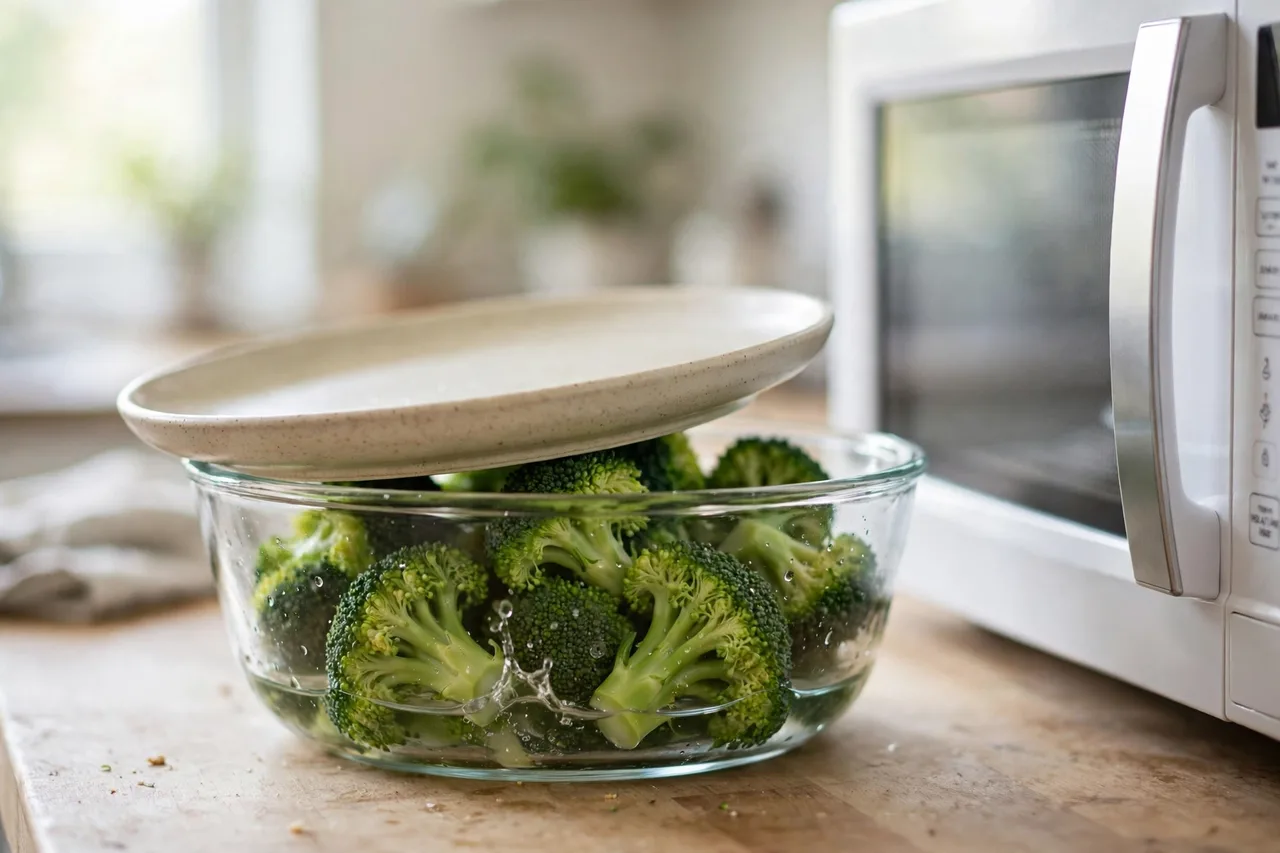
Yes, you can microwave broccoli, and for a small batch it is one of the fastest ways to get a tender, bright green side dish on the table. Fresh florets cook in 3 to 5 minutes on high, frozen florets take 4 to 6 minutes, and all you need is a microwave-safe dish, a tablespoon or two of water, and a loose cover. The microwave steams the florets in their own moisture, so you skip the pot, the steamer basket, and most of the cleanup. The method is simple, but the details matter: broccoli goes from crisp and tender to limp and dull in about 30 seconds, uneven pieces cook unevenly, and too much water turns a good head into a soggy mess. This guide covers the step by step method, timing charts by size and wattage, frozen broccoli, the soggy and rubbery problems, the sulfur smell, what microwaving does to nutrients, reheating, seasoning ideas, and the safety rules that keep every batch safe.
Can You Microwave Broccoli? The Short Answer
Yes. Cut the head into even florets about 1 to 1.5 inches wide, rinse them, and place them in a microwave-safe dish. Add 2 to 3 tablespoons of water, cover loosely with a microwave-safe lid or plate, and cook on high for 3 to 5 minutes, checking after 2 minutes. Let the dish rest covered for 1 minute, then test a stalk with a fork. It should pierce easily but still offer slight resistance, and the colour should be bright green. Drain any leftover water, season, and serve right away.
That short answer works in most home kitchens, but the range of times you see online is wide for a reason. Some guides say 3 minutes, others say 5 minutes, and both can be right in their own kitchen. Floret size, how much broccoli you cook at once, starting temperature, and microwave wattage all change the result. A small bowl of small florets in a 1200-watt oven can be done in 3 minutes, while a full pound of large florets in a 700-watt oven can need 6 minutes or more. The rest of this guide gives you starting times plus the checks that tell you when the broccoli is actually done, so you are not guessing.
If you are new to microwave cooking in general, our main guide to can you microwave it explains which foods and containers are safe and which ones to keep out of the oven. Broccoli sits firmly in the safe group, and it is one of the vegetables the microwave handles best.
Why the Microwave Works Well for Broccoli
Broccoli is a good match for microwave cooking because it is mostly water, and microwaves heat water directly. When you trap that heat under a loose cover, the florets steam in their own moisture in a few minutes. There is no pot of boiling water to watch, no steamer basket to set up, and the florets stay in one dish from start to finish. That is the whole appeal: a green vegetable side dish in under 5 minutes with one dish to wash.
Speed is not the only advantage. Short cooking with little water is also kind to nutrients. Broccoli is a source of vitamins C and K, plus folate and fibre, and the water-soluble vitamins in that list are the ones most easily lost into cooking water. Boiling a head for 7 minutes in a full pot gives those vitamins plenty of time and water to escape. Microwaving for 3 to 4 minutes with 2 tablespoons of water gives them almost nowhere to go. The principle is simple and widely supported: cooking methods that minimise time, temperature, and water help vegetables retain the most nutrients, and microwaving fits that description well. This does not mean microwaving is magic, and it does not mean boiling is bad for you. It means that for a vegetable you want tender and bright, the microwave is a sensible choice rather than a lazy one.
The microwave also gives you control that the hob does not. You cook in 30-second bursts, you check, and you stop the moment the florets are right. On the hob, a pot keeps boiling while you reach for the colander, and the difference between tender and mushy can pass in the time it takes to drain the water. In the microwave, the timer stops the heat the instant you press the button.
None of this means the microwave is perfect for broccoli. It will never give you the charred edges of roasting or the browned flavour of a hot pan, and it will punish you for overcooking in seconds rather than minutes. But for a quick weeknight side dish, it is hard to beat, and the rest of this guide is about getting the small details right so the result is bright, tender, and worth serving.
How to Microwave Broccoli Step by Step
Follow these steps exactly the first time, then adjust the timing to your own microwave once you know how it behaves.
Step 1: Choose a fresh head. Pick a head that is dark green and firm, with tightly closed buds and no yellow patches or soft spots. The stalk should feel solid, not bendy, and the cut end should look fresh rather than dried out. Old broccoli that has lost its moisture turns rubbery in the microwave no matter how careful you are, so start with a good head.
Step 2: Cut even florets. Cut the head into florets about 1 to 1.5 inches wide, keeping them as similar in size as you can. Slice the thick stalk lengthwise so the pieces cook at the same rate as the tops. Uniform size is the single most important factor in microwave cooking, because large pieces stay raw in the centre while small pieces turn to mush. If your head has a mix of thick and thin florets, keep them in separate piles so you can add the thin ones later.
Step 3: Rinse and shake. Rinse the florets under cold running water and shake off the excess. Pay attention to the tops, because grit and small insects hide between the tiny buds. Do not pat the florets completely dry. The thin film of water left on them helps make steam, and for a small batch it can be most of the water you need.
Step 4: Arrange in a single layer. Place the florets in a wide, shallow microwave-safe dish, with the thick cut ends toward the outside edge and the delicate tops toward the centre, because microwave energy is stronger near the edges of the turntable. A single layer matters more than it sounds. Florets piled on top of each other steam unevenly, and the ones in the middle come out soggy while the ones on top stay firm.
Step 5: Add a little water. Pour 2 to 3 tablespoons of water over the florets, or 1 tablespoon for a small single serving. That is all you need. The water is there to make steam, not to boil the broccoli. If the florets are sitting in a pool, you have added too much, and the result will be waterlogged.
Step 6: Cover loosely. Place a microwave-safe lid, a microwave-safe plate, or vented plastic wrap over the dish. The cover traps steam so the florets cook evenly, but it must not be sealed tight. Leave a small gap, or use a lid with a vent, so steam can escape. A sealed container can build up pressure, and a tight lid can be hard to remove safely when the dish is hot.
Step 7: Microwave on high in short bursts. Cook for 2 minutes, then check. Continue in 30-second bursts until the stalks pierce easily with a fork, usually 3 to 5 minutes in total. The exact time depends on your microwave, so check early rather than late.
Step 8: Rest, then drain and season. Let the dish sit covered for 1 minute after the timer stops. The trapped steam finishes the centre of the florets while the outside stays bright. Then lift the cover away from your face, drain off any leftover water at once, and season. Add salt after cooking, not before, because salt draws moisture out of the florets while they cook and can leave them limp.
That is the whole method. Eight steps, one dish, and about 5 minutes from fridge to plate.
Microwave Times for Broccoli
Use this chart as your starting point. Times assume a single layer in a shallow dish, a loose cover, and 2 to 3 tablespoons of water or less. If your microwave is 700 watts, start at the top of the range. If it is 1200 watts, start at the bottom. Check with a fork at the first time listed, then add 30-second bursts until the stalks are tender.
| Broccoli amount | Water | Time on high (1000 watts) | Notes |
|---|---|---|---|
| 1 cup small florets (about half a pound) | 1 tablespoon | 2 to 3 minutes | Check at 2 minutes, they overcook fast |
| 2 cups medium florets (about 1 pound) | 2 tablespoons | 3 to 4 minutes | The most common batch size |
| 3 cups large florets (about 1.5 pounds) | 3 tablespoons | 4 to 5 minutes | Stir once halfway through |
| Whole small head, cut into florets | 3 tablespoons | 4 to 5 minutes | Keep floret sizes even |
| Broccoli stems, peeled and sliced into coins | 2 tablespoons | 3 to 4 minutes | Tender but not mushy when done |
| Frozen florets (no sauce) | None or 1 tablespoon | 4 to 6 minutes | Stir halfway, start checking at 3 minutes |
| Riced broccoli (fresh) | 1 tablespoon | 3 to 3.5 minutes | Stir once, it cooks very fast |
Two things about this chart are worth remembering. First, the difference between small and large florets is bigger than most people expect. A small floret can be done in half the time of a large one, so if your head is mixed, sort it by size and cook the large pieces first, then add the small ones for the last minute or two. Second, wattage matters more than most recipes admit. A 700-watt microwave can need a full extra minute compared with a 1200-watt one, and the only reliable fix is to check early and add time in small bursts. The fork test beats the clock every time: a done floret bends slightly, pierces easily, and still springs back a little when you let go.
The same logic applies to other vegetables. If you have cooked cauliflower in the microwave, you already know the pattern: short bursts, check early, and let the resting time finish the job. Broccoli is a little faster than cauliflower because the florets are smaller and thinner, so start a minute earlier than you would for cauliflower.
Can You Microwave Frozen Broccoli?
Yes, and it is one of the easiest ways to cook it. Frozen broccoli is blanched before freezing, which means it is partly cooked already, so it needs less time than you might expect and it needs no thawing. Cooking it straight from the freezer also keeps it firmer than thawing first, because thawing lets the florets sit in their own water and go soft before they even reach the microwave.
Place the frozen florets in a microwave-safe dish in a single layer if you can manage it. Add no water, or at most 1 tablespoon, because the ice crystals on the florets melt into water of their own. Cover loosely and microwave on high for 4 to 6 minutes for a 10-ounce bag, stirring halfway through. Start checking at 3 minutes. Frozen broccoli goes from hot to mushy quickly, and since it is already partly cooked, your job is mostly to heat it through rather than cook it from raw.
Two methods work well for frozen broccoli, and the one you pick depends on how much you are cooking. For a small amount, the dish method with a loose cover is the most even. For a single serving, a microwave-safe steamer bag works well too, and it is convenient when you want almost no cleanup. Either way, drain the dish well before serving. Frozen broccoli releases a surprising amount of water, and if you skip the draining step, the florets sit in a puddle and go limp on the plate.
Be honest with yourself about texture. Microwaved frozen broccoli is softer than fresh broccoli cooked the same way, and no technique fully closes that gap. It is still good in pasta, stir fries, soups, and egg dishes, where soft florets are fine. If you want firm florets as a standalone side dish, fresh broccoli is the better choice. Frozen broccoli also works well alongside other frozen vegetables, and our guide to microwaving frozen vegetables covers the same no-thaw, stir-halfway approach for mixed bags.
Can You Microwave Broccoli Without Water?
You can, but the result is rarely good. Without added water there is not enough steam to cook the florets evenly, so the outside dries out and turns tough while the inside stays firm. Broccoli has a lot of surface area in its tiny buds, and those buds dry out fast when there is no steam to protect them. A tablespoon or two of water makes a real difference, and it is the cheapest fix in this whole guide.
The only exception is freshly washed florets that are still wet from the rinse, because the water clinging to them can be enough on its own for a small batch. If you try the no-water method, use a tight-fitting lid rather than a loose plate, cook in shorter bursts, and check after 90 seconds. If the buds look dry or brown at the edges, add a tablespoon of water and cover again. Dry spots and browned edges are signs that the florets are scorching rather than steaming, and once the buds are scorched, no amount of extra cooking fixes them.
Frozen broccoli is the other exception. The ice on the florets melts into water as it heats, so frozen broccoli often needs no added water at all. Adding water to frozen broccoli is one of the most common mistakes, and it is the fastest way to end up with waterlogged florets. For fresh broccoli, though, the rule is simple: always add a splash of water.
Can You Microwave Broccoli in a Steamer Bag?
Yes, if the bag is made for microwave use. Steamer bags designed for the microwave work well for a single serving of broccoli, and they are convenient on nights when you want almost no cleanup. Place the florets in the bag with a tablespoon of water, seal it the way the instructions say, and leave the vent open. Microwave on high for 3 to 4 minutes for fresh florets, then let the bag sit for 1 minute before opening it away from your face.
Do not use a regular plastic bag, a sandwich bag, or cling film that is not labelled microwave-safe, because it can melt onto the food. Always leave a vent or a small opening so steam can escape, and never seal a bag completely shut. A sealed bag can puff up and burst, which is messy at best and dangerous at worst. Also check the bag before you use it: if it is torn, cracked, or already used once, throw it away. Steamer bags are single-use items, and a damaged bag does not hold steam the way it should.
Why Microwaved Broccoli Goes Soggy, Mushy, or Rubbery
Soggy broccoli is the most common complaint about microwaving it, and it almost always comes down to three things: too much water, too much time, or too much crowding. The good news is that all three are easy to fix, and once you know what to look for, the problem rarely comes back.
Too much water is the first cause. Broccoli only needs 2 to 3 tablespoons of water to make steam. If you add half a cup, the florets are no longer steaming, they are boiling, and boiling is exactly what makes broccoli waterlogged and flavourless. The water also dilutes the seasoning and leaves a grey puddle at the bottom of the dish. Use a tablespoon measure the first few times until the amount feels natural. Freshly washed florets already carry some water on their surface, so if they are still dripping wet from the rinse, you can use even less.
Too much time is the second cause. Broccoli has thin cell walls, and once the heat breaks them down, the structure collapses fast. The window between tender and mushy is about 30 seconds for small florets, which is why the guides that say to cook for 5 minutes and walk away are bad advice. Check at 2 minutes, then add 30-second bursts. Remember that the florets keep cooking for a minute after the timer stops, so take them out when they are just slightly underdone rather than perfect. They will finish during the rest.
Crowding is the third cause. Florets piled on top of each other trap steam between them, and the ones in the middle stew in their own moisture while the ones on top dry out. A single layer in a wide, shallow dish fixes this. If you need to cook a large head, cook it in two batches rather than one tall pile. Two quick batches still take less time than boiling a pot of water.
Rubbery broccoli is a different failure, and it usually means the opposite problem: not enough moisture, or heat applied too hard for too long. When florets dry out, their cell walls soften but their structure toughens, and the result is that chewy, bouncy texture people complain about. The fix is the same set of habits: even pieces, enough water to make steam, a cover that traps it, and short bursts with a rest in between. If your microwave is very powerful, above 1100 watts, try cooking at 80 percent power for 3 minutes instead of full power. The lower power gives the heat time to move from the outside to the inside, and the florets come out tender instead of tough.
Why Does Microwaved Broccoli Smell?
Broccoli belongs to the cruciferous family, and like cabbage and cauliflower it contains sulfur compounds. When broccoli is overcooked, those compounds break down and release a strong, unpleasant smell that fills the kitchen. The smell is not a sign that the broccoli is unsafe. It is a sign that it cooked too long, and it is one of the most reliable warnings that the florets are about to go mushy.
The fix is the same as the fix for mushiness: cook for less time, check early, and stop the moment the florets are tender. Fresh broccoli cooked for 3 minutes barely smells at all. The same head cooked for 6 minutes smells like a school cafeteria. If the smell bothers you, open a window before you start, and do not leave the dish covered after the timer stops, because trapped steam keeps the sulfur compounds breaking down. Adding a squeeze of lemon after cooking helps too, but add it after, not before, because acid added before cooking speeds up colour loss and can make the smell worse.
A faint smell is normal even with perfect broccoli, so do not chase zero smell. If the florets are bright green and tender, the smell will fade within a few minutes. If the smell is strong and the florets are olive-coloured and soft, that batch is overcooked, and the honest fix is to start a fresh batch with a shorter time rather than trying to rescue it.
Does Microwaving Broccoli Destroy Nutrients?
No, microwaving does not destroy nutrients any more than other cooking methods, and for broccoli it often preserves them better than boiling. The reason is simple: nutrient loss in vegetables is driven mostly by time, temperature, and water. Boiling gives vitamins plenty of all three, because the florets sit in a full pot of hot water for several minutes and the water-soluble vitamins leach out into water that gets poured away. Microwaving uses a few tablespoons of water and a few minutes of heat, so there is far less time and water for vitamins to escape into.
Harvard Health explains the same principle for cooking vegetables in general: the method that best retains nutrients is the one that cooks quickly, heats food for the shortest amount of time, and uses as little liquid as possible. The microwave checks all three boxes, as long as you do not overcook the florets. The FDA makes a similar point, noting that foods cooked in the microwave may keep more of their vitamins and minerals because of the short cooking times and the small amount of water involved.
That said, you should be careful with the numbers you see online. Some blogs claim exact percentages, such as microwaved broccoli keeping 90 percent of its vitamin C against 66 percent when boiled, and they present those figures as settled fact. Those numbers come from specific studies with specific methods, and they do not transfer neatly to your kitchen, where wattage, floret size, and cooking time all differ. What you can say with confidence is that short cooking with little water preserves more nutrients than long boiling in a lot of water, and that overcooking is what causes the biggest losses. If the florets are bright green and tender, you have kept most of what matters. If they are grey and mushy, the nutrients went with the texture.
Broccoli is worth cooking well because it brings a lot to the plate. A cup of raw broccoli is a useful source of vitamin C, vitamin K, and folate, plus fibre and a range of plant compounds. Cooking it briefly in the microwave keeps that package mostly intact, and it does it in a fraction of the time that boiling or roasting takes. For a full discussion of the science, see the Harvard Health article on microwave cooking and nutrition, which lays out how cooking time, temperature, and water affect nutrient retention.
How to Reheat Broccoli in the Microwave
Reheating already-cooked broccoli takes much less time than cooking it from raw, so treat it as a warm-up, not a second cook. Place the leftover florets in a microwave-safe dish, no extra water needed unless they have dried out in the fridge. Cover loosely and microwave in 30-second bursts on high, checking after each one. Most portions are warm through in 60 to 90 seconds in total. Going longer just pushes them further into mush.
Reheat only once, and only reheat the portion you are about to eat. A second reheating almost always turns broccoli rubbery, because the cell walls have already been weakened once and the second round of heat finishes them off. If you have a large amount of leftover broccoli, it is often better to use it cold in a salad, chopped into pasta, or folded into an omelette than to reheat the whole batch. Cold broccoli with a lemon dressing is a perfectly good lunch, and it avoids the rubbery problem entirely.
One more tip: if the leftover broccoli was stored in a sauce or with cheese, reheat it at 70 percent power instead of full power. Sauces and cheese heat faster than the florets and can scorch while the centre is still cool, and the lower power gives the heat time to even out. Stir once halfway through if you can, and let it rest for 30 seconds before eating so the temperature evens out.
Broccoli Stems: Use Them or Toss Them?
Use them. The thick stalk of a broccoli head is the part most people throw away, and it is a waste. The stem is sweet, tender when cooked, and just as nutritious as the florets. The only reason it has a bad reputation is that people cook it whole and unpeeled, and then it stays tough while the florets turn to mush.
To use the stem, cut it away from the head and peel off the tough outer layer with a vegetable peeler. The skin is fibrous and woody, and peeling is what makes the difference. Then slice the peeled stem into coins about a quarter inch thick, or cut it into sticks. Microwaved coins take 3 to 4 minutes on high with 2 tablespoons of water, which is about the same time as medium florets, so you can cook them in the same dish. The coins should be tender when pierced with a fork but still hold their shape.
Peeled stems are also good raw. Thin slices of raw broccoli stem are crunchy and mild, and they work well in salads and slaws, or with a dip. If you have been throwing the stems away, try one peeled stem in your next batch. Most people who try it never go back to wasting half the head.
Seasoning and Serving Ideas
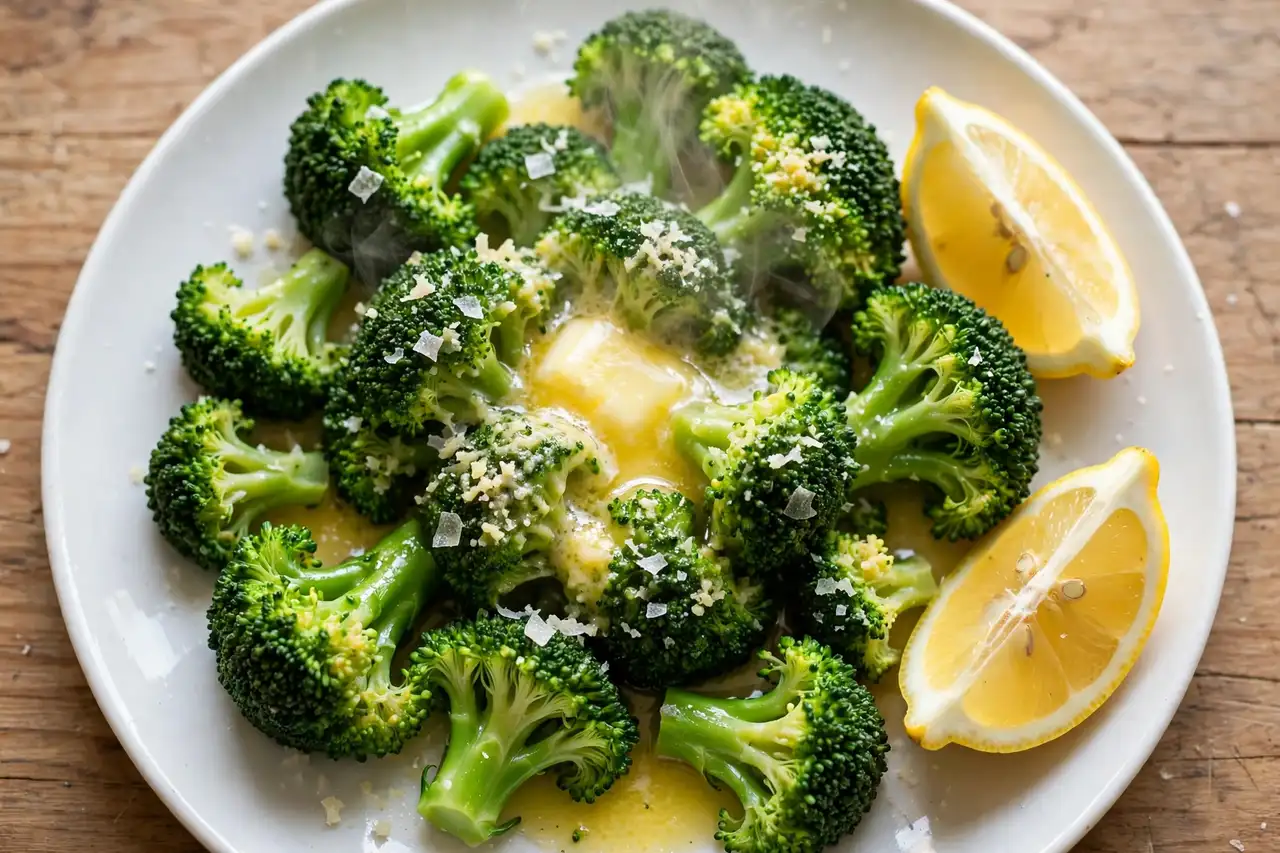
Broccoli straight from the microwave is mild and slightly grassy, which makes it a blank canvas for seasoning. The key rule is to season after cooking, not before. Salt added before cooking draws moisture out of the florets and can leave them limp, and lemon juice added before cooking speeds up colour loss. Cook the broccoli plain, drain it, and then dress it while it is still hot.
Butter and lemon is the classic combination, and it works for a reason. Toss the hot florets with a small knob of butter so it melts over them, then squeeze half a lemon over the top and add a pinch of flaked sea salt. The butter adds richness, the lemon adds brightness, and the salt sharpens both. Grated parmesan is another easy win: sprinkle it over the hot florets and let the heat from the broccoli melt it. A drizzle of olive oil with cracked black pepper and a pinch of chilli flakes gives a sharper, more grown-up version of the same idea.
For a fuller meal, serve microwaved broccoli alongside a protein it can share a plate with. It goes well with grilled chicken, salmon, or a fried egg, and it is a natural partner for pasta, rice, and noodles. If you cooked brussels sprouts in the microwave, you already know the same seasoning pattern works there too: butter, lemon, and salt, added hot, with parmesan if you want it richer. Keep the seasoning simple and let the broccoli taste like broccoli.
Three quick combinations that work every time: butter, lemon, and parmesan; olive oil, garlic, and chilli flakes; and soy sauce, sesame oil, and toasted sesame seeds. The first is the crowd-pleaser, the second suits pasta nights, and the third turns a plain side into something that fits an Asian-style meal. None of them needs more than a minute of extra work, and all of them start from the same plain microwaved florets.
Microwave vs Other Cooking Methods
The microwave is not the only way to cook broccoli, and it is not always the best way. It is the fastest way, and it is the best way when you want tender florets with minimal cleanup. But roasting gives you charred edges and a deeper flavour that the microwave can never match, and steaming on the hob gives you more control over a large batch. Here is how the methods compare for a standard batch of florets.
| Method | Time | Texture | Best for |
|---|---|---|---|
| Microwave | 3 to 5 minutes | Tender, bright green | Quick weeknight side, small batches |
| Steaming on the hob | 5 to 7 minutes | Tender, bright green | Larger batches, even cooking |
| Boiling | 4 to 6 minutes | Soft, can go waterlogged | Soups and dishes where softness is fine |
| Roasting | 20 to 25 minutes | Charred edges, nutty flavour | Flavour-first meals, larger batches |
| Stir frying | 5 to 7 minutes | Crisp, lightly browned | Asian-style dishes, mixed vegetables |
Choose the method that fits the meal. If you need a side dish in 5 minutes with one dish to wash, the microwave wins. If you want browned, caramelised edges, roast the broccoli instead. If you are cooking for a crowd, steam it on the hob where a bigger pot gives you more even results. The microwave is a tool, not a religion, and knowing when to use it is what makes it useful.
One combination worth trying is the microwave plus a hot pan. Microwave the florets for 2 minutes to cook them most of the way through, then finish them in a screaming-hot skillet with a little oil for 60 seconds. You get the speed of the microwave and the browned edges of the pan, and the total time is still under 5 minutes. It is the best of both methods for nights when you want a little more flavour without waiting for the oven.
Food Safety Rules for Microwaving Broccoli
Microwaving broccoli is safe when you follow the basic rules, and those rules are the same ones that apply to all microwave cooking. The USDA Food Safety and Inspection Service warns that microwaves can cook unevenly and leave cold spots where harmful bacteria can survive, so it advises stirring, rotating, or turning food midway through cooking, and letting food stand for a few minutes after heating so the temperature evens out. For plain vegetables the risk is low, because broccoli is not a high-risk food and you are cooking it from raw to hot in one go. But the habits are good to build, and they also improve the texture, because stirring is what evens out the cooking.
Use only microwave-safe dishes. Glass and ceramic are the safest choices, because they distribute heat evenly and do not warp. Do not use metal bowls or foil, because metal reflects microwaves, which prevents cooking and can cause sparking that damages the oven. Do not use plastic containers unless they are labelled microwave-safe, and never use single-use containers such as yoghurt tubs or margarine tubs, which are designed for cold storage and can warp or melt. If you cover the dish with plastic wrap, use wrap labelled microwave-safe and do not let it touch the food. Clemson Extension gives the same advice in its microwave food safety factsheet, and it is worth reading if you are new to microwave cooking.
Watch out for steam burns. A covered dish of broccoli holds a lot of hot steam, and lifting the lid toward your face is the most common way people get hurt. Lift the cover away from you, and let the steam escape for a few seconds before you reach in. The dish itself will be hot too, so use oven mitts or a folded towel. The USDA factsheet on cooking safely in the microwave covers these points in detail, including the advice to stir and rotate food and to allow standing time before eating.
Finally, store leftovers properly. Cooked broccoli should go into the fridge within 2 hours, in a covered container, and it keeps for 3 to 4 days. Do not leave cooked broccoli on the counter overnight, and do not reheat it more than once. These are the same leftover rules that apply to any cooked vegetable, and they are the ones that keep a quick side dish from becoming a food safety problem.
Frequently Asked Questions
These are the questions people ask most often about microwaving broccoli, answered directly.
How long do you microwave broccoli?
Fresh florets take 3 to 5 minutes on high in a 1000-watt microwave, depending on size. Small florets are done in 2 to 3 minutes, medium florets in 3 to 4 minutes, and large florets in 4 to 5 minutes. Check at 2 minutes and add 30-second bursts until a fork slides into the stalk easily. Lower-wattage ovens need up to a minute more, and higher-wattage ovens need a little less, so treat the chart as a starting point and trust the fork test.
Can you microwave frozen broccoli?
Yes, you can microwave frozen broccoli without thawing it. Place the frozen florets in a microwave-safe dish, add no water or at most 1 tablespoon, cover loosely, and cook on high for 4 to 6 minutes, stirring halfway through. Frozen broccoli is blanched before freezing, so it is partly cooked already, and it goes soft quickly, so start checking at 3 minutes and drain the dish well before serving.
Can you microwave broccoli without water?
You can, but the result is rarely good. Without water there is not enough steam to cook the florets evenly, so the outside dries out and turns tough while the inside stays firm. A tablespoon or two of water makes a real difference. The only exception is freshly washed florets that are still wet from the rinse, because the water clinging to them can be enough on its own. Frozen broccoli is the other exception, because the ice on the florets melts into water as it heats.
Do you need to cut broccoli into florets before microwaving?
Yes, always cut the head into florets before microwaving. You cannot put a whole head in the microwave and expect it to cook evenly. The thick stalk needs more energy to soften than the delicate tops, so if you leave it whole, the tops will turn to mush before the centre is tender. Cut the florets to a uniform size, about 1 to 1.5 inches wide, and slice the thick stalk lengthwise so the pieces cook at the same rate.
Why is my microwaved broccoli mushy?
Mushy broccoli usually comes from too much water, too much time, or too much crowding. Use only 2 to 3 tablespoons of water, cook in a single layer, and check at 2 minutes instead of cooking for a fixed 5 minutes. Drain the dish the moment the timer stops, and rest the florets uncovered for 1 minute so the steam escapes instead of soaking back into them. Remember that the florets keep cooking for a minute after the timer stops, so take them out when they are just slightly underdone.
Why is my microwaved broccoli rubbery?
Rubbery broccoli usually means it dried out, either because there was not enough water, the cover was too loose to trap steam, or it was reheated too long or too many times. The fix is to use 2 to 3 tablespoons of water, cover the dish snugly, cook in short bursts, and let the dish rest covered for 1 minute. If your microwave is very powerful, try cooking at 80 percent power. Reheat leftovers only once, in 30-second bursts, and only reheat the portion you are about to eat.
Why does microwaved broccoli smell bad?
Broccoli contains sulfur compounds, and when it is overcooked those compounds break down and release a strong, unpleasant smell. The smell is not a sign that the broccoli is unsafe, it is a sign that it cooked too long. Fresh broccoli cooked for 3 minutes barely smells at all, while the same head cooked for 6 minutes smells strongly. Cook for less time, check early, and do not leave the dish covered after the timer stops. Adding lemon after cooking helps, but add it after, not before.
Does microwaving broccoli lose nutrients?
Microwaving loses fewer nutrients than boiling for most vegetables, because it uses less water and a shorter cooking time. Broccoli is a source of vitamins C and K, plus folate and fibre, and the water-soluble vitamins in that list are the ones most easily lost into cooking water. The FDA notes that cooking methods which minimise time, temperature, and water help vegetables retain the most nutrients, and microwaving fits that description, as long as you do not overcook the florets, because nutrient loss rises sharply once they go mushy.
Can you microwave broccoli with cheese?
Yes, but add cheese after cooking, not before. Cheese can go rubbery if it cooks for too long in the microwave, and it can also trap steam and make the florets soggy. Microwave the florets plain, drain them, then sprinkle grated cheese on top while they are still hot so it melts over them. For a cheesy broccoli bake, the oven is a better choice than the microwave, because the dry heat of the oven gives the cheese a browned top that the microwave cannot match.
Can you microwave broccoli in a plastic bag?
Yes, but only in a bag made for microwave use. Steamer bags designed for the microwave work well for a single serving, and they are convenient when you want almost no cleanup. Do not use a regular plastic bag, a sandwich bag, or cling film that is not labelled microwave-safe, because it can melt onto the food. Always leave a vent or a small opening so steam can escape, and never seal a bag completely shut.
Can you reheat broccoli in the microwave?
Yes, reheat cooked broccoli in the microwave for 30 to 45 seconds on high for a single serving, covered loosely, with no extra water. Most portions are warm through in 60 to 90 seconds in total. Reheat only once, because a second reheating turns the florets mushy and dull. If you have a large amount of leftover broccoli, it is often better to use it cold in a salad or chopped into pasta than to reheat the whole batch.
How do you keep broccoli bright green in the microwave?
Cook it briefly, check early, and do not add acid before cooking. Short cooking protects the chlorophyll that gives broccoli its green colour, and lemon juice or vinegar added before cooking speeds up colour loss. Use only a little water, because too much water dilutes the colour as well as the flavour. Rest the dish uncovered for 1 minute after cooking so the steam escapes, and season with lemon only after the florets are on the plate. If the florets turn olive or yellow, they are overcooked, and the colour will not come back.
Is it safe to microwave broccoli?
Yes, microwaving broccoli is safe when you use a microwave-safe dish, cover the food loosely, and stir or turn the florets halfway through for even heating. The USDA advises stirring, rotating, and resting microwaved food, because microwaves can leave cold spots. For plain vegetables the risk is low, but the habits are good to build. Watch out for steam burns when you lift the cover, and never use metal containers or foil in the microwave.
Can you microwave broccoli stems?
Yes, and you should. The thick stalk is sweet and tender when cooked, and it is just as nutritious as the florets. Peel off the tough outer layer with a vegetable peeler, then slice the stem into coins about a quarter inch thick and microwave them for 3 to 4 minutes on high with 2 tablespoons of water. The coins should be tender when pierced with a fork but still hold their shape. Peeled stems are also good raw in salads and slaws.
Broccoli has a reputation for being fussy, but in the microwave it is one of the easiest vegetables to cook well, as long as you respect the three rules that matter most. Cut even florets so every piece cooks at the same rate, use only a tablespoon or two of water so the florets steam instead of boil, and check with a fork early instead of trusting the clock. Get those three right and you get bright green, tender florets in under 5 minutes with one dish to wash. Cook them fresh, season them simply with butter and lemon, and serve them hot, and the green vegetable that used to feel like a chore becomes an easy weeknight side dish. If you want to cook more vegetables the same way, our guide to corn on the cob uses the same short-burst, check-early method.
