

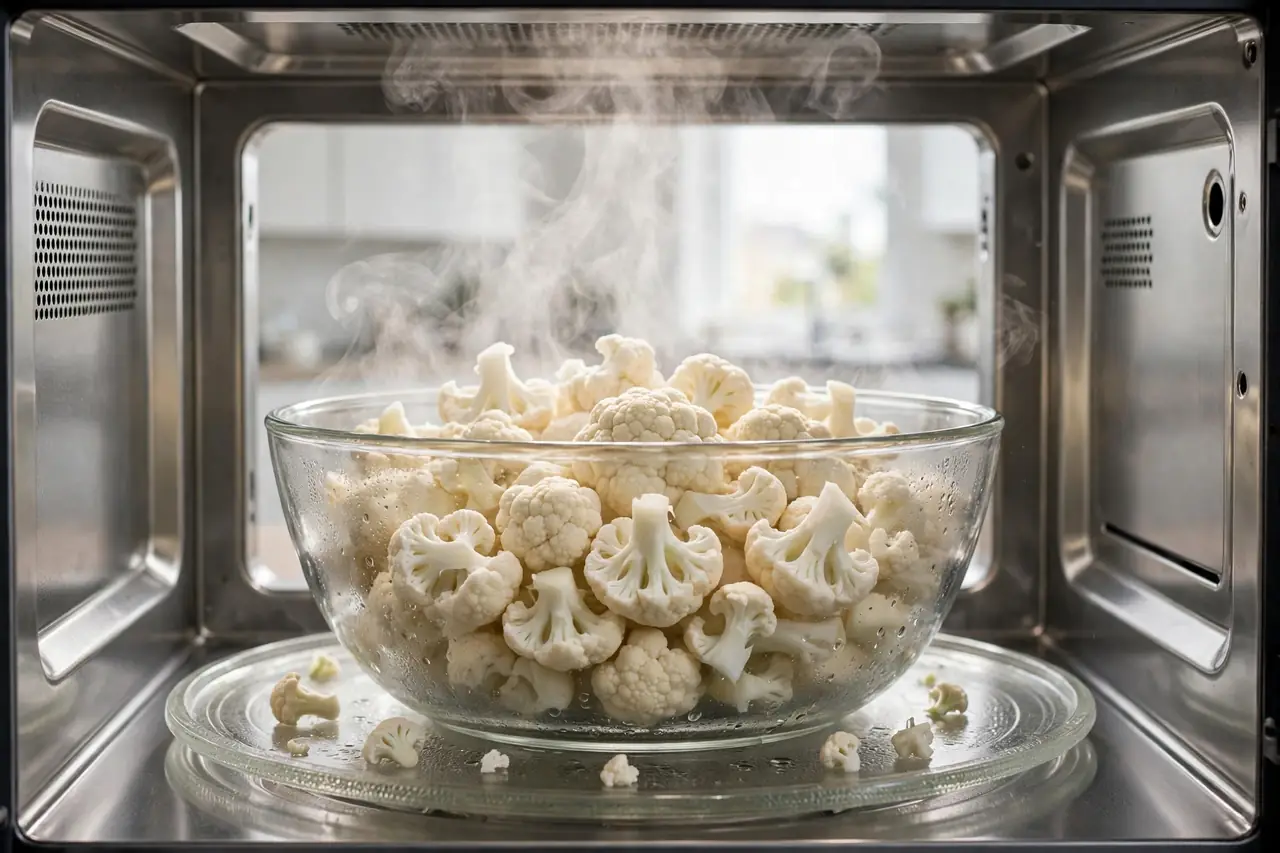
Yes, you can microwave cauliflower, and for a fresh head cut into even florets it is one of the fastest ways to get a tender side dish on the table. Cut the head into florets about 4 centimetres across, place them in a microwave safe glass or ceramic bowl, add 2 tablespoons of water, cover loosely, and microwave on high for 4 to 6 minutes in a 1000 watt oven, stirring halfway through. Let the bowl stand covered for 1 to 2 minutes, drain off any water, and season while the florets are still hot. They are ready when a fork slides in with a little resistance, not when they fall apart.
Cauliflower suits the microwave for a simple reason. It is mostly water and fibre, so microwave energy turns that water into steam inside the floret itself, and the floret cooks in its own steam without a pot of boiling water. That is also the reason microwaved cauliflower can disappoint. The same steam that cooks it so fast can pool in the bowl, turn it soggy, and make the kitchen smell strong if you keep heating past the point where it is tender. The fix is not a secret method. It is less water than you expect, even pieces, a stir halfway through, and stopping at tender crisp rather than cooking for a fixed time.
This guide gives you the method that works for the cauliflower most people buy, the times for frozen cauliflower, cauliflower rice, and a whole head, and honest answers to the questions that confuse people most. That includes how much water to add, whether to cover the bowl, why one guide says 4 minutes while another says 10 minutes, why microwaved cauliflower smells, and when the microwave is the wrong tool. If you only need the quick answer, the short answer section and the step list are enough. If you want cauliflower that tastes like you meant it, read the sections on cutting, water, and timing.
Short answer: can you microwave cauliflower?
Yes. Microwave cauliflower in a microwave safe glass or ceramic bowl, cut into even florets, covered loosely so steam can escape, in short bursts with a stir halfway through. For about 450 grams of fresh florets, about half a medium head, use 4 to 6 minutes total on high in a 1000 watt microwave, then let them stand covered for 1 to 2 minutes. Drain off the liquid before you season them, or the seasoning will sit in the puddle at the bottom of the bowl instead of on the florets. Do not microwave cauliflower in a metal dish, in a sealed container, or in packaging that is not labelled microwave safe, and do not keep heating it in the hope that it will brown. Extra microwave time makes cauliflower mushy, not golden.
For safety, fresh cauliflower needs to be cooked until tender and steaming hot throughout, and leftovers need the same care as any cooked vegetable dish. The USDA Food Safety and Inspection Service guidance on microwave cooking stresses stirring or rotating food during cooking, covering food loosely, and observing standing time, because microwaves heat unevenly and leave cold spots where bacteria can survive. You can read that guidance in the USDA microwave ovens and food safety sheet. The Clemson Extension guide on microwave food safety gives the same practical rules in plain form: stir or rotate midway, allow standing time so heat can spread evenly, and use a food thermometer where a safe temperature matters. For plain cauliflower, the main safety steps are even heating, standing time, prompt refrigeration of leftovers, and reheating until steaming hot throughout. If a leftover dish also contains meat, poultry, or eggs, the 165 degrees Fahrenheit reheating target for leftovers applies to that dish as a whole.
If you want the broader rules that apply across foods, the main can you microwave it guide covers containers, covering, stirring, and standing time in one place. The cauliflower method below follows those same rules, with the amounts and times adjusted for how dense cauliflower is.
Why cauliflower works in the microwave, and why it goes wrong
Cauliflower is a dense vegetable with a tight head of florets and thick stems. That density is the whole story. Thin vegetables such as spinach soften in 2 to 3 minutes, while cauliflower stems need longer for heat to reach the centre. When you cut a head into small, even florets, you solve most of that problem before the microwave even starts. Small pieces have more surface area, steam reaches them faster, and no single thick stem lags far behind the rest.
The second factor is water. Cauliflower already contains a lot of water, so it does not need a bath to cook. A small amount of added water turns into steam under a loose cover, and that steam does the cooking. Too much water does the opposite of what people expect. Instead of cooking the cauliflower faster, it boils the florets, washes out flavour, and leaves a pool at the bottom of the bowl. That pool is the most common cause of soggy microwaved cauliflower, and it is easy to avoid once you know to measure the water instead of guessing.
The third factor is time. Cauliflower goes from tender crisp to mushy in a short window, often in less than 2 minutes. That is why the guides disagree so much. A guide that tests a small bowl of small florets in a 1200 watt oven can honestly report 4 minutes, while a guide that tests a full head in a deep bowl in a 700 watt oven can honestly report 8 to 10 minutes. Both can be right for their own test, and both can be wrong for your kitchen. The fork test beats the timer every time: check early, stir, and add short bursts only if the stems still resist.
The fourth factor is carryover cooking. Cauliflower keeps cooking after the microwave stops, while it stands covered in its own steam. If it is perfect the moment the microwave beeps, it will be overcooked by the time you sit down to eat. Stop a little early, let it stand for 1 to 2 minutes, and check again. That standing time is not wasted time. It is part of the cooking, and it also evens out hot and cold spots, which is exactly why USDA guidance insists on it.
How to choose and cut cauliflower for the microwave
Choose a head that feels heavy for its size, with tight, white florets, firm stems, and no soft brown spots. Loose, spreading florets and dark spots usually mean an older head, and older cauliflower softens faster and smells stronger when heated. The leaves should look fresh, not limp or yellow. A head with a few small brown marks is still usable if you trim those parts away, but a head that smells sour or feels slimy in the fridge is past its best and heat will not fix it.
Store a fresh head in the crisper drawer, loosely wrapped, and use it within 3 to 5 days for the best texture. Cut florets ahead of time only if you need to: cut florets keep for 2 to 3 days in a sealed container in the fridge, but they dry out at the cut surfaces and cook a little less evenly than florets cut just before cooking. If you buy pre cut florets, check the bag for brown edges and use them within the date on the bag.
To cut a head, remove the green leaves and trim the thick core, then cut the head into quarters through the core. Break or cut each quarter into florets about 4 centimetres across, roughly the size of a golf ball, and trim any very thick stems so they are no thicker than about 2 centimetres. Uniform size matters more than exact size. A bowl that mixes tiny crumbs and large chunks will give you a mix of mushy crumbs and firm chunks, and no timer can fix that. Save the crumbs for soup, or add them only in the last minute, because they cook fastest.
Rinse the florets briefly under cold water and shake off the excess, or pat them dry with a clean towel. Do not soak them in a bowl of water for minutes at a time. Soaking adds water that you will then have to cook off, and it pushes the result toward soggy. A quick rinse is enough to remove soil and any grit hiding between the florets.
How to microwave cauliflower, step by step
Start with a microwave safe glass or ceramic bowl that is wide rather than deep. A wide, shallow bowl works better than a deep, narrow one, because microwaves heat the edges faster than the centre, and a deep pile hides the centre pieces from even heating. If one layer does not fit, heat in two batches. Two even batches beat one uneven batch that you have to fix later.
Place about 450 grams of florets, about half a medium head, in the bowl in a layer that is not piled high. Add 2 tablespoons of water. That is the amount for a half head. For a full head, about 900 grams, use 3 tablespoons, not double, because the florets themselves release water as they heat. For a single serving, about 200 grams, 1 tablespoon is enough. If your florets are very fresh and wet from rinsing, use the lower end of the range.
Cover the bowl loosely. A microwave safe lid left ajar, an inverted microwave safe plate, or a damp paper towel all work. The cover traps steam, which helps the cauliflower cook evenly, but it must leave a gap for excess steam to escape. Do not seal the bowl tight, and do not use plastic wrap with no vent, and keep any wrap from touching the food. This is the point where guides disagree, and the disagreement is honest. Some cooks leave the bowl uncovered because they want a drier result, and uncovered cauliflower does release more steam. The trade is uneven cooking and drier edges, so a loose cover is the safer default, especially for a first attempt. If you want a drier finish, drain the liquid well after cooking, and finish the florets in a hot pan for a minute or two, instead of skipping the cover and risking dry edges.
Microwave on high for 4 minutes, then remove the bowl carefully with oven gloves, stir the florets so the outer pieces move to the middle, and check how they look. They should already be brightening in colour and softening at the edges. Return the bowl to the microwave and heat for 1 to 2 more minutes, stirring once more if you are heating a large batch. Let the cauliflower stand, covered, for 1 to 2 minutes. Standing time matters, because heat keeps spreading from hot pieces to cooler pieces during that rest, and the texture settles. Check before you add more time. The florets are ready when a fork slides into the thickest stem with a little resistance, and the florets still hold their shape when lifted.
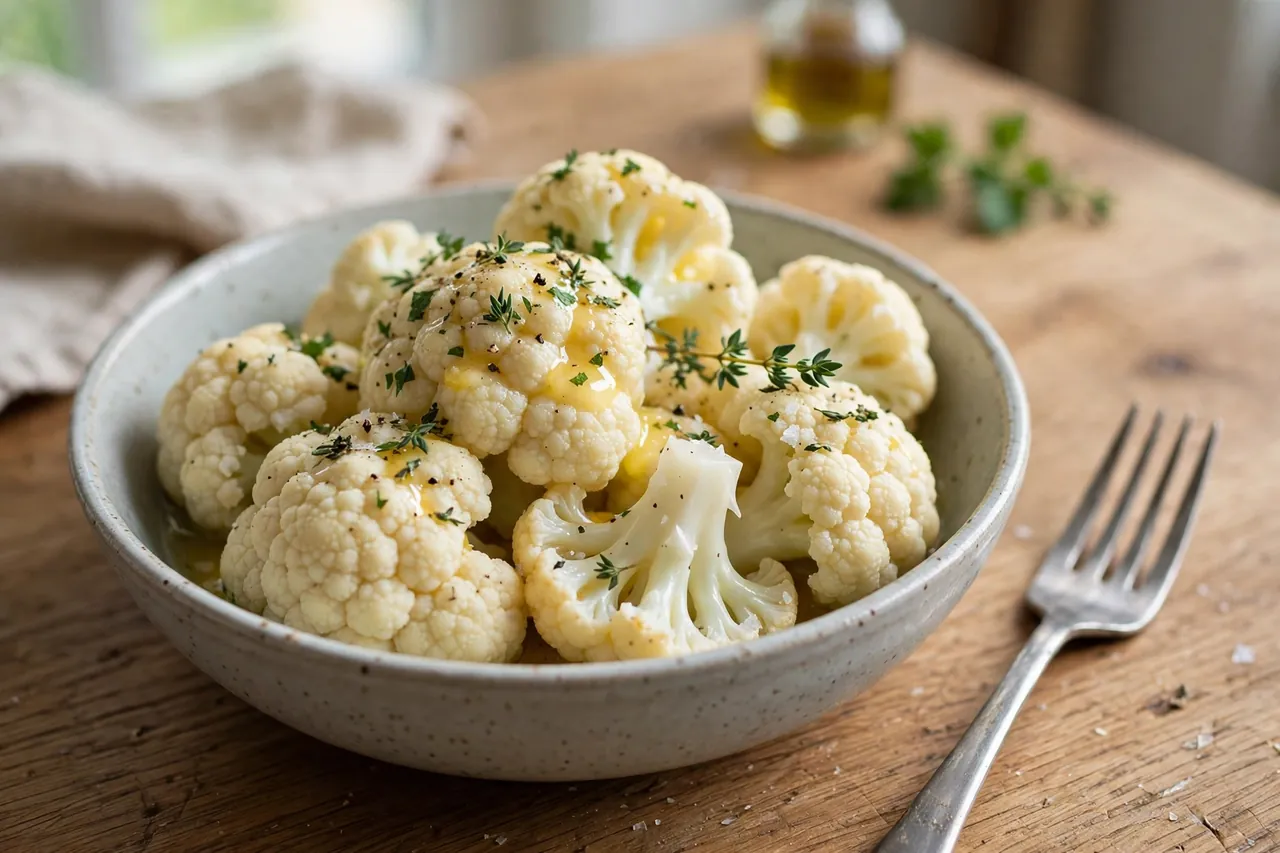
Drain the liquid before seasoning. Tip the bowl gently over the sink, or lift the florets out with a slotted spoon, and leave most of the liquid behind. The liquid is not waste if you want it, it makes a light base for a soup, but seasoning cauliflower while it sits in it gives you seasoned liquid and bland florets. Season after draining, with salt, butter, olive oil, garlic, lemon, or herbs, and toss while the florets are still hot, so the seasoning coats them at once. If you salted before cooking, the florets may release even more water, so seasoning after cooking is the better habit for microwaved cauliflower.
For a simple finishing touch, a small knob of butter tossed through hot drained florets gives a richer result than butter added at the start, because butter added early melts into the cooking liquid and drains away with it. The site guide to microwaving butter explains how fast butter softens and melts in the microwave, which is why a cold knob tossed through hot cauliflower, rather than a long microwave melt, keeps the butter where you want it, on the florets.
Microwave times for cauliflower
Times below are starting points for a 1000 watt microwave, florets about 4 centimetres across, in a loosely covered bowl, with the water amounts given above. Lower wattage ovens need more time, higher wattage ovens need less, and the thickness of your stems matters more than the wattage on the label. Start at the lower end, check with a fork, and add 30 to 60 second bursts. You can always add time, but you cannot undo mushy cauliflower.
| Cauliflower form | Amount | Water | Time on high | Stand time |
|---|---|---|---|---|
| Fresh florets, small (2 to 3 cm) | 450 g | 2 tbsp | 4 to 5 minutes | 1 to 2 minutes |
| Fresh florets, standard (about 4 cm) | 450 g | 2 tbsp | 4 to 6 minutes | 1 to 2 minutes |
| Fresh florets, large (5 cm or more) | 450 g | 2 tbsp | 5 to 7 minutes | 2 minutes |
| Fresh florets, full head | 900 g | 3 tbsp | 7 to 9 minutes, in two batches if deep | 2 minutes |
| Frozen florets, from frozen | 450 g | 1 tbsp | 5 to 7 minutes | 1 to 2 minutes |
| Cauliflower rice, fresh | 450 g | 1 tbsp | 3 to 4 minutes | 1 minute |
| Cauliflower rice, frozen | 450 g | No added water | 4 to 5 minutes | 1 minute |
| Leftover cooked cauliflower | 1 to 2 cups | 1 tbsp | 1 to 2 minutes, stir halfway | 1 minute |
If your microwave is 700 to 800 watts, add about 30 percent to these times and keep the same stir pattern. If it is 1200 watts, start at the lower end and check early, because the edge pieces can soften fast. Wattage is usually printed inside the door or in the manual. When in doubt, start short and use your eyes and a fork, not just the timer. Cauliflower that is ready looks white or pale cream, feels tender in the stem, and holds its shape. Cauliflower that needs more time still feels firm in the centre and looks dry on the surface. Cauliflower that has gone too far looks grey, falls apart when lifted, and sits in a pool of water.
How wattage changes the time
Microwave wattage is the power of the oven, and it changes cooking time in a predictable way, but it is not the only variable. Bowl shape, portion size, floret size, and whether the cauliflower is fresh or frozen all shift the time as well. Use the table below as a starting adjustment, then check with a fork. The safest habit is to set the first cook shorter than you think you need, because the standing time finishes the job.
| Microwave power | Fresh florets, 450 g | What to watch |
|---|---|---|
| 600 to 700 watts | 6 to 8 minutes | Stir twice, check at 5 minutes |
| 800 to 900 watts | 5 to 6 minutes | Stir once halfway, check at 4 minutes |
| 1000 watts | 4 to 6 minutes | Stir once halfway, check at 4 minutes |
| 1100 to 1200 watts | 4 to 5 minutes | Check at 3 minutes, edges soften first |
A microwave without a turntable needs extra care. Turn the bowl halfway through cooking, or stir more thoroughly, because the same spots will keep heating while other spots stay cool. That is the same cold spot problem USDA guidance warns about, and stirring is the practical fix in a home kitchen.
Can you microwave frozen cauliflower?
Yes, and frozen cauliflower is one of the easiest forms to microwave, because the florets are already cut to a fairly even size and partly cooked by blanching before freezing. Place the florets frozen in a microwave safe bowl, add only 1 tablespoon of water for 450 grams, cover loosely, and heat for 5 to 7 minutes total in a 1000 watt microwave, stirring halfway through. Frozen florets release more water than fresh ones as the ice melts, so drain them very well before seasoning, or the extra water will thin the dish.
Do not thaw frozen cauliflower first unless the bag tells you to. Thawing in the fridge or on the counter gives the florets time to release water and turn limp before cooking even starts, and it adds a food safety risk if thawed food sits at room temperature for too long. Cooking from frozen is both simpler and safer here. The one exception is a steam in bag product: if the bag has microwave instructions, follow them exactly, including the venting step and the standing time, because the bag and the timing were tested together. If a bag has no microwave instructions at all, treat it as a storage bag, not a cooking bag, and tip the florets into a glass bowl instead.
Frozen cauliflower will not brown in the microwave, and it will be softer than fresh cauliflower, so it suits soups, mashes, sauces, and fillings better than a side dish where crisp texture is the point. For a side dish, fresh florets are the better choice. For a mash, frozen florets are a good shortcut, because you are going to break them down anyway. The broader method for frozen vegetables, including the bag rule and the stirring habit, is covered in the guide to microwaving frozen vegetables, and the cauliflower times above sit inside that same method.
Can you microwave a whole cauliflower head?
You can, but it is the least reliable way to microwave cauliflower, and it is not the method this guide recommends for a first attempt. A whole head is thick in the centre and thin at the edges, so it cooks unevenly: the outer florets overcook while the dense core stays firm. If you still want to try it, cut a deep cross into the core, place the head stem side down in a large microwave safe dish, add 4 tablespoons of water, cover loosely, and microwave on high for 10 to 12 minutes, turning the head halfway through and checking the core with a fork. Expect mixed results, and expect the outer florets to be softer than the centre.
Cutting the head into florets first takes only a few minutes and fixes the unevenness problem completely. That is why every reliable guide, including the Purdue Extension preparation note for cauliflower, which describes microwaving cut cauliflower in a covered bowl with a little water for about 3 minutes for a smaller amount, works from cut pieces rather than a whole head. You can read that short preparation guidance on the Purdue FoodLink cauliflower page. The principle is the same at any scale: even pieces, a little water, a loose cover, and a fork check.
Can you microwave cauliflower rice, mash, and cauliflower cheese?
Cauliflower rice microwaves very well, because the tiny pieces heat fast and evenly. For fresh cauliflower rice, place 450 grams in a microwave safe bowl, add 1 tablespoon of water, cover loosely, and microwave on high for 3 to 4 minutes, stirring halfway through. For frozen cauliflower rice, use no added water, because the ice provides the moisture, and microwave for 4 to 5 minutes, stirring halfway and draining well. Cauliflower rice goes mushy fast, so check at 3 minutes and stop as soon as it is tender. Do not add salt before cooking, because salt draws out water and makes the rice wet.
For mashed cauliflower, microwave florets by the standard method until they are fully tender, not just tender crisp, then drain very well and mash with butter, milk, salt, and pepper. The draining step matters more for mash than for a side dish, because any water left in the bowl will make the mash thin. If the mash still looks wet, return it to the microwave uncovered for 1 minute to drive off steam, then mash again. A potato masher gives a rustic mash, while a blender gives a smooth puree, but blend in short pulses so you do not turn it into glue.
Cauliflower cheese is a different job, because the cheese and the cauliflower need different treatment. Microwave the florets first until tender crisp, drain them well, then add cheese sauce or grated cheese and microwave in short bursts at 50 percent power until the cheese just melts. Heating cheese on high for minutes at a time makes it split into oil and rubber, which is why the cheese guide on this site recommends short bursts at half power. You can read that method in the guide to microwaving cheese. For cauliflower cheese, the microwave is best for reheating a single serving, not for building the dish from scratch. If you want a browned, bubbling top, finish the dish under a grill or in a hot oven for a few minutes after microwaving, because microwaves do not brown.
The same logic applies to other vegetable dishes. Mushrooms, for example, release their own liquid and need draining before seasoning, just like cauliflower, and the timing and draining habits in the guide to microwaving mushrooms transfer well to cauliflower, even though the two vegetables cook at different speeds.
Cover or no cover? Why guides disagree
Both cover tips appear in real guides, and both are honest, because they solve different problems. A loose cover traps steam, which cooks the florets evenly and keeps them moist. No cover lets steam escape, which gives a drier result but risks uneven cooking and dry edges. The best default is a loose cover, because even cooking matters more than dryness, and you can always drain and finish in a pan if you want a drier result. The worst option is a tight seal with no vent, because steam builds up, the cover can pop off, and hot steam can burn you when you open it.
Plastic wrap needs extra care. If you cover a bowl with plastic wrap, keep the wrap from touching the food, vent one corner so steam can escape, and use only wrap labelled microwave safe. A safer default is a microwave safe lid left ajar, an inverted plate, or a damp paper towel. Glass and ceramic bowls are the safest containers here, because they heat evenly and do not interact with the food. Do not use metal, foil, or a container with metallic trim, and do not use a plastic container that is not labelled microwave safe.
One more container warning is worth stating plainly. A container that held cold food is not automatically safe for hot food. A takeaway tub, a yoghurt pot, or a storage box that was never meant for heat can warp, melt, or leach chemicals when microwaved. Transfer the cauliflower to a labelled microwave safe dish first. It takes one extra minute and removes the entire question.
Why microwaved cauliflower smells, and how to reduce it
Cauliflower belongs to the brassica family, along with cabbage, broccoli, and kale, and all of these vegetables contain sulfur compounds. When heated, those compounds break down and release the familiar strong smell. The smell gets stronger the longer you cook, and it gets stronger still when cauliflower is overcooked. That is why a short, careful microwave cook often smells less than a long boil: less time at high heat means fewer sulfur compounds released.
To keep the smell down, cook only until tender crisp, drain promptly, and do not leave the bowl covered for a long time after cooking, because trapped steam concentrates the smell. A splash of lemon juice or vinegar in the seasoning, or a knob of butter with herbs, helps balance the smell on the plate without hiding the cauliflower flavour. Ventilate the kitchen while cooking, and avoid reheating cauliflower multiple times, because each reheat releases more sulfur compounds and softens the texture further.
Colour is a useful clue. Fresh microwaved cauliflower should stay white or pale cream. Grey or yellow brown colour usually means overcooking or an old head, not a safety problem on its own, but it is a sign that the texture and flavour have suffered. If the florets turn grey and mushy, they are still safe to eat if they were fresh and handled properly, but they will not taste good, and it is better to use them in a soup or mash than to serve them as a side dish.
Does microwaving cauliflower lose nutrients?
Microwaving cauliflower with a little water and a short cooking time is one of the gentlest common cooking methods for water soluble vitamins, including vitamin C and the B vitamins. Those vitamins dissolve into cooking water, so the less water you use and the shorter you cook, the more stays in the food. Boiling cauliflower in a full pot of water is hardest on those vitamins, because of the large volume of water and the longer cooking time. Steaming sits in the middle, and microwaving with 2 tablespoons of water sits at the favourable end of that comparison, because the cooking time is short and the water volume is tiny.
That does not mean microwaving preserves every nutrient perfectly, and no honest guide should invent a percentage for nutrient retention. Cooking always changes nutrient levels, and the exact change depends on the head, the cooking time, and how much water you drain away. What cooking research consistently finds is the pattern: less water plus shorter time equals better retention of water soluble nutrients. The method in this guide follows that pattern closely, which is why it is a nutritionally sound choice rather than a compromise.
One practical tip follows from that pattern. Drain the cooking liquid, but do not throw away the idea of using it. If you are making soup, use the liquid as part of the stock, because some of the nutrients that left the florets are in that liquid. For a side dish, draining is still the right call for texture, even though it means losing the small amount of nutrients in the liquid. Texture and flavour matter too, and a side dish nobody enjoys is not a nutritional win.
Common mistakes that ruin microwaved cauliflower
Too much water is the first mistake, and it is the most common. People fill the bowl halfway with water because they are thinking of boiling, not steaming. Use 2 tablespoons for half a head, not a cup. The Tasting Table note on the water mistake for cauliflower makes the same point in plain form: a small amount of water turns into steam, and that steam is what cooks the florets through, without leaving them wet. You can read that short explanation on the Tasting Table cauliflower water guide.
Uneven pieces are the second mistake. A bowl that mixes tiny crumbs and large chunks cannot cook evenly, no matter how good the timer is. Cut evenly, or accept that the small pieces will be mushy while the large pieces are still firm. Overcrowding is the third mistake. A deep pile in a small bowl steams the bottom layer to mush while the top layer stays dry. Use a wide bowl, spread the florets out, and cook in two batches for a full head.
Skipping the stir is the fourth mistake. Microwaves heat unevenly by design, with hot and cold spots inside the cavity. Stirring halfway through moves the cooler pieces into hotter zones and is the single most effective fix available to a home cook. Skipping the standing time is the fifth mistake. Standing time finishes the cooking and evens out the temperature, so skipping it leaves cold spots and a texture that feels half cooked. Overcooking is the sixth mistake, and it is the hardest to undo. Once cauliflower is mushy, no seasoning or finishing step can restore its bite. Check early, every time.
Salting before cooking is a smaller mistake, but it still matters. A normal amount of salt is fine, but a heavy dose before microwaving draws water out of the florets and can soften their texture faster. Season lightly before cooking, if at all, and adjust after draining. Adding butter or oil at the start is a similar small mistake for a side dish, because the fat melts into the cooking liquid and drains away. Add fat after draining, while the florets are hot, so it coats them instead of washing away.
Microwave versus stove versus oven for cauliflower
The microwave wins on speed and cleanup, the stovetop steamer wins on evenness for larger batches, and the oven wins on browning and flavour depth. None of them is best for every job, and choosing on purpose is better than arguing about which method is correct in general. Use the table below to pick the right tool for the meal you are actually making.
| Method | Typical time | Texture | Best for |
|---|---|---|---|
| Microwave, covered bowl | 4 to 6 minutes for 450 g | Tender crisp, pale, moist | Quick weeknight sides, 1 to 2 servings |
| Stovetop steamer | 8 to 12 minutes | Even, tender, bright | Larger batches, meal prep |
| Boiling | 6 to 10 minutes | Soft, sometimes waterlogged | Soups and mashes, where texture matters less |
| Oven roasting | 25 to 35 minutes at high heat | Browned, nutty, firm edges | Flavour first meals, guests, cauliflower steaks |
| Air fryer | 12 to 18 minutes | Crisp edges, drier centre | Small batches where crispness matters |
A good hybrid is to microwave first, then finish in a hot pan or under a grill. Microwave the florets until just tender, drain them well, then toss them in a hot skillet with olive oil, garlic, and a pinch of salt for 2 to 3 minutes until the edges colour. You get most of the speed of the microwave and much of the flavour of roasting, without waiting 30 minutes for the oven. This hybrid also fixes the main weakness of microwaved cauliflower, which is that it never browns on its own.
Serving ideas that work after microwaving
Keep serving simple, because microwaved cauliflower is at its best when the seasoning is fresh and the florets are hot. Toss hot drained florets with butter, lemon zest, parsley, and black pepper for a classic side. Add garlic, chilli flakes, and olive oil for a sharper version. Add toasted almonds or pine nuts for crunch, because microwaved cauliflower has no crisp edges of its own. Add Parmesan and a squeeze of lemon for a salty, bright finish, but add the cheese after draining, not before microwaving, so it melts on the hot florets instead of splitting in the cooking liquid.
For a fuller meal, serve microwaved cauliflower alongside grilled chicken, fish, or tofu, with rice or flatbread, and a sauce on the side. For a lighter meal, toss it with chickpeas, herbs, lemon, and olive oil for a warm salad. For a comfort meal, mash it with butter and milk, or fold it into a cheese sauce after microwaving, as described above. In every case, drain first, season hot, and serve promptly, because cauliflower left sitting in its cooking liquid keeps softening.
Storage, leftovers, and reheating
Cool leftover cauliflower quickly, within 2 hours of cooking, and store it in a shallow airtight container in the fridge. Use it within 3 to 4 days, following the general leftover guidance that cooked vegetables should be refrigerated promptly and not left at room temperature for long. Do not store cauliflower in its cooking liquid, because it will keep softening in the fridge and turn mushy by the next day. Drain it, cool it, and store it dry.
To reheat, place 1 to 2 cups in a microwave safe bowl, add 1 tablespoon of water, cover loosely, and microwave on high for 1 to 2 minutes, stirring halfway through. Let it stand for 1 minute, drain if needed, and check that it is steaming hot throughout before eating. Do not reheat cauliflower more than once, and do not reheat a portion you have already reheated and cooled again. If a leftover dish contains meat, poultry, or eggs, reheat that dish until it reaches 165 degrees Fahrenheit in the centre, measured with a food thermometer, and let it stand before eating.
Freezing cooked cauliflower is possible, but the texture after thawing is soft, so frozen cooked cauliflower suits soups and mashes better than a side dish. Cool it, pack it flat in freezer bags with the air pressed out, label it with the date, and use it within 2 to 3 months. Thaw it in the fridge overnight, then reheat by the method above, draining well. Fresh cauliflower also freezes well raw if blanched first, but that is a separate preserving job, not a microwave shortcut.
Safety checklist before you press start
Use a microwave safe glass or ceramic bowl, never metal, foil, or a container with metallic trim. Cover loosely and leave a vent for steam. Stir halfway through and let the food stand covered for 1 to 2 minutes after cooking. Open the cover away from your face and hands, because trapped steam can burn in a second. Use oven gloves, because the bowl and the steam will both be hot. Check the thickest stems with a fork, not just the surface florets, because the surface can feel hot while the centre is still firm.
Never microwave cauliflower in a sealed container, in packaging that is not labelled microwave safe, or in a bag with no microwave instructions. Never leave the microwave unattended for a long cook, and stop at once if you smell burning or see scorching, because that means the water has boiled off and the florets are drying out. If the bowl is dry and the cauliflower smells burnt, do not add water and start again. Discard the burnt pieces, because burnt flavour will not wash out, and check that the bowl itself is still safe to use.
Frequently asked questions
These answers are direct first, then a short explanation. Times assume a 1000 watt microwave unless stated otherwise, and the fork test always beats the timer.
How long does it take to microwave cauliflower?
Microwave 450 grams of fresh florets for 4 to 6 minutes on high, stirring halfway through, then let them stand covered for 1 to 2 minutes. Small florets need 4 to 5 minutes, standard florets need 4 to 6 minutes, and large florets need 5 to 7 minutes. Check with a fork at the lower end of the range, because wattage, bowl shape, and floret size all shift the time.
Do I need to add water to microwave cauliflower?
Yes, add a small amount of water, but only 2 tablespoons for 450 grams of fresh florets. That water turns into steam under a loose cover, and the steam cooks the florets through. Without any water, the florets dry out at the edges and cook unevenly. With too much water, they boil and turn soggy, so measure the water instead of guessing.
Can you microwave frozen cauliflower?
Yes, microwave frozen cauliflower straight from frozen, with no thawing first. Use 1 tablespoon of water for 450 grams, cover loosely, and microwave for 5 to 7 minutes on high, stirring halfway through. Drain very well before seasoning, because frozen florets release more water than fresh ones as the ice melts.
Can you microwave a whole cauliflower head?
Yes, but it cooks unevenly, so cutting it into florets first gives a better result. If you microwave a whole head, cut a deep cross into the core, add 4 tablespoons of water, cover loosely, and microwave for 10 to 12 minutes, turning halfway through. Expect the outer florets to be softer than the centre, even with turning.
Can you microwave cauliflower rice?
Yes, microwave cauliflower rice for 3 to 4 minutes if fresh, or 4 to 5 minutes if frozen, stirring halfway through. Use 1 tablespoon of water for fresh rice and no added water for frozen rice. Check at 3 minutes, because cauliflower rice goes mushy fast, and drain well before seasoning.
Does microwaving cauliflower lose nutrients?
Microwaving with a little water and a short cooking time preserves water soluble vitamins better than boiling in a full pot of water. Vitamin C and B vitamins dissolve into cooking water, so less water and shorter time mean more stays in the food. No cooking method preserves every nutrient perfectly, but the microwave method in this guide follows the favourable pattern of less water plus shorter time.
Why does microwaved cauliflower smell strong?
Cauliflower contains sulfur compounds that break down when heated, and the smell gets stronger the longer you cook. Overcooking is the main cause of a strong smell, so cook only until tender crisp, drain promptly, and do not leave the bowl covered for a long time after cooking. A splash of lemon juice in the seasoning also helps balance the smell on the plate.
Why is my microwaved cauliflower soggy?
Soggy cauliflower is usually caused by too much water, uneven pieces, overcrowding, or overcooking, not by the microwave itself. Use 2 tablespoons of water for 450 grams, cut florets to an even size, use a wide bowl, stir halfway through, and stop at tender crisp. Drain immediately after the standing time, because florets left sitting in cooking liquid keep softening.
Can you microwave cauliflower cheese?
Yes, but microwave the florets first, drain them well, then add cheese and heat in short bursts at 50 percent power until the cheese just melts. Heating cheese on high for minutes makes it split into oil and rubber. For a browned top, finish the dish under a grill or in a hot oven, because microwaves do not brown.
Can you reheat cauliflower in the microwave?
Yes, reheat 1 to 2 cups of cooked cauliflower with 1 tablespoon of water, covered loosely, for 1 to 2 minutes on high, stirring halfway through. Let it stand for 1 minute and check that it is steaming hot throughout. Reheat only once, refrigerate leftovers within 2 hours of cooking, and use them within 3 to 4 days.
Is it safe to microwave cauliflower in plastic?
Only in a plastic container or wrap that is clearly labelled microwave safe, and only with a vent for steam and no contact between wrap and food. A safer default is a glass or ceramic bowl with a microwave safe lid left ajar or an inverted plate. Never microwave cauliflower in a storage tub, takeaway box, or bag that is not labelled microwave safe.
Can you microwave cauliflower in the bag it came in?
Only if the bag is a steam in bag product with printed microwave instructions, and then follow those instructions exactly. If the bag has no microwave instructions, treat it as a storage bag and tip the florets into a glass bowl. The food being microwaveable does not automatically mean the packaging is microwaveable.
Can you microwave purple or orange cauliflower?
Yes, purple, orange, and green cauliflower microwave the same way as white cauliflower, with the same times and water amounts. Purple cauliflower may lose some colour in the cooking liquid, which is normal, and orange cauliflower keeps its colour better. Cut, water, cover, and fork check rules are identical, because the difference is pigment, not density.
How long does microwaved cauliflower last in the fridge?
Microwaved cauliflower lasts 3 to 4 days in the fridge in a shallow airtight container, if it was cooled within 2 hours of cooking and stored drained, not in cooking liquid. Do not leave it at room temperature for more than 2 hours in total, reheat only the portion you will eat, and discard it if it smells sour or feels slimy.
Cauliflower is a good microwave vegetable when you treat it like steaming, not boiling: even florets, a little water, a loose cover, a stir halfway through, and a fork check before more time. That method gives you a fast, tender side dish without a pot to wash, and it leaves you free to finish the florets with butter, lemon, herbs, or cheese while they are still hot. Start at 4 minutes, stir, stand, drain, and season, and you will get tender crisp cauliflower far more often than soggy cauliflower.

1 Comment
Pingback: Can You Microwave Broccoli? Times and Safety