

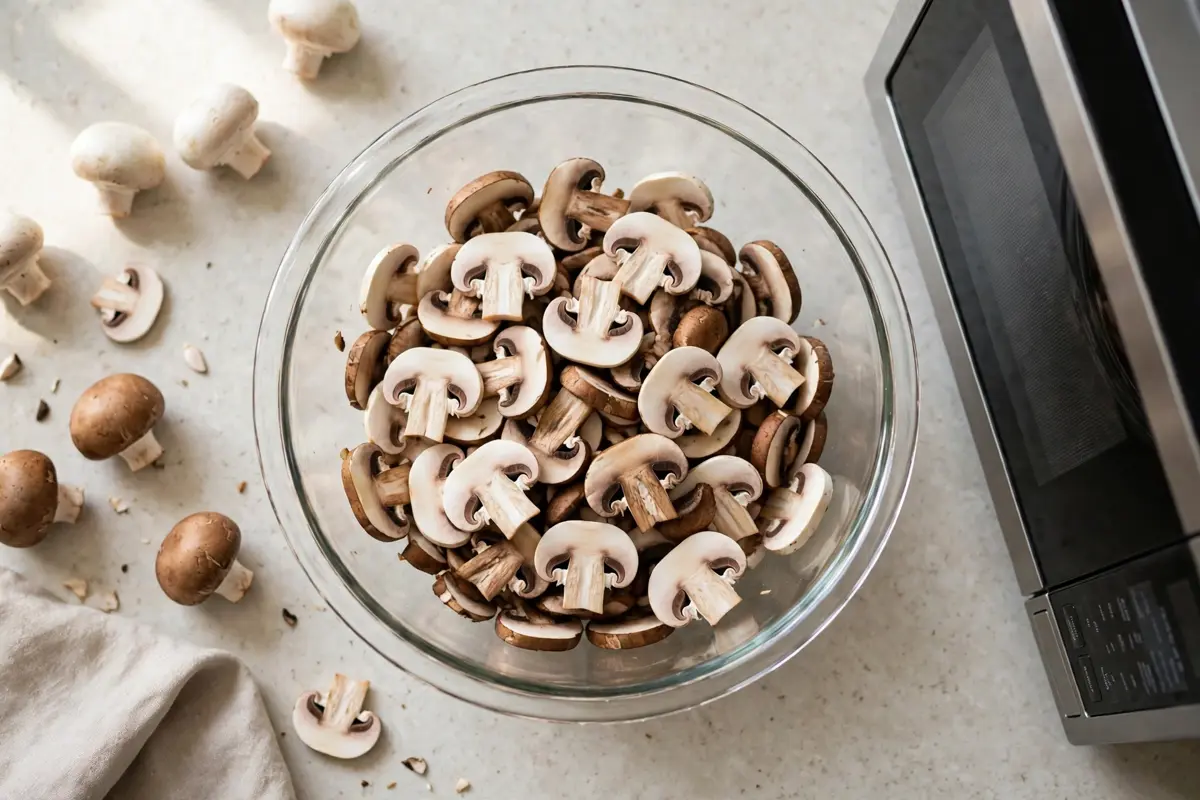
Yes, you can microwave mushrooms, and for sliced button or cremini mushrooms it is one of the fastest ways to get a tender side dish on the table. Clean them, slice them evenly, place them in a single layer in a microwave safe bowl, cover loosely, and heat in short bursts with a stir halfway through. For an 8 ounce batch of sliced mushrooms in a 1000 watt microwave, start with 2 minutes on high, stir, then heat for 1 more minute and check. They are ready when they have shrunk, released their liquid, and feel tender all the way through.
Mushrooms suit the microwave for a simple reason. They are mostly water, so microwave energy turns that water into steam inside the mushroom itself, and the mushroom cooks in its own juices without added fat. That is also the reason microwaved mushrooms can disappoint. The same water that cooks them so fast can pool in the bowl, turn them soggy, and make them rubbery if you keep heating past the point where they are tender. The fix is not a secret method. It is draining the liquid before seasoning, stopping at tenderness rather than cooking for a fixed time, and finishing in a hot pan when you actually want browned edges.
This guide gives you the method that works for the mushrooms most people buy, the times for other types, and honest answers to the questions that confuse people most. That includes frozen, canned, and dried mushrooms, the old warning that reheating mushrooms is unsafe, why some mushrooms spark, and why one guide tells you to cover the bowl while another tells you to leave it uncovered. Both cover tips appear in real guides, and this article explains when each one makes sense, so you can choose on purpose instead of guessing. If you only need the quick answer, the short answer section and the step list are enough. If you want mushrooms that taste like you meant them, read the sections on slicing, draining, and timing.
Short answer: can you microwave mushrooms?
Yes. Microwave mushrooms in a microwave safe glass or ceramic bowl, sliced evenly, covered loosely so steam can escape, in short bursts with a stir halfway through. For 8 ounces of sliced white button or cremini mushrooms, use 2 to 3 minutes total on high in a 1000 watt microwave, then let them stand covered for 1 to 2 minutes. Drain off the liquid before you season them, or the seasoning will sit in the puddle at the bottom of the bowl instead of on the mushrooms. Do not microwave mushrooms in the can, in a metal dish, or in a sealed container, and do not keep heating them in the hope that they will brown. Extra microwave time makes mushrooms rubbery, not golden.
For safety, fresh cultivated mushrooms such as button, cremini, and portobello need to be cooked until tender and steaming hot throughout, and leftovers need the same care as any cooked vegetable dish. The USDA Food Safety and Inspection Service leftovers guidance says leftovers should be refrigerated within 2 hours of cooking, kept for 3 to 4 days in the fridge, and reheated to 165 degrees Fahrenheit (74 degrees Celsius), measured with a food thermometer, with covering, stirring, and standing time in the microwave to even out the heat. That 165 degree target is a leftovers rule, not a fresh mushroom rule, and it matters most when you reheat a mushroom dish the next day. The FDA guidance on microwave ovens adds the container rules that matter here: use microwave safe containers, do not use metal, and vent covers so steam can escape.
One safety point needs to be said plainly, because it is where a microwave guide can mislead. Microwaving does not make an unknown wild mushroom safe to eat. Only eat mushrooms you can identify with confidence, or cultivated mushrooms bought from a shop, and cook them thoroughly. If you picked mushrooms yourself and you are not sure what they are, do not eat them, microwaved or not. That rule has nothing to do with cooking time, and no microwave setting can fix a wrong identification.
Which mushrooms work best in the microwave?
White button and cremini mushrooms work best, and they are also the easiest to buy. They are firm, they slice evenly, and they turn tender in 2 to 3 minutes without falling apart. Cremini mushrooms, also called baby bellas, follow the same timing as white buttons when cut to the same thickness, and they have a slightly deeper flavour. If you buy only one type for microwaving, buy cremini, because they hold their shape a little better and taste a little richer in a simple butter and herb finish.
Portobello mushrooms work well too, but they need more time and a different cut. A whole portobello cap is thick in the centre and thin at the edge, so it cooks unevenly if you heat it whole without flipping. Slice the cap, or flip a whole cap halfway through, and allow 3 to 4 minutes for an 8 ounce batch of sliced caps. Remove the dark gills if you do not want them to colour a sauce grey, but keep them if you are eating the mushrooms on their own, because they carry a lot of flavour.
Shiitake mushrooms need their tough stems removed first, then slice the caps thinly. They take about 3 to 4 minutes for an 8 ounce batch, and they keep a pleasant chew that button mushrooms lose faster. Oyster mushrooms are delicate, they tear easily, and they cook fast, so start with 2 minutes and check early. Enoki mushrooms are thinner still, so trim the root cluster, separate the strands, and start with 45 to 60 seconds, checking every 20 seconds after the first 30 seconds. Lion’s mane tears into chunks, holds its shape well, and takes about 2 to 3 minutes, with a stir once and a check for a tender, slightly springy feel.
The type matters less than the cut. Mushrooms sliced to the same thickness cook at the same rate, while a bowl that mixes thick chunks and thin slices will give you a mix of firm chunks and mushy slices, and no timer can fix that. Aim for slices about 5 millimetres thick for button and cremini mushrooms, and keep whole small mushrooms whole only when they are all about the same size. If the mushrooms vary a lot in size, slice the large ones and leave the small ones whole, so the batch evens out.
For a broader view of how one grower explains mushroom cooking, the Monterey Mushrooms cooking guide lists microwaving as one of the simplest methods, with sliced mushrooms in a covered bowl on high for 2 to 3 minutes, stirring once after a minute or so. That matches the method in this guide, and it is a useful check, because a grower has no reason to dress up a method that does not work for its own product.
How to microwave mushrooms, step by step
Start by cleaning the mushrooms. Wipe them with a damp cloth or paper towel, or rinse them briefly under cold water and pat them dry. The old advice to never wash mushrooms comes from a fair worry, that soaking makes them soggy, but a quick rinse does not waterlog a mushroom, and a mushroom straight from the shop often carries a little soil. Do not soak them in a bowl of water for minutes at a time. Rinse, shake off the water, and pat dry, and you keep both cleanliness and texture.
Trim the very end of each stem if it looks dry or dirty, and remove shiitake stems completely, because they stay tough even after cooking. Slice button, cremini, and portobello mushrooms evenly, or leave very small button mushrooms whole. Place them in a microwave safe glass or ceramic bowl, in a layer that is not piled high. A wide, shallow bowl works better than a deep, narrow one, because microwaves heat the edges faster than the centre, and a deep pile hides the centre pieces from even heating. If one layer does not fit, heat in two batches. Two even batches beat one uneven batch that you have to fix later.
Cover the bowl loosely. A microwave safe lid left ajar, an inverted microwave safe plate, or a damp paper towel all work. The cover traps steam, which helps the mushrooms cook evenly, but it must leave a gap for excess steam to escape. Do not seal the bowl tight, and do not use plastic wrap with no vent, and keep any wrap from touching the food. This is the point where guides disagree, and the disagreement is honest. Some cooks leave the bowl uncovered because they want a drier result, and uncovered mushrooms do release more steam. The trade is uneven cooking and drier edges, so a loose cover is the safer default, especially for a first attempt. If you want a drier finish, drain the liquid well after cooking, and finish the mushrooms in a hot pan for a minute or two, instead of skipping the cover and risking dry edges.
Microwave on high for 1 minute, then remove the bowl carefully with oven gloves, stir the mushrooms so the outer pieces move to the middle, and check how they look. They should already be shrinking and releasing liquid. Return the bowl to the microwave and heat for 1 to 2 more minutes, stirring once more if you are heating a large batch. Let the mushrooms stand, covered, for 1 to 2 minutes. Standing time matters, because heat keeps spreading from hot pieces to cooler pieces during that rest, and the texture settles. Check before you add more time. The mushrooms are ready when they feel tender when pressed with a fork, they have shrunk noticeably, and they sit in a little of their own liquid.
Drain the liquid before seasoning. Tip the bowl gently, or lift the mushrooms out with a slotted spoon, and leave most of the liquid behind. The liquid is not waste if you want it, it makes a good base for a soup or a sauce, but seasoning mushrooms while they sit in it gives you seasoned liquid and bland mushrooms. Season after draining, with salt, butter, garlic, parsley, or a splash of soy sauce, and toss while the mushrooms are still hot, so the seasoning coats them at once. If you salted before cooking, the mushrooms may release even more water, so seasoning after cooking is the better habit for microwaved mushrooms.
For a simple finishing touch, a small knob of butter tossed through hot drained mushrooms gives a richer result than butter added at the start, because butter added early melts into the cooking liquid and drains away with it. The site guide to microwaving butter explains how fast butter softens and melts in the microwave, which is why a cold knob tossed through hot mushrooms, rather than a long microwave melt, keeps the butter where you want it, on the mushrooms.
Microwave times for mushrooms by type
Times below are starting points for a 1000 watt microwave and an 8 ounce batch, sliced as described above, in a loosely covered bowl. Lower wattage ovens need more time, higher wattage ovens need less, and the thickness of your slices matters more than the wattage on the label. Start at the lower end, check, and add 30 second bursts. You can always add time, but you cannot undo rubbery mushrooms.
| Mushroom type | Preparation | First heat | Stir, then second heat | Stand time |
|---|---|---|---|---|
| White button, sliced | Slices about 5 millimetres thick | 1 minute on high | 1 to 2 minutes | 1 to 2 minutes |
| Cremini, sliced | Slices about 5 millimetres thick | 1 minute on high | 1 to 2 minutes | 1 to 2 minutes |
| Portobello, sliced or whole cap | Slice caps, or flip whole caps halfway | 2 minutes on high | 1 to 2 minutes | 2 minutes |
| Shiitake, caps only | Remove stems, slice caps thinly | 1 to 2 minutes on high | 1 to 2 minutes | 1 to 2 minutes |
| Oyster, torn | Tear into even pieces | 1 minute on high | 1 minute, check early | 1 minute |
| Enoki, separated | Trim root cluster, separate strands | 45 to 60 seconds on high | 20 second checks | 1 minute |
| Lion’s mane, chunks | Tear into even chunks | 1 minute on high | 1 to 2 minutes | 1 to 2 minutes |
| Frozen sliced mushrooms | From frozen, no thawing needed | 2 minutes on high | 1 to 2 minutes | 1 to 2 minutes |
| Canned mushrooms, drained | Drain well first | 30 seconds on high | 15 to 30 seconds if needed | 1 minute |
If your microwave is 700 to 800 watts, add about 30 percent to these times and keep the same stir pattern. If it is 1200 watts, start at the lower end and check early, because the edge pieces can toughen fast. Wattage is usually printed inside the door or in the manual. When in doubt, start short and use your eyes and a fork, not just the timer. Mushrooms that are ready look smaller, feel tender, and release liquid when pressed. Mushrooms that need more time still feel firm in the centre and look pale and dry on the surface.
For a whole batch that you have not sliced, do not microwave a pile of whole large mushrooms and expect even results. Whole mushrooms heat at the outside first, and the centre of a thick cap lags behind. Slice large mushrooms, flip whole caps halfway, and keep pieces even. Cutting is the single step that most improves microwaved mushrooms, and skipping it is the single step that most ruins them.
Can you microwave frozen, canned, and dried mushrooms?
Frozen sliced mushrooms microwave well, and they do not need thawing first. Place them frozen in a microwave safe bowl, cover loosely, and heat for about 3 to 4 minutes total for an 8 ounce batch, stirring halfway through. Frozen mushrooms release more water than fresh ones, so drain them very well before seasoning or adding them to eggs, pasta, or a filling, or the extra water will thin the dish. Frozen mushrooms will not brown in the microwave, and they will be softer than fresh mushrooms, so they suit soups, sauces, and fillings better than a side dish where texture is the point.
Canned mushrooms are already cooked, so microwaving them is reheating, not cooking. Drain them well, place them in a microwave safe bowl, cover loosely, and heat for 30 to 45 seconds, stir, and check that they are hot throughout. Do not microwave canned mushrooms in the can, and do not heat them in the canning liquid unless you want a very watery result. Skip the canning liquid for most dishes, because it leaves mushrooms watery, especially when you add them to eggs or pasta. Canned mushrooms are a useful shortcut for a quick topping, but they will never taste like freshly microwaved button mushrooms, because they were cooked, canned, and stored long before they reached your bowl.
Dried mushrooms need a different approach, and the microwave is not the best tool for the first step. Soak dried mushrooms in hot water for 20 to 30 minutes until they soften, drain them, and squeeze out excess water gently before cooking. You can then microwave the rehydrated mushrooms as you would fresh sliced mushrooms, for 2 to 3 minutes, but check early, because rehydrated mushrooms vary in thickness and some pieces soften faster than others. Do not microwave dried mushrooms dry in the hope of cooking them. Dry mushrooms have almost no water for the microwave to heat, so they will scorch, smell burnt, and stay tough. The soaking liquid, strained through a fine sieve or paper towel to remove grit, makes a useful mushroom stock for soup or risotto, so save it instead of tipping it away.
For other foods that share the same pattern, the site guides to frozen vegetables and canned beans show the same logic: frozen foods need a longer heat and a good drain, canned foods need only a short reheat, and the package or the soaking step matters more than a single universal time. Mushrooms follow that pattern closely, which is why a frozen mushroom batch and a fresh mushroom batch should never share the same timer.
Is it safe to reheat mushrooms in the microwave?
Yes, provided they were stored correctly in the first place. The old warning that reheating mushrooms creates toxins is not supported by food safety guidance, and it is worth naming plainly, because it still stops people from using leftovers they could safely eat. The Dr Weil food safety note on reheating mushrooms states the point directly: reheating mushrooms in a microwave or by other means is safe, and the more important question is storing them correctly. The risk is not the reheating step. The risk is mushrooms that sat at room temperature for hours after cooking, where bacteria had time to grow, and no reheating can reliably fix food that was stored badly.
Store cooked mushrooms promptly. Move them to a clean, covered container in the fridge within 2 hours of cooking, or within 1 hour if the room is above 90 degrees Fahrenheit, and use them within 3 to 4 days, following the USDA leftovers window linked earlier. Do not store cooked mushrooms in the microwave dish with a loose cover, and do not leave a mushroom dish on the counter while you finish the rest of the evening. A sealed container in the fridge keeps mushrooms fresher and stops them picking up other fridge smells.
To reheat, place the mushrooms in a single layer in a microwave safe dish, add a splash of water or broth if they look dry, cover loosely, and heat in 30 second bursts, stirring between bursts. Let them stand covered for 1 to 2 minutes, then check the temperature in several places, including the centre of the thickest piece, with a food thermometer. For a leftover dish, the USDA target is 165 degrees Fahrenheit throughout. If any spot is below that target, heat in 30 second bursts until it reaches it. Reheat only the portion you will eat, and reheat leftovers only once. Repeated cooling and reheating dries mushrooms out, worsens texture, and gives bacteria more chances to grow during cooling.
One honest limit applies here. Reheated mushrooms will be softer than freshly cooked mushrooms, and reheating will not restore a crisp edge or a firm bite. If texture matters, reheat the mushrooms briefly in the microwave to get them hot through, then finish them for 1 to 2 minutes in a hot pan. That two step method gives you safe heat plus a better texture, and it is much better than microwaving leftover mushrooms for a long time in the hope that they will firm up, which they will not.
Discard cooked mushrooms that smell sour, feel slimy, or have been in the fridge for more than 4 days, even if they look fine. Freezing cooked mushrooms is possible for longer storage, but the texture on thawing is softer, so frozen cooked mushrooms suit soups and sauces better than a side dish. When the storage history is unknown, for example a dish left out overnight, discarding is cheaper than a bad meal.
Why microwaved mushrooms go soggy, rubbery, or spark
Soggy mushrooms are usually seasoned too early, crowded in a deep bowl, or served in their cooking liquid. The microwave heats the water around the mushrooms as much as the mushrooms themselves, so a puddle in the bowl steams the pieces instead of finishing them. Pressing does not apply to mushrooms the way it applies to tofu, so the fixes here are spacing, draining, and seasoning order. Spread the pieces out, drain the liquid halfway through if it pools heavily, season after draining, and finish with a stand time that lets steam escape. If the mushrooms are already soggy, drain them, pat them dry, and finish them in a hot pan, where dry heat can do what the microwave could not.
Rubbery mushrooms are almost always overcooked mushrooms. Too much time on high drives water out of the mushroom, tightens its structure, and leaves a dense, squeaky piece. The fix is prevention, not rescue, because once the structure has tightened, extra sauce can hide the texture but cannot fully reverse it. Next time, use shorter bursts, stir halfway, and stop at the first sign of tenderness, not at the point where the mushrooms look dry. A mushroom that is tender and a little wet is one drain away from good. A mushroom that is rubbery is a much harder rescue.
Uneven cooking, with dry edges and a cool centre, is a cold spot problem, not a bad batch. The edges heat first, the centre lags, and a single long heat makes the gap worse. Stir the pieces, swap outer and inner pieces, rotate the dish if there is no turntable, and use standing time. A wide dish helps too, because a deep bowl hides the centre from even heating. If your microwave has no turntable, rotate the dish by hand halfway through, every time, not just when you remember.
Sparking is rare with ordinary shop bought button or cremini mushrooms, but it is real, and it deserves a calm explanation rather than a scary one. Sparking, also called arcing, can happen when dry material with a high mineral content sits in the microwave with little water to absorb the energy. Leafy greens with mineral rich leaves are the usual example, and mushrooms carry minerals too, though in much smaller amounts in the flesh itself. Dry, unwashed mushrooms with soil or grit on them, or a bowl heated with almost no moisture, are more likely to spark than clean, lightly damp mushrooms in a covered bowl. If you see sparks, stop the microwave at once, leave the door closed for a few seconds, then check the bowl. Wash the mushrooms properly, add a splash of water if the bowl is dry, remove any grit, and do not restart with the same dry setup. A single brief spark from grit is not a reason to throw the microwave away, but repeated sparking, or sparking with a clean damp bowl, means you should stop and have the oven checked.
Mushrooms that taste bland after microwaving are not a microwave failure, they are a seasoning timing failure. Mushrooms absorb flavour from butter, garlic, herbs, and sauces, but they absorb little from a dry sprinkle added at the end to a cold bowl. Toss hot drained mushrooms in butter, garlic, and parsley at once, while they are still steaming and porous, or fold them hot into a sauce, a soup, or an omelette filling. Salt, soy sauce, garlic, thyme, and a squeeze of lemon do more for microwaved mushrooms than extra cooking time ever will.
Microwave versus pan, oven, and air fryer for mushrooms
The microwave wins on speed and on pre cooking. It is the fastest way to tenderise a batch, warm mushrooms for a filling, thaw a frozen batch, and reheat leftovers. It is also a good tool for removing water before another method, because it drives moisture out evenly without adding oil. If you want mushrooms ready for an omelette, a pasta sauce, or a soup in under 5 minutes, start in the microwave.
The pan wins on flavour and texture. A hot oiled pan browns the surface, builds a deeper savoury flavour, and lets the released water cook away, which the microwave cannot do. The oven wins on large batches and even browning, because it heats from all sides with dry air. The air fryer wins on crisp edges with little oil, and it is a good rescue tool for yesterday mushrooms that need a fresh edge. None of those methods beat the microwave for a quick warm through, and none of them should be used to reheat a single portion when the microwave will do it in 2 minutes.
A hybrid method often beats any single method. Microwave sliced mushrooms for 2 minutes, stir, microwave for 1 more minute, drain them well, then finish them in a hot pan with butter and garlic for 2 to 3 minutes until the edges colour. You get microwave speed, pan flavour, and a texture that neither method gives alone. For mushrooms going into another dish, the hybrid is simpler: microwave, drain, and fold them straight into the hot dish, where the dish finishes the job without a separate pan step.
For other foods that share the same trade, the site guide to microwaving pizza shows the same pattern in reverse: the microwave is best for even, moist heating in a short time, and a pan or oven finish is best when you want browning. Mushrooms follow that pattern closely, which is why a microwave plus pan finish is the method most experienced cooks actually use when browned mushrooms are the point.
Five easy uses for microwaved mushrooms
Mushroom omelette filling is the simplest starting point. Microwave sliced mushrooms as above, drain them very well, and fold them into beaten eggs before cooking the omelette, or spoon them hot over one half of a cooked omelette with cheese. Draining matters most here, because undrained mushrooms release water into the eggs and leave a watery omelette. The site guide to eggs and the canned soup guide both stress the same drain step, and mushrooms punish a skipped drain more than most fillings.
Garlic butter mushrooms are a quick side dish. Microwave cremini slices, drain them, and toss them hot with butter, garlic, parsley, and a pinch of salt. Serve them at once, while the butter is still coating the mushrooms, with bread, rice, or a simple grilled dish. If you want a richer version, add a splash of cream after draining and heat for 30 seconds more, stirring well, but do not boil the cream hard, or it will split.
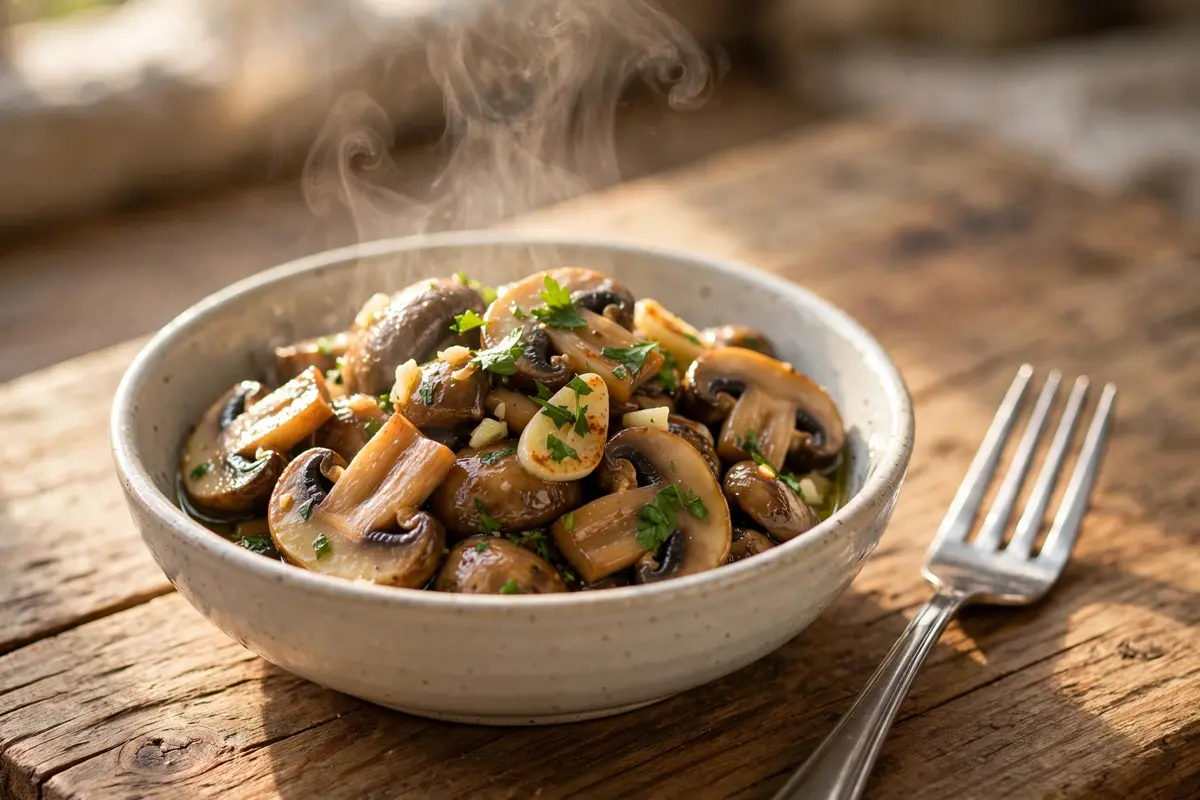
Mushroom pasta sauce uses the microwave as a pre cook. Microwave sliced mushrooms, drain them, then fold them into a hot tomato or cream sauce and simmer for 2 to 3 minutes. The microwave step firms the mushrooms just enough that they hold their shape in the sauce, instead of releasing all their water into it. For a mushroom soup, the same method works: microwave, drain lightly, keep a little of the liquid for flavour, and add the mushrooms to hot broth with herbs.
Mushroom and cheese toast is a good use for mushrooms that are tender but not browned. Microwave the slices, drain them, spoon them over toast, top with grated cheese, and grill or toast briefly until the cheese melts. The short grill step gives the browning the microwave could not, and the toast stays crisp because the mushrooms were drained first.
Mushroom rice bowl is a forgiving leftover meal. Warm leftover mushrooms in short bursts, stir well, check the temperature, then serve them over rice with a sauce and vegetables. The rice and sauce carry the dish, so softer reheated mushrooms work fine here, and the bowl is a good way to use a portion that would be disappointing on its own as a side dish.
Common mistakes to avoid
The most common mistake is microwaving mushrooms in a pile, in a deep bowl, with no stir. The pile steams unevenly, the centre stays cool, and no timer can fix either problem. Spread the pieces out, use a wide bowl, and stir once. Those three steps prevent most microwaved mushroom failures.
The second mistake is using one time for all mushroom types. Button mushrooms need 2 to 3 minutes, portobello slices need 3 to 4 minutes, and enoki strands need under a minute. Treating enoki like portobello gives you mush. Treating portobello like enoki gives you firm, half cooked caps. Match the time to the type, every time.
The third mistake is skipping standing time. Mushrooms checked straight out of the microwave will read hot at the edge and cool in the centre, and the cook will add another minute that toughens the edge further. Stand for 1 to 2 minutes, covered, then check again. Standing time is not wasted time, it is part of the cooking.
The fourth mistake is seasoning before draining. Salt and sauce added to a bowl full of mushroom liquid season the liquid, not the mushrooms, and the dish tastes watery even when the mushrooms themselves are fine. Drain first, season hot, and toss at once. That order alone improves most microwaved mushroom dishes.
The fifth mistake is expecting browning from the microwave alone. The microwave heats water, it does not brown surfaces. If you want browned mushrooms, finish them in a pan, oven, or air fryer. Judging microwaved mushrooms by browning alone will always disappoint, because you are judging them by a job they were never meant to do.
Quick checklist before you press start
Use this checklist when you are in a hurry. Mushrooms cleaned, sliced evenly, spread in a single layer in a microwave safe glass or ceramic bowl. Bowl covered loosely, with a vent. Button or cremini mushrooms on high in short bursts with a stir. Standing time of 1 to 2 minutes. Liquid drained before seasoning. Leftovers checked to 165 degrees Fahrenheit in several places. Leftovers stored promptly in a covered container in the fridge. No can, no metal, no sealed container in the microwave.
If any step is missing, pause and fix it before heating. A missing stir means cold spots. A sealed cover means steam pressure. A can in the microwave means a container risk. The checklist takes five seconds to run through, and it prevents almost every microwaved mushroom failure.
For the full microwave guide, start with the money page: Can You Microwave It? The Complete Guide. It links the whole series, including containers, foods, and safety guides, and it is the best place to check a new food before you microwave it. For a cheesy mushroom topping, short bursts beat one long heat when melting cheese, which helps when mushrooms and cheese share a dish.
Frequently asked questions
These are the questions readers ask most about microwaving mushrooms, with a short direct answer first in each case, then the detail you need to get it right.
Can you microwave mushrooms?
Yes. You can microwave mushrooms safely in a microwave safe glass or ceramic bowl, sliced evenly, covered loosely, in short bursts with a stir halfway through. For 8 ounces of sliced button or cremini mushrooms, allow 2 to 3 minutes total on high in a 1000 watt microwave, plus 1 to 2 minutes of standing time, and drain the liquid before seasoning.
How long do you microwave mushrooms?
Sliced button or cremini mushrooms usually take 2 to 3 minutes total on high for an 8 ounce batch, with a stir after the first minute. Portobello slices take 3 to 4 minutes, shiitake caps take 3 to 4 minutes, oyster mushrooms take about 2 minutes, and enoki strands take 45 to 60 seconds. Start at the lower end, check tenderness, and add 30 second bursts only if needed.
Do you cover mushrooms in the microwave?
Cover them loosely, with a microwave safe lid left ajar, an inverted plate, or a damp paper towel, so steam is trapped for even cooking but can still escape. A sealed cover risks steam pressure, and no cover at all gives drier edges and less even cooking. If you want a drier finish, drain well after cooking and finish in a hot pan, rather than skipping the cover.
Can you microwave whole mushrooms?
Yes, if they are small and even in size, but slice large mushrooms for even cooking. A whole portobello cap should be flipped halfway through, because its thick centre cooks slower than its thin edge. Whole mushrooms can also trap steam, so pierce or slice any very large cap, and check the centre for tenderness before serving.
Why do my microwaved mushrooms turn out soggy?
Soggy mushrooms are usually crowded, seasoned before draining, or served in their cooking liquid. Spread the pieces in a wide bowl, stir once, drain the liquid before seasoning, and season while the mushrooms are hot. If they are already soggy, drain them and finish them in a hot pan for 1 to 2 minutes, which drives off surface water.
Why do my microwaved mushrooms turn rubbery?
Rubbery mushrooms are usually overcooked. Too much time on high drives water out and tightens the mushroom structure, leaving a dense, squeaky texture. Prevent it with short bursts, a stir halfway through, and stopping at the first sign of tenderness. Rubbery mushrooms can be softened in hot soup or sauce, but they will not return to a fresh tender texture.
Can you microwave frozen mushrooms?
Yes. Microwave frozen sliced mushrooms from frozen, covered loosely, for about 3 to 4 minutes total for an 8 ounce batch, stirring halfway through, then drain very well before use. Frozen mushrooms release more water than fresh ones, so they suit soups, sauces, and fillings better than a side dish where a firm bite matters.
Can you microwave canned mushrooms?
Yes, for a short reheat only. Drain canned mushrooms well, place them in a microwave safe bowl, cover loosely, and heat for 30 to 45 seconds, stir, and check that they are hot throughout. Do not microwave them in the can, and do not heat them in the canning liquid unless you want a very watery result.
Is it safe to reheat mushrooms in the microwave?
Yes, if they were stored correctly. Refrigerate cooked mushrooms within 2 hours, use them within 3 to 4 days, and reheat them to 165 degrees Fahrenheit throughout, with stirring and standing time. The old warning that reheating mushrooms creates toxins is not supported by food safety guidance. The real risk is mushrooms left at room temperature for hours, which should be discarded, not reheated.
Can mushrooms spark in the microwave?
Sparking is rare with clean, damp, shop bought mushrooms, but it can happen with dry material carrying grit or mineral rich residue, because there is little water to absorb the microwave energy. If you see sparks, stop at once, check for grit, wash the mushrooms properly, and add a splash of water if the bowl is dry. Repeated sparking with a clean damp bowl means the oven should be checked.
Should you wash mushrooms before microwaving?
Yes, a quick rinse or a wipe is enough. Rinse briefly under cold water and pat dry, or wipe with a damp cloth, to remove soil without waterlogging the mushrooms. Do not soak mushrooms in a bowl of water, because soaking makes them soggy. A quick rinse does not ruin texture, and it also removes grit that can cause sparking.
Can you microwave mushrooms with butter or garlic?
Yes. A small knob of butter or a little oil can be added at the start, but butter tossed through hot drained mushrooms gives a better result, because butter added early melts into the cooking liquid and drains away with it. Add garlic and herbs after draining, toss while hot, and finish with salt, so the seasoning stays on the mushrooms.
Do microwaved mushrooms lose nutrients?
Microwaving is a gentle method for nutrients, because it is fast and uses little or no added water, so water soluble vitamins are less likely to leach away than in boiling. The bigger nutrition factors are the butter, salt, and sauce you add, not the heating method. A light seasoning and vegetables alongside the mushrooms keep the dish lighter than a heavy, salty sauce, whatever method you use.
Can you microwave dried mushrooms?
Not dry. Soak dried mushrooms in hot water for 20 to 30 minutes until soft, drain and squeeze out excess water gently, then microwave the rehydrated mushrooms for 2 to 3 minutes, checking early. Microwaving dried mushrooms dry will scorch them and leave them tough. Save the strained soaking liquid for soup or risotto, because it carries a lot of mushroom flavour.
Microwaved mushrooms will not replace a pan full of browned mushrooms, and they do not need to. They are a fast, honest method for tender mushrooms in a filling, a sauce, or a quick side dish, and they work best when you respect their water content instead of fighting it. Slice evenly, cover loosely, stir once, stop at tenderness, drain before seasoning, and finish in a pan when browning is the point. Follow that order, and the microwave becomes a useful mushroom tool, not a shortcut that ruins a good ingredient.

1 Comment
Pingback: Can You Microwave Spinach? Times and Safety