

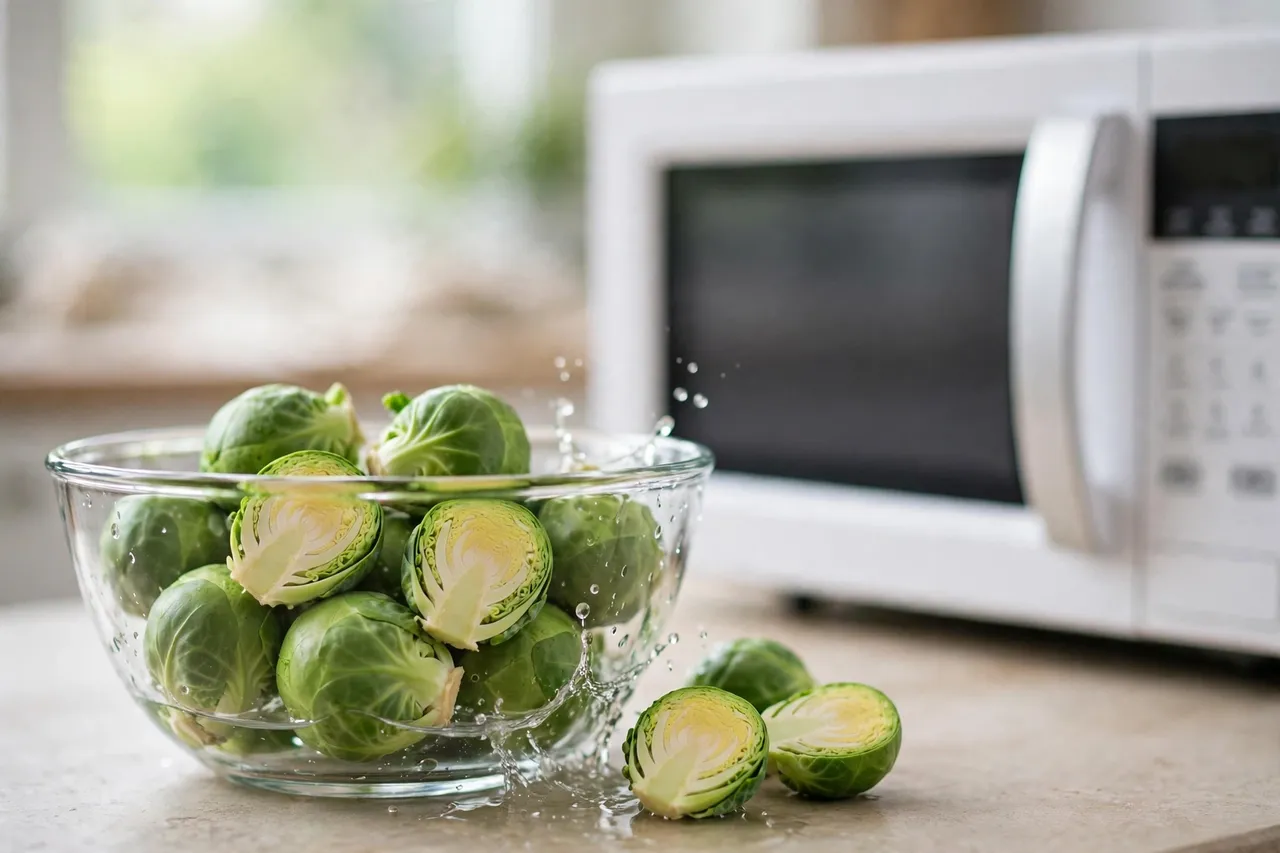
Yes, you can microwave Brussels sprouts, and for a small batch it is one of the fastest ways to get a tender, bright green side dish on the table. Halved sprouts cook in about 4 to 6 minutes on high, whole sprouts take 5 to 8 minutes, and frozen sprouts need about 6 to 8 minutes, all with just a splash of water and a loose cover. The microwave steams them in their own moisture, so you skip the pot, the steamer basket, and most of the cleanup. The method is simple, but the details matter: whole sprouts can pop open with a loud bang, times vary a lot between microwaves, and one extra minute can turn firm sprouts into mush. This guide covers the step by step method, timing charts by size and wattage, frozen sprouts, the exploding problem, the sulfur smell, soggy fixes, seasoning ideas, and the safety rules that keep every batch safe.
Can You Microwave Brussels Sprouts? The Short Answer
Yes. Trim the stem ends, peel off any yellow or loose outer leaves, and cut larger sprouts in half through the stem end. Place them in a microwave-safe dish, add 2 to 3 tablespoons of water, and cover loosely with a microwave-safe lid or plate. Cook on high for 4 to 6 minutes for halved sprouts, or 5 to 8 minutes for whole sprouts, stirring once halfway through. Let the dish rest for 1 minute with the cover on, then pierce a sprout with a fork. It should slide in with light resistance and the sprout should still look bright green. If it feels firm, add 30-second bursts until it is tender. Drain any leftover water, season, and serve right away.
That short answer works in most home kitchens, but the range of times you see online is wide for a reason. Some guides say 3 minutes, others say 8 to 10 minutes, and both can be right in their own kitchen. Sprout size, how many you cook at once, starting temperature, and microwave wattage all change the result. A cup of small halved sprouts in a 1200-watt oven can be done in 3 minutes, while a pound of large whole sprouts in a 700-watt oven can need 8 minutes or more. The rest of this guide gives you starting times plus the checks that tell you when the sprouts are actually done, so you are not guessing.
Why the Microwave Works Well for Brussels Sprouts
Brussels sprouts are a good match for microwave cooking because they are dense, tightly layered, and full of water. Microwaves heat by exciting water molecules, so a sprout steams itself from the inside out when you trap that moisture under a cover. You use only a few tablespoons of water instead of a full pot, which means less of the flavor and fewer of the water-soluble nutrients wash away. Cooking guides from university extension services, including the Utah State University guide to Brussels sprouts, list microwaving as one of the standard ways to cook them, right next to boiling, steaming, and roasting.
The speed is the other big win. Roasting takes 25 to 30 minutes plus oven preheating, and boiling takes 10 minutes plus the time to bring a pot of water to a boil. The microwave does the same job in under 8 minutes with one dish to wash. That makes it the practical choice on a weeknight, for a single serving, or when the oven and stove are already busy with the rest of dinner. The trade-off is real, though: a microwave cannot brown or crisp the leaves the way an oven can, and it punishes overcooking fast. A sprout goes from tender to mushy in about a minute, and overcooked sprouts release the sulfur smell that gives this vegetable its bad reputation. Short bursts and a fork check are what keep the method working.
How to Microwave Brussels Sprouts Step by Step
Start by picking sprouts that feel firm and heavy for their size, with tight green leaves and no yellow patches. Loose, yellowing leaves mean the sprout is old and will taste more bitter. Rinse them under cold water and shake off the excess. Trim a thin slice off the stem end, about a quarter inch, and pull off any outer leaves that are yellow, wilted, or damaged. If the sprouts are larger than a walnut, cut them in half lengthwise through the stem end so the two halves stay attached at the base and cook evenly. Small sprouts, about an inch across, can stay whole.
Put the sprouts in a wide, shallow microwave-safe dish, glass or ceramic works best, and spread them in a single layer if you can. Crowding them more than two layers deep leaves the middle sprouts raw while the edges overcook, so cook in two batches if you have more than a pound. Add 2 to 3 tablespoons of water for a pound of sprouts, less if the sprouts are still wet from rinsing. The water is there to make steam, not to boil the sprouts, so do not pour in a cup. Cover the dish loosely with a microwave-safe lid, a plate, or vented plastic wrap. The cover should sit on top without sealing tight, because steam needs a way out.
Microwave on high and start with the short end of the time range for your batch. For halved fresh sprouts, start at 4 minutes. For whole fresh sprouts, start at 5 minutes. Stop halfway, carefully lift the cover away from your face so the steam escapes away from you, and stir or shake the dish so the sprouts on the edge move toward the middle. Put the cover back and finish the time. When the timer ends, leave the dish covered for 1 minute. That rest lets the heat even out and finishes the steam. Then drain the water, season with salt, pepper, and a little butter or olive oil, and serve while the sprouts are still bright green.
Microwave Times for Brussels Sprouts
Times depend on sprout size, quantity, and your microwave wattage. The chart below assumes a 1000-watt microwave and a covered microwave-safe dish. If your microwave is 700 watts, add about 1 to 2 minutes. If it is 1200 watts, start at the low end of each range and check early. Always check with a fork rather than trusting the clock alone, because sprouts vary more than most vegetables.
| Batch | Water | Time on high (1000W) | Notes |
|---|---|---|---|
| 1 cup halved fresh sprouts | 1 to 2 tablespoons | 3 to 4 minutes | Check at 3 minutes, stir once |
| 2 cups halved fresh sprouts | 2 tablespoons | 4 to 5 minutes | Stir halfway through |
| 1 pound whole fresh sprouts | 3 tablespoons | 6 to 8 minutes | Halve large ones, stir every 2 minutes |
| 1 pound halved fresh sprouts | 2 to 3 tablespoons | 5 to 7 minutes | Stir halfway through, rest 1 minute |
| 2 cups frozen sprouts | 1 tablespoon | 6 to 8 minutes | No thawing, drain well after cooking |
| 1 pound frozen sprouts | 1 to 2 tablespoons | 8 to 10 minutes | Stir halfway, check for icy centers |
Notice how much the numbers move between sources. One recipe blog says 3 to 5 minutes for fresh sprouts, another says 5 to 7 minutes, and a third says 8 to 10 minutes for whole sprouts. The gap comes from different batch sizes, different wattages, and different ideas of done. A recipe that cooks one cup of halved sprouts in a 1200-watt oven will always be faster than a guide that cooks a full pound of whole sprouts in a 700-watt oven. Use the chart as a starting point, then let the fork decide. A sprout is done when a fork slides into the stem end with light pressure and the center is tender but still holds its shape.
Can You Microwave Frozen Brussels Sprouts?
Yes, frozen Brussels sprouts microwave well, and you do not need to thaw them first. Most frozen sprouts are blanched before freezing, which means they are already partly cooked, so they need less time than you might expect. Place them in a microwave-safe dish, add just 1 tablespoon of water, cover loosely, and cook on high for 6 to 8 minutes for two cups, or 8 to 10 minutes for a full pound. Stir halfway through so the sprouts on the edge, which heat fastest, do not turn to mush while the middle ones are still icy.
Skip the extra water that fresh sprouts need. Frozen sprouts release a lot of moisture as they thaw, and adding a full splash of water leaves them sitting in a puddle, which is the fastest route to a soggy result. After cooking, drain the dish well and let the sprouts rest for 1 minute before seasoning. If they taste watery, spread them on a plate for a minute so the surface steam escapes, or finish them for 2 minutes in a hot skillet with a little oil. That quick pan finish also fixes the other weakness of frozen sprouts, which is a soft texture. The microwave does the cooking, and the skillet adds the little bit of browning that makes them taste like they were roasted.
Frozen sprouts are also the easiest option for a single serving. A handful in a mug or small bowl, a tablespoon of water, a small plate on top, and 3 to 4 minutes on high gives you a hot side dish with almost no cleanup. Just make sure the mug is microwave-safe and has no metallic trim, and do not fill it more than two-thirds full, because the sprouts swell slightly and the water can bubble over.
Why Brussels Sprouts Can Pop or Explode in the Microwave
Whole Brussels sprouts can pop, burst, or even explode in the microwave, and the reason is trapped steam. A sprout is a tight ball of layered leaves with a dense core, and when the water inside heats up, it turns to steam faster than it can escape through those layers. Pressure builds inside until the leaves give way, usually with a loud pop and a spray of hot sprout pieces. It is the same physics that makes whole potatoes, eggs in their shell, and whole grapes pop in a microwave, and it is the reason food safety guides tell you to pierce or cut foods with skins before microwaving them.
The fix is simple and it is the single most important step in this whole guide: cut large sprouts in half, and score or pierce whole ones. Halving a sprout through the stem end opens the layers and gives steam a direct path out, which is why halved sprouts almost never pop. If you want to cook small sprouts whole, cut a small cross in the stem end with the tip of a knife, about a quarter inch deep. That tiny vent is enough to release pressure. Cooking at full power in short bursts also helps, because it heats the sprout more gently than one long blast. And never seal the dish tight. A cover that is clamped down traps steam in the dish as well as in the sprouts, and when that seal finally gives way it can blow the cover off. Leave a gap or use a vented lid every time.
If a sprout does pop, do not panic. Switch the microwave off, wait a minute for the steam to settle, and open the door carefully. The mess is usually small, a few leaves and some water, and the sprouts that stayed intact are still fine to eat. Wipe the inside of the microwave before the splatter dries, because dried sprout residue burns and adds a bad smell to the next thing you cook. The pop is a warning, not a disaster, and it tells you to halve the next batch.
Why Do Microwaved Brussels Sprouts Smell So Strong?
Brussels sprouts belong to the cruciferous family, along with broccoli, cauliflower, cabbage, and kale, and all of them contain sulfur compounds called glucosinolates. When you cut or heat a sprout, those compounds break down and release sulfur gases, including hydrogen sulfide, which is the same gas that gives rotten eggs their smell. The longer and hotter you cook a sprout, the more of those gases escape. That is why a batch that cooks for 4 minutes smells mild and green, while a batch that cooks for 10 minutes can clear a room.
Overcooking is the main cause of the smell, and it is also the main cause of the bitter taste people complain about. The sulfur compounds are heat sensitive, so short cooking at high power releases far less gas than long cooking at any power. Cooking in plenty of water makes it worse too, because the compounds dissolve into the water and then steam out of the dish in a cloud. Using only a few tablespoons of water and a loose cover keeps most of the gas inside the dish until you lift the lid, and opening the lid near the stove vent or an open window helps a lot.
Freshness matters as well. Older sprouts that have sat in the fridge for a week or more have already started breaking down, so they release more sulfur gas when heated. Buy sprouts that feel firm with bright green, tightly packed leaves, and cook them within three to four days. A squeeze of lemon juice or a splash of vinegar after cooking also helps, because acid softens the sulfur taste on your tongue. And if the smell lingers in the microwave, heat a bowl of water with a few lemon slices for 2 minutes, let it sit for 5 minutes, then wipe the inside clean. That clears the smell from the cavity in one step.
How to Keep Brussels Sprouts From Going Soggy or Mushy
Soggy sprouts are the most common complaint about microwaving them, and the cause is almost always too much water or too much time. Brussels sprouts need only a little water to steam, and any water left in the dish after cooking keeps cooking them while they sit. Use 2 to 3 tablespoons for a pound of fresh sprouts, and only 1 tablespoon for frozen sprouts. Drain the dish the moment the rest period ends. Do not leave the sprouts sitting in hot water while you finish the rest of dinner.
Batch size matters just as much. A single layer of sprouts in a wide dish steams evenly, but a deep pile traps water at the bottom and leaves the sprouts on top undercooked while the ones underneath turn to mush. Keep the layer no more than two sprouts deep, and cook a second batch if you need more. Stirring halfway through also evens things out, because microwaves heat the edges of a dish faster than the center. Move the edge sprouts toward the middle and the middle sprouts toward the edge, and the whole batch finishes at the same time.
The last trick is the rest period. One minute with the cover on lets the heat even out, but five minutes with the cover on turns tender sprouts into soft ones, because the trapped steam keeps cooking them. Set a timer for the rest, drain the water, and spread the sprouts on a plate or in a serving bowl so the steam can escape. If they still feel soft, a quick finish in a hot skillet with a little oil for 2 minutes firms up the outside and adds flavor at the same time. That two-step method, microwave first and skillet second, is how many cooks get sprouts that taste roasted with a fraction of the time.
Can You Get Crispy Brussels Sprouts From a Microwave?
Honestly, no, not from the microwave alone. Crispiness comes from the Maillard reaction, the browning that happens when food hits dry heat above about 300 degrees Fahrenheit, and a microwave cooks with steam, not dry heat. The inside of a microwave never gets hot enough or dry enough to brown a leaf. Any recipe that promises crispy sprouts straight from the microwave is overselling the method, and you will be disappointed if you expect roasted edges from a steamed sprout.
What you can do is use the microwave as a shortcut and finish the sprouts somewhere hot. Microwave halved sprouts for 3 minutes, just until they start to soften, then toss them with a little oil and salt and spread them cut side down in a screaming hot cast-iron skillet for 2 minutes per side. The skillet gives you the brown, caramelized faces that a microwave cannot, and the whole dish still takes under 10 minutes. The same trick works under a broiler for 3 to 4 minutes, or in an air fryer at 400 degrees for 4 to 5 minutes. The microwave does the slow, even cooking, and the hot surface does the fast browning, and together they beat either method on its own.
If you skip the finish and serve the sprouts straight from the microwave, lean into what the method does well. Season them boldly with garlic butter, parmesan, lemon, or a balsamic glaze, and serve them hot. A well-seasoned steamed sprout tastes clean and sweet, and it is a perfectly good side dish on its own. It just is not a roasted sprout, and pretending otherwise sets the wrong expectation.
Common Problems and Fixes
Almost every Brussels sprout failure in the microwave comes down to one of five causes, and each one has a simple fix. The table below covers the problems readers report most often, including the ones that show up in forum threads and recipe comments again and again. If your batch went wrong, find the symptom here and change one thing next time, not five. Changing one variable at a time is how you learn your own microwave, and once you know it, every batch after that is easy.
| Problem | Likely cause | Fix |
|---|---|---|
| Sprouts pop or burst | Whole sprouts with no steam vent | Halve large sprouts or cut a cross in the stem end |
| Strong sulfur smell | Overcooked, or old sprouts | Cook 1 to 2 minutes less, use fresh sprouts, add lemon after cooking |
| Soggy, watery sprouts | Too much water, or left sitting in the dish | Use 2 to 3 tablespoons only, drain right after the 1-minute rest |
| Mushy outside, raw center | Batch too deep, or no stirring | Single layer, stir halfway, cook in 30-second bursts at the end |
| Bitter taste | Overcooked, or old and yellowing sprouts | Stop at tender-crisp, buy firm green sprouts, balance with salt and acid |
| Uneven cooking | Mixed sizes in one batch | Sort by size, halve the large ones, quarter the very large ones |
| Smell lingers in the microwave | Splatter and steam residue on the walls | Heat lemon water for 2 minutes, wipe the cavity clean |
One more problem deserves a mention because it confuses a lot of first-time cooks: the sprouts look done on the outside but feel hard in the middle. That usually means the sprouts were very large or very cold from the fridge, and the outside steamed while the core stayed cool. Halving solves it most of the time, because the cut face lets heat reach the center directly. For very large sprouts, quarter them. And always let the dish rest for a minute after cooking, because the heat keeps moving toward the center during that rest, which evens out the last bit of firmness without any extra microwave time.
Seasoning and Serving Ideas
Plain steamed Brussels sprouts need salt. Add it after cooking, not before, because salt draws moisture out of the leaves while they cook and can leave them soggy. A pinch of flaky salt, a crack of black pepper, and a knob of butter melting over the hot sprouts is the simplest finish, and it is the one most people come back to. Olive oil works the same way, and a squeeze of lemon at the end brightens the flavor and softens any lingering sulfur taste.
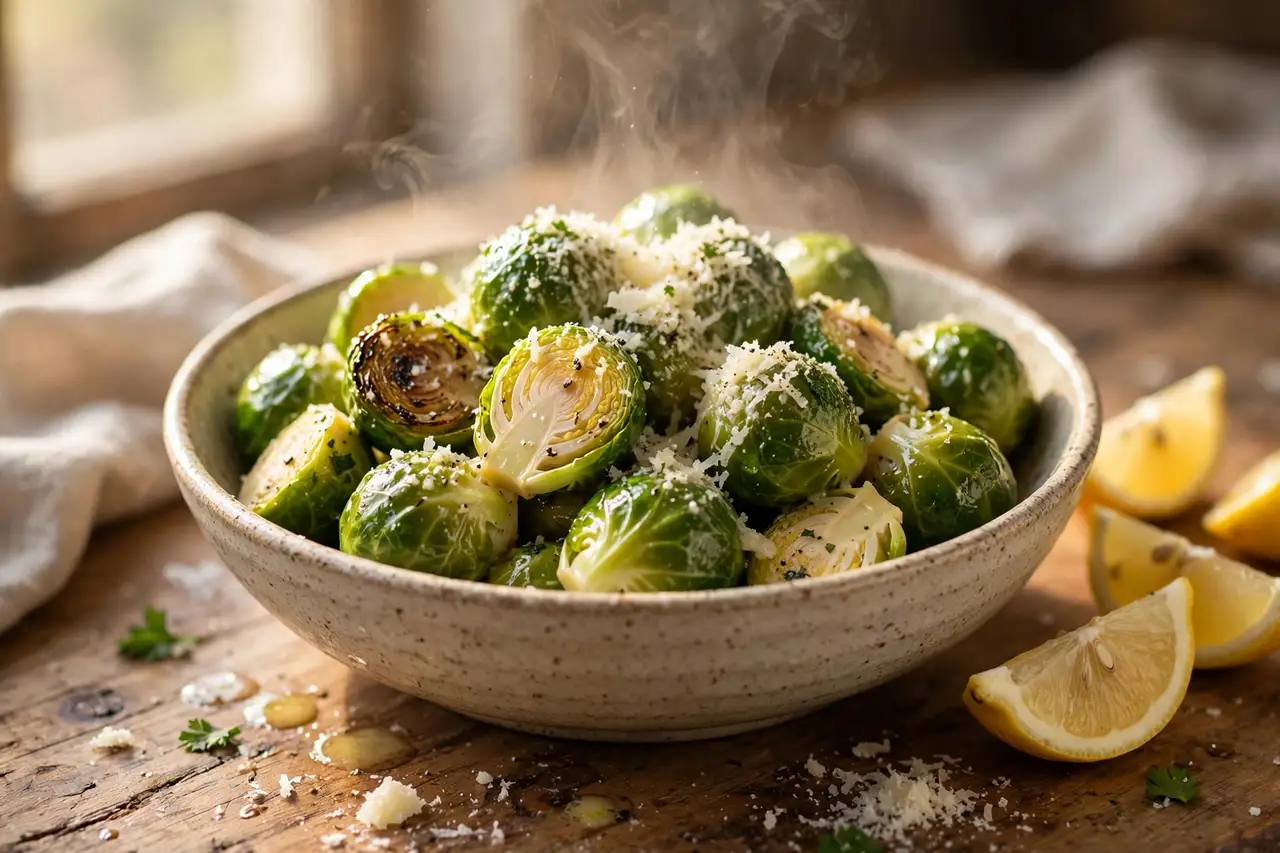
For a richer side dish, toss the hot sprouts with grated parmesan and a little garlic butter, then microwave for 30 seconds more so the cheese just melts. A drizzle of balsamic glaze adds sweetness that balances the natural bitterness of the sprout, and a spoonful of honey mustard does the same job with a little tang. Bacon is the classic partner: cook crumbled bacon separately, then fold it through the sprouts with a splash of the bacon fat. That combination is popular for a reason, and it turns a plain vegetable into the dish people ask about at holiday dinners.
Brussels sprouts also fit well next to the other microwave vegetables in this guide. They pair with microwave baked potatoes and corn on the cob for a fast weeknight plate, and they sit nicely beside roast chicken, pork chops, or a simple pasta dinner. If you are planning a holiday meal, microwave the sprouts first and finish them in the skillet while the turkey rests, so they arrive at the table hot and browned without taking oven space. For more microwave cooking ideas across vegetables and containers, start with our microwave safety and method guide, which covers the rules that apply to every food in this series.
Storing and Reheating Leftover Brussels Sprouts
Cooked Brussels sprouts keep in the fridge for 3 to 4 days in an airtight container. Let them cool to room temperature before you put the lid on, because sealing them while they are still steaming traps moisture and makes them soggy by the next day. Spread them in a single layer in the container if you can, and do not add dressing or sauce until you serve them. Sauces soak into the leaves overnight and turn the sprouts soft.
To reheat, microwave them in 30-second bursts on high, stirring between bursts, until they are just hot through. One minute is usually enough for a single serving. Do not reheat them for the full original cooking time, because that cooks them a second time and pushes them straight into mush. A better option for leftovers is a hot skillet with a little oil for 2 to 3 minutes, which warms them through and firms the outside back up. Avoid reheating sprouts more than once, because each round of heating releases more sulfur smell and softens the texture further.
Freezing cooked sprouts is possible but not recommended, because the texture after thawing is soft and watery. If you do freeze them, spread them on a tray to freeze individually first, then move them to a bag. They keep for 2 to 3 months. Raw sprouts freeze better than cooked ones: blanch them for 3 minutes, cool them in ice water, drain well, and freeze in portions. You can microwave those straight from the freezer later, using the frozen times in the chart above. For general frozen vegetable timing, our guide to microwaving frozen vegetables covers the same rules in more detail.
Brussels Sprouts vs Broccoli and Cauliflower in the Microwave
Brussels sprouts, broccoli, and cauliflower are close cousins, and they share the same microwave method: a splash of water, a loose cover, high power, and short bursts. The differences are in timing and in what goes wrong. Broccoli florets cook fastest, about 3 to 4 minutes for a pound, because the thin florets have a lot of surface area and very little dense core. Cauliflower is in the middle at 4 to 6 minutes, because the florets are denser than broccoli but still looser than a sprout. Brussels sprouts are the slowest of the three, at 5 to 8 minutes for whole sprouts, because each sprout is a tight, dense ball with a thick core that heat has to reach.
The failure modes differ too. Broccoli goes limp and loses its bright green color when overcooked, but it rarely pops. Cauliflower turns soft and watery and can smell strongly if cooked too long. Brussels sprouts are the only one of the three that can actually burst, because their layered ball shape traps steam better than an open floret. That is why halving matters for sprouts in a way it does not for broccoli or cauliflower. If you already know how to microwave cauliflower, you know the method for sprouts, just add 1 to 2 minutes and always cut the big ones in half.
Nutrition is similar across the three. All of them keep most of their vitamin C and folate when microwaved briefly with little water, because short cooking and minimal water are exactly what protects water-soluble vitamins. Boiling the same vegetables in a full pot leaches far more into the water, which is then poured away. If you want the healthiest version of any of them, the microwave is a strong choice, as long as you stop at tender-crisp and do not cook them into softness.
Safety Rules to Follow Every Time
Microwaves are safe when you use them as designed, but Brussels sprouts add a few specific risks that are worth taking seriously. The first is steam burns. A covered dish full of hot sprouts releases a cloud of steam the moment you lift the lid, and that steam is hot enough to burn your hand or face. Always lift the cover away from you, tilt it so the steam escapes on the far side, and use oven mitts or a towel to hold the dish. The dish itself stays hot for several minutes after cooking, so set it on a trivet or a folded towel, not straight onto a cold countertop, which can crack glass.
The second rule is about containers. Use only dishes labeled microwave-safe, and never use metal, foil, or containers with metallic trim. Foam takeout trays, cold-storage tubs, and single-use plastic containers are not made for microwave heat and can warp, melt, or release chemicals into food. The USDA Food Safety and Inspection Service guide to cooking safely in the microwave covers the container rules and the stirring and resting steps that prevent cold spots, and the Clemson Extension microwave food safety factsheet gives the same guidance in a short, practical form. For Brussels sprouts specifically, the Utah State University Extension guide to Brussels sprouts lists microwaving as a standard cooking method and gives a starting time of about 4 minutes for half a pound in a covered dish with a quarter cup of water.
The third rule is about even heating. Microwaves heat unevenly and leave cold spots, so always stir halfway through and rest the dish for a minute after cooking. Plain sprouts are not a high-risk food, because they are a plain vegetable with no meat or eggs involved, but the stirring and resting habit matters for every microwave dish and it costs nothing. Finally, if you ever see sparking, smell burning, or hear a loud bang that is not a single sprout popping, switch the microwave off, keep the door closed, and unplug it. Sparking usually means metal got into the cavity or the waveguide cover is damaged, and that is a job for a repair technician, not a home fix.
Frequently Asked Questions
These are the questions people ask most about microwaving Brussels sprouts, answered directly. Each answer starts with the short version, then adds the detail you need.
Can you microwave Brussels sprouts?
Yes, you can microwave Brussels sprouts. Halve large sprouts, place them in a microwave-safe dish with 2 to 3 tablespoons of water, cover loosely, and cook on high for 4 to 8 minutes depending on size. Stir halfway through and rest for 1 minute before serving.
How long do you microwave Brussels sprouts?
Halved fresh sprouts take 4 to 6 minutes on high in a 1000-watt microwave. Whole fresh sprouts take 5 to 8 minutes. Frozen sprouts take 6 to 10 minutes. Start at the low end of the range and add 30-second bursts until a fork slides into the stem end easily.
Can you microwave frozen Brussels sprouts?
Yes, you can microwave frozen Brussels sprouts without thawing them. Use only 1 tablespoon of water, cover loosely, and cook for 6 to 8 minutes for two cups or 8 to 10 minutes for a pound. Stir halfway through and drain well after cooking, because frozen sprouts release a lot of water.
Do Brussels sprouts explode in the microwave?
Whole Brussels sprouts can pop or burst in the microwave because steam builds up inside their tight layers faster than it can escape. Halving large sprouts or cutting a small cross in the stem end gives the steam a way out and almost always prevents popping. Never cook them in a tightly sealed container.
Why do microwaved Brussels sprouts smell so bad?
Brussels sprouts contain sulfur compounds called glucosinolates, which release hydrogen sulfide gas when heated. Overcooking releases far more of this gas than short cooking, so the smell is strongest when sprouts cook too long. Cook them briefly, use fresh sprouts, and add lemon juice after cooking to soften the smell and taste.
Can you microwave Brussels sprouts without water?
You can, but the result is usually dry and uneven. A few tablespoons of water create the steam that cooks the sprouts evenly and keeps them tender. Without water, the outer leaves dry out and turn leathery while the centers stay firm. Freshly washed sprouts with water still clinging to them are the one exception, because that surface water is enough to make steam.
Should you cut Brussels sprouts in half before microwaving?
Yes, cut any sprout larger than a walnut in half lengthwise through the stem end. Halving helps them cook evenly, stops them from popping, and cuts about 1 to 2 minutes off the cooking time. Small sprouts about an inch across can stay whole, but score a small cross in the stem end first.
Can you microwave Brussels sprouts in a plastic bag or steamer bag?
Yes, if the bag is labeled microwave-safe and designed for steaming. Follow the time on the package and do not seal the bag completely, because steam needs a vent. Do not use ordinary sandwich bags, zip bags, or grocery bags, because they are not made for microwave heat and can melt or release chemicals into the food.
How do you keep Brussels sprouts from getting soggy in the microwave?
Use only 2 to 3 tablespoons of water for fresh sprouts and 1 tablespoon for frozen ones. Cook in a single layer, stir halfway through, and drain the dish as soon as the 1-minute rest ends. Do not leave the sprouts sitting in hot water, and do not cover them for longer than the rest period.
Can you microwave Brussels sprouts the day before and reheat them?
Yes, you can cook them a day ahead and keep them in an airtight container in the fridge. Reheat in 30-second bursts on high, stirring between bursts, until just hot through. One minute is usually enough for a single serving. Reheating in a hot skillet for 2 to 3 minutes gives a better texture than a second round in the microwave.
Are microwaved Brussels sprouts healthy?
Yes, microwaved Brussels sprouts are a healthy choice. Short cooking with little water preserves more vitamin C and folate than boiling in a full pot, because fewer nutrients wash into the cooking water. The microwave method adds no fat on its own, so the health of the dish depends on what you add after cooking, like butter, oil, or cheese.
Can you microwave Brussels sprouts with bacon or cheese?
Yes, but cook the bacon separately and add it after the sprouts are done, because bacon needs longer and renders fat that makes the sprouts greasy. For cheese, microwave the sprouts first, sprinkle grated parmesan or cheddar over the hot sprouts, and microwave for 30 to 60 seconds more until the cheese melts. Watch closely so the cheese does not burn.
Why are my microwaved Brussels sprouts bitter?
Bitterness usually comes from overcooking or from old sprouts. Overcooked sprouts release more bitter sulfur compounds, and older sprouts with yellow or loose leaves taste more bitter than fresh ones. Cook them only until tender-crisp, buy firm green sprouts, and balance the bitterness with salt, a squeeze of lemon, or a drizzle of balsamic glaze.
Can you microwave Brussels sprouts in a mug for one serving?
Yes, a mug works well for a single serving. Place a handful of halved sprouts in a microwave-safe mug, add 1 tablespoon of water, cover with a small plate, and cook on high for 3 to 4 minutes. Check with a fork and add 30-second bursts if needed. Do not fill the mug more than two-thirds full, and make sure it has no metallic trim.
Brussels sprouts have a reputation for being tricky, but in the microwave they are one of the easiest vegetables to cook well, as long as you respect the three rules that matter most. Halve the big ones so steam can escape, use only a few tablespoons of water so they steam instead of boil, and check with a fork early instead of trusting the clock. Get those three right and you get bright green, tender sprouts in under 8 minutes with one dish to wash. Cook them fresh, season them boldly, and serve them hot, and the vegetable that used to clear the room becomes the side dish people ask for again.
