

Yes, you can microwave carrots, and for a small side dish it is one of the fastest ways to get a tender vegetable on the table. Place 1 pound of carrots, peeled and sliced into even coins about 6 millimetres thick, in a microwave safe glass or ceramic dish, add 2 tablespoons of water, cover the dish loosely so steam can escape, and microwave on high for 4 to 6 minutes in a 1000 watt oven. Stir the carrots halfway through, let the dish stand covered for 1 to 2 minutes, then drain off any liquid and season while the carrots are still hot. They are ready when a fork slides in with slight resistance and the pieces still hold their shape, not when they have collapsed into a soft pile.
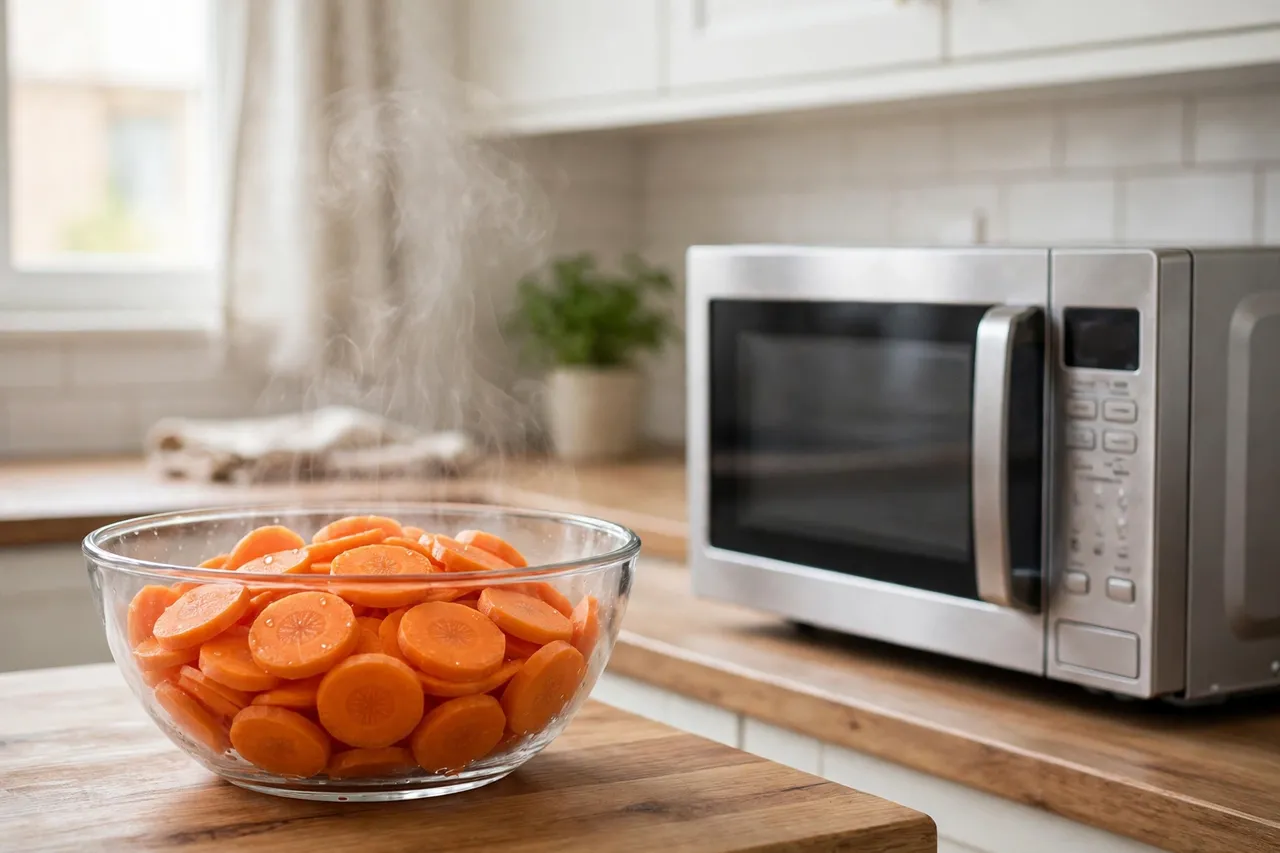
Carrots suit the microwave for a simple reason. They are dense, sweet, and full of water, so a covered dish turns into a small steamer and cooks them from the inside out in minutes. That speed is also the reason microwaved carrots disappoint so often. A minute too long turns tender coins mushy, too much added water turns them into a boiled vegetable, and uneven pieces cook at different speeds so one half of the dish is soft while the other half is still firm. None of those problems means the microwave is the wrong tool. They mean the method matters more than the timer, and the method in this guide is built around the three things that actually decide the result: even pieces, a small amount of water, and stopping early.
This guide gives you the method that works for the carrots most people buy, the times for sliced, stick, baby, whole, and frozen carrots, and honest answers to the questions that confuse people most. That includes how much water to add when guides disagree, whether you can microwave a whole carrot, why microwaved carrots turn soggy or rubbery, whether you should peel them or salt them first, how to reheat leftovers safely, and when the stove or the oven is the better tool. If you only need the quick answer, the short answer section and the step list are enough. If you want carrots that taste like you meant them, read the sections on water, slicing, and timing. For the wider picture of what microwaves well and what does not, see the complete microwave guide on this site.
Short answer: can you microwave carrots?
Yes. Microwave carrots in a microwave safe glass or ceramic dish, in even pieces, with a small amount of water, covered loosely so steam can escape, in short bursts with a stir halfway through. For 1 pound of sliced carrots, about 450 grams, use 4 to 6 minutes on high in a 1000 watt microwave, then let the dish stand covered for 1 to 2 minutes. For 2 cups of baby carrots, use 4 to 6 minutes on high and check at 4 minutes. For frozen sliced carrots, use 3 to 5 minutes on high with only 1 tablespoon of water, because frozen carrots are already softened from blanching before freezing. Drain off the liquid before you season, or the seasoning will sit in the puddle at the bottom of the dish instead of on the carrots.
Do not microwave carrots in a metal dish, in a sealed container, or in packaging that is not labelled microwave safe, and do not keep heating them in the hope that a hard centre will suddenly soften. Carrots go from tender to mushy in a short window, and extra minutes past that window only make them softer and drier. If the carrots are still firm after the standing time, add 30 seconds at a time and check after each burst. That habit, checking early and adding small bursts, is the single most useful habit in this whole guide.
The safety rules for microwaving carrots are the same rules that apply to most vegetables. The United States Department of Agriculture explains in its microwave cooking guidance that microwaves can heat unevenly and leave cold spots, so food should be arranged evenly, covered, stirred or rotated midway through cooking, and allowed to stand so heat spreads through the food before it is served. You can read that guidance in the USDA Food Safety and Inspection Service fact sheet on cooking safely in the microwave oven. Carrots are not meat, so they carry no minimum internal temperature of their own, but the same habits, even pieces, a cover, a stir, and a standing time, are what keep the result even and safe.
How to microwave carrots step by step
The method below works for fresh carrots in any common home microwave. It assumes a 1000 watt oven and a covered glass or ceramic dish. If your oven is weaker, use the upper end of the times. If it is stronger, start at the lower end and check early.
Start by choosing firm carrots that snap cleanly when you bend them. Limp carrots that have dried out in the crisper drawer will not rehydrate well in a quick steam, and they are the carrots most likely to taste rubbery no matter how carefully you time them. If your carrots are slightly bendy, soak them in cold water for 20 to 30 minutes first, then pat them dry. That small step revives the texture more than any timing trick.
Wash the carrots well under running water and scrub off any soil. Peeling is optional, and the choice is covered in detail later in this guide, but scrubbing is not optional. Peel if you prefer a smoother texture or if the skin looks rough or bitter. Leave the skin on if the carrots are young and tender and you have scrubbed them clean. Either way, trim off the green tops and any cracked or woody ends before you cut.
Cut the carrots into even pieces. This is the step people rush, and it is the step that decides whether the dish cooks evenly. Slice coins about 6 millimetres thick, or cut sticks of roughly the same thickness and length. If you mix thin coins with thick chunks in one dish, the thin pieces will turn to mush before the thick pieces are tender. When one carrot is much thicker than the others, cut the thick end into halves or quarters lengthwise first, then slice, so every piece is close to the same size.
Place the pieces in a single layer as far as possible in a microwave safe dish, and add 2 tablespoons of water for 1 pound of fresh sliced carrots. Cover the dish with a microwave safe lid left slightly ajar, a microwave safe plate set on top, or vented plastic wrap. The cover traps steam, which is what actually cooks the carrots, but the vent matters. A fully sealed dish builds up pressure and can splatter or burst open when you lift the lid.
Microwave on high for 2 minutes, then take the dish out with oven mitts, stir the carrots well, and put the dish back for another 2 minutes. After that second burst, check with a fork. If the fork slides in with slight resistance, stop. If the centres are still hard, add 1 minute, stir again, and check once more. The total for most 1 pound batches lands between 4 and 6 minutes, but your oven, your dish, and the thickness of your slices all move that number.
Let the dish stand covered for 1 to 2 minutes after the microwave stops. Standing time is not idle time. Heat keeps spreading from the hotter outer pieces to the cooler centres during those minutes, and the carrots finish cooking gently instead of being blasted into mush. Lift the lid away from your face when you open it, because trapped steam is hot enough to burn. Drain off any liquid, toss the carrots with butter, oil, salt, or herbs while they are hot, and serve at once.
Microwave times for carrots by cut and type
The table below gives starting times for a 1000 watt microwave with a covered dish. Treat every time as a starting point, not a promise. Check early the first time you cook a new cut, note what worked in your oven, and use that number next time. That personal number will beat any table, including this one.
| Carrot cut or type | Amount | Water | Time on high (1000 watts) |
|---|---|---|---|
| Thin coins, 6 millimetres thick | 1 pound (about 450 grams) | 2 tablespoons | 4 to 6 minutes |
| Sticks, about 6 millimetres thick | 1 pound (about 450 grams) | 2 tablespoons | 5 to 7 minutes |
| Baby carrots, whole | 2 cups (about 300 grams) | 2 tablespoons | 4 to 6 minutes |
| Whole medium carrots, halved lengthwise | 4 carrots | 2 tablespoons | 6 to 8 minutes |
| Whole medium carrots, uncut | 4 carrots | 2 to 3 tablespoons | 8 to 10 minutes |
| Frozen sliced carrots | 2 cups (about 300 grams) | 1 tablespoon | 3 to 5 minutes |
| Frozen baby carrots | 2 cups (about 300 grams) | 1 tablespoon | 4 to 6 minutes |
| Carrot coins for mashing | 1 pound (about 450 grams) | 2 tablespoons | 7 to 8 minutes |
Notice how wide the ranges are, and notice that other guides disagree with each other by even more. Some guides say sliced carrots take 3 to 4 minutes, others say 6 to 9 minutes for the same cut. For comparison, the Better Homes and Gardens test kitchen guide lists 6 to 9 minutes for quarter inch slices and 7 to 9 minutes for baby carrots, which sits at the long end of the range. Some say frozen carrots need less time because they are already blanched, others say they need more time because they start frozen. Both claims contain part of the truth, and that is why this guide keeps telling you to check early. The disagreement in published times is not a sign that anyone is lying. It is a sign that wattage, dish shape, piece size, and starting temperature all matter, and no single number can cover every kitchen.
The one pattern that holds across almost every guide is this: thin, even pieces cook fastest and most evenly, thick whole carrots cook slowest and least evenly, and frozen carrots behave differently from fresh ones because blanching has already softened their structure. Work with that pattern and your own fork test, and the exact minute count matters far less.
How much water should you add?
Water is the most argued detail in microwaved carrots, and the argument exists because both extremes fail in visible ways. Too little water, and the carrots dry out, toughen, and cook unevenly. Too much water, and the carrots boil instead of steam, which washes out flavour and leaves them soggy. The sweet spot for fresh sliced carrots is small: 2 tablespoons of water for 1 pound of carrots in a covered dish. That is enough to make steam without creating a pool for the carrots to sit in.
For baby carrots, use the same 2 tablespoons for 2 cups. For frozen carrots, use only 1 tablespoon, because frozen carrots release water as they thaw and cook, and because blanching before freezing has already softened them. If you add the full fresh amount to frozen carrots, you will end up draining a surprising amount of liquid and wondering where the flavour went. If you add no water at all to fresh carrots, the dish will still cook, but the edges will dry and toughen while the centres lag behind, and the texture will be noticeably worse.
The dish shape matters as much as the amount. A wide, shallow dish lets steam reach more pieces at once and cooks more evenly than a tall, narrow bowl where the bottom pieces stew and the top pieces steam. If you only have a deep bowl, stir twice instead of once, and spread the pieces out as much as the bowl allows. And whatever dish you use, drain the carrots the moment they reach tenderness. Carrots left sitting in hot liquid keep cooking and softening, and a dish that was perfect at the fork test can be mushy five minutes later.
One more water detail is worth knowing. Salt draws moisture out of vegetables, which is why salting before microwaving can make carrots turn watery. Season after draining, not before cooking, and you keep control of both the water and the seasoning. The same logic applies to butter and oil: add them after cooking, when they coat the hot carrots instead of sliding off into the cooking liquid.
Adjusting for your microwave wattage
Microwave wattage is the hidden variable behind most timing disagreements. A 700 watt oven cooks noticeably slower than a 1200 watt oven, and a recipe written for one will mislead owners of the other. If you do not know your wattage, check the label inside the door or in the manual. Most home ovens fall between 700 and 1200 watts.
As a rough guide, if a time is written for 1000 watts, add about 1 minute for a 700 watt oven and subtract about 1 minute for a 1200 watt oven, then check early anyway. Low wattage ovens are more forgiving, because the carrots heat more gently and the window between tender and mushy is wider. High wattage ovens are faster but less forgiving, because that window narrows and 30 extra seconds can change the texture. If your oven is 1200 watts or stronger, consider cooking at 80 percent power for thick pieces, which slows the heating enough to let the centres catch up with the edges.
Turntable or no turntable also matters. A turntable rotates the dish through the hot and cold spots inside the oven and evens out the cooking. If your oven has no turntable, or if you have switched it off, rotate the dish by hand halfway through cooking and stir well. The Clemson Extension guide to microwave food safety makes the same point in general terms: standing time lets heat distribute evenly, and stirring or rotating midway through cooking helps remove cold spots. Those habits cost seconds and save whole dishes.
Baby carrots in the microwave
Baby carrots are a good microwave candidate because they are already peeled, already cut to a fairly uniform size, and already close to the thickness that cooks evenly. The catch is that true baby carrots and bagged baby carrots are not quite the same thing. Bagged baby carrots are usually full sized carrots cut down and shaped, so they are thicker and denser than the thin, young carrots sold with their tops on. Both microwave well, but the bagged kind needs the full time.
For 2 cups of bagged baby carrots, use 2 tablespoons of water, a covered dish, and 4 to 6 minutes on high, checking at 4 minutes. The carrots are done when a fork enters with slight resistance. Some guides give shorter times for baby carrots, around 3 to 5 minutes, and some give longer times, up to 7 minutes. The difference comes down to how thick the bagged carrots are and how powerful the oven is. Start at 4 minutes, and you will not go far wrong.
Do not slice baby carrots unless you need them smaller for a child or for a mixed dish. Keeping them whole keeps the dish simple and avoids creating thin pieces that overcook while the whole ones are still firm. If you do cut them, cut them all the same way, lengthwise into halves, so the pieces stay similar in size. And do not crowd the dish. Baby carrots piled deep in a small bowl cook unevenly, with the top layer steaming and the bottom layer stewing. Spread them in a single layer where you can.
Baby carrots also make a useful test case for your oven. Cook one batch, note the exact time that gave you tender but firm carrots, and you have a personal baseline for every other carrot cut. That baseline is more valuable than any published table, because it already accounts for your oven, your dish, and your taste.
Frozen carrots in the microwave
Frozen carrots are one of the easiest microwave vegetables, because the work of blanching has already been done before freezing. Blanching softens the structure slightly, which means frozen carrots need less cooking than raw carrots of the same size, but they also start from frozen, which adds thawing time. The net result is a cooking time that is close to fresh, sometimes slightly shorter, and a water amount that should be smaller.
For 2 cups of frozen sliced carrots, use 1 tablespoon of water, a covered dish, and 3 to 5 minutes on high, stirring halfway through. For frozen baby carrots, use 1 tablespoon of water and 4 to 6 minutes on high, checking at 4 minutes. Do not thaw frozen carrots first unless a recipe asks you to. Microwaving straight from frozen is faster, keeps the texture better, and avoids a soggy thawed stage where the carrots sit in their own liquid.
Watch the water carefully with frozen carrots. They release liquid as they thaw, so a dish that started with the right amount can end up swimming by the end of cooking. Drain promptly, and if you plan to season with butter, toss the drained carrots while they are hot so the butter melts into the pieces rather than pooling in the dish. Frozen carrots also reheat well, which makes them a practical choice for meal prep, and the same method works for the frozen mixed vegetables covered in our frozen vegetables guide.
One caution applies to frozen carrots in sauce or in a bag with added seasoning. Check the packaging before microwaving. Some bags are designed to be microwaved in the bag, with vents built in, and some are not. If the bag is not labelled microwave safe, tip the carrots into a microwave safe dish instead. Never microwave a sealed bag that has no vent, because steam pressure can burst it.
Whole carrots in the microwave
You can microwave whole carrots, but it is the least reliable way to cook them, and for most meals it is not the best choice. A whole carrot is thick at one end and thin at the other, so the thin tip overcooks while the thick end is still firm. The centre of a thick carrot also heats more slowly than the outside, which means the outside can turn soft before the middle is tender. The result is often a carrot that is mushy at the tip, firm in the middle, and uneven all the way through.
If you do microwave whole carrots, halve them lengthwise first. That one cut roughly doubles the surface area, lets steam reach the centre faster, and makes the cooking far more even. Use 2 tablespoons of water, a covered dish, and 6 to 8 minutes on high for 4 halved medium carrots, turning them halfway through. If you insist on cooking them uncut, allow 8 to 10 minutes on high, turn them at least once, and accept that the result will be less even than sliced carrots.
Whole carrots do not carry the same bursting risk as a whole potato or a whole egg, because their skin is thinner and their structure is less sealed, but piercing is still a sensible habit for thick whole carrots. A few shallow slits along the thick end let steam escape and reduce the chance of a split or a splatter. More importantly, do not seal a whole carrot in a closed container with no vent. Steam needs somewhere to go, and a sealed dish is the one setup that turns a safe vegetable into a mess.
For most weeknight cooking, the honest advice is simple: slice the carrots. Slicing takes less than a minute, and it buys you even cooking, a shorter time, and a better texture. Save whole carrots for the rare case where presentation matters more than evenness, and halve them first even then.
Why microwaved carrots turn mushy, soggy, or rubbery
Almost every microwaved carrot complaint falls into one of three textures, and each one has a different cause. Knowing which one you got tells you what to change next time, instead of guessing and repeating the same mistake.
Mushy carrots usually mean too much time, not too much water. The carrots were cooked past tender into collapse, or they sat in hot liquid after cooking and kept softening. Fix it by checking a full minute earlier next time, draining the moment the fork test passes, and adding time in 30 second bursts instead of full minutes. Remember that standing time keeps cooking the carrots gently, so stopping when they are just slightly firmer than you want is often the right call.
Soggy carrots usually mean too much water, or a dish that trapped too much liquid. The carrots taste watery and diluted, and the seasoning slides off into the puddle. Fix it by cutting the water back to 2 tablespoons for fresh carrots or 1 tablespoon for frozen, using a wider dish, and draining promptly. Salting before cooking can also contribute, because salt pulls water out of the pieces and into the dish.
Rubbery carrots are the most confusing complaint, because the cause is often the carrot itself rather than the method. Older carrots that have dried out in the fridge do not rehydrate well in a quick steam, and they can taste tough and rubbery even when the timing is right. Undercooking can also cause a rubbery bite, especially with thick pieces or a low wattage oven, because the fibres have not softened enough. Fix it by starting with firm, fresh carrots, cutting even pieces, adding enough water to make real steam, and giving the dish a full standing time. If the carrots are still rubbery after those fixes, the carrots were probably past their best before they went into the microwave.
Uneven cooking, where some pieces are soft and others are hard in the same dish, almost always means uneven pieces. Thin ends cook faster than thick centres, and small pieces cook faster than large ones. Fix it by cutting to a uniform size, stirring halfway through, and rotating the dish if your oven has no turntable. That single habit, uniform pieces plus a stir, solves more microwave problems than any other change.
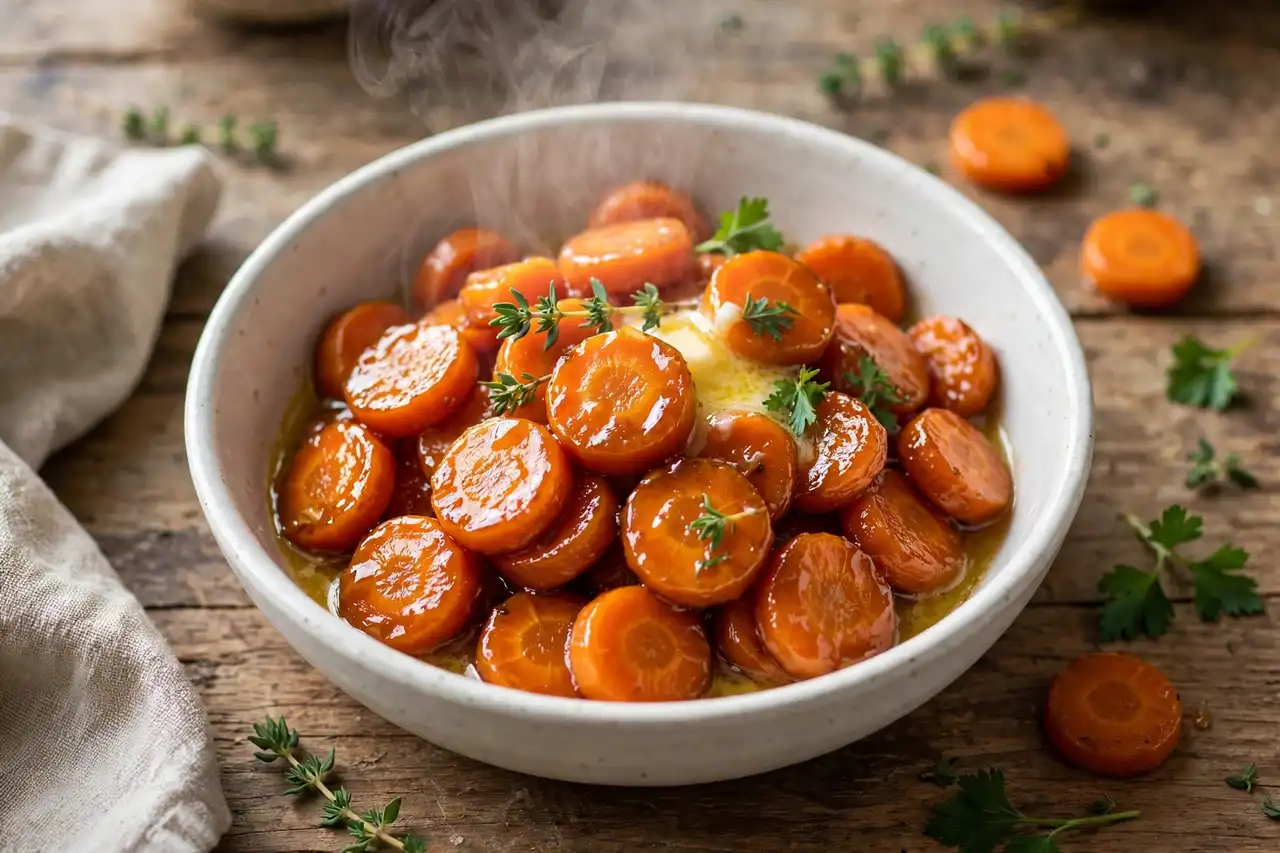
The served dish above shows the target texture: coins that hold their shape, glisten with butter, and still look like carrots rather than a soft orange mash. If your carrots look like that, the method worked. If they look collapsed or waterlogged, the fixes in this section will get you closer next time.
Should you peel carrots before microwaving?
Peeling is a matter of taste and of the carrots you bought, not a safety rule. Young, tender carrots with smooth skin taste fine unpeeled once they are scrubbed clean, and keeping the skin saves time and keeps a little extra fibre in the dish. Older carrots with rough, bitter, or cracked skin taste better peeled, because the outer layer can carry a bitter note that steaming does not remove.
There is one practical reason to peel that has nothing to do with taste. Soil and grit hide in the crevices of unpeeled carrots, and a quick rinse does not always remove it. If you are short on time, peeling is faster and more reliable than scrubbing every crevice. If you do keep the skin, scrub with a vegetable brush under running water and check the grooves near the top, where soil collects most.
For baby carrots, peeling is already done for you, so the question does not arise. For full sized carrots, try both ways once and see which texture you prefer. The microwave time does not change in any meaningful way, so the choice is purely about flavour and effort.
Should you salt carrots before microwaving?
No, season after cooking. Salt draws moisture out of the carrots while they cook, which adds liquid to the dish and can make the result watery. It also makes it harder to judge the water amount, because the carrots themselves contribute extra liquid you did not plan for. Seasoning after draining gives you full control: the carrots are tender, the dish is dry, and the salt, butter, or herbs coat the pieces instead of dissolving into cooking water.
The same logic applies to sugar glazes and honey. A glaze added before microwaving can scorch or turn sticky in hot spots, and it will slide off into the cooking liquid. Cook the carrots plain, drain them, then toss them in a warm glaze in a separate pan or in the same dish after draining. You get the sweet finish without the burnt edges or the watery glaze.
One exception is worth noting. If you are microwaving carrots as part of a mixed dish with a sauce, such as a curry or a stew base, seasoning during cooking is fine, because the sauce is meant to absorb the liquid anyway. For plain carrots served as a side dish, season after, every time.
Microwaved carrots and nutrition
People often ask whether microwaving destroys the nutrients in carrots. The honest answer is that no cooking method keeps every nutrient perfectly, and microwaving compares well with most other methods for a simple reason: it uses little water and a short cooking time. Water soluble vitamins leach into cooking water, so a method that uses 2 tablespoons of water and 5 minutes loses less to the water than a method that boils carrots in a full pot for 15 minutes. Draining still removes some nutrients with the liquid, which is another reason to use as little water as you can.
That does not make microwaved carrots a health food claim or a reason to avoid other methods. Roasting, steaming, and boiling all produce good carrots, and variety in cooking methods is more useful than loyalty to one. The practical point is narrower: if you already microwave carrots because it is fast, you are not making a nutritionally poor choice compared with boiling them. Use little water, cook briefly, drain promptly, and serve with a little fat, such as butter or olive oil, which helps your body absorb the fat soluble nutrients in carrots.
Avoid guides that attach precise percentages to nutrient retention for microwaved carrots without naming a study. Those numbers vary with carrot variety, piece size, water amount, and cooking time, and a single percentage quoted without context is more marketing than measurement. The qualitative pattern, less water and less time means less leaching, is reliable enough to cook by.
Microwave safety for carrots
Carrots are a low risk microwave food, but the general safety habits still matter. Use a microwave safe dish, glass or ceramic are the safest choices, and avoid metal, foam trays, and thin plastic that can warp. Check that any plastic wrap or lid you use is labelled microwave safe, and leave a vent for steam. Never use a container with a metal trim or a metal handle in the microwave.
Covering matters for a second reason beyond even cooking. A loose cover keeps splatters inside the oven and keeps steam around the food, which helps it cook evenly. A tight seal does the opposite: it traps pressure and can burst open when you lift it. A lid left slightly ajar, a plate set on top of the bowl, or vented wrap all give you the benefits of a cover without the pressure risk.
Steam burns are the most common microwave injury with vegetables, and they are easy to avoid. Use oven mitts to lift the dish, because the dish itself gets hot, and lift the lid away from your face so the first puff of steam goes away from you, not towards you. Let the dish stand for a minute before you stir or serve, which also improves the texture. These are the same habits the USDA guidance recommends for all microwave cooking, and they apply just as much to a bowl of carrots as to a casserole.
For reheating cooked carrots, the USDA reheating guidance is clear: reheat leftovers until they reach 165 degrees Fahrenheit throughout, then allow standing time before eating. In practice, that means reheating in a covered dish with a splash of water, in short bursts with a stir, until the carrots are steaming hot all the way through, not just warm at the edges. Do not reheat carrots more than once, because the texture degrades quickly and the food spends more time in the temperature range where bacteria grow fastest.
Seasoning and serving ideas
Plain microwaved carrots are a blank canvas, and the simplest finishes are often the best. Toss hot, drained carrots with a knob of butter, a pinch of salt, and black pepper. Add chopped parsley, dill, or thyme for a fresh note. A squeeze of lemon or orange juice brightens the sweetness without adding cooking time. A drizzle of olive oil and a pinch of cumin or smoked paprika gives a warmer, savoury version.
For a slightly richer side dish, toss the drained carrots with butter and a teaspoon of honey or maple syrup, then return them to the microwave for 30 seconds to warm the glaze through. Add toasted sesame seeds or chopped nuts for crunch, because microwaved carrots are soft by nature and a crunchy topping gives the dish contrast. Crumbled feta or goat cheese also works well, added after cooking so it softens slightly without melting into the liquid.
Microwaved carrots pair well with roast chicken, grilled fish, rice dishes, and grain bowls. They also work chopped into salads once cooled, or mashed with butter for a quick carrot mash. If you are cooking for children, cut the coins smaller, cook them a little softer, and season lightly. The same method scales down easily: halve the amount, keep the water at 1 tablespoon, and check at 3 minutes.
For more vegetable ideas cooked the same way, our guides to microwaving cauliflower and microwaving spinach use the same covered dish and short burst method, with times adjusted for each vegetable. The pattern transfers well, because most tender vegetables respond to steam, even pieces, and an early fork test.
When the microwave is not the best tool
The microwave is fast, but it cannot do everything. It steams, it does not roast, and that limits what it can deliver. If you want caramelised edges, a browned surface, or a deep roasted flavour, use the oven or a pan. Microwaved carrots will never develop the crisp, sweet edges that roasting gives, because the microwave heats with steam rather than dry heat. That is not a failure of the method. It is a property of the tool.
Large batches are another weak spot. Cooking more than 2 pounds of carrots at once in a single dish leads to uneven results, with the outer pieces overcooking while the centre pieces lag. For a crowd, cook in two batches or use the stove, where a larger pot and more stirring room give you better control. The same applies to glazed carrots for a holiday table: a pan gives you control over the glaze and the browning that a microwave cannot match.
Finally, the microwave is a poor choice for carrots you plan to freeze after cooking. Cooked carrots that are frozen and thawed turn noticeably softer and slightly grainy, and microwaving them a second time makes the texture worse. Cook only what you will eat within a few days, and freeze raw carrots, properly blanched, instead of cooked ones if you need long storage.
Microwave versus stove versus oven
Choosing a method is really choosing a trade off between speed, texture, and effort. The microwave wins on speed and cleanup. The stove wins on control for larger batches. The oven wins on flavour and texture for roasted carrots. None of them is wrong, and the best method depends on what you need that day.
| Method | Time for 1 pound sliced carrots | Texture | Best for |
|---|---|---|---|
| Microwave, covered dish | 4 to 6 minutes plus standing time | Tender, steamed, soft edges | Quick weeknight side dishes |
| Stovetop steaming | 8 to 12 minutes | Tender, even, slightly firmer | Larger batches and precise control |
| Boiling | 8 to 10 minutes | Soft, can turn watery | Carrots for mashing or soups |
| Roasting in the oven | 25 to 35 minutes | Caramelised edges, sweet, firm centres | Flavour first meals and holiday sides |
If speed is the priority, the microwave is the clear winner, and the time saved is real: a side dish in under 10 minutes including prep, with one dish to wash. If flavour is the priority and you have half an hour, roasting will reward you with edges and sweetness that steaming cannot produce. Many cooks use both methods in the same week, microwaving on busy nights and roasting on slower ones, and there is no reason to choose only one.
Storage and reheating
Cool cooked carrots quickly and store them in an airtight container in the fridge. They keep well for 3 to 4 days. Do not leave cooked carrots at room temperature for more than 2 hours, because that is the window in which bacteria grow fastest on cooked food. If you are unsure how long a dish has been sitting out, discard it rather than reheating it and hoping for the best.
To reheat, place the carrots in a covered microwave safe dish, add a splash of water, and heat in short bursts with a stir, until they are steaming hot throughout. That usually takes 1 to 2 minutes for a single serving and 2 to 3 minutes for a larger portion. Add butter or seasoning after reheating, not before, so the flavour stays fresh. Reheat only once, and only the portion you plan to eat, because each reheating softens the texture further.
Raw carrots store far longer than cooked ones. Whole, unpeeled carrots keep for several weeks in the fridge in a sealed bag or container, while cut carrots keep for about a week. If your carrots go limp before you cook them, the cold water soak described earlier can revive them for microwaving, but carrots that are slimy, mouldy, or smell off should be discarded, not rescued.
Mistakes to avoid
The most common mistake is cooking by the clock instead of by the fork. Timers are starting points, and every oven differs. Check early, check with a fork, and stop when the carrots are just tender. The second most common mistake is uneven cutting. Take the extra minute to cut even pieces, and the dish will repay you with even cooking.
The third mistake is too much water. It is tempting to add a generous splash to be safe, but a pool of water boils the carrots instead of steaming them. Start with 2 tablespoons for fresh carrots and 1 tablespoon for frozen, and add more only if the dish looks dry halfway through, which it rarely will in a covered dish. The fourth mistake is sealing the dish completely. Always leave a vent, always lift the lid away from your face, and always use oven mitts.
The fifth mistake is seasoning too early. Salt before cooking pulls water out and makes the dish watery. Butter before cooking slides into the cooking liquid. Season after draining, when the carrots are hot and ready to absorb flavour. The sixth mistake is leaving the carrots in hot liquid after cooking. Drain promptly, because standing in liquid is still cooking, and it is the quiet cause of many mushy dishes.
Finally, do not microwave carrots in packaging that is not labelled microwave safe, and do not microwave a sealed bag or container with no vent. Those are the only setups in this guide that carry a real safety risk beyond a bad texture, and both are easy to avoid by tipping the food into a glass or ceramic dish first.
Frequently asked questions
These are the questions people actually ask about microwaving carrots, with direct answers first and a short explanation after each one. If your question is not here, the method sections above cover the principles behind almost every variation.
Can you microwave carrots?
Yes, you can microwave carrots safely in a microwave safe dish with a small amount of water and a loose cover. Use even pieces, stir halfway through, and let the dish stand for 1 to 2 minutes after cooking. Sliced carrots usually take 4 to 6 minutes on high in a 1000 watt oven.
How long do you microwave carrots?
Sliced carrots take 4 to 6 minutes on high for 1 pound in a 1000 watt oven, baby carrots take 4 to 6 minutes for 2 cups, and frozen sliced carrots take 3 to 5 minutes. Check early and add 30 second bursts if needed, because wattage and piece size change the exact time.
How much water do you add when microwaving carrots?
Add 2 tablespoons of water for 1 pound of fresh carrots and 1 tablespoon for 2 cups of frozen carrots. That is enough to make steam without boiling the carrots. Drain promptly after cooking so the carrots do not keep softening in hot liquid.
Can you microwave whole carrots?
Yes, but sliced carrots cook more evenly and faster. If you microwave whole carrots, halve them lengthwise first, use 6 to 8 minutes on high for 4 medium carrots, and turn them halfway through. Uncut whole carrots need 8 to 10 minutes and cook less evenly.
Can you microwave baby carrots?
Yes, baby carrots microwave very well because they are already a fairly uniform size. Use 2 cups with 2 tablespoons of water in a covered dish, microwave on high for 4 to 6 minutes, and check at 4 minutes. They are done when a fork enters with slight resistance.
Can you microwave frozen carrots without thawing?
Yes, microwave frozen carrots straight from frozen with 1 tablespoon of water in a covered dish. Frozen sliced carrots take 3 to 5 minutes on high, and frozen baby carrots take 4 to 6 minutes. Stir halfway through and drain promptly, because frozen carrots release extra water as they thaw.
Do you need to peel carrots before microwaving?
No, peeling is optional if you scrub the carrots clean. Peel older carrots with rough or bitter skin, and keep the skin on young, tender carrots if you prefer. The microwave time does not change in any meaningful way either way.
Should you salt carrots before microwaving?
No, season after cooking. Salt draws moisture out of the carrots while they cook and can make the dish watery. Drain the carrots first, then toss them with salt, butter, or herbs while they are hot.
Why do microwaved carrots turn mushy?
Mushy carrots usually mean too much time or too long sitting in hot liquid after cooking. Check a minute earlier next time, drain the moment the fork test passes, and add time in 30 second bursts. Standing time also keeps cooking the carrots gently, so stop when they are just tender.
Why do microwaved carrots turn rubbery?
Rubbery carrots are often caused by older, dried out carrots that do not rehydrate well, or by undercooking thick pieces. Start with firm carrots, cut even pieces, add enough water to make real steam, and give the dish a full standing time. Soaking slightly limp carrots in cold water for 20 to 30 minutes before cooking can also help.
Can you microwave carrots in a plastic container?
Only if the container is labelled microwave safe. Glass or ceramic dishes are the safest choice. Avoid metal, foam trays, thin plastic that can warp, and any container with metal trim. If a plastic lid or wrap is not labelled microwave safe, do not use it in the microwave.
How do you reheat cooked carrots in the microwave?
Reheat in a covered microwave safe dish with a splash of water, in short bursts with a stir, until the carrots are steaming hot throughout. That usually takes 1 to 2 minutes for a serving. Reheat only once, and follow the USDA guidance to reheat leftovers until they reach 165 degrees Fahrenheit throughout.
How long do microwaved carrots last in the fridge?
Cooked carrots keep for 3 to 4 days in an airtight container in the fridge. Cool them quickly, do not leave them at room temperature for more than 2 hours, and reheat only the portion you plan to eat. Discard carrots that smell off or look slimy, even if they are within the time window.
Are microwaved carrots as healthy as steamed carrots?
Microwaved carrots compare well with steamed carrots because both methods use little water and a short cooking time. Microwaving uses a covered dish to steam the carrots in their own moisture plus a small amount of added water, so it keeps the same practical advantage as stovetop steaming: less leaching into cooking water than boiling. Serve with a little fat, such as butter or olive oil, to help absorb the fat soluble nutrients in carrots.
If you want to keep exploring microwave vegetables, try our guide to microwaving zucchini, which uses the same covered dish method with times tuned to that vegetable. The pattern transfers well, because most tender vegetables respond to steam, even pieces, and an early fork test.

1 Comment
Pingback: Can You Microwave Sweet Potatoes? Times and Safety