

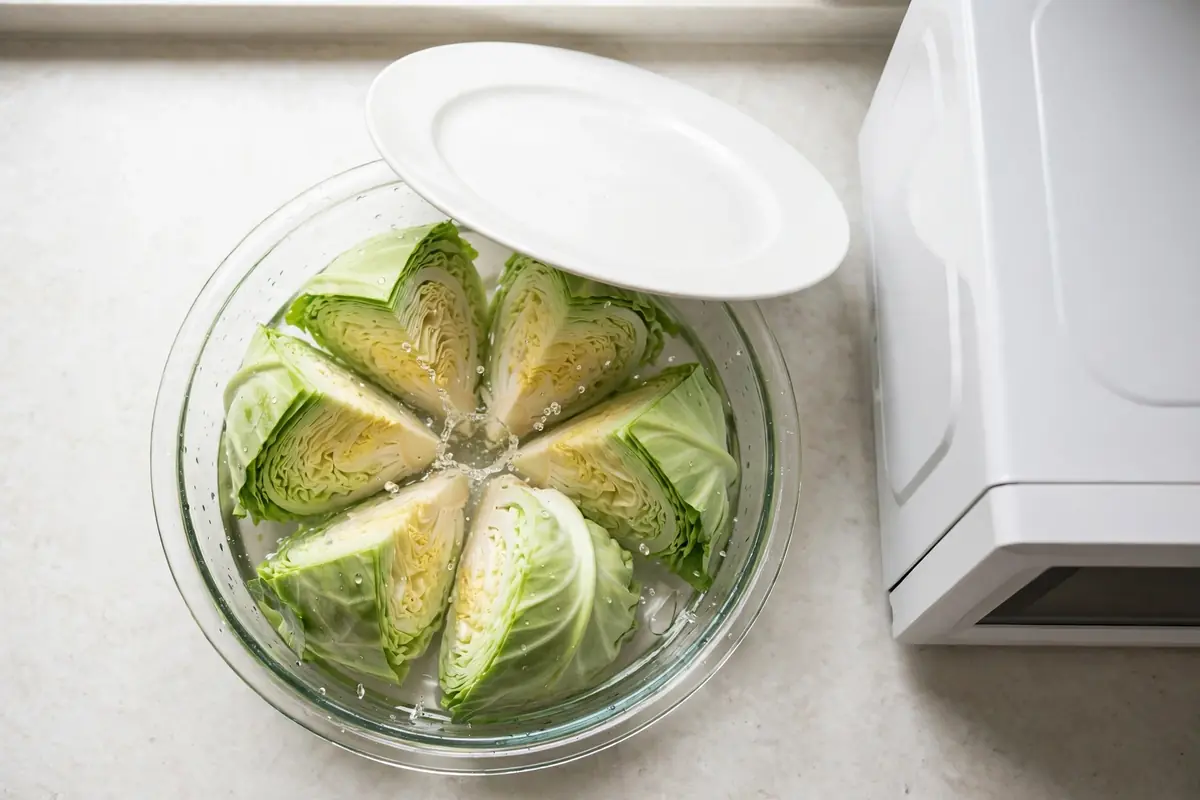
Yes, you can microwave cabbage, and it is one of the fastest ways to cook it. Shredded cabbage takes 2 to 4 minutes on high, wedges take 6 to 8 minutes, and all you need is a microwave-safe dish, a couple of tablespoons of water, and a loose cover to trap the steam. The microwave turns a vegetable that many people only think of as a slow-cooked side into a tender dish in under ten minutes, with almost no washing up and no pot to watch.
Cabbage has two problems that stop people trying it in the microwave, and both are real. The first is sogginess: too much water or too much time turns crisp leaves into a limp, watery pile. The second is the smell: overcooked cabbage releases sulfur compounds that can fill a kitchen with a strong, eggy odour. The good news is that both problems have the same fix, and it is simple. Use very little water, keep the cooking time short, check early, and drain the cabbage the moment it is done. This guide covers the step by step method, timing charts for shredded cabbage, wedges, and every common type, the honest truth about the smell, how to keep the texture crisp, reheating, storage, safety, and the mistakes that ruin the result. The safety advice follows the microwave guidance published by the USDA and the FDA, and the timings come from several tested recipe guides. Those guides do not all agree to the minute, so where they differ, this article says so and gives you the range to work with.
Can You Microwave Cabbage? The Short Answer
Yes. Cut the cabbage into shreds or wedges, place it in a microwave-safe dish with 2 tablespoons of water, and cover the dish loosely with a lid or a microwave-safe plate, leaving a small gap for steam to escape. Cook on high. Shredded cabbage takes 2 to 4 minutes in a 1000 watt microwave, and wedges take 6 to 8 minutes. Let the dish stand, still covered, for 1 minute so the heat spreads evenly, then test a piece with a fork. If the fork slides in easily and the cabbage still has a little bite, it is done. If it resists, cook for another 30 seconds and test again.
The microwave suits cabbage because the leaves are mostly water, and the trapped steam softens the thick ribs without turning the leaves to mush. Boiling can waterlog the cabbage and wash flavour and vitamins into the pot. Roasting gives a caramelised result but takes 25 minutes or more. The microwave gives you a steamed result in a few minutes, with the bright green colour kept, as long as you keep the cooking time short and do not drown the cabbage in water. The one thing the microwave does not do well is browning, so if you want charred edges, finish the wedges in a hot pan for a minute or two after microwaving.
How Long to Microwave Cabbage
Timing depends on the form of the cabbage, the amount, the type, and your microwave wattage, and the ranges below come from several tested guides. They agree closely on shredded cabbage and wedges, but they differ more on large batches, so treat the longer times as a starting point for a full head, not a rule. Start at the low end of the range, then add time in 30 second bursts. Every microwave heats a little differently, and cabbage that is overcooked goes soft, grey, and smelly, so checking early is always better than guessing long.
| Cabbage form | Amount | Time on high (1000W) | Rest time |
|---|---|---|---|
| Shredded green cabbage | 1 cup | 2 to 3 minutes | 1 minute, covered |
| Shredded green cabbage | 2 cups | 3 to 4 minutes | 1 minute, covered |
| Shredded green cabbage | 4 cups | 4 to 5 minutes | 1 minute, covered |
| Green cabbage wedges | Half a head | 6 to 8 minutes | 1 minute, covered |
| Green cabbage wedges | Half a head, thick cut | 9 to 11 minutes | 1 minute, covered |
| Red cabbage, shredded | 2 cups | 4 to 6 minutes | 1 minute, covered |
| Red cabbage wedges | Half a head | 6 to 8 minutes | 1 minute, covered |
| Savoy cabbage, shredded | 2 cups | 3 to 5 minutes | 1 minute, covered |
| Napa cabbage, shredded | 2 cups | 2 to 4 minutes | 1 minute, covered |
| Frozen cabbage, shredded | 2 cups | 4 to 6 minutes | 1 minute, covered |
These times assume a 1000 watt microwave and cabbage at room temperature. Cabbage straight from the fridge may need an extra 30 seconds. If your microwave is 700 watts, add about 1 minute to each time. If it is 1200 watts, start checking 1 minute earlier than the range suggests. The size of the pieces matters more than anything else: thin shreds cook in a couple of minutes, while thick wedges need the full time because the heat has to reach the dense core. Cut the pieces as evenly as you can, because a mix of thin shreds and thick chunks will cook unevenly, with the thin pieces turning mushy while the thick ones stay raw.
One timing disagreement is worth knowing about. Some guides say a large batch of red cabbage needs 15 to 20 minutes, pausing every 5 minutes to stir. That figure comes from cooking a whole half head or more in one deep bowl, where the pile is thick and the steam has to work through layers of leaves. It is not wrong, but it is not the time for a normal serving. For a side dish of 2 to 4 cups, the shorter times in the table above are the right starting point. A tested steaming guide from Chef’s Resource puts shredded cabbage at 4 to 6 minutes for a half head with 2 tablespoons of water, which sits inside the ranges above. If you are cooking a very large batch, cook it in two smaller batches instead of one deep pile, because the smaller batches cook faster and far more evenly.
How to Microwave Shredded Cabbage Step by Step
Shredded cabbage is the fastest form to microwave, and it is the best choice when you want cabbage for stir fries, coleslaw, soups, or a quick side dish. Follow these steps and you will get tender shreds with a little bite left, not a soggy pile.
- Choose a fresh, heavy head. Pick a cabbage that feels heavy for its size, with crisp outer leaves and no brown spots or soft patches. A fresh head has tight leaves and a clean, pale cut stem. Avoid heads that feel light or have loose, wilted outer leaves, because older cabbage cooks up tougher and smellier.
- Remove the outer leaves and rinse. Peel off the outer two or three leaves and throw them away. Rinse the head under cool running water and shake off the excess. You do not need to dry it completely, because a little surface water helps make steam, but do not leave it dripping.
- Cut out the core and shred. Cut the head into quarters through the stem, then slice out the hard triangular core from each quarter. Shred the quarters into strips about a quarter of an inch wide. Even strips cook evenly, so take a moment to keep them uniform rather than rushing the knife work.
- Add a little water. Place the shreds in a wide, shallow microwave-safe dish and add 2 tablespoons of water for a half head, or about 1 teaspoon per cup for smaller amounts. That is enough to make steam. More water makes the cabbage soggy, and the leaves release their own moisture as they cook, so you need far less than you think.
- Cover loosely. Put a microwave-safe lid or plate over the dish, leaving a small gap at one edge so steam can escape. A sealed cover can build up pressure and pop off, and it also traps too much water against the leaves. A wide, shallow dish works better than a deep bowl, because the shreds spread out in a thin layer and the steam reaches them all.
- Cook on high and stir halfway. Microwave for 2 minutes, then lift the cover carefully, away from your face, and stir the shreds so the ones at the bottom move to the top. Cook for 1 to 2 more minutes, depending on the amount. Most batches are done between 3 and 5 minutes in total.
- Rest, then drain. Leave the dish covered for 1 minute. The trapped heat finishes the centres. Then drain the cabbage immediately, because leaving it sitting in the leftover water lets the carry-over heat keep cooking it, and that is how crisp shreds turn limp. Season after draining, not before, so the salt does not draw out extra water during cooking.
The fork test is the only reliable way to judge doneness. Push a fork into a thick rib: it should slide in with slight resistance, like a firm green bean. If the rib bends without resistance, the cabbage is done, and if it is already soft and floppy, it has gone too far. Next time, take a minute off the cooking time. Cabbage goes from perfect to overdone in about 60 seconds, so the difference between crisp and soggy is one extra burst.
How to Microwave Cabbage Wedges
Wedges are the best form when you want cabbage as a side dish on its own, with butter and lemon, or as a base for a topping. A wedge keeps its shape, holds a little sauce, and looks far better on a plate than a pile of shreds. The method is the same as for shredded cabbage, but the timing is longer and the cutting matters more.
Cut the head into quarters through the stem, then cut each quarter into two wedges, keeping a piece of the core attached to each wedge so the leaves stay together. If the wedges are wider than an inch and a half at the thickest part, they will cook unevenly, with the outside turning soft while the core stays crunchy, so trim them down. Place the wedges cut side down in a wide dish, add 2 tablespoons of water, and cover loosely. Cook on high for 6 minutes, then check by pushing a fork into the thickest part of a wedge. If it resists, cook for 1 to 2 more minutes and check again. Most wedges are done between 6 and 8 minutes, though very thick wedges from a large head can need 9 to 11 minutes.
Turn the wedges once halfway through if you can, because the bottom of the dish gets more heat than the top, and a turn evens it out. Rest the dish covered for 1 minute, then drain and serve right away. Wedges cool fast and go limp as they sit, so do not leave them waiting while you finish the rest of the meal. If you want a little colour, brush the cooked wedges with melted butter and slide them under a hot grill for 2 minutes, or sear them cut side down in a hot pan for 1 minute. The microwave does the cooking, and the pan or grill adds the finish.
Microwaving Red Cabbage
Red cabbage works in the microwave just as well as green cabbage, and the timings are nearly the same: shredded red cabbage takes 4 to 6 minutes, and wedges take 6 to 8 minutes. The difference is the colour. Red cabbage gets its deep purple red colour from pigments called anthocyanins, and those pigments react to acid and to alkaline water. A splash of vinegar or lemon juice in the cooking water keeps the colour bright red. Plain tap water, which is often slightly alkaline, can turn the cabbage a dull blue grey, especially if you cook it for a long time.
To keep red cabbage looking its best, add 1 teaspoon of white vinegar or lemon juice to the 2 tablespoons of water before cooking, and keep the cooking time as short as you can. Do not add baking soda or any alkaline ingredient, because that pushes the colour the wrong way. Season with salt after cooking, and serve it warm rather than letting it sit, because the colour fades as it cools and dries out. Red cabbage is often cooked with apple and vinegar as a braised side, and the microwave is a good shortcut for that dish: cook the shredded red cabbage for 4 minutes, stir in a diced apple and a tablespoon of vinegar, then cook for 2 more minutes. The apple softens, the vinegar keeps the colour bright, and the whole dish is ready in under ten minutes.
Red cabbage is a little tougher than green cabbage, so it can take a minute longer for the same cut, and that is normal. If your shredded red cabbage is still firm after 6 minutes, add 1 minute at a time rather than jumping to a long cook, because the extra minute is usually enough. The leaves should be tender with a slight bite, not soft and floppy.
Savoy and Napa Cabbage in the Microwave
Savoy and napa cabbage are the delicate members of the family, and they need less time than green or red cabbage. Savoy has crinkly, tender leaves that cook fast, and napa has soft, pale leaves with a high water content that turns to mush if you overcook it. If you use green cabbage times for either of them, you will end up with a soggy result.
Savoy cabbage, shredded, takes 3 to 5 minutes, and savoy wedges take 5 to 7 minutes. The crinkly leaves trap steam between their folds, so they cook a little faster than they look, and they also hold more water, so use even less added water than you would for green cabbage: 1 tablespoon is enough for 2 cups. Napa cabbage is the quickest of all. Shredded napa takes 2 to 4 minutes, and napa wedges take 4 to 6 minutes. Napa leaves are so thin that they wilt almost as soon as the steam hits them, so start checking after 2 minutes and take them out the moment they are tender.
Both types are good choices when you want a softer, milder cabbage, and both work well in the microwave because their thin leaves heat through evenly. If you are cooking napa for a stir fry, undercook it by 1 minute on purpose, because the residual heat and the hot pan will finish it, and a napa leaf that is already fully cooked will fall apart in the pan. The same rule applies to savoy in soups: microwave it for 3 minutes, then stir it into the hot soup off the heat, and let the soup finish the job.
Can You Microwave a Whole Head of Cabbage?
You can, but you should not, and every tested guide agrees on this point. A whole head does not cook evenly in a microwave. The outer leaves turn to mush while the dense core stays raw, because the microwaves heat the outside first and the thick, tightly packed centre never catches up. A small head takes 8 to 10 minutes and a large head takes 10 to 12 minutes, and even then the result is uneven, with soft outer leaves and a crunchy middle.
There is one exception, and it is worth knowing. If you need soft whole leaves for cabbage rolls, a whole head is actually the right starting point, but the method is different. Cut out the core first, place the head in a dish with a few tablespoons of water, cover loosely, and microwave for 3 to 4 minutes. Then peel off the softened outer leaves, return the head to the microwave for another 2 to 3 minutes, and peel off the next layer. Repeat until you have enough leaves. This works because you are peeling the leaves off as they soften, rather than trying to cook the whole head through in one go.
For every other purpose, cut the cabbage first. Quarters, wedges, or shreds cook evenly, cook faster, and give you a far better result than a whole head ever will. The few minutes you spend cutting are saved twice over in cooking time, and the texture is better in every way.
How Much Water to Add When Microwaving Cabbage
Water is the part of this recipe where most people go wrong, and the guides disagree with each other, so it helps to know the range and why it varies. The most common advice is 2 tablespoons of water for a half head of cabbage, or about 1 teaspoon per cup of shredded cabbage. One older guide recommends a quarter of a cup of water in the bottom of the bowl, which is four times as much. That larger amount comes from a time when microwaves were weaker and dishes were deeper, and it is more water than a modern microwave needs.
The honest answer is that cabbage brings its own water. The leaves are about 90 percent water, and they release a surprising amount of moisture as they heat. The added water only needs to start the steam, and once the steam is going, the cabbage keeps it going by itself. That is why 2 tablespoons is enough for a half head, and why a single cup of shreds needs only a teaspoon. If you add a quarter of a cup, the cabbage ends up sitting in a pool at the bottom of the dish, and that pool is what makes it soggy.
A useful test is to look at the bottom of the dish when the cabbage is done. If there is a thin film of water, you used the right amount. If there is a puddle, use less next time. If the leaves look dry and papery, use a little more. The right amount also depends on the dish: a wide, shallow dish needs less water than a deep bowl, because the steam spreads out and the leaves are not piled in a pool. When in doubt, start with less. You can always add a tablespoon and cook for another minute, but you cannot take water out of a soggy batch.
Why Does Microwaved Cabbage Smell?
The smell is the question people ask most about cooking cabbage, and it has a simple cause. Cabbage belongs to the brassica family, along with broccoli, cauliflower, and brussels sprouts, and all of them contain sulfur compounds. When cabbage is heated, those compounds break down and release gases, including hydrogen sulfide, which smells like rotten eggs. The longer and hotter you cook the cabbage, the more gas is released, and the stronger the smell becomes. That is why a pot of cabbage boiled for 20 minutes can fill a whole house, while a quick microwave cook barely smells at all.
The microwave is actually one of the best tools for keeping the smell down, because the cooking time is so short. The sulfur compounds need time and sustained heat to build up, and a 3 to 5 minute microwave cook does not give them much of either. The smell gets bad when the cabbage is overcooked, cooked in too much water, or left sitting hot in a sealed container after cooking. All three mistakes give the sulfur compounds more time to form and nowhere to go.
If smell is your main worry, there are a few honest fixes that work. Keep the cooking time short and check early, because overcooking is the biggest cause. Add a teaspoon of vinegar or lemon juice to the cooking water, because the acid helps neutralise some of the sulfur compounds and adds a bright flavour at the same time. Do not seal the lid tight, because a small vent lets the steam, and some of the gas, escape instead of building up. Open a window or turn on the extractor fan while you cook, and serve the cabbage right away rather than letting it sit. A bay leaf in the dish can help mask the smell, and a knob of butter or a drizzle of olive oil on the finished cabbage covers what is left. None of these tricks will remove the smell completely, because it is a natural part of the vegetable, but together they keep it mild enough that most people will not notice it.
How to Stop Cabbage Going Soggy
Sogginess is the other common complaint, and it comes from the same two mistakes: too much water and too much time. Cabbage leaves are thin and full of water, so they go from crisp to limp fast, and once they are limp there is no way back. The fix is a set of small habits that add up to a big difference.
First, use less water than you think you need. Two tablespoons for a half head is the right amount, and a single cup of shreds needs only a teaspoon. Second, use a wide, shallow dish instead of a deep bowl, so the cabbage spreads out in a thin layer and the steam reaches it evenly instead of pooling at the bottom. Third, check early and cook in short bursts. Start with the low end of the time range, stir halfway, and add time in 30 second bursts. Fourth, drain the cabbage the moment it is done, because the leftover water in the dish keeps cooking it. Fifth, do not salt the cabbage before cooking. Salt draws moisture out of the leaves, which adds to the water in the dish and makes the result wetter. Season after draining instead. Sixth, rest the dish for only 1 minute, not longer, because a long rest lets the steam keep softening the leaves past the point you wanted.
If your cabbage still comes out soggy, the most likely cause is the amount. Try halving the water next time, or try the dry method: place the shreds in a dish with no added water at all, cover loosely, and cook for 2 to 3 minutes. The leaves release enough of their own moisture to make steam, and the result is often crisper than the wet method. The dry method works best for small batches of shreds, and it is worth trying if you have had soggy results before.
Microwaving Frozen Cabbage
Yes, you can microwave frozen cabbage, and it is a handy shortcut when you have a bag of frozen shreds in the freezer. Frozen cabbage is usually blanched before freezing, which means it is already partly cooked, so it needs less time than you might expect. Shredded frozen cabbage takes 4 to 6 minutes for 2 cups, and you should stir it halfway through so the frozen clumps in the middle get the same heat as the edges.
Do not add any extra water to frozen cabbage, because the ice crystals melt into water as they heat, and that is more than enough moisture. In fact, frozen cabbage often comes out wetter than fresh cabbage, so drain it well after cooking and give it an extra minute uncovered if it still looks watery. The texture will be softer than fresh cabbage, which is normal: freezing breaks down the cell walls, so frozen cabbage never stays as crisp. It is best used in soups, stews, stir fries, and braised dishes, where a softer texture is fine, rather than as a standalone side where you want a bite.
Let the dish stand covered for 1 to 2 minutes after cooking, then check the temperature in the middle of the pile before serving. Frozen food heats unevenly in a microwave, and the centre can stay cold while the edges are hot, so stirring halfway and resting at the end are both important. The USDA guidance on microwave cooking is clear on this point: stir or rotate food during cooking, let it stand afterwards so the heat spreads evenly, and check that it is heated through before eating. The same rules apply to fresh cabbage, but they matter more with frozen food.
Cabbage Leaves for Cabbage Rolls
The microwave is one of the easiest ways to soften cabbage leaves for cabbage rolls, and it is far simpler than boiling a whole head in a large pot. The leaves need to be soft enough to roll without cracking, but still strong enough to hold a filling, and the microwave gives you that in a few minutes.
Cut out the core of the head with a sharp knife, place the head in a microwave-safe dish with 3 tablespoons of water, and cover loosely. Microwave on high for 3 to 4 minutes, then carefully peel off the outer leaves, which should be soft and flexible. Return the head to the microwave for another 2 to 3 minutes, peel off the next layer, and repeat until you have enough leaves. Most heads give you 10 to 12 usable leaves this way. Trim the thick rib from the base of each leaf with a knife so it folds flat, then fill and roll as usual.
This method works because you are softening one layer at a time, rather than trying to cook the whole head through. The leaves come off cleanly, without the tearing that happens when you try to peel raw leaves from a hard head. If a leaf cracks when you roll it, it was undercooked, so give the head another minute. If the leaves feel limp and fall apart, they were overcooked, so take a minute off next time. For more on microwave times for other vegetables you might serve alongside cabbage rolls, see the guide to microwaving green beans.
Seasoning and Serving Ideas
Plain microwaved cabbage is mild and a little sweet, and it takes seasoning well, so it is worth finishing it properly instead of serving it bare. The simplest finish is a knob of butter, a squeeze of lemon, salt, and black pepper, stirred through while the cabbage is still hot. The butter coats the leaves and stops them drying out, and the lemon brightens the flavour and helps with the smell at the same time.
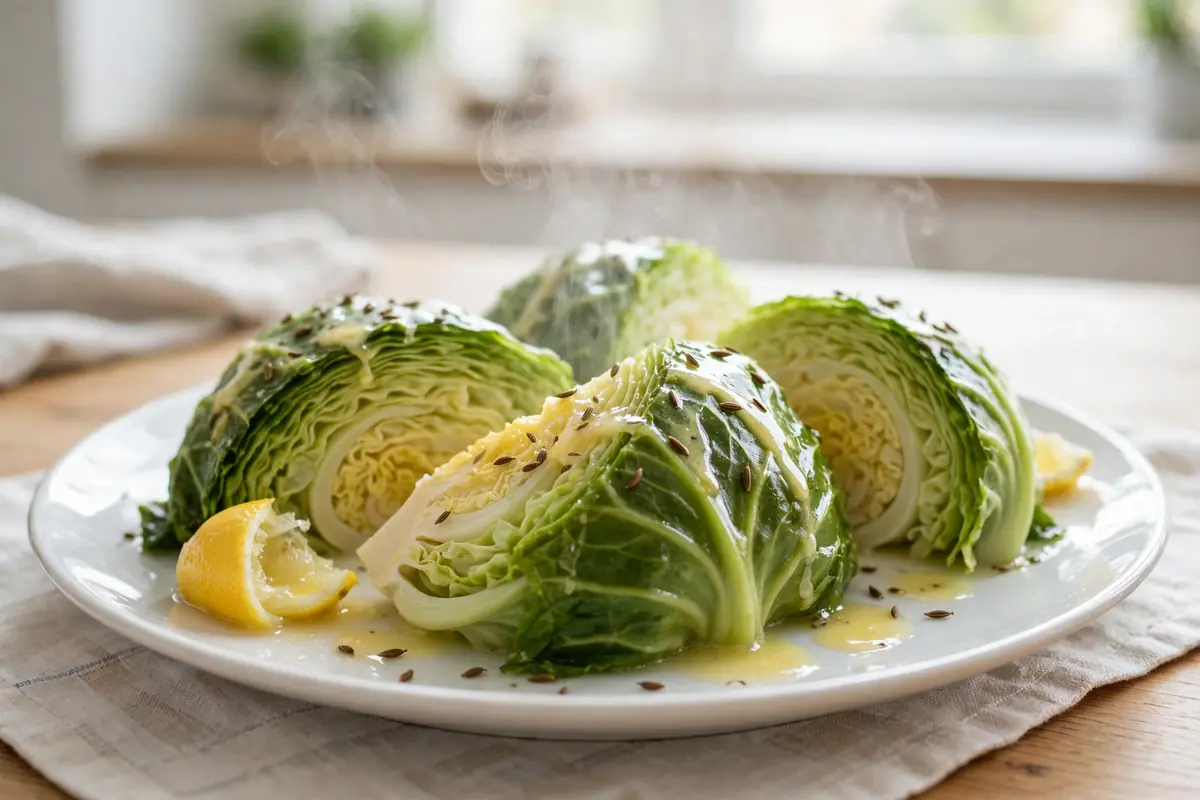
Caraway seeds are the classic cabbage spice, and a teaspoon scattered over the hot cabbage with a little butter is the traditional way to serve it in many European kitchens. Dill works well too, and a pinch of smoked paprika gives a warm, savoury note that suits wedges in particular. For an Asian style finish, toss the hot shreds with a teaspoon of soy sauce, a few drops of sesame oil, and a sprinkle of sesame seeds. For a braised red cabbage, stir in a diced apple and a tablespoon of vinegar during the last 2 minutes of cooking, as described above.
Microwaved cabbage works as a side dish with roast pork, sausages, mashed potatoes, and grilled chicken, and the shreds are good stirred into soups, stir fries, and noodle dishes. It also works as a base for coleslaw: microwave the shreds for 2 minutes only, so they are just softened, then cool them quickly under cold water, drain well, and mix with your usual coleslaw dressing. The brief microwave cook takes the raw edge off the cabbage without making it soggy, which is exactly what a good coleslaw needs. If you want another quick vegetable side to pair with cabbage, the guide to microwaving broccoli uses the same steam method and the same timings idea.
Is Microwaving Cabbage Healthy?
Yes, microwaving is one of the healthiest ways to cook cabbage. Cabbage is a low calorie vegetable that is rich in vitamin C, vitamin K, folate, and fibre, and it also contains small amounts of calcium and potassium. The question is not whether cabbage is healthy, because it is, but whether the cooking method keeps those nutrients in the food, and that is where the microwave does well.
Vitamin C and folate are water soluble, which means they leak into cooking water and are lost when that water is thrown away. Boiling is the worst method for this, because the cabbage sits in a large volume of water for a long time, and much of the vitamin C ends up in the pot. Microwaving uses very little water and very short cooking times, so far less of those vitamins are lost. The USDA guidance on microwave cooking notes the same principle: short cooking times and small amounts of water help keep nutrients in vegetables. Steaming on the stove is similarly good, but the microwave is faster and uses even less water.
The other factor is time. Vitamin C breaks down with heat, and the longer a vegetable is heated, the more is lost. A 3 to 5 minute microwave cook is short enough that most of the vitamin C survives, while a 20 minute boil loses far more. The fibre in cabbage is not affected by cooking at all, and the vitamin K is more stable than vitamin C, so both survive either way. The practical advice is simple: keep the cook time short, use the smallest amount of water that makes steam, and do not overcook. If you follow those three rules, microwaved cabbage keeps more of its nutrients than boiled cabbage, and it is one of the healthiest things you can make in a microwave.
Reheating and Storing Leftover Cabbage
Cooked cabbage keeps well in the fridge, and the microwave is the best way to reheat it, as long as you use short bursts and a little water. Let the cabbage cool for 20 to 30 minutes after cooking, then move it to an airtight container and refrigerate it. Cooked cabbage keeps for 3 to 4 days in the fridge. Spread it in a single layer in the container rather than piling it up, because a piled batch goes slimy faster as moisture pools at the bottom.
To reheat, place the cabbage in a microwave-safe dish, sprinkle 1 tablespoon of water over it, and cover loosely. Microwave on medium power in 30 second bursts, stirring after each burst, until it is heated through. This usually takes 60 to 90 seconds in total. Reheated cabbage will be softer than fresh cabbage, and the smell will be a little stronger, because the sulfur compounds keep forming as it sits. A fresh squeeze of lemon after reheating helps with both the flavour and the smell. Never reheat the same portion more than once, because each round of heating makes the texture worse and increases the risk of the food spending too long at a temperature where bacteria can grow.
If you have a large amount of leftover cabbage, it is often better to use it in a new dish than to reheat it on its own. Stir it into a soup, add it to a stir fry, or mix it with mashed potatoes for a quick bubble and squeak style side. The extra ingredients mask the softer texture, and the cabbage gets a second life instead of a second reheating. For storage times and reheating steps for other vegetables, the guide to microwaving cauliflower follows the same rules.
Microwave Safety for Cabbage
Microwaving cabbage is safe, and the safety rules are the same ones that apply to any vegetable in a microwave. The USDA guidance on cooking with microwave ovens sets out the key points: stir or rotate food during cooking, because microwaves heat unevenly and can leave cold spots; let the food stand for a minute or two after cooking, so the heat spreads evenly; and use a food thermometer to check that food is heated through when it matters, which is more important for meat than for cabbage, but still good practice for any reheated dish.
Use only containers labelled microwave-safe. Glass and ceramic are the safest choices, because they do not warp or release chemicals at high heat. If you use plastic, check that it is labelled microwave-safe, and do not use containers with metal trim, cracked lids, or tight seals. Never use aluminium foil or any metal in the microwave, and never use a container that is not meant for heating. The FDA guidance on microwave oven safety covers the same points and adds a useful warning: never run a microwave empty, and do not use an oven with a damaged door or seal, because that is when microwave energy can leak.
The other safety point is steam. Always lift the lid away from your face when you open a covered dish, because the trapped steam is hot enough to burn. Use oven mitts to lift the dish out, because the dish itself will be hot even if the cabbage looks cool. Let the cabbage stand for 1 minute before serving, both to even out the heat and to let the steam settle. These are small habits, but they are the ones that prevent the most common microwave injuries, which are steam burns and hot dishes, not radiation. For a general overview of what can and cannot go in a microwave, see the site guide at Can You Microwave It?.
Common Mistakes That Ruin Microwaved Cabbage
Most bad microwaved cabbage comes from a small number of avoidable mistakes, and knowing them in advance saves you from learning them the hard way. The list below covers the ones that come up again and again.
- Cooking a whole head. The outside turns to mush while the core stays raw. Cut the cabbage into shreds or wedges first, every time.
- Adding too much water. A quarter of a cup is too much for a normal serving. Two tablespoons for a half head is enough, and the cabbage releases its own moisture as it cooks.
- Cooking for too long. Cabbage goes from perfect to soggy in about a minute. Start at the low end of the time range and add time in 30 second bursts.
- Sealing the lid tight. A sealed cover traps too much water against the leaves and can pop off from pressure. Leave a small gap for steam to escape.
- Skipping the stir. Microwaves heat unevenly, and the bottom of the dish gets more heat than the top. Stir halfway through so the whole batch cooks at the same rate.
- Leaving it in the water. Drain the cabbage the moment it is done. The leftover water keeps cooking it, and that is how crisp shreds turn limp.
- Salting before cooking. Salt draws moisture out of the leaves, which adds water to the dish. Season after draining instead.
- Using a deep bowl for a large batch. A deep pile cooks unevenly, with the top raw and the bottom soggy. Use a wide, shallow dish, or cook in two smaller batches.
- Cutting uneven pieces. A mix of thin shreds and thick chunks will never cook evenly. Keep the pieces as uniform as you can.
- Forgetting the rest time. The cabbage keeps cooking from its own heat after the microwave stops. Rest it covered for 1 minute, then test with a fork before adding more time.
If your cabbage still comes out wrong after fixing these, the most likely cause is your microwave wattage. A 1200 watt microwave cooks much faster than a 700 watt one, and the same time that works in one kitchen can overcook the cabbage in another. Note the time that works for your own microwave and use it as your starting point next time, rather than trusting a guide time blindly.
Cabbage vs Other Cooking Methods
The microwave is not the only way to cook cabbage, and it is not the best way for every dish, so it helps to know how it compares. Boiling is the slowest and the least kind to nutrients, because the cabbage sits in a large volume of water for 10 to 15 minutes and much of the vitamin C ends up in the pot. Steaming on the stove is gentle and keeps nutrients well, but it takes 8 to 10 minutes and needs a steamer basket and a pot to wash. Roasting gives the best flavour, with caramelised edges and a nutty taste, but it takes 25 to 30 minutes in a hot oven. Sautéing is fast and gives a good flavour, but it uses more oil and needs constant attention.
| Method | Time | Texture | Nutrient keeping | Best for |
|---|---|---|---|---|
| Microwave | 3 to 8 minutes | Tender, slight bite | Good, little water | Quick side dishes |
| Boiling | 10 to 15 minutes | Soft, can go soggy | Poor, vitamins lost to water | Soups and stews |
| Steaming | 8 to 10 minutes | Tender, bright colour | Good, no water contact | Plain side dishes |
| Roasting | 25 to 30 minutes | Crisp edges, sweet | Good, no water | Wedges with char |
| Sautéing | 6 to 8 minutes | Tender, lightly browned | Good, little water | Stir fries |
The microwave wins on speed and convenience, and it is the best choice when you want a quick side dish with almost no washing up. It loses to roasting on flavour, because it cannot brown the leaves, and it loses to steaming on texture for very delicate leaves, because the microwave can be harsher if you overcook by a minute. The practical answer is to use the microwave for everyday cabbage, and save the oven for the times when you want caramelised wedges. You can also combine the two: microwave the wedges for 5 minutes to cook them through, then finish them in a hot oven or pan for 2 minutes to get the browned edges. That gives you the speed of the microwave and the flavour of roasting in about 7 minutes.
If you are building a set of quick vegetable sides, the same steam method works for most leafy and cruciferous vegetables. The guide to microwaving okra covers another vegetable where timing and water amount matter just as much, and the guide to microwaving frozen vegetables covers the frozen side of the same question.
Frequently Asked Questions
Can you microwave cabbage?
Yes, you can microwave cabbage. Shredded cabbage takes 2 to 4 minutes on high, wedges take 6 to 8 minutes, and you only need a microwave-safe dish, 2 tablespoons of water, and a loose cover to trap the steam. Let it stand covered for 1 minute, then drain and serve.
How long does it take to microwave cabbage?
It depends on the cut and the type. Shredded green cabbage takes 2 to 4 minutes, green cabbage wedges take 6 to 8 minutes, red cabbage takes 4 to 6 minutes shredded and 6 to 8 minutes in wedges, savoy takes 3 to 5 minutes shredded, and napa takes 2 to 4 minutes shredded. Start at the low end of the range and add time in 30 second bursts.
Can you microwave a whole head of cabbage?
You can, but you should not. A whole head cooks unevenly, with the outer leaves turning to mush while the dense core stays raw. Cut the cabbage into shreds or wedges first. The only exception is softening leaves for cabbage rolls, where you microwave the cored head for 3 to 4 minutes at a time and peel off the softened outer leaves as they loosen.
Do you need to add water when microwaving cabbage?
Yes, a little. Two tablespoons of water for a half head, or about 1 teaspoon per cup of shredded cabbage, is enough to make steam. Cabbage releases its own moisture as it cooks, so more water than that makes it soggy. For a small batch of shreds, you can even use the dry method with no added water at all.
Why does microwaved cabbage smell so bad?
The smell comes from sulfur compounds that break down into gases, including hydrogen sulfide, when cabbage is heated. The longer and hotter you cook it, the stronger the smell. Keep the cooking time short, add a teaspoon of vinegar or lemon juice to the water, leave a small vent in the lid, and serve the cabbage right away instead of letting it sit.
How do you keep microwaved cabbage from going soggy?
Use very little water, use a wide shallow dish instead of a deep bowl, check early and cook in 30 second bursts, stir halfway through, and drain the cabbage the moment it is done. Do not salt it before cooking, because salt draws extra moisture out of the leaves. Rest it covered for only 1 minute.
Can you microwave red cabbage?
Yes, red cabbage microwaves well, with the same timings as green cabbage: 4 to 6 minutes shredded and 6 to 8 minutes in wedges. Add 1 teaspoon of vinegar or lemon juice to the cooking water to keep the colour bright red, because plain tap water can turn it a dull blue grey.
Can you microwave savoy cabbage?
Yes, savoy cabbage takes 3 to 5 minutes shredded and 5 to 7 minutes in wedges. The crinkly leaves trap steam between their folds, so they cook a little faster than they look, and they hold more water, so use only 1 tablespoon of water for 2 cups.
Can you microwave napa cabbage?
Yes, napa cabbage is the quickest of all, taking 2 to 4 minutes shredded and 4 to 6 minutes in wedges. The thin leaves wilt almost as soon as the steam hits them, so start checking after 2 minutes and take them out the moment they are tender. Undercook napa by 1 minute if it is going into a stir fry or soup.
Can you microwave frozen cabbage?
Yes, shredded frozen cabbage takes 4 to 6 minutes for 2 cups. Do not add any extra water, because the ice melts into water as it heats. Stir halfway through, rest covered for 1 to 2 minutes, and drain well, because frozen cabbage comes out wetter and softer than fresh cabbage.
Can you microwave cabbage leaves for cabbage rolls?
Yes, cut out the core, place the head in a dish with 3 tablespoons of water, cover loosely, and microwave for 3 to 4 minutes. Peel off the softened outer leaves, return the head for another 2 to 3 minutes, and repeat until you have enough leaves. Trim the thick rib from each leaf so it folds flat.
Is microwaved cabbage healthy?
Yes, microwaving is one of the healthiest ways to cook cabbage. It uses very little water and very short cooking times, so fewer water soluble vitamins such as vitamin C and folate are lost than with boiling. Cabbage is low in calories and rich in vitamin C, vitamin K, folate, and fibre.
Can you reheat cabbage in the microwave?
Yes, reheat leftover cabbage in a microwave-safe dish with 1 tablespoon of water, covered loosely, on medium power in 30 second bursts, stirring after each burst, until heated through. This usually takes 60 to 90 seconds in total. Reheated cabbage will be softer and a little smellier than fresh cabbage, so add a fresh squeeze of lemon after reheating, and never reheat the same portion more than once.
How long does microwaved cabbage last in the fridge?
Cooked cabbage keeps for 3 to 4 days in the fridge in an airtight container. Let it cool for 20 to 30 minutes before refrigerating, spread it in a single layer rather than piling it up, and use it in a soup or stir fry if you want to give it a second life instead of reheating it on its own.
The Bottom Line
Microwaving cabbage is fast, simple, and safe, and it turns a vegetable with a tricky reputation into a tender side dish in under ten minutes. Cut the cabbage into shreds or wedges, never cook a whole head, use just 2 tablespoons of water, cover loosely, and cook on high: 2 to 4 minutes for shreds and 6 to 8 minutes for wedges. Rest the dish covered for 1 minute, drain it right away, and season with butter, lemon, and salt at the end. If the smell worries you, keep the cooking time short and add a teaspoon of vinegar or lemon juice to the water. If sogginess is your problem, use less water, a wide shallow dish, and 30 second bursts. Trust the fork test over the timer, cut the pieces evenly, and the microwave will give you cabbage that is bright, tender, and nearly smell free, with almost no washing up.
