

There is a special kind of sadness in a cold slice of leftover pizza at 11 p.m. The cheese has gone stiff, the crust has gone floppy, and the microwave is calling your name with the promise of hot pizza in under a minute. So you nuke it, and what comes out is technically hot pizza, but the crust has the texture of a wet sponge and the cheese has turned into something between rubber and glue. You eat it anyway, because it is midnight and you are committed, but you wonder if there is a better way.
There is, and it involves a mug of water. The water-cup trick is the single best-known microwave pizza hack, recommended by everyone from food writers to Domino’s Pizza itself, and it genuinely helps. It will not give you oven-crisp crust, nothing in a microwave will, but it is the difference between sad pizza and decent pizza in 45 seconds. This guide covers why microwaved pizza goes soggy in the first place, the exact water-cup method, timing per slice, the damp-paper-towel alternative, an honest ranking of every reheating method, and the food-safety question everyone asks: is it safe to eat the pizza that sat out overnight?
The Short Answer
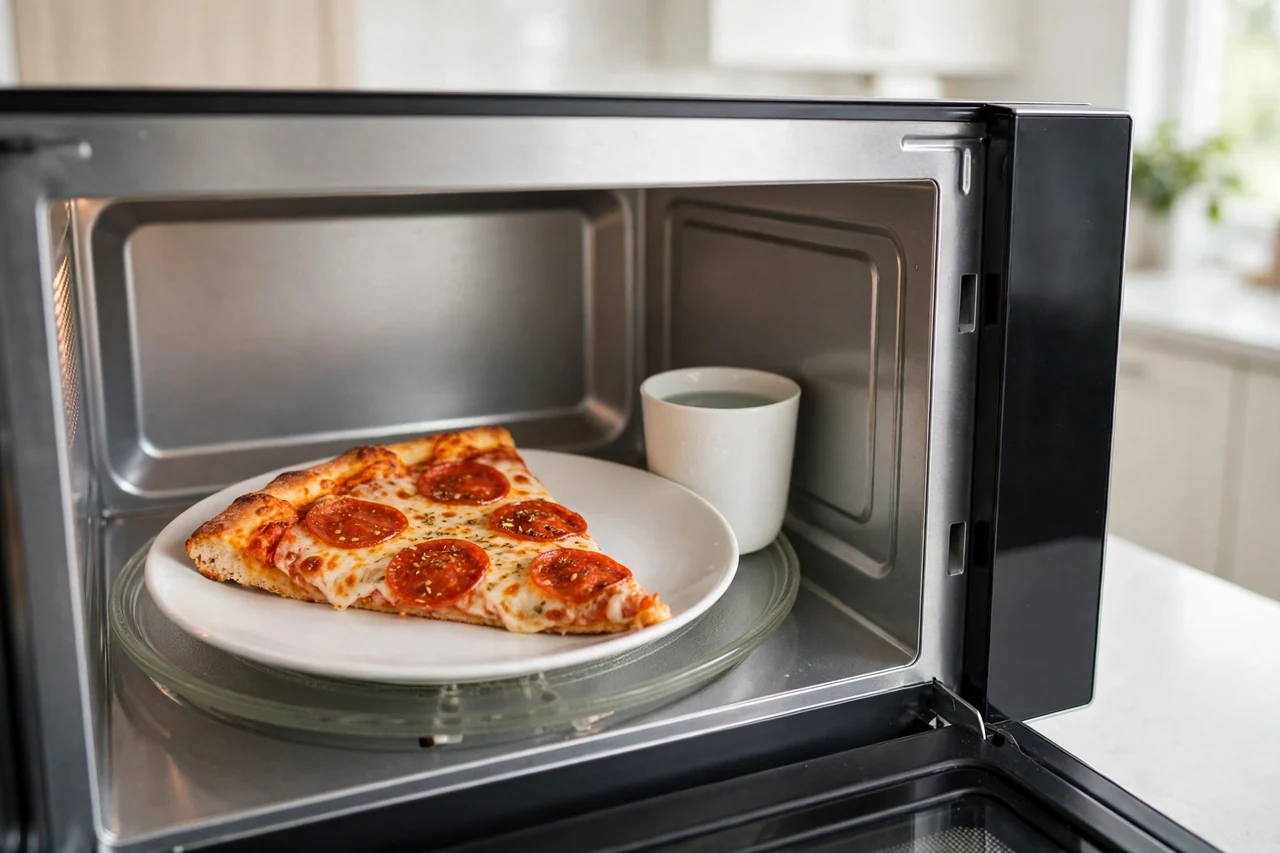
Yes, you can microwave pizza, and the best way to do it is with the water-cup trick. Place your slice on a microwave-safe plate, set a microwave-safe mug half-filled with water next to it on the turntable, and microwave one slice for 30 to 45 seconds at full power or 60 to 90 seconds at 50 percent power. Let it rest for a minute before eating.
The water cup works by absorbing some of the microwave energy and adding a little humidity to the oven cavity, which keeps the crust from turning tough and rubbery. It will not make the crust crispy, but it noticeably improves the texture compared to microwaving the slice alone. For a broader view of what reheats well in a microwave and what does not, see Can You Microwave It? The Complete Safety Chart. If crispy crust is the goal, the skillet method below beats every microwave trick ever invented.
Why Microwaved Pizza Goes Soggy (And Rubbery)
To fix the problem, you need to know what the microwave is actually doing to your slice. Three things happen at once, and all three are bad for texture.
First, the microwave turns the water inside the pizza into steam, fast. That steam has to go somewhere, and the nearest somewhere is up through the cheese and out through the crust. The crust, which was crisp when it left the pizzeria, absorbs that steam like a sponge and goes soft and soggy. This is the main event: sogginess is steam trapped in bread.
Second, the microwave overcooks the cheese proteins. Cheese is an emulsion of fat, water, and protein, and rapid microwave heating makes the proteins tighten and squeeze out fat and water. That is why microwaved cheese goes from stretchy to rubbery to oddly greasy, sometimes all in the same slice. Longer heating makes it worse, which is why short bursts matter so much.
Third, the starch in the crust undergoes changes. When bread cools in the fridge, its starches recrystallize in a process called retrogradation, which is why cold pizza crust tastes stale and firm. Reheating reverses some of that, but uneven microwave heating reverses it unevenly, leaving you with spots that are gummy and spots that are tough. The whole slice ends up with a texture that no one would describe as fresh.
Understanding this trio, steam sogginess, protein tightening, humidity loss, tells you exactly what a good reheating method needs to do: heat the slice fast enough to be convenient, gently enough to protect the cheese, and in a way that manages moisture instead of trapping it. Every method below is judged against those three jobs.
How to Reheat Pizza in the Microwave: The Water-Cup Method
Here is the method step by step, refined from the versions published by food writers and recommended by Domino’s.
Put one or two slices on a microwave-safe plate, not overlapping. Overlapping slices steam each other and heat unevenly, so give each slice its own space. If you are reheating more than two slices, work in batches; crowding the plate defeats the whole method.
Fill a microwave-safe mug about halfway with water and set it on the turntable next to the plate, not touching the pizza. The mug should be plain ceramic or glass with no metallic decoration. The water serves two purposes: it absorbs a share of the microwave energy so the pizza heats more gently, and it releases a little steam that keeps the oven cavity humid, which protects the crust from drying into cardboard.
Microwave for 30 to 45 seconds at full power for a single slice. That is shorter than you think, and that is the point: most people nuke pizza for two minutes and then wonder why it is ruined. For two slices, go 60 to 75 seconds. If your microwave runs hot or the slices are thick, use 50 percent power and extend to 60 to 90 seconds per slice; lower power is gentler on the cheese.
Let the slice rest for a full minute before you bite in. The cheese continues to settle and the heat evens out during the rest, and you avoid the molten-cheese mouth burn that ruins more late-night pizza sessions than anything else. The slice will not be crispy, but it will be hot, the cheese will be melty rather than rubbery, and the crust will be soft-chewy rather than soggy. For the price of 45 seconds and a mug of water, that is a very good deal.
Does the Water Cup Trick Really Work? An Honest Assessment
Yes, with realistic expectations. The water-cup trick is not magic and it is not a myth; it is a modest, real improvement with a clear mechanism, and the food writers who tested it describe the effect consistently.
What it actually does: the water absorbs microwave energy that would otherwise go straight into the pizza, so the slice heats slightly more slowly and evenly. The gentle steam it gives off keeps the crust’s surface from drying out and toughening. The practical result, as Tasting Table’s test of the hack found, is a slice with a better-preserved crust texture and more evenly melted cheese than microwaving the slice alone.
What it does not do: it does not make the crust crispy. Crispness requires dry, direct, high heat, the kind a skillet or oven provides, and a microwave fundamentally cannot produce it because it heats by exciting water molecules. Anyone promising crispy microwave pizza is selling something. The trick moves the result from “regrettable” to “perfectly fine,” which is exactly what a 45-second method should be judged on.
One caution from testing: keep the heating time short. If you microwave for several minutes, the water mug itself starts boiling and pumping real steam into the cavity, which undoes the benefit and can make the crust wetter, not drier. Under a minute per slice is the zone where the trick helps. Past that, you are steaming your pizza, and nobody wants steamed pizza.
How Long to Microwave a Pizza Slice
Timing is everything with pizza because the line between melty and rubbery is about 30 seconds wide. This table assumes a standard 1,000-watt microwave and refrigerated slices.
| What you are heating | Full power | 50 percent power |
|---|---|---|
| 1 thin-crust slice | 30 to 40 seconds | 60 to 75 seconds |
| 1 regular slice | 40 to 50 seconds | 75 to 90 seconds |
| 1 thick or deep-dish slice | 60 to 75 seconds | 90 to 120 seconds |
| 2 regular slices | 60 to 75 seconds | 2 to 2 and a half minutes |
Always use the water cup alongside, and always rest the slice for a minute after. If the cheese is not quite melted after the rest, add 15-second bursts rather than another full minute; cheese goes from perfect to rubber very fast. Cold spots in the middle of a thick slice are normal with microwaves; the rest period evens most of them out.
The Damp Paper Towel Alternative
If you do not want to fuss with a mug, the damp paper towel method is the other well-known microwave trick, and Tasting Table’s reheating roundup covers it as the moisture-focused option.
Dampen a paper towel so it is just barely moist, with no water dripping off it, and drape it loosely over the slice, covering it fully. Microwave at 50 percent power for 1 to 2 minutes. The towel traps a thin layer of humidity around the slice, which keeps the crust from drying out and helps the cheese melt gently.
The key word is damp, not wet. A dripping towel soaks the crust and gives you the exact sogginess you are trying to avoid. Wring it out well. And use plain white paper towels with no printed patterns, since inks and dyes do not belong near hot food. For more on what paper products can handle the microwave, see Can You Microwave Paper Towels?.
Between the two tricks, the water cup gives slightly better crust texture and the paper towel gives slightly better cheese melt, but the difference is small. Pick whichever one you will actually bother to do.
Better Ways to Reheat Pizza: Ranked Honestly
The microwave is the fastest method and the worst for texture. If you have even five extra minutes, these methods beat it decisively.
The skillet method is the champion. Heat a nonstick or cast-iron skillet over medium heat, place the slice in the dry pan, and cover with a lid for 2 to 3 minutes. The direct heat crisps the bottom crust while the trapped steam melts the cheese from above. For extra insurance, add a teaspoon of water to the pan (not on the pizza) before covering; the steam finishes the cheese without wetting the crust. Total time is about 4 minutes, and the result is genuinely close to fresh pizza.
The oven or toaster oven comes second. Preheat to 375 degrees Fahrenheit, place slices directly on the rack or a baking sheet, and heat for 8 to 10 minutes. The dry heat re-crisps the crust beautifully and melts the cheese evenly. It takes the longest, but for multiple slices it is the most even method.
The air fryer is the speed-quality compromise. Set it to 350 degrees Fahrenheit and heat slices for 3 to 5 minutes. The circulating hot air crisps the crust fast and melts the cheese well. It is the best choice when you want near-skillet quality without watching a pan.
| Method | Time | Crust result | Effort |
|---|---|---|---|
| Microwave with water cup | Under 1 minute | Soft, not soggy | Minimal |
| Air fryer at 350 F | 3 to 5 minutes | Crisp | Low |
| Skillet with lid | 4 minutes | Crisp bottom, melty top | Medium |
| Oven at 375 F | 8 to 10 minutes | Crisp all over | Low, but slow |
The honest ranking for texture: skillet first, oven second, air fryer third, microwave last. The honest ranking for speed is the exact reverse. Choose based on how much you care right now.
Is It Safe to Eat Pizza Left Out Overnight?
No, and this is the one part of this guide where there is no wiggle room. Pizza is a perishable food: cheese, meat toppings, and sauce all sit squarely in the category the USDA worries about. The USDA’s rule is that perishable food must not sit at room temperature for more than two hours (one hour if it is above 90 degrees Fahrenheit), because bacteria multiply fastest between 40 and 140 degrees Fahrenheit, a range food-safety experts call the danger zone. The USDA’s own food-safety guidance names pizza explicitly among the foods that cannot stay at room temperature for more than two hours.
Overnight is roughly four times that limit. Reheating does not save it, either. A hot microwave kills many bacteria, but some bacteria produce toxins that survive heating, so you cannot cook your way out of an all-night room-temperature stay. If the pizza sat out all night, throw it out. It hurts, but food poisoning hurts more.
The safe routine is simple: box up leftover pizza and refrigerate it within two hours of it arriving or coming out of the oven. In the fridge it keeps safely for 3 to 4 days. When you reheat it, the USDA recommends bringing leftovers to 165 degrees Fahrenheit, steaming hot throughout, which also happens to be when the cheese is at its best.
Storing Leftover Pizza the Right Way
Good reheating starts with good storage, because a slice that dried out in the fridge for three days will never come back fully.
Cool the pizza first, but not for long: get it into the fridge within two hours. Stack slices with parchment or wax paper between them so the cheese does not fuse the slices into a single inseparable brick, then seal them in an airtight container or zip-top bag. The box the pizza came in is fine for the first night in a pinch, but it is not airtight, so transfer to something sealed for longer storage. Do not microwave pizza in the delivery box itself; most boxes carry inks and adhesives that are not food-safe when heated, a point covered in detail in Can You Microwave Cardboard Takeout Boxes?.
Refrigerated pizza keeps 3 to 4 days. After that, the quality drops and the safety margin shrinks, so freeze what you will not eat: wrap slices individually, freeze for up to 2 months, and reheat from frozen in the oven or air fryer. Never refreeze pizza that has already been thawed and reheated.
Frequently Asked Questions
Straight answers to the questions people actually search about microwaving pizza.
Can you reheat pizza in the microwave?
Yes. Put the slice on a microwave-safe plate, set a half-filled mug of water next to it, and microwave 30 to 45 seconds for one slice. It will be hot and edible with decent texture, though never crispy. For crispy crust, use a skillet or oven instead. The microwave is the speed option, not the quality option.
How do you reheat pizza in the microwave without it getting soggy?
Use the water-cup trick and keep the time short. Place a half-filled mug of water next to the slice, microwave just 30 to 45 seconds, and do not overlap slices. The short time is critical: long microwaving pumps steam into the crust, which is what makes it soggy. Let the slice rest for a minute after heating so the cheese settles instead of turning rubbery.
How long do you microwave a pizza slice?
One regular slice needs 40 to 50 seconds at full power, or 75 to 90 seconds at 50 percent power, always with the water cup alongside. Thin-crust slices need a little less (30 to 40 seconds); thick or deep-dish slices need a little more (60 to 75 seconds). Add time in 15-second bursts, not full minutes, because cheese goes rubbery fast.
Does the water cup trick really work?
Yes, within realistic limits. The water absorbs some microwave energy and adds gentle humidity, which keeps the crust from toughening and helps the cheese melt evenly. Food writers who tested it found a noticeable improvement over microwaving the slice alone. It does not make the crust crispy; no microwave method can. It moves the result from regrettable to perfectly fine in 45 seconds.
Is it safe to eat pizza left out overnight?
No. The USDA says perishable foods like pizza must not sit at room temperature for more than two hours, and overnight is far past that limit. Reheating does not make it safe, because some bacterial toxins survive heat. Throw overnight pizza out. Refrigerate leftovers within two hours and they keep safely for 3 to 4 days.
Why does microwaved pizza get rubbery and chewy?
Because the microwave overheats the cheese proteins, making them tighten and squeeze out fat and water, and because uneven heating partially reverses the staling that happened in the fridge, leaving gummy and tough patches. Both problems get worse with longer heating. Short bursts, lower power, and the water cup all reduce the rubberiness.
Can you microwave frozen pizza?
You can, but you should not expect much. Frozen pizza is designed for oven baking, and microwaving it from frozen gives you a hot-but-soggy result with unevenly melted cheese. If you must, thaw it in the fridge first, then use the water-cup method. For frozen pizza, the oven or air fryer at the package temperature is dramatically better and worth the wait.
Should you use full power or half power for pizza?
Half power gives better texture, full power gives more speed. At 50 percent power the cheese melts gently instead of seizing into rubber, and the crust heats more evenly. If you are only reheating one slice and you are in a hurry, 30 to 45 seconds at full power with the water cup is fine. If texture matters more than seconds, go half power for 60 to 90 seconds.
Can you reheat pizza twice?
You can, but each round makes it worse and the food-safety clock keeps ticking. Every reheat drives more moisture out of the crust and toughens the cheese further, so twice-reheated pizza is noticeably inferior. From a safety view, only reheat the portion you will eat, and do not keep returning the same slices to the fridge for another round. When in doubt, the 3-to-4-day fridge limit still applies from when the pizza was first cooked.
What is the absolute best way to reheat pizza?
A skillet on the stove. Medium heat, slice in a dry pan, lid on, 2 to 3 minutes, with a teaspoon of water flicked into the pan (not onto the pizza) to steam the cheese. You get a crisp bottom crust and fully melted cheese in about 4 minutes. The oven at 375 degrees for 8 to 10 minutes is the best hands-off method, and the air fryer at 350 degrees for 3 to 5 minutes is the best fast method.
How long does leftover pizza last in the fridge?
Three to 4 days in an airtight container, according to USDA leftover guidance. Stack slices with parchment between them so they do not fuse, seal them well, and refrigerate within two hours of cooking or delivery. After 4 days, freeze or discard. Frozen pizza slices keep their quality for up to 2 months.
Can you microwave pizza in the cardboard box?
No. Pizza boxes are not microwave-safe: the cardboard can contain inks, adhesives, and recycled content that are not meant to be heated, and the box can scorch or catch fire with extended microwaving. Always transfer the slice to a microwave-safe plate first. The box is for transport and short-term storage, not for the microwave.
Why does the cheese get tough instead of melty?
Because microwave energy heats the cheese too fast, causing its proteins to contract and expel moisture and fat, a process that turns stretchy melted cheese into a tough, rubbery sheet. Low-moisture mozzarella, the standard pizza cheese, is especially prone to this. Shorter heating times and 50 percent power keep the proteins from seizing, which is why timing matters more than any trick.
Is cold pizza safe to eat?
Yes, as long as it was refrigerated within two hours and eaten within 3 to 4 days. Cold pizza straight from the fridge is perfectly safe; the safety issue is only about time spent at room temperature, not about temperature of serving. Plenty of people prefer it cold, and food-safety-wise there is nothing wrong with that.
The Bottom Line
The microwave is the fastest way to reheat pizza and the least impressive for texture, and the water-cup trick is what makes the trade-off acceptable. Forty-five seconds, a mug of water, a minute of rest, and you get hot pizza with melty cheese and a crust that is soft instead of soggy. It is not fresh pizza, and it is not trying to be.
When you have four minutes, use the skillet and get pizza that genuinely rivals fresh. When you have ten, use the oven. And whatever method you choose, get the leftovers into the fridge within two hours, because the food-safety rules do not bend for midnight cravings. Hot pizza is a pleasure; safe pizza is a requirement. Do both.
