

If you have ever stood in front of your microwave holding a leftover burrito wrapped in foil, you are not alone. That moment of doubt is one of the most common kitchen fears in America. Can you microwave aluminum foil, or will it spark, smoke, and ruin your appliance the second you press start? Almost every kitchen has a foil scare story, from a forgotten butter wrapper to a leftover burrito that sparked like a firework. This guide clears the confusion up once and for all.
Here is the honest promise of this guide. You will get the nuanced, USDA-backed truth that most articles skip. You will learn exactly when foil is acceptable, the strict rules that make it safe, and the everyday habits that make it dangerous. You will also learn what to do if sparks appear and which safer alternatives to use instead. By the end, you will never guess about foil and microwaves again.
Can You Microwave Aluminum Foil? The Honest Answer
Here is the short answer. In most everyday situations, no, you should not microwave aluminum foil. But the USDA actually permits one narrow exception: small, smooth pieces of foil can shield thin parts of food from overcooking, as long as you follow strict rules. For most people, the safest choice is to skip the foil and use a microwave-safe lid, paper towel, or parchment paper instead.
Most articles give you a flat no and move on. That advice is safe, but it hides the full truth. The USDA’s food safety guidance says small amounts of smooth foil can be used to shield areas like poultry drumsticks and wings from overcooking. This is a deliberate technique with precise rules, not a casual habit. The gap between those two messages is where kitchen accidents happen, because people either treat all foil use as safe or panic over harmless moments like a tiny foil label.
Why do the simple guides say no when the USDA says sometimes? Because misuse is far more common than correct use. Foil that is crumpled, wrapped around food, or pushed against the oven wall will spark. Most microwave manufacturers advise against foil for exactly this reason. They know that in a busy kitchen, the rules get forgotten. So the honest answer is this: technically yes under strict rules, practically no for everyday reheating. When in doubt, leave the foil out.
Think about how this question usually comes up in real life. You are reheating Chinese takeout and notice a metal handle on the container. You are softening butter and realize the wrapper has a foil layer. You are warming a frozen burrito and the foil label is still attached. These accidental encounters are exactly how most foil sparks start, and they are the reason this article exists. On forums, users describe forgetting the foil on butter packaging and watching it catch fire within seconds, or ruining a batch of toffees by leaving foil wrappers on. The pattern is always the same: nobody planned to microwave foil, it just happened.
If you want the big picture on which materials are safe and which are not, see our main reference, Can You Microwave It? The Complete Safety Chart, where foil sits alongside every common kitchen material in one quick lookup table.
Why Aluminum Foil Sparks in the Microwave
The direct answer is that foil reflects microwaves and concentrates electrical energy at sharp edges, which causes sparks called arcing. Smooth flat metal behaves very differently from thin crumpled foil, and that difference explains everything about why foil misbehaves in your microwave.
A microwave oven cooks with invisible electromagnetic waves. These waves bounce around the metal cavity of the oven until they are absorbed by water, fat, and sugar molecules in your food. Those molecules move rapidly, and their movement becomes heat. Metal does not absorb these waves. It reflects them, like a mirror reflects light. The walls of your microwave are metal, and they are thick, smooth, and designed to reflect energy safely back into the cavity.
Aluminum foil is a very different story. It is extremely thin, often crinkled, and full of tiny edges and points. When microwaves strike the foil, they push electrical charges along its surface. On a flat, smooth piece of metal, these charges spread out harmlessly. But sharp edges, crinkles, and folds act like funnels. They concentrate the charge into tiny points. When the buildup gets strong enough, it jumps through the air as a spark. Scientists call this arcing, and it is the same basic idea as lightning on a tiny scale.
What Arcing Actually Does to Your Microwave
Arcing is not just a light show. Each spark is an intense burst of heat that can reach thousands of degrees at the contact point. Repeated arcing can pit and scar the interior walls of the microwave, which creates more rough spots where future sparks happen more easily. In bad cases, sparks can damage the magnetron, the part that generates the microwaves. A damaged magnetron can mean a dead microwave and an expensive repair.
Sparks can also ignite things. A bit of grease, a paper label, or food residue near the foil can catch fire when a spark lands on it. This is how foil incidents turn into real kitchen fires. The danger is not that the foil explodes like a movie bomb. The danger is that sparks start small fires, melt the foil into your food, or quietly damage the oven so it fails later. That is why safety experts take even a single spark seriously.
Why Crumpled Foil Is Far Worse Than Smooth Foil
Crumpled foil is the most dangerous form because every crease is a sharp edge where charge concentrates. A ball of foil is practically a spark factory, with hundreds of points and valleys where energy builds up. Flattened, smooth foil has far fewer of these points, which is why the USDA rules insist on new, smooth foil only. Old foil that has been reused is always somewhat creased, so it is never the right choice for shielding.
Thickness matters too, in a small way. Standard household foil is thin enough to heat up fast and burn through. Heavier gauge foil conducts charge a little more evenly, but it is still not safe to use carelessly. The shape of the foil matters much more than its thickness. A flat smooth sheet is calm. A crumpled sheet with sticking-out edges is trouble. This is the single most useful thing to remember if you ever intentionally shield food with foil.
What the USDA Says About Foil in the Microwave
The USDA guidance is clear: small, smooth pieces of foil can shield food in a microwave, but only under strict rules. The USDA’s food safety publication on microwave ovens states that it can be safe to use small amounts of aluminum foil in a microwave oven, while warning that microwaves cannot pass through metal and food completely covered in foil will not heat. This is the nuanced position most quick-answer articles never mention.
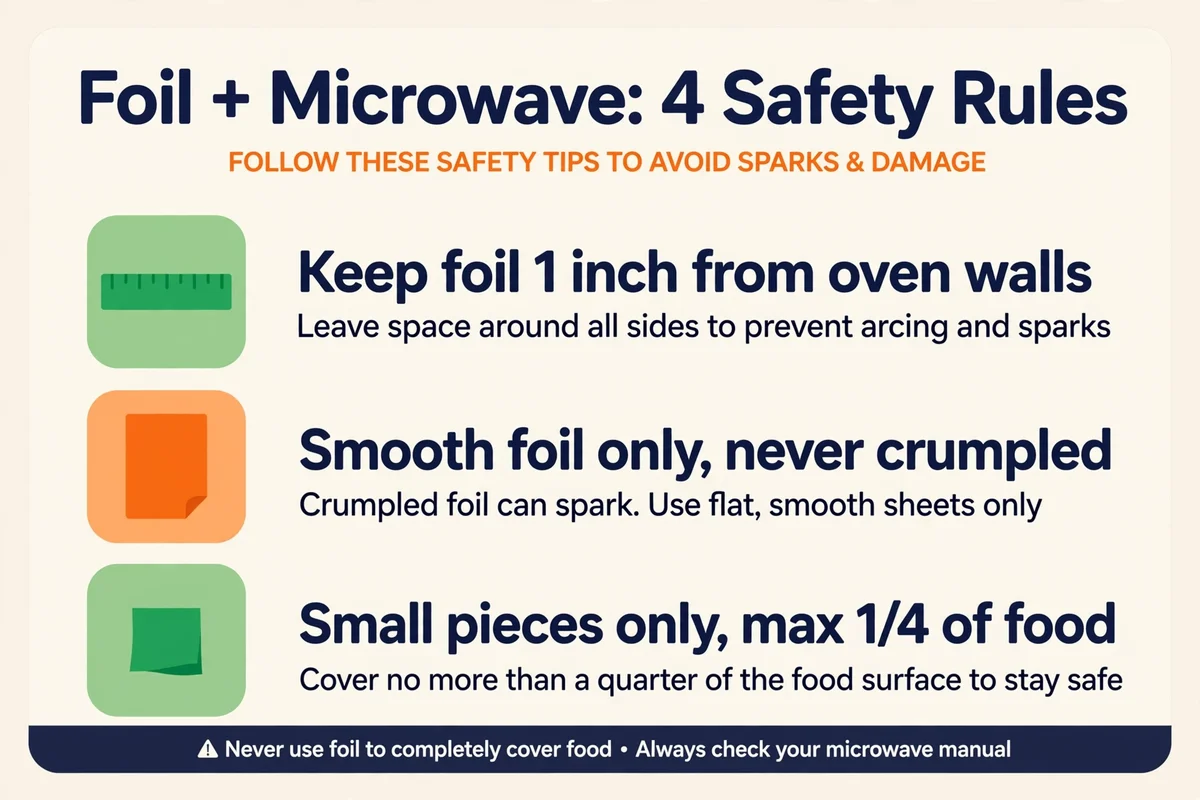
Here are the USDA’s general rules for safe use of aluminum foil, restated in plain language. First, use new, smooth foil only, because wrinkled foil causes arcing. Second, cover no more than one quarter of the food with foil. Third, shape the foil smoothly to the food so no edges stick out. Fourth, it makes no difference which side of the foil, shiny or dull, faces out. Fifth, do not place the foil closer than one inch from the oven walls. Sixth, if your microwave has metal shelves or a metal turntable, do not let foil shielding touch or sit close to them.
The USDA also gives one clear emergency rule. If you see arcing, immediately remove the foil shielding, and if the food came in a foil container, transfer it to a microwave-safe dish. Always consult your own microwave manual too, because the USDA tells you to follow the manufacturer’s recommendations as well. If your manual says no foil at all, that wins. You can read the USDA’s full guidance in their microwave ovens and food safety publication, which lays out these rules alongside the rest of their microwave safety advice.
Why Manufacturers Say No Even When the USDA Says Sometimes
Most microwave brands, including big names like Panasonic, advise against foil entirely. A Panasonic spokesperson has said publicly that thin pieces of metal like aluminum foil can cause arcing and ignition, and that users should check everything is suitable for microwave use or risk damaging the machine. Other brands publish the same strict stance in their manufacturer guidance on using aluminum foil in a microwave. This is stricter than the USDA, and there is a good reason for the difference. The USDA is describing what is physically possible under ideal conditions. The manufacturer is protecting itself against what real people do in real kitchens.
Manuals are written for the worst case. They know you will be distracted, rushed, and probably microwaving leftovers at midnight. Some manuals even note that warranty claims can be affected if the oven shows damage from metal use, so the financial risk is real too. The safe move is to treat the manufacturer’s manual as your final authority. If it says no foil, there is no debate. Only use foil for shielding if your manual allows it and you can follow every rule without rushing.
When Is It Okay to Microwave Aluminum Foil? Shielding, Wrapping, and Covering Compared
The direct answer is that shielding thin parts of food is the only use the USDA supports, while wrapping and covering food with foil are unsafe. The table below makes the differences clear, because these three uses look similar but carry very different risks.
| Use | What it looks like | Risk level | What the USDA says |
|---|---|---|---|
| Shielding | Small smooth pieces on wing tips, drumstick ends, or dish edges | Low, if every rule is followed | Allowed: new smooth foil, max 1/4 of food, 1 inch from walls |
| Wrapping | Food fully wrapped in foil, like a burrito | High | Unsafe: food cannot absorb microwaves, heat reflects, fire risk |
| Covering | Loose foil tented over a bowl or plate | High | Unsafe: edges hang near walls and food, arcing likely |
| Foil containers | Frozen meals in aluminum trays | Medium to high | Only if package says microwave-safe and you follow its instructions |
| Twist ties and metal handles | Takeout boxes, bag ties, dishes with metallic trim | High | Never microwave these, no exception |
Shielding works because you are deliberately blocking microwaves from reaching one small spot. Chicken wing tips and drumstick ends cook faster than the rest of the bird, so a tiny smooth piece of foil protects them from drying out or burning. This is a classic technique from conventional cooking, adapted for the microwave. It only works when the foil is small, flat, smooth, and molded tightly to the food with no edges sticking out. The moment the piece is too big, too loose, or too close to the wall, you have left the safe zone.
Wrapping is the opposite of shielding. When you wrap food completely in foil, the microwaves cannot reach the food at all, because microwaves cannot pass through metal. The food stays cold while the oven’s energy bounces around the cavity with nothing to absorb it. That is nearly the same as running the microwave empty, which can damage the magnetron. The foil also heats up from the reflected energy, and its crinkled surface sparks. This is the number one foil mistake, usually done with leftover sandwiches, burritos, or baked potatoes.
Covering food with a loose sheet of foil feels harmless, but it combines the worst of both worlds. The sheet blocks microwaves from the food underneath, so heating is uneven. The loose edges and corners of the sheet are sharp points where charge concentrates, and they often sit close to the oven walls, which is exactly where sparks jump. If you want to cover food in the microwave, reach for a microwave-safe lid, a paper towel, or parchment paper instead. For more on covering options, see our guide on can you microwave paper towels, which explains how to use them correctly.
If you do decide to shield food with foil, here is the safe sequence. First, confirm your microwave manual allows foil use. Second, tear off a small piece of new foil and keep it flat and smooth, never crumpled. Third, mold it snugly onto just the thin spot, like the tip of a wing, covering no more than a quarter of the food. Fourth, check that no edges stick out and that the foil sits at least one inch from every oven wall. Fifth, stay near the microwave and watch for sparks. If you see even one spark, stop the oven and remove the foil immediately.
What to Do If Aluminum Foil Sparks in Your Microwave
If foil sparks in your microwave, stop the oven immediately and remove the foil before doing anything else. Do not open the door and reach in while sparks are flying. Press stop, wait a few seconds for the sparks to settle, then carefully remove the food and the foil.
Once the foil is out, inspect your microwave. Look for scorch marks, pitting, or melted spots on the interior walls and on the wave guide cover, which is usually a small mica or cardboard-colored panel inside the cavity. Small scorch marks on the wall are cosmetic, but damage to the wave guide cover can let future sparks spread, so check your manual about replacing it. If the microwave smells strongly of burnt metal or behaves oddly afterward, unplug it and do not use it until it has been checked. A repair shop can tell you whether the magnetron was harmed.
Now think about the food. If the foil only sparked briefly and never touched the food, the food is fine to eat. If the foil burned, melted, or blackened onto the food, throw the food away. Burnt foil can leave tiny sharp metal fragments and residue on the food, and it is not worth the risk. Also, let any foil cool before touching it. Sparks can heat foil far past the point where it will burn your fingers.
How to Check That Your Microwave Still Works Safely
After a foil incident, test the oven with a simple water test before cooking real food. Place a microwave-safe mug of water in the center of the oven and heat it for one minute. The water should get hot and the oven should run without any sparks, strange noises, or burning smells. If everything looks and sounds normal, the oven is almost certainly fine. This is the same kind of basic safety check recommended in our broader guide on things you should never put in the microwave.
Pay attention to future performance too. If heating becomes uneven, cooking takes much longer than before, or you hear new buzzing sounds, the magnetron may have been damaged. Magnetron damage from one short foil accident is uncommon but possible, and it is the main reason experts say to stop the oven at the first spark. A quick reaction is the difference between a scary moment and a broken appliance.
Safer Alternatives to Aluminum Foil in the Microwave
The best alternative to foil in the microwave is a microwave-safe lid or cover, which does everything foil cannot. It lets microwaves reach the food, holds in steam, prevents splatters, and carries zero spark risk. If you own one silicone or glass lid that fits your bowls, you have solved most of the problems foil was supposed to solve.
Paper towels are the next best option. A damp paper towel laid over food keeps it moist and catches splatters without blocking microwaves. Use plain white paper towels and check that they do not contain metal fragments, because some recycled paper products can. Avoid printed or colored towels, since the inks are not always microwave-safe.
Parchment paper is another excellent cover. It tolerates microwave heat well, does not stick to most foods, and can be loosely tented over a dish. Wax paper works too, but keep it from touching the food, since wax can melt at high temperatures. Plastic wrap is safe only if it is labeled microwave-safe, and you should leave a small vent so steam can escape. Never let plastic wrap touch the food during microwaving. For plastic containers in general, see our guide on can you microwave Ziploc bags before you reach for one.
What About Glass and Ceramic Lids?
Glass and ceramic lids are the gold standard for covering food in a microwave. They are heavy enough to stay put, they let microwaves pass through to the food, and they can go straight from microwave to table. Just make sure the dish and lid are both labeled microwave-safe, because some glass and ceramic items have metallic trim or glazes that are not safe. Dishes with gold rims or metallic paint belong in the same danger category as foil, since the thin metal trim can arc. When you are unsure about a container’s symbols, our microwave safe symbols decoded guide walks through every marking.
One more habit to build: check for hidden metal before every microwave run. Twist ties on bread bags, foil seals on yogurt cups, metal handles on takeout containers, and foil-lined frozen trays are the usual suspects. A two-second scan of what is going into the oven prevents almost every foil accident. It is the simplest safety upgrade in this entire article, and it costs nothing.
Frequently Asked Questions
Can you microwave aluminum foil safely?
No, not in normal everyday use. The only exception the USDA allows is using small, smooth pieces of foil to shield thin parts of food from overcooking, and only if the foil stays at least one inch from the oven walls, covers no more than one quarter of the food, and has no crinkled edges. For reheating and covering, foil is never the safe choice. Use a microwave-safe lid, paper towel, or parchment paper instead.
Why does aluminum foil spark in the microwave?
Foil sparks because microwaves create electrical charges on its surface, and those charges concentrate at sharp edges, crinkles, and folds until they jump through the air as sparks. This sparking is called arcing. Smooth flat metal spreads the charge harmlessly, but thin crumpled foil turns every crease into a spark point. That is why the USDA rules insist on new, smooth foil only.
What happens if you accidentally microwave aluminum foil?
You will usually see sparks within seconds, and you should stop the microwave immediately. Brief sparking is often harmless, but prolonged sparking can scar the oven walls, damage the magnetron, or start a fire if it ignites grease or food residue. Afterward, remove the foil, check for scorch marks inside the oven, and throw away any food the foil burned or melted onto.
Can I microwave food wrapped in aluminum foil?
No, never microwave food fully wrapped in foil. Microwaves cannot pass through metal, so the food underneath will not heat while the oven’s energy bounces around with nowhere to go. The wrapped foil will heat up, spark, and can damage the microwave or start a fire. Always unwrap the food and transfer it to a microwave-safe dish first. Running the oven with fully wrapped food is close to running it empty, which manufacturers warn against.
Can you microwave a TV dinner in its foil tray?
Only if the packaging specifically says it is microwave-safe. Some frozen meals come in foil trays that were designed and tested for microwave use, with instructions like removing a film or using a specific power setting. If the package does not clearly state microwave safety, transfer the food to a glass or ceramic dish. Never guess, because an untested foil tray can arc against the oven walls.
Does it matter if the foil is crumpled or smooth?
Yes, it matters a great deal. Crumpled foil is far more likely to spark because every crease and fold creates a sharp point where electrical charge concentrates. Smooth, flat foil spreads the charge evenly and is much calmer. This is why the USDA’s first rule is to use new, smooth foil only. Reused foil is always somewhat creased, so it should never be used for shielding in a microwave.
Can I cover a bowl with foil in the microwave if the foil does not touch the food?
No, this is still unsafe even when the foil does not touch the food. A loose foil cover blocks microwaves from reaching the food, so heating becomes uneven. Its loose edges and corners are sharp spark points, and they often sit close to the oven walls where arcing happens most easily. Cover the bowl with a microwave-safe lid, a damp paper towel, or parchment paper instead.
Will aluminum foil explode in the microwave?
No, foil does not explode like a bomb. What actually happens is sparking, smoking, and sometimes small flames if the sparks ignite grease or food residue. The real dangers are fire, damage to the microwave’s interior, and harm to the magnetron from repeated arcing. The effects are serious enough without an explosion, so treat any sparking as an emergency and stop the oven right away.
Can I eat food that was microwaved with foil?
It depends on what happened. If the foil sparked briefly and never touched or burned onto the food, the food is safe to eat. If the foil burned, blackened, or melted onto the food, throw the food away, because it may contain tiny sharp metal fragments or burnt residue. When in doubt, do not eat it. Food is replaceable, and the risk is not worth a saved meal.
What does the USDA say about microwaving aluminum foil?
The USDA says small amounts of aluminum foil can be used to shield areas of food, such as poultry drumsticks and wings, from overcooking. Their rules are: use new smooth foil only, cover no more than one quarter of the food, shape it smoothly so no edges stick out, keep it one inch from the oven walls, and remove it immediately if you see sparks. The USDA also says to always follow your microwave manufacturer’s recommendations, which are often stricter.
Can I microwave aluminum foil containers from the store?
Only if the container or its packaging is clearly labeled microwave-safe. Some foil trays are engineered for microwave use, but most are made for conventional ovens only. Check the bottom of the tray and the package instructions. If there is no microwave-safe marking, transfer the food to a microwave-safe dish. For other containers, stick to plain glass or ceramic dishes that carry a microwave-safe label.
Do twist ties and gold-trimmed plates spark in the microwave too?
Yes, any thin metal can spark, not just foil. Twist ties contain a metal wire, gold or metallic trim on plates is a thin layer of metal, and metal handles on takeout containers are classic spark sources. These are actually the most common cause of accidental arcing, because people forget they are there. Remove twist ties, transfer food off metallic-trimmed dishes, and take food out of handled takeout boxes before microwaving.
My microwave has a metal rack. Can I use foil with it?
You should be extra careful here. A metal rack that came with your microwave is designed for it and is safe to use as directed. But the USDA specifically warns not to let foil shielding touch or sit close to metal shelves or a metal turntable, because sparks can jump between the foil and the rack. If your oven has metal racks, foil shielding is riskier, so consider skipping it and using a paper towel or lid instead. Check your manual for the final word.
What are the safest alternatives to aluminum foil in the microwave?
The safest alternatives are microwave-safe lids, plain white paper towels, parchment paper, and glass or ceramic covers. A silicone or glass lid that fits your bowls handles covering, splatter protection, and steam retention with zero spark risk.
Conclusion
So, can you microwave aluminum foil? For everyday reheating, the answer is a clear no. The USDA allows one narrow exception, which is shielding small parts of food with smooth foil under strict rules, but even that is an advanced technique, not a daily habit. Misuse causes sparks, oven damage, and real fire risk, and most manufacturers advise against foil entirely.
Your two takeaways are simple. First, never wrap, cover, or reheat food in foil, and always scan for hidden metal like twist ties and gold trim before pressing start. Second, when you need to cover food in the microwave, reach for a microwave-safe lid, paper towel, or parchment paper instead. These three habits will keep your microwave safe for years, and you will never have to wonder about foil again.

1 Comment
Pingback: Can You Microwave Bread? Safe Method + Times