

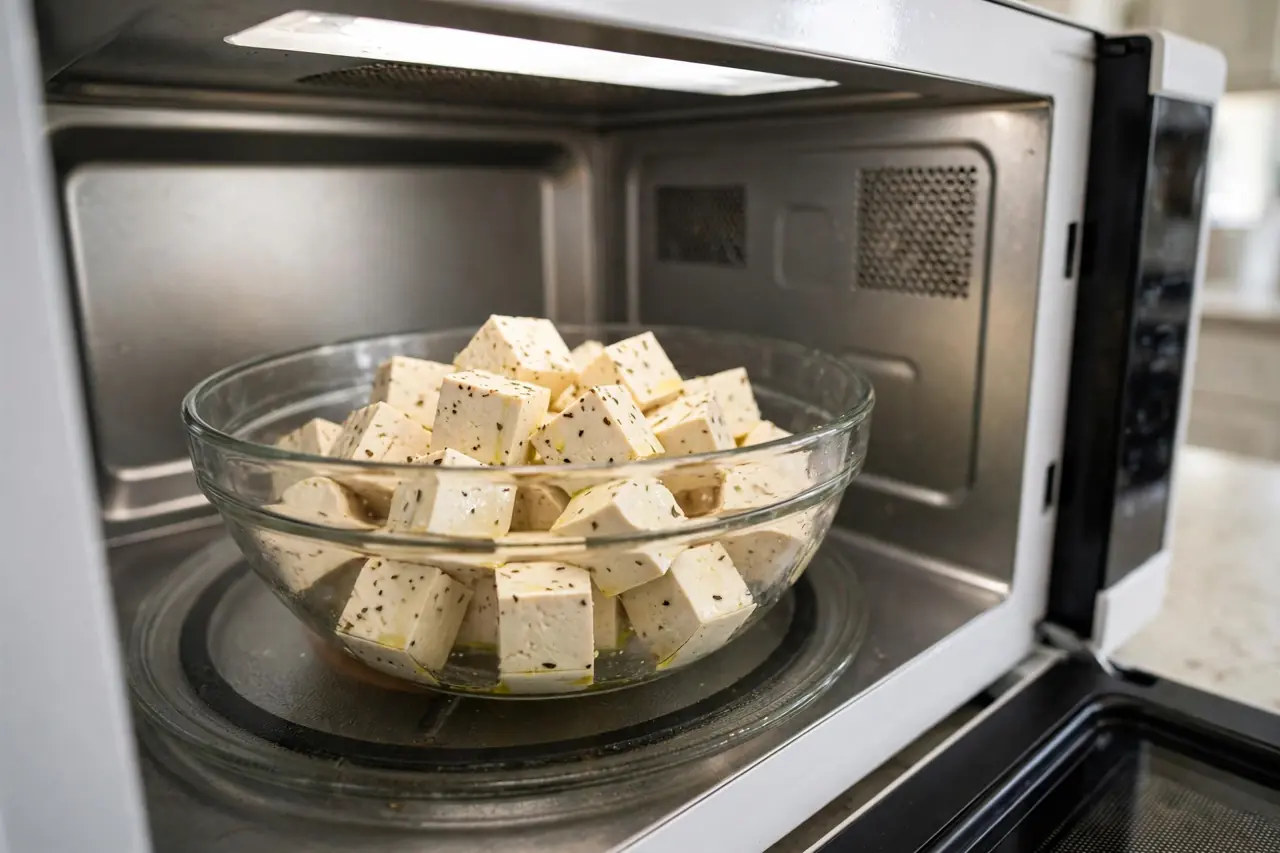
Yes, you can microwave tofu, and for firm and extra firm tofu it is one of the fastest ways to get it ready for a meal. Drain the block, press or pat it dry, cut it into cubes or slices, place it in a single layer in a microwave safe dish, cover loosely, and heat in short bursts with a flip halfway through. For silken and soft tofu, use a gentler approach, with medium power and only 30 to 90 seconds, because high heat turns it rubbery and watery.
Tofu is already cooked during manufacturing, since soy milk is boiled to make the curds, so microwaving fresh tofu is mostly reheating and changing its texture, not cooking it from raw. That fact makes the microwave a useful tool, but it does not make every method safe or tasty. A firm block heated in a pile, in its plastic tub, with no vent, will heat unevenly, steam in its own liquid, and come out soggy in the middle and tough at the edges. The same block, drained, spaced out, and flipped once, comes out firmer, drier on the surface, and ready to take on sauce in a stir fry, a rice bowl, or a salad.
This guide covers each tofu type separately, because that is where most guides go wrong. Firm, extra firm, soft, silken, smoked, and frozen tofu do not behave the same way in a microwave, and a single time for all of them will fail at least one of them. You will also find exact starting times, the safety rules that matter for leftovers, how to thaw frozen tofu, how to fix rubbery or soggy results, and when to skip the microwave and finish in a pan instead. If you only need the quick answer, the short answer section and the step list are enough. If you want tofu that tastes like you meant it, read the sections on pressing, spacing, and power.
Short answer: can you microwave tofu?
Yes. Microwave tofu in a microwave safe glass or ceramic dish, never in the tub it came in, unless that tub is clearly labelled microwave safe, which most tofu tubs are not. For firm or extra firm tofu, microwave cubes in a single layer for 3 minutes, flip or stir, then microwave for 2 to 3 more minutes, until the pieces feel firmer and the surface looks matte rather than shiny and wet. For silken or soft tofu, warm it gently on medium power (50 to 70 percent) for 30 to 90 seconds, without vigorous stirring, and stop as soon as it is warm through. For leftover tofu, heat it until it reaches 165 degrees Fahrenheit (74 degrees Celsius) in the thickest part, measured with a food thermometer, after stirring and standing time.
The safety logic comes from general microwave guidance, not from a special tofu rule. The FDA guidance on microwave ovens warns that metal and unsuitable containers should not be used, because microwaves reflect off metal and food can heat unevenly. The USDA guidance on leftovers advises reheating leftovers to 165 degrees Fahrenheit, covering food in the microwave, and rotating or stirring it for even heating, because microwaves can leave cold spots where bacteria survive. Tofu is dense and wet, so it is exactly the kind of food that hides a cold spot in the centre while the edge is steaming, which is why stirring, flipping, and standing time matter more than the clock alone.
One more safety point deserves to be said plainly. Guidance on tofu is mixed in one place: thawing. Some manufacturer pages list room temperature thawing as an option for silken tofu, while USDA food safety guidance says perishable food should never be thawed on the counter. This guide follows the USDA position. Thaw tofu in the fridge, or use the microwave defrost setting and cook or eat it right away, and do not leave it sitting on the counter to thaw for an hour. When guidance is mixed, the safer rule wins.
Which tofu works best in the microwave?
Firm and extra firm tofu hold up best. They have less water, a tighter curd, and enough structure to survive cubing, flipping, and a second round of heat without falling apart. They are the best choice if you want the microwave to do real work, such as pressing out water, firming the texture, or pre cooking tofu before a quick pan finish. If you buy only one type for microwaving, buy extra firm.
Medium tofu sits in the middle. It will warm well and hold a cube shape for a short heat, but it breaks if you stir it hard or heat it too long. Use it for soups, scrambles, and saucy dishes, where a little breakage does not matter, and keep the time short.
Soft and silken tofu are a different food in practice, even though they share a name. They are mostly water held in a delicate curd, they are sold pre cooked, and they are meant to stay smooth. The microwave can warm them, and it can warm them well, but it cannot firm them the way it firms a block, and it will ruin them if you treat them like firm tofu. Think of silken tofu as warming, not cooking, and stop early.
Smoked tofu and baked tofu are already flavoured and firm, so they reheat well in the microwave in short bursts. Watch the edges, because smoked tofu dries out faster than plain firm tofu, and a dry edge turns leathery in under a minute on high. A splash of water, broth, or sauce in the dish, plus a loose cover, keeps it moist.
Seasoned, marinated, or sauced tofu from a previous meal counts as leftovers for safety purposes, even if it was cooked yesterday in your own kitchen. The same 165 degree rule applies, and the same stir and stand routine applies. Sauce helps here, because it carries heat around the pieces and stops the surface drying out, but it also hides cold spots, so stir the sauce well and check the centre of the thickest piece.
How to microwave firm or extra firm tofu, step by step
Start by draining the block. Open the pack over the sink, tip away the packing liquid, and place the block on a plate lined with paper towels or a clean tea towel. Press it gently with another towel on top for 5 to 10 minutes if you have time. A proper tofu press works too, but a stack of towels and a plate with a can on top does the same job for this purpose. Pressing is not about squeezing every drop out. It is about removing surface water so the microwave heats the tofu, not a puddle around it.
Cut the pressed block into cubes about 1.5 centimetres across, or slices about 1 centimetre thick. Cubes heat more evenly than one thick slab, and they give you more surface for seasoning later. If you plan to finish the tofu in a pan, slices work well too, because they flip cleanly. Keep the pieces roughly the same size. A mix of tiny crumbs and thick chunks will give you a mix of dry crumbs and cold chunks, and no timer can fix that.
Place the pieces in a single layer in a microwave safe glass or ceramic dish. Do not pile them in a bowl, because the pieces in the middle will steam while the pieces at the edge dry out. If one layer does not fit, heat in two batches. It feels slower, but two even batches beat one uneven batch that you have to fix later. Coat the pieces lightly with oil or cooking spray if you like, and season lightly now, or wait and season after heating. Oil helps the surface dry and firm up, but too much oil pools in the dish and fries the bottom pieces while the top pieces stay pale.
Cover the dish loosely. A microwave safe lid left ajar, an inverted microwave safe plate, or a damp paper towel all work. The cover traps steam, which helps heat evenly, but it must leave a gap for excess steam to escape. Do not seal the dish tight, and do not use plastic wrap with no vent, and keep any wrap from touching the food. For firm tofu that you want drier, you can also leave the dish uncovered for the first round, then cover for the second, but uncovered tofu splatters more and dries at the edges, so a loose cover is the safer default.
Microwave on high for 3 minutes. Remove the dish carefully with oven gloves, flip or stir the pieces, and swap the outer pieces to the middle, because microwaves heat the edges faster than the centre. Return the dish to the microwave and heat for 2 to 3 more minutes. Let the tofu stand, covered, for 2 to 3 minutes. Standing time matters, because heat keeps spreading from hot pieces to cooler pieces during that rest, and the surface firms up as steam escapes. Check the texture before you decide it needs more time. The tofu should feel firmer, look matte, and hold its shape when you press it lightly with a fork.
If the tofu still looks wet, drain any liquid from the dish, pat the pieces dry, and heat for one more minute, then stand again. If it already feels firm, stop. More time will not make it crisp, it will only make it rubbery. Crispness comes from a hot pan, an oven, or an air fryer after the microwave, not from extra minutes in the microwave itself. For a simple finish, tip the microwaved cubes into a hot oiled pan for 2 to 3 minutes, until the edges colour, and add sauce only at the end, so it coats rather than steams the tofu.
Microwave times for tofu by type
Times below are starting points for a 1000 watt microwave and a standard 350 to 400 gram block, cut as described above. Lower wattage ovens need more time, higher wattage ovens need less, and the size of your pieces matters more than the wattage on the label. Start at the lower end, check, and add 30 second bursts. You can always add time, but you cannot undo rubbery tofu.
| Tofu type | Power | First heat | Flip or stir, then second heat | Stand time |
|---|---|---|---|---|
| Firm or extra firm, cubes | High | 3 minutes | 2 to 3 minutes | 2 to 3 minutes |
| Firm or extra firm, slices | High | 2 minutes | 2 minutes, flip once | 2 minutes |
| Medium tofu, cubes | Medium to high | 2 minutes | 1 to 2 minutes, stir gently | 2 minutes |
| Soft or silken tofu, in a dish | Medium (50 to 70 percent) | 30 to 60 seconds | 30 seconds, no vigorous stirring | 1 minute |
| Leftover cooked tofu, any firm type | High, in short bursts | 1 to 2 minutes | 30 to 60 second bursts until 165 degrees Fahrenheit | 2 to 3 minutes, then check again |
| Frozen tofu, defrosting | Defrost setting | 30 to 60 second bursts | Flip between bursts, 3 to 5 minutes total | 2 minutes, then press |
If your microwave is 700 to 800 watts, add about 30 percent to these times and keep the same flip pattern. If it is 1200 watts, start at the lower end and check early, because the edge pieces can toughen fast. Wattage is usually printed inside the door or in the manual. When in doubt, start short and use your eyes and fingers, not just the timer. Firm tofu that is ready looks matte, feels springy rather than squishy, and holds a cube shape when lifted with tongs.
For a whole block that you have not cut, do not microwave it as one thick slab and expect even results. A whole block heats at the outside first, steams in the middle, and can split or pop as steam builds inside. Cut it first, even if you plan to crumble it later for a scramble. Cutting is the single step that most improves microwave tofu, and skipping it is the single step that most ruins it.
How to microwave silken and soft tofu without ruining it
Silken tofu needs a gentle hand from the start. Drain it carefully, because it breaks if you tip it hard or press it. Do not press silken tofu. Place it in its liquid, or in a small amount of broth or sauce, in a microwave safe bowl. The liquid protects the curd, carries heat gently, and stops the surface drying out. If you drain silken tofu completely and heat it dry, it will seize, weep water, and turn spongy.
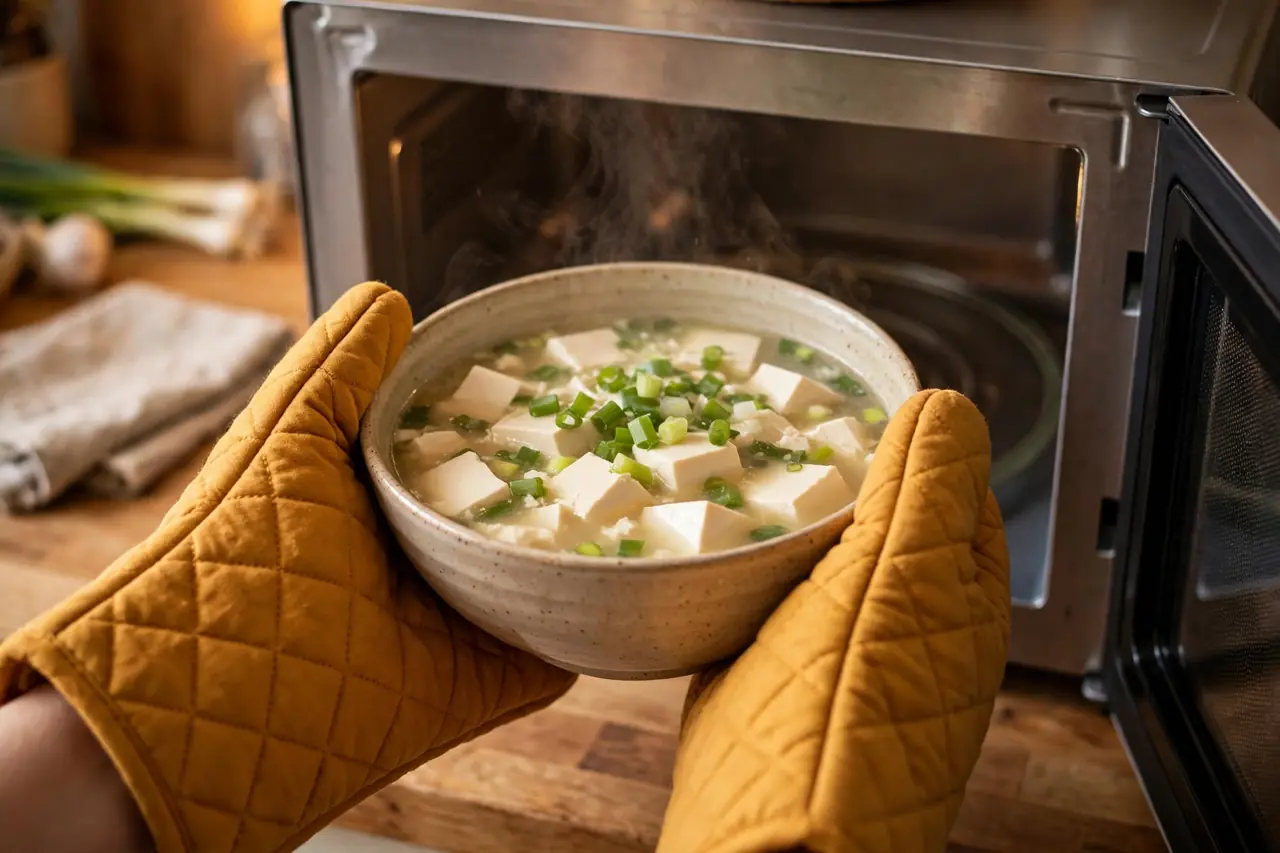
Use medium power, 50 to 70 percent, and heat in short bursts of 30 seconds. Check after each burst by looking, not stirring hard. The tofu is ready when it is warm through and just starting to steam, not when it is bubbling hard. For a single serving in soup, 30 to 90 seconds total is usually enough. For a larger bowl, 2 minutes on medium, checked every 30 seconds, is a safer ceiling than one long blast on high.
Do not stir silken tofu vigorously in the microwave, and do not stir it at all until it has stood for 1 minute after heating. Stirring breaks the curd into grains, and once it is grainy, no amount of careful handling will make it smooth again. If you are warming silken tofu for a soup or a sauce, warm it in the liquid it will be served in, and stir the liquid around it gently, not through it.
Silken tofu also has a temperature trap. It can look cool and calm on top while the liquid underneath is very hot, and the first spoonful can scald. Stir the surrounding liquid gently after standing time, test a small spoonful, and serve it warm, not boiling. For babies, toddlers, or anyone sensitive to heat, test the temperature on the inside of your wrist, and wait until it is comfortably warm, not hot.
If silken tofu does go rubbery, do not throw it away at once. Rubbery silken tofu softens again in hot broth, so drop it into miso soup, a noodle soup, or a saucy dish, and let it sit in the hot liquid for a few minutes. It will not return to silky smooth, but it will become pleasant to eat, and the soup will carry the flavour.
Can you microwave tofu in its container or packaging?
No, not as a default. Most tofu tubs are cold storage containers, not cooking containers, and the Clemson Extension microwave food safety guide, which summarises USDA guidance, lists cold storage containers such as margarine tubs and yogurt cartons among containers that are not safe in the microwave, because they are not approved for cooking and chemicals can migrate into food. A tofu tub is not named on that list, but no major tofu maker page we checked says its tub can go in the microwave either, and the safe habit is the same: lift the block out, drain it, and put it in glass or ceramic.
The same rule applies to plastic bags, vacuum packs, and shelf stable cartons for silken tofu. Open the pack, tip the tofu into a microwave safe dish, and discard or recycle the packaging. If a specific pack is labelled microwave safe, follow that label exactly, including any vent or time instruction, and stop if the pack warps, smells of hot plastic, or feels soft. A label is a promise for that exact pack, not a general rule for all tofu packaging.
Metal is a hard no, and this includes foil lids, metal trays, and any dish with metallic paint or trim. The same FDA guidance linked above notes that microwaves reflect off metal, which can cause uneven cooking and, in the case of thin foil or sharp edges, sparking. If your tofu came with a foil seal, remove it fully before the dish goes anywhere near the microwave, and check that no small foil fragment is stuck to the block.
Plastic wrap needs care too. If you use it as a cover, vent one corner and keep it from touching the food, following the USDA advice to vent the lid or wrap. A safer cover for tofu is a microwave safe lid left ajar, an inverted plate, or a damp paper towel. Those covers cannot melt into the food, and they let steam out without a separate vent step to remember.
For more on containers in general, the site guide to microwaving plastic and the microwave safe symbols guide explain which marks to trust and which containers to leave out of the microwave. Tofu is a good test case for those guides, because it arrives in a container that looks sturdy but is not made for heat.
How to thaw frozen tofu in the microwave
Freezing changes tofu on purpose for many cooks. Ice crystals push water out of the curd, leaving a spongier, chewier block that soaks up marinade better than fresh tofu. Firm and extra firm tofu freeze best. Silken tofu can be frozen too, and Mori-Nu tofu tips describe freezing silken firm and extra firm slices for at least 48 hours for a texture closer to a light fish fillet, and for several days for a texture closer to chicken, but the same page lists room temperature thawing as an option, which this guide does not recommend for food safety reasons.
For a safe microwave thaw, remove all packaging, place the frozen block on a microwave safe plate lined with paper towels, and use the defrost setting in 30 to 60 second bursts. Flip the block between bursts, and check the centre with a knife or fork. A standard 350 to 400 gram block usually takes 3 to 5 minutes total on defrost, but do not trust the total alone. The edges can start cooking while the centre is still frozen, so flipping and checking matter more than the timer.
Once thawed, press the tofu well, because frozen then thawed tofu holds noticeably more loose liquid than fresh tofu. Press it between towels for 10 minutes, or press it in a tofu press, then cut it and cook it as firm tofu above. Do not refreeze tofu that was thawed in the microwave unless you cook it first, and do not leave thawed tofu at room temperature while you prepare the rest of the meal. Thawed tofu goes back in the fridge if it will wait more than a few minutes.
The fridge method is still the most even thaw, if you have time. Move frozen tofu to the fridge the night before, let it thaw overnight, drain, press, and use it the next day. The microwave method is for when you forgot to plan, not for when you want the best texture. If you have a choice and a day to spare, choose the fridge, and save the microwave for reheating the cooked dish.
Frozen tofu that smells sour, feels slimy after thawing, or has been frozen for many months with heavy freezer burn is best discarded. Freezing pauses most bacterial growth, but it does not fix tofu that was already old when it went in, and freezer burn ruins the texture even when the tofu is technically safe. When the history is unknown, discarding is cheaper than a bad meal.
Reheating leftover tofu safely
Leftover tofu follows the same rules as other leftovers, with one extra texture warning. Reheat it only once, heat it thoroughly, and eat it promptly. The Illinois Extension leftover guide repeats the USDA window of 3 to 4 days in the fridge for cooked leftovers, and the 165 degree reheating target. Tofu leftovers that have sat in the fridge for 5 or 6 days, or that spent hours at room temperature after cooking, should be discarded, even if they smell fine.
To reheat, place the tofu in a single layer in a microwave safe dish, add a splash of water, broth, or sauce if it looks dry, cover loosely, and heat in 60 second bursts, stirring or flipping between bursts. Let it stand, covered, for 2 to 3 minutes, then check the temperature in several places, including the centre of the thickest piece. The USDA standing time advice for microwaved food is at least 3 minutes in some of its microwave guidance, so a 2 to 3 minute stand, followed by a second check, is a practical way to follow it without overcooking the tofu. If any spot is below 165 degrees Fahrenheit, heat in 30 second bursts until it reaches that temperature throughout.
Crispy tofu from yesterday will not stay crispy in the microwave. The microwave steams it, which softens the crust, and that is normal. If crispness matters, reheat the tofu briefly in the microwave to get it hot through, then finish it for 2 to 3 minutes in a hot pan, an oven, or an air fryer. That two step method gives you safe heat plus a fresh crust, and it is much better than microwaving crispy tofu for a long time in the hope that it will crisp, which it will not.
Tofu in sauce reheats better than plain tofu, because the sauce carries heat and moisture. Stir the sauce well, heat in short bursts, and check the tofu pieces inside the sauce, not just the sauce itself. Sauce can boil at the edge while a piece in the middle is still cool, especially in a deep bowl. A wide, shallow dish and a good stir solve most of that problem.
Store leftover tofu promptly after cooking. Move it to a clean, covered container in the fridge within 2 hours of cooking, or within 1 hour if the room is above 90 degrees Fahrenheit. Do not store leftover tofu in its original tub if that tub was opened and used for cooking, and do not store it in the microwave dish with a loose cover. A sealed container in the fridge keeps it fresher and stops it picking up other fridge smells.
Why microwaved tofu goes rubbery, soggy, or dry
Rubbery tofu is almost always overcooked tofu. High power for too long drives water out of the curd, tightens the protein network, and leaves a dense, bouncy piece that squeaks when you bite it. The fix is prevention, not rescue, because once the protein has tightened, extra sauce can hide the texture but cannot fully reverse it. Next time, use shorter bursts, lower the power for silken tofu, and stop at the first sign of firmness, not at the point where the tofu looks dry.
Soggy tofu is usually under pressed, overcrowded, or heated in a pile. The microwave heats the water around the tofu as much as the tofu itself, so a puddle in the dish steams the pieces instead of firming them. Press first, space the pieces out, drain liquid halfway through if it pools, and finish with a stand time that lets steam escape. If the tofu is already soggy, drain it, pat it dry, and finish it in a hot pan, where dry heat can do what the microwave could not.
Dry tofu at the edges with a cold centre is a cold spot problem, not a bad block. The edges heat first, the centre lags, and a single long heat makes the gap worse. Flip the pieces, swap outer and inner pieces, stir sauces, rotate the dish if there is no turntable, and use standing time. A wide dish helps too, because a deep bowl hides the centre from even heating.
Tofu that sticks to the dish usually went in dry, with no oil and no liquid, in a dish that was not quite smooth. A light coat of oil or cooking spray on the dish, a splash of water or sauce, and a single layer all help. If pieces do stick, let the dish stand for 1 minute, then lift them gently with a spatula. Scraping hot tofu off a dry dish tears the pieces and leaves a mess that is harder to clean than the tofu was to cook.
Tofu that tastes bland after microwaving is not a microwave failure, it is a seasoning timing failure. Tofu absorbs flavour from marinades and sauces, but it absorbs little from a dry sprinkle added at the end. Marinate firm tofu for 15 to 30 minutes before microwaving if you have time, or toss hot microwaved tofu in sauce immediately after heating, while it is still steaming and porous. Salt, soy sauce, garlic, ginger, chilli, and a squeeze of lemon or lime do more for microwaved tofu than extra cooking time ever will.
Microwave versus pan, oven, and air fryer for tofu
The microwave wins on speed, pressing, and pre cooking. It is the fastest way to firm a block, warm silken tofu for soup, thaw a frozen block, and reheat leftovers. It is also the best tool for removing water before another method, because it drives moisture out evenly without adding oil. If you want tofu ready for a stir fry in under 10 minutes, start in the microwave.
The pan wins on flavour and texture. A hot oiled pan browns the surface, builds a crust, and lets sauce caramelise lightly, which the microwave cannot do. The oven wins on large batches and even browning, because it heats from all sides with dry air. The air fryer wins on crispness with little oil, and it is the best rescue tool for yesterday crispy tofu. None of those methods beat the microwave for a quick warm through, and none of them should be used to reheat a single portion when the microwave will do it in 2 minutes.
A hybrid method often beats any single method. Microwave firm tofu for 3 minutes, flip, microwave for 2 more minutes, then finish it in a hot pan for 2 to 3 minutes with sauce. You get microwave speed, pan flavour, and a texture that neither method gives alone. For silken tofu, the hybrid is reversed: warm it gently in the microwave, then serve it in hot broth, where the broth finishes the job without breaking the curd.
For other foods that share the same trade, the site guides to frozen vegetables and canned beans show the same pattern: the microwave is best for even, moist heating in a short time, and a pan finish is best when you want browning. Tofu follows that pattern closely, which is why a microwave plus pan finish is the method most experienced tofu cooks actually use.
Five easy microwaved tofu meals
Microwaved tofu and rice bowl is the simplest starting point. Microwave firm tofu cubes as above, toss them hot with soy sauce, sesame oil, garlic, and a pinch of chilli flakes, and serve over rice with steamed vegetables. The hot tofu absorbs the sauce at once, so toss it while it is still steaming, not after it has cooled and tightened.
Silken tofu miso soup is a gentle microwave meal. Warm silken tofu in its liquid on medium power for 60 seconds, then tip it gently into hot miso broth with spring onions and seaweed. Do not boil the soup hard after adding the tofu, because boiling breaks the curd. Serve it warm, with the tofu in soft spoonfuls, not in hard cubes.
Tofu scramble uses the microwave as a pre cook. Microwave medium tofu cubes for 2 minutes, drain, crumble them lightly with a fork, then finish in a pan with turmeric, garlic, and vegetables for a breakfast scramble. The microwave step firms the tofu just enough that it crumbles cleanly instead of turning to mush in the pan.
Spicy peanut tofu bowl is a good use for microwaved firm tofu that is not yet crisp. Microwave the cubes, toss them hot with peanut sauce, lime juice, and chilli, and serve over noodles or rice with cucumber and carrots. The sauce coats the warm, porous tofu better than it coats cold tofu, so the timing of the toss matters.
Tofu and vegetable soup is a forgiving leftover meal. Warm leftover tofu in its sauce in short bursts, stir well, check the temperature, then add it to hot vegetable soup and let it sit for 2 minutes before serving. The soup finishes the heating evenly, and the tofu soaks up broth flavour without drying out.
Common mistakes to avoid
The most common mistake is microwaving tofu in its tub, or in a pile, with no flip. The tub is not made for heat, the pile steams unevenly, and no timer can fix either problem. Transfer to a microwave safe dish, spread the pieces out, and flip once. Those three steps prevent most microwave tofu failures.
The second mistake is using one method for all tofu types. Firm tofu needs high power and a flip. Silken tofu needs medium power, short bursts, and no hard stirring. Treating silken tofu like firm tofu gives you rubbery grains. Treating firm tofu like silken tofu gives you cold, wet cubes. Match the method to the type, every time.
The third mistake is skipping standing time. Tofu that is checked straight out of the microwave will read hot at the edge and cool in the centre, and the cook will add another minute that toughens the edge further. Stand for 2 to 3 minutes, covered, then check again. Standing time is not wasted time, it is part of the cooking.
The fourth mistake is reheating the whole container every time you want a portion. Each reheat dries tofu and gives bacteria more chances to grow during cooling. Heat only what you will eat, store the rest promptly, and reheat leftovers once, thoroughly, to 165 degrees Fahrenheit.
The fifth mistake is expecting crispness from the microwave alone. The microwave heats water, it does not brown surfaces. If you want crisp tofu, finish it in a pan, oven, or air fryer. Judging microwaved tofu by crispness alone will always disappoint, because you are judging it by a job it was never meant to do.
Quick checklist before you press start
Use this checklist when you are in a hurry. Tofu out of its tub, into a microwave safe glass or ceramic dish. Block pressed or patted dry, cut into even pieces, spread in a single layer. Dish covered loosely, with a vent. Firm tofu on high in short bursts with a flip. Silken tofu on medium in 30 second bursts, no hard stirring. Stand for 2 to 3 minutes. Leftovers checked to 165 degrees Fahrenheit in several places. Sauce added hot, after heating, for the best flavour. Leftovers stored promptly in a covered container in the fridge.
If any step is missing, pause and fix it before heating. A missing flip means cold spots. A sealed cover means steam pressure. A tub in the microwave means a container risk. The checklist takes five seconds to run through, and it prevents almost every microwave tofu failure.
For the full microwave guide, start with the money page: Can You Microwave It? The Complete Guide. It links the whole series, including containers, foods, and safety guides, and it is the best place to check a new food before you microwave it.
Frequently asked questions
These are the questions readers ask most about microwaving tofu, with a short direct answer first in each case, then the detail you need to get it right.
Can you microwave tofu?
Yes. You can microwave tofu safely in a microwave safe glass or ceramic dish, with firm tofu heated in short bursts and flipped halfway through, and silken tofu warmed gently on medium power. Do not microwave tofu in its tub, do not pile it in a deep bowl, and do not expect crispness from the microwave alone.
How long do you microwave firm tofu?
Firm or extra firm tofu cubes usually take 3 minutes on high, then a flip, then 2 to 3 more minutes, plus 2 to 3 minutes of standing time, in a 1000 watt microwave. Start at the lower end, check the texture, and add 30 second bursts only if needed. Lower wattage ovens need more time, and larger pieces need more time than small cubes.
Can you microwave silken tofu?
Yes, but warm it gently. Use medium power (50 to 70 percent), heat in 30 second bursts for 30 to 90 seconds total for a single serving, and do not stir it vigorously. Keep it in its liquid or in broth, let it stand for 1 minute, and serve it warm, not boiling. High heat turns silken tofu rubbery and watery.
Can you microwave tofu in its package?
No, not as a default. Most tofu tubs, bags, and cartons are cold storage packaging, not cooking containers, and they are not labelled microwave safe. Transfer the tofu to a microwave safe glass or ceramic dish first. Only use packaging in the microwave if that exact pack is clearly labelled microwave safe, and follow its instructions exactly.
Does microwaving tofu make it crispy?
No. Microwaving firms tofu and removes water, but it does not brown or crisp the surface, because microwaves heat water rather than browning food with dry heat. For crisp tofu, microwave it first to firm it, then finish it in a hot oiled pan, an oven, or an air fryer for 2 to 3 minutes until the edges colour.
Why does my microwaved tofu turn rubbery?
Rubbery tofu is usually overcooked tofu. Too much time on high drives water out of the curd and tightens the protein, leaving a dense, bouncy texture. Prevent it with shorter bursts, a flip halfway through, and stopping at the first sign of firmness. Rubbery tofu can be rescued in hot broth or a saucy dish, where liquid softens it again.
Can you microwave frozen tofu?
Yes, for thawing. Use the defrost setting in 30 to 60 second bursts, flipping between bursts, for 3 to 5 minutes total for a standard block, then press it well before cooking. Do not thaw tofu on the counter, and do not refreeze tofu thawed in the microwave unless you cook it first. Fridge thawing overnight gives a more even result if you have time.
Can you reheat tofu in the microwave?
Yes. Reheat leftover tofu in short bursts, stirring or flipping between bursts, and heat it until it reaches 165 degrees Fahrenheit (74 degrees Celsius) in the thickest part, measured with a food thermometer, after standing time. Reheat only the portion you will eat, and reheat leftovers only once, provided they were refrigerated promptly and used within 3 to 4 days.
Is microwaved tofu safe to eat cold after heating?
Fresh tofu is pre cooked during manufacturing, so a freshly opened block can be eaten cold, but leftover tofu that has been cooked and stored must be reheated thoroughly to 165 degrees Fahrenheit, not just warmed at the edge. When in doubt, use a thermometer, check several places, and discard leftovers that have been out for more than 2 hours or stored for more than 3 to 4 days.
Can you microwave tofu with sauce or marinade?
Yes, and sauce helps. A splash of sauce, broth, or water keeps tofu moist, carries heat evenly, and stops the surface drying out. Heat in short bursts, stir the sauce well, and check the tofu pieces inside the sauce, not just the sauce itself, because sauce can boil at the edge while a piece in the middle stays cool. Add fresh sauce after heating too, for the best flavour.
Do you need to press tofu before microwaving?
Pressing helps firm tofu a lot, and it is not needed for silken tofu. Press firm or extra firm tofu between towels for 5 to 10 minutes, or use a tofu press, to remove surface water before cutting and heating. Pressing gives a firmer texture, less steaming in the dish, and better sauce absorption after heating. Do not press silken or soft tofu, because it will break.
Can you microwave tofu twice?
You can reheat leftover tofu once, thoroughly, to 165 degrees Fahrenheit, provided it was refrigerated promptly and used within 3 to 4 days. Repeated cooling and reheating dries tofu out, worsens texture, and gives bacteria more chances to grow. Heat only what you will eat, and discard the rest if it has been reheated already or left out too long.
What dish should you use to microwave tofu?
Use a microwave safe glass or ceramic dish, large enough for a single layer of pieces, with a loose cover that vents steam. Avoid metal, foil, containers with metallic trim, cold storage tubs, and any plastic that is not clearly labelled microwave safe. Check the dish for cracks before use, and use oven gloves, because glass and ceramic stay hot after heating.
Is microwaved tofu healthy?
Tofu is a useful source of plant protein, and microwaving does not change that in a meaningful way. The bigger nutrition factors are the sauce, the oil, and the salt you add, not the heating method. A light sauce, a small amount of oil, and vegetables alongside the tofu keep the meal lighter than a heavy, salty sauce, whatever method you use to heat it.

1 Comment
Pingback: Can You Microwave Edamame? Times and Safety