

Everyone has a microwave story. The fork someone forgot on the plate. The egg that redecorated the interior. The travel mug that came out stone cold while the coffee inside stayed cold too. Microwaves feel foolproof until the exact moment they are not, and the difference between a convenient appliance and a kitchen hazard is simply knowing what goes in and what never should.
These are the things you should never put in a microwave, organized by what actually goes wrong: things that spark, things that explode, things that poison your food with chemicals, and things that damage the oven itself. Each one comes with the reason, so you remember the rule instead of just memorizing a list. For the flip side, the full list of what is safe, see Can You Microwave It? The Complete Safety Chart.
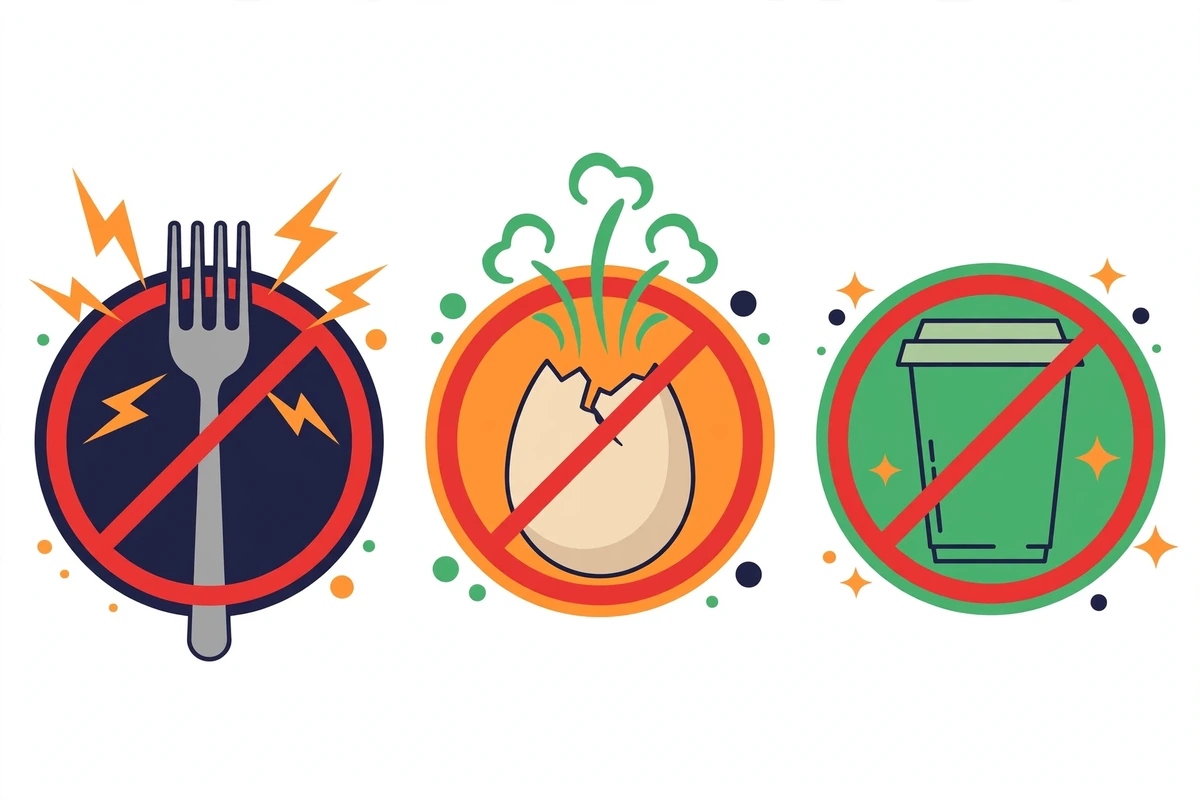
Metal and Aluminum Foil: Why Sparks Fly
Direct answer: metal reflects microwaves instead of absorbing them, which causes arcing (sparks) that can damage your oven or start a fire.
This is the number one rule for a reason. A microwave cooks by bouncing energy around its metal interior until food absorbs it. When you add metal of your own, the waves hit it and reflect, and electric charges build up on sharp edges and points until they discharge as visible sparks. That sparking is called arcing, and it can pit the oven walls, destroy the waveguide cover, or ignite nearby food or packaging.
The usual suspects are obvious: forks, knives, spoons left on plates. The sneaky ones are not: plates and mugs with metallic gold or silver trim, twist ties with wire inside, the metal handle on a Chinese takeout container, and aluminum foil used to cover a dish. Even small bits count. Recycled paper towels can contain tiny metal fragments from the recycling process, which is why plain white paper towels are the safe choice for covering food.
If you ever see sparking, press stop immediately and leave the door closed for a moment. Do not open it and reach in while arcs are still flashing. Remove the metal item, check that nothing is smoldering, and inspect the oven interior for damage before using it again. One important nuance: some microwave manuals allow tiny, smooth pieces of foil used as shields in specific situations, but unless your manual explicitly describes it, treat all foil as forbidden. Our full guide to metal in the microwave explains the rare exceptions and why they do not apply to your leftovers.
Whole Eggs: The Explosion Everyone Warns About
Direct answer: an egg in its shell is a sealed pressure vessel in a microwave, and steam buildup will make it explode, sometimes after you take it out.
If metal is the most-sparked rule, eggs are the most-exploded one. The shell and its inner membranes trap steam as the water inside the egg heats, pressure climbs with nowhere to go, and the shell shatters violently. The cruel twist is the delayed explosion: the egg can look perfectly fine when the timer stops, then erupt when you tap, peel, or bite it, because the inside superheated past boiling point under pressure. Documented cases include burns to the mouth and face from reheated peeled eggs that felt merely warm on the outside.
This applies to raw eggs in shells and to whole hard-boiled eggs, peeled or not. Poking a pinhole in the shell does not vent steam fast enough, and submerging the egg in water only slows the inevitable. There is no safe in-shell method. The USDA’s microwave safety guidance says to pierce the yolks and whites of any egg you microwave, which rules out the shell entirely. We wrote an entire guide to microwaving eggs safely covering the physics, the delayed-explosion danger, and the methods that actually work (crack it out, pierce the yolk, short bursts). Read that before breakfast, not after the bang.
Grapes, Hot Peppers, and Foods That Spark or Burst
Direct answer: grapes can create plasma fireballs, hot peppers release pepper-spray-like fumes, and mineral-rich vegetables can arc, so none of them belong in a microwave.
Grapes are the internet’s favorite microwave science experiment, and the science is genuinely wild. A grape is almost entirely water wrapped in a thin skin, and its diameter is close to the wavelength of the microwaves inside the oven. Energy gets trapped and concentrated instead of spreading out, and two grape halves placed near each other can generate a flare of plasma, the same state of matter as lightning. It looks incredible on video and it can wreck your microwave. Whole grapes can also burst from steam pressure like tiny water balloons.
Hot peppers are dangerous for a completely different reason. Microwaving them releases capsaicin, the compound that makes peppers hot, into the air as an aerosol. Open the door and you get a faceful of what is effectively homemade pepper spray: burning eyes, coughing, trouble breathing. It is excruciating and entirely avoidable. Cook peppers on the stove with ventilation instead.
Then there are the sparking vegetables. Kale, spinach, carrots, green beans, and bell peppers are rich in minerals like iron, magnesium, and selenium, which behave like tiny bits of metal under microwave energy. Raw leafy greens in particular can throw sparks and even catch fire. Cooked greens are generally fine, since cooking changes their structure and moisture, but a pile of raw kale is a light show waiting to happen. The pattern to remember: small, wet, round things trap energy, and mineral-dense raw vegetables arc. When in doubt, use the stove.
Foam, Single-Use Plastics, and Melamine: The Chemical List
Direct answer: heated foam can release styrene, single-use plastics can melt and leach chemicals like BPA, and melamine can break down under microwave heat, so keep all three out.
This category will not spark or explode. It is quieter and, over time, worse. Foam containers (expanded polystyrene) soften near boiling temperatures and can release styrene, which the National Research Council classifies as reasonably anticipated to be a human carcinogen. The cup may look fine while the chemistry is not. This is why noodle cups and foam takeout boxes say not to microwave them, and why our cup noodles guide insists on transferring the noodles to a real bowl.
Single-use plastics are the next trap. Yogurt tubs, margarine containers, disposable water bottles, and takeout clamshells were designed for cold storage, not for heat. In a microwave they can warp, melt, and release chemicals into your food. The “microwave safe” claim on a single-use item is worth less than the same claim on a container actually engineered for reheating, and many single-use items carry no claim at all.
Melamine deserves special mention because it looks indestructible. Those sturdy, colorful plates and bowls feel like they could survive anything, but melamine resin can break down under microwave heat and migrate chemicals into food. Some are even labeled microwave safe, and food safety experts still advise against it. When a material’s safety depends on you trusting a label more than the chemistry, choose glass or ceramic and skip the debate.
Paper Bags, Sealed Containers, and Running It Empty
Direct answer: brown paper bags can catch fire and release fumes from inks and glues, sealed containers explode from trapped steam, and running a microwave empty can destroy the magnetron.
Brown paper grocery bags look like a clever popcorn hack. They are a fire hazard. The inks, glues, and recycled fibers in a grocery bag are not food-grade and not heat-tested; under microwave energy they can release fumes, and the bag itself can ignite. Popcorn bags from the store are a different product entirely, engineered with heat susceptors for exactly this purpose. A grocery bag is not a popcorn bag, no matter how similar they look. Newspaper is out for the same reason: the inks are not meant to be heated near food.
Sealed containers are the explosion category’s quiet member. A closed jar, a sealed bottle, a container with the lid screwed on tight: as the contents heat, steam and expanding air have nowhere to go, pressure climbs, and the container bursts. Always vent lids, leave a corner of the cover open, or transfer the food to a vented dish. This same physics is why you pierce potatoes and sausages before microwaving them.
Finally, never run the microwave with nothing inside. The magnetron generates energy that needs something to absorb; with no food or water present, the waves reflect back into the magnetron itself and can damage or destroy it. It takes only seconds. If you are testing whether the oven works, heat a cup of water. And a related electrical note from fire safety authorities: plug the microwave directly into a wall outlet, never into an extension cord, and open the door slowly and away from your face so escaping steam does not burn you.
The Complete “Never Microwave” Reference Table
Direct answer: if it is metal, sealed, foam, single-use plastic, or on this table, keep it out of the microwave.
| Item | What happens | Why |
|---|---|---|
| Metal utensils, foil | Sparking, fire | Metal reflects microwaves; charges arc at edges |
| Metallic-trim dishes | Sparking, damaged glaze | Trim acts like foil; glaze can crack |
| Whole eggs (raw or boiled) | Explosion, burns | Sealed steam pressure; delayed superheating bursts |
| Grapes (whole or halved) | Plasma flare, fire | Size traps microwave wavelength; steam bursts |
| Hot peppers | Toxic fumes | Capsaicin aerosolizes like pepper spray |
| Raw leafy greens, some vegetables | Sparking, fire | Minerals (iron, magnesium) arc like metal |
| Foam containers (#6) | Melting, styrene release | Softens near boiling; probable carcinogen leaching |
| Single-use plastics | Melting, chemical leaching | Not heat-tested; BPA and other additives migrate |
| Melamine dishes | Chemical breakdown | Resin degrades under microwave heat |
| Brown paper bags, newspaper | Fire, toxic fumes | Inks and glues not food-grade; paper ignites |
| Sealed jars and bottles | Explosion | Trapped steam and air pressure |
| Travel mugs (steel) | No heating, sparking risk | Metal shell blocks and reflects energy |
| Breast milk / baby formula | Nutrient damage, hot spots | Uneven heating burns baby; degrades proteins |
| Frozen meat (full defrost) | Bacterial growth | Outside cooks while inside stays frozen; uneven zones breed bacteria |
| Nothing at all | Magnetron damage | Energy with nowhere to go reflects into the oven |
Two entries deserve a final word. Breast milk and formula should never be microwaved because uneven heating creates scalding hot spots that can burn a baby’s mouth, and high heat can damage the milk’s immune-boosting proteins; warm the bottle in warm water instead. Frozen meat is a food-safety trap: the microwave thaws the outside into the bacterial danger zone while the center stays frozen, so use the defrost setting only if you cook the meat immediately after, and never refreeze without cooking.
What To Do When Something Goes Wrong in the Microwave
Direct answer: for sparks, press stop and keep the door closed; for fire, keep the door closed, unplug the oven, and never open it until the flames are out; for burns, cool under running water.
Even careful people make mistakes, so know the drill before you need it. If you see sparking, press stop (do not yank the door open mid-arc) and wait a few seconds, then remove the metal item and inspect the interior for scorch marks or a damaged waveguide cover, the small panel on the inside wall. If food catches fire, keep the door closed, because opening it feeds the flames oxygen. Turn the oven off, unplug it, and wait until you are certain the fire is out before opening the door. A small flare-up usually suffocates within seconds in a closed oven.
For burns from hot food or exploding containers, cool the skin under cool (not ice-cold) running water for at least ten minutes, remove rings or tight items near the burn before swelling starts, and cover loosely with a clean cloth. Seek medical care for any burn larger than your palm, any burn on the face or hands, or any burn that blisters badly. And if your microwave sparked heavily, smells strongly of burning electronics, or shows visible interior damage, have it checked by qualified service personnel before using it again. A two-minute scare is cheap; a damaged oven used blindly is not.
When in Doubt, Leave It Out
The things you should never put in a microwave all fail for one of four reasons: they spark (metal, grapes, mineral-rich greens), they explode (eggs, sealed containers), they contaminate food (foam, single-use plastics, melamine, printed paper), or they wreck the oven (running it empty). Learn the four categories and you do not need to memorize fifteen items. And for everything you are unsure about, the answer is thirty seconds away in Can You Microwave It? The Complete Safety Chart.
Frequently Asked Questions
What happens if you put metal in the microwave?
The metal reflects microwave energy instead of absorbing it, causing electric charges to build up and discharge as sparks (arcing). This can pit the oven walls, damage internal components, ignite food or packaging, and in bad cases start a fire. If you see sparking, stop the microwave immediately and remove the metal item before using the oven again.
Can you put aluminum foil in the microwave?
No, not for normal use. Aluminum foil is thin metal and causes the same arcing and fire risk as any metal. Some microwave manuals describe very specific shielding uses with small, smooth pieces of foil, but unless your manual explicitly instructs it, treat all foil as forbidden and use a microwave-safe cover instead.
Why do grapes spark in the microwave?
A grape’s diameter is close to the wavelength of microwave energy, so the waves get trapped and concentrated inside the fruit instead of spreading out. With two grape halves near each other, the concentrated energy can ignite a flare of plasma. Whole grapes can also burst from steam pressure. It is a fascinating physics demo and a terrible idea in your kitchen.
Can you microwave an egg in its shell?
Never. The shell seals steam inside as the egg heats, pressure builds until the shell shatters, and the egg explodes. Worse, the explosion can be delayed: the egg may look fine when the timer stops and erupt when you touch or bite it. Our egg safety guide covers safe microwave egg methods that actually work.
What happens if you run a microwave empty?
The magnetron keeps generating energy with nothing to absorb it, so the waves reflect back into the magnetron and the oven walls. This can overheat and destroy the magnetron in seconds, killing the microwave. Always heat something, even just a cup of water, when testing or running the oven.
Can you microwave styrofoam?
No, unless the specific container is labeled microwave safe after testing, which plain foam food containers are not. Heated polystyrene softens and warps near boiling temperatures and can release styrene into food. Transfer food from foam takeout boxes and cups into glass or ceramic before microwaving. Details are in our styrofoam guide.
Why can’t you microwave hot peppers?
Heating hot peppers releases capsaicin into the air as a fine aerosol. When you open the microwave door, you inhale what amounts to homemade pepper spray: burning eyes, coughing, and difficulty breathing. The peppers can also spark or burst. Cook hot peppers on the stove with the vent fan running instead.
Can you microwave a paper bag?
No. Brown grocery bags are not food-grade for heating: their inks, glues, and recycled fibers can release fumes under microwave energy, and the bag can catch fire. Store-bought microwave popcorn bags are engineered differently with heat susceptors and are the only “paper bag” designed for this. Never substitute a grocery bag.
Is it safe to microwave breast milk?
No. Microwaves heat unevenly, creating hot spots that can scald a baby’s mouth even when the bottle feels lukewarm outside. High heat can also damage some of breast milk’s beneficial proteins. Warm the bottle in a bowl of warm water or under warm running tap water instead, and always test the temperature on your wrist.
Can you microwave frozen meat to defrost it?
Only with the defrost setting and only if you cook the meat immediately afterward. A full-power microwave thaws the outer layers into the bacterial danger zone (40-140°F) while the center stays frozen, letting bacteria multiply on the surface. Never defrost meat in the microwave and then put it back in the freezer; cook it first.
What happens if you microwave a sealed jar?
As the contents heat, steam and expanding air build pressure with no escape route, and the jar can burst apart violently, throwing hot food and glass shards. Always loosen or remove lids, vent plastic covers, and leave a gap for steam. This applies to jars, bottles, and any container with a tight seal.
Can you microwave melamine plates?
You should not. Melamine resin can break down under microwave heat and migrate chemicals into food, even though the dishes feel sturdy and heat-resistant. Some are labeled microwave safe, but food safety experts advise against microwaving melamine regardless. Use glass, ceramic, or labeled microwave-safe plastic instead.
Why do some vegetables spark in the microwave?
Vegetables rich in minerals like iron, magnesium, and selenium, including kale, spinach, carrots, and bell peppers, contain tiny amounts of elements that behave like metal under microwave energy. The minerals cause mini arcs of electricity, especially in raw leafy greens with lots of surface area and edges. Cooking the vegetables first generally stops the sparking.
Can you microwave a travel mug?
No, if it is stainless steel or has any metal, which most travel mugs do. The metal shell reflects microwaves, so the drink barely heats while the oven works against itself, and arcing is possible. Only microwave a travel mug if it is clearly labeled microwave safe and contains no metal. Otherwise, pour the drink into a ceramic mug first.
