

It is past midnight, the kitchen is dark, and there is a cup of instant noodles on the shelf. The instructions say to add boiling water and wait three minutes. The microwave would be faster. You stare at the foam cup and wonder: can you microwave cup noodles right in the cup they came in?
For most cups, the answer is no. The classic foam cup is not built for microwave energy. It can warp, leak boiling soup across your microwave, and release styrene, a chemical you do not want in your dinner. But the full answer has a twist: packaging changed in 2024, and some cups on the shelf today are genuinely microwaveable. The difference is on the label, and this guide shows you exactly what to look for.
Below you will find why foam cups fail, what the 2024 packaging change means for you, a brand-by-brand breakdown, the two safe ways to use your microwave with instant noodles, and the second hidden danger (superheated water) that most articles never mention. For the quick verdict on every other container, see Can You Microwave It? The Complete Safety Chart.
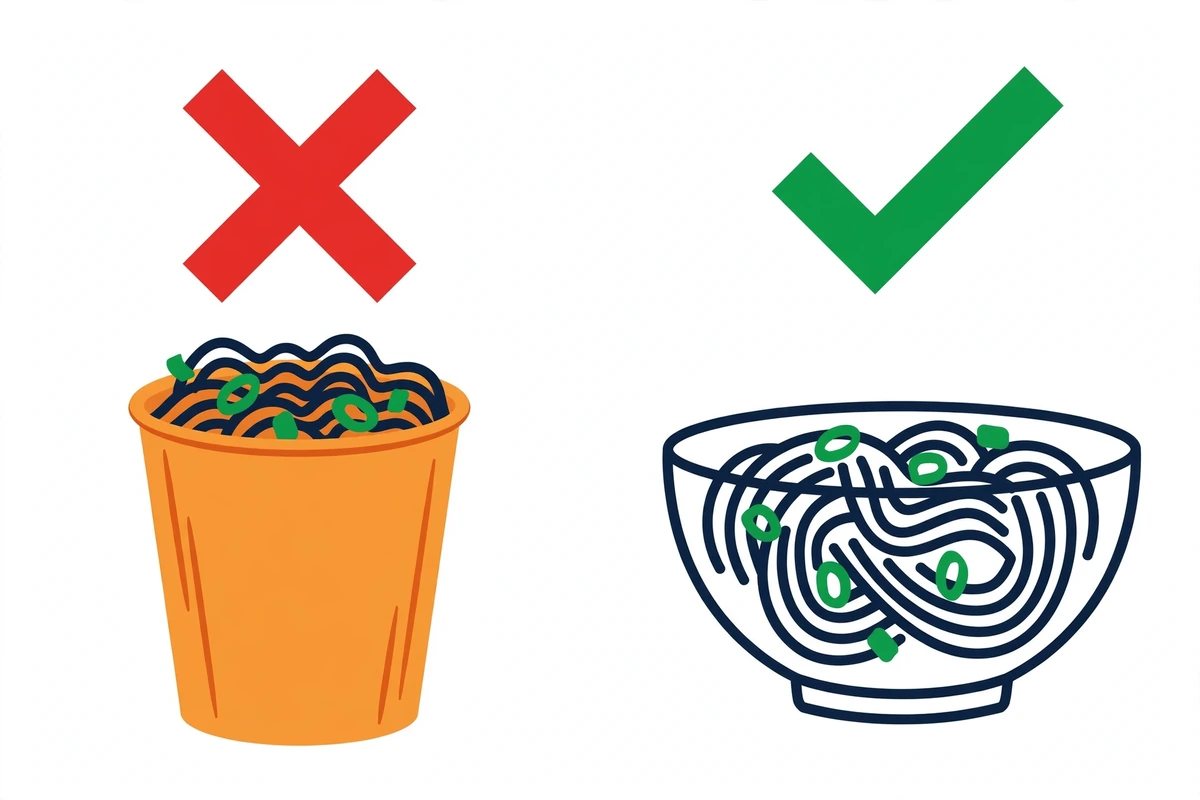
Can You Microwave Cup Noodles in the Original Cup?
Direct answer: no, not if the cup is foam (expanded polystyrene), which most classic cup noodles use. Only microwave the cup if the label says “microwave safe.”
The cup your noodles came in was designed for one job: holding hot water that you pour in from a kettle. It was not designed to sit inside a microwave while water boils violently around it. Manufacturers know this, which is why brands like Maruchan print “Do Not Microwave” on the cup. That is not a suggestion or a legal decoration. It is the result of product testing, and ignoring it risks both your health and a spectacular mess.
There is one real exception, and it is recent. In 2024, Nissin switched its iconic Cup Noodles in the United States from foam to a paper-based cup that is labeled microwaveable, with instructions for a 2 minute 15 second cook. If your cup says it can be microwaved, believe the label. If it says nothing, or says not to, believe that instead. When in doubt, the safe move never changes: heat the water separately or move the noodles to a bowl you trust.
Why the Foam Cup Fails in a Microwave
Direct answer: expanded polystyrene softens and warps near boiling temperatures, can leak or collapse, and heated foam can release styrene into your food.
Most inexpensive instant noodle cups are made from expanded polystyrene (EPS), the foam most people call styrofoam. EPS is a brilliant insulator. It keeps your hands from burning and your soup hot. But it is a poor container for active microwave cooking, for three reasons that stack up.
First, the structure gives up. EPS softens as temperatures approach and pass the boiling point of water. Inside a microwave, water does not just get hot, it boils hard and fast, and the cup walls take the full beating. The cup can warp, develop pinholes, or simply collapse at the bottom. If that happens while you are carrying it, boiling broth lands on your hands and the floor.
Second, chemistry. EPS contains styrene. The National Research Council has classified styrene as reasonably anticipated to be a human carcinogen, and the World Health Organization moved it to “probably carcinogenic” in 2017. Heat increases the movement of chemicals out of plastics and into food, a process called leaching. A cup holding poured-in hot water is one thing. A cup being blasted with microwave energy while its contents boil is a much more aggressive situation.
Third, the FDA’s position is narrower than people think. The agency has cleared some specific foam food containers for microwave use, but only the ones that carry clear microwave-safe labeling after testing. A plain foam noodle cup with no such label is not in that group. This is exactly why our guide to microwaving styrofoam draws the same line: labeled and tested is fine, everything else is not.
None of this means one microwaved foam cup will make you sick tomorrow. It means you are adding an avoidable chemical exposure and a real burn risk to save about ninety seconds, which is a bad trade by any measure.
The 2024 Change: Nissin’s New Microwaveable Paper Cup
Direct answer: yes, since 2024 Nissin’s US Cup Noodles come in a paper-based cup designed to be microwaved for 2 minutes 15 seconds, so the old “never microwave the cup” rule no longer covers every brand.
This is the update most older articles miss, and it matters because it changed the correct answer. For decades, the foam cup was so iconic that “Cup Noodles” and “foam cup” felt like the same thing. Then Nissin announced it was dropping polystyrene packaging in the United States in favor of a paper cup, explicitly so customers could microwave the whole thing. The new instructions are simple: add water to the fill line, microwave 2 minutes 15 seconds, let stand, stir, eat.
Why does this change your shopping? Because two cups that look almost identical on the shelf can now have opposite instructions. An old-stock foam cup says do not microwave. The new paper cup says go ahead. Imported or store-brand cups may use either material. The only reliable guide is the label on the specific cup in your hand, not your memory of what cup noodles “always” were.
This is also a good moment to retire a myth: “I have microwaved foam cups for years and I am fine” proves nothing about safety. Chemical exposure from heated plastics is about repeated low doses over time, not about one dramatic event. The absence of an immediate disaster is not evidence of safety, it is just luck with a slow clock.
Which Noodle Cups Can Handle the Microwave: Brand by Brand
Direct answer: check the label every time, but as a rule, Maruchan foam cups cannot be microwaved, new Nissin paper cups can, and unmarked cups should be treated as unsafe.
| Cup type | Microwave the cup? | Why |
|---|---|---|
| Maruchan foam cup | No | EPS foam, labeled “Do Not Microwave,” warps and can leach styrene |
| Nissin Cup Noodles, new paper cup (2024+) | Yes | Paper-based, manufacturer labeled microwaveable, 2:15 cook time |
| Nissin Cup Noodles, old foam cup | No | Same EPS problems as Maruchan |
| Store-brand foam cups | No | Almost always EPS with no microwave testing |
| Polypropylene bowls (labeled #5 PP) | Yes, if labeled | Heat-resistant plastic, but confirm the microwave-safe mark |
| Unmarked or unknown cups | No | No label means no testing; transfer to a safe bowl |
Two details deserve emphasis. First, “paper cup” does not automatically mean safe either. Some paper cups have plastic or wax linings and glues that are not rated for microwaves, so the paper cup still needs the label. Second, even a microwave-safe cup has limits: overheating, cooking without enough water, or reusing a single-use cup can all push it past what it was tested for. Single-use means single use.
If you eat a lot of instant noodles, the practical upgrade is a dedicated microwave noodle bowl, the kind with a vented lid sold for a few dollars. It pays for itself the first time a foam cup does not collapse in your hands.
The Right Way to Make Cup Noodles With a Microwave
Direct answer: either boil water in a separate microwave-safe container and pour it in, or move the dry noodles to a microwave-safe bowl and cook them there. Both methods are fast and safe.
You do not have to give up the microwave. You just have to stop microwaving the packaging. Pick the method that matches your situation.
Method 1: Heat the Water Separately (the Manufacturer’s Way)
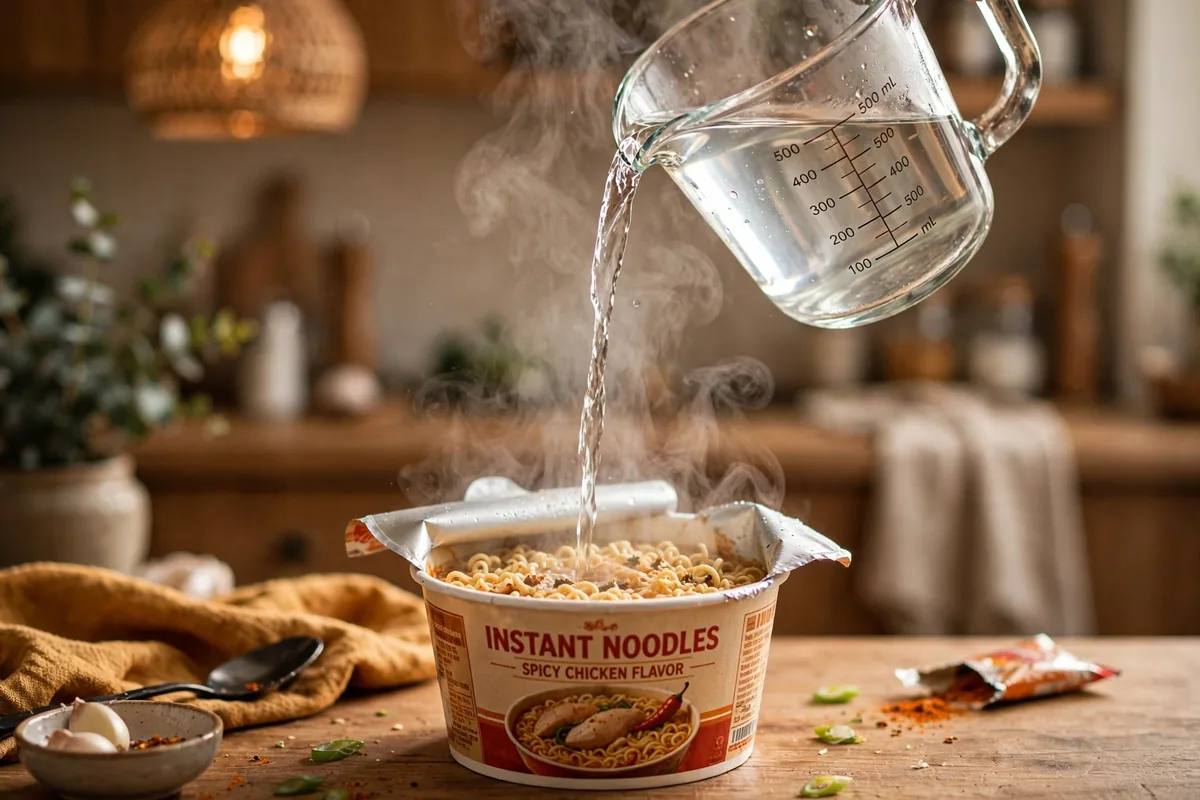
This is the method printed on the cup, and it produces the best noodle texture because the noodles steep gently instead of being blasted. Pour water into a microwave-safe glass measuring cup or bowl, leaving an inch of headspace. Microwave until it boils, usually 2 to 3 minutes depending on your oven. Peel the noodle lid back halfway, pour the boiling water to the fill line, close the lid (a fork laid across the top holds it down), and wait 3 minutes. Stir well and eat. Total active effort: about thirty seconds.
Method 2: Transfer the Noodles to a Microwave-Safe Bowl
If you prefer to cook the noodles directly, dump the dry noodle block and seasoning into a microwave-safe bowl, add water to cover, and microwave 3 to 4 minutes, stirring halfway. Use a bowl with room to spare, because starchy water boils up enthusiastically. Let it stand a minute before eating. This method works for any brand, any cup material, with zero label-reading required, and the cleanup is one bowl.
A quick safety note for both methods: lift lids and covers away from your face. A faceful of steam at midnight is a memorable way to learn respect for boiling water.
Superheated Water: The Second Danger Nobody Mentions
Direct answer: yes, plain water microwaved in a smooth container can heat past boiling without bubbling, then erupt violently when disturbed, so always give it something to form bubbles on.
Here is the hazard hiding inside the “safe” method. When you microwave very clean water in a very smooth container, like a new glass measuring cup, it can become superheated: hotter than boiling point, but not boiling, because there are no rough spots for bubbles to form on. It looks calm. Then you drop in the seasoning packet, or you bump the cup, and the water flash-boils all at once, erupting upward like a small geyser. People get serious burns this way every year.
The fix is almost embarrassingly simple. Put a wooden chopstick, a wooden skewer, or even a pinch of salt or sugar in the water before microwaving. The rough surface gives bubbles a place to form, so the water boils normally instead of superheating. Do not use anything metal, and do not microwave the water for far longer than needed. Heat it until it boils, then stop.
This is also why you should never microwave cup noodles without water at all. Dry noodles in a foam cup can scorch, the cup can melt or catch fire, and the noodles turn into an inedible brick. Water is not optional; it is the entire cooking medium.
How to Spot a Misleading Microwave-Safe Claim
Direct answer: trust the manufacturer’s label on your specific container, not generic claims, because there is no single universal standard and one brand’s testing does not cover another’s cup.
This matters more than it sounds. Unlike electrical safety marks, microwave-safe labeling has no single global standard that every brand follows identically. One company’s “microwave safe” might mean tested at full power for five minutes, while another’s means tested for gentle reheating only. Food writers who have dug into this point out that the wavy-line symbol tells you the manufacturer did some testing, but it does not tell you the exact conditions.
So read the whole label, not just the symbol. Look for time limits (“microwave up to 2 minutes”), power guidance, and food-type notes (“for reheating only, not for cooking”). A container rated for reheating leftovers may not survive boiling soup from scratch. And be skeptical of marketplace listings or dollar-store packaging where the symbol looks photocopied or the wording is vague. The USDA’s microwave safety guidance puts the rule simply: only use cookware specially manufactured for microwave use. When the labeling is unclear, the safe default is always the same: move the food to glass or ceramic and microwave that instead. A two-dollar thrift-store bowl beats a melted cup every time.
The Bottom Line on Cup Noodles and Microwaves
Can you microwave cup noodles in the styrofoam cup? No, and the label on the cup agrees with every food safety authority on this one. Foam warps, can leak boiling soup, and heated polystyrene can release styrene into your food. The 2024 switch to microwaveable paper cups changed the answer for one major brand, which is exactly why reading the label beats remembering the rule. Heat your water separately or move the noodles to a microwave-safe bowl, watch out for superheated water, and your midnight noodles stay exactly what they should be: fast, cheap, and uneventful. For the same straight answer on any other container, check Can You Microwave It? The Complete Safety Chart.
Frequently Asked Questions
Can you microwave cup noodles in the styrofoam cup?
No. Foam (expanded polystyrene) cups are not designed for microwave cooking. They can warp, melt, or collapse under the heat, spilling boiling soup, and heated foam can release styrene into your food. Brands like Maruchan print “Do Not Microwave” on the cup. Heat water separately or transfer the noodles to a microwave-safe bowl instead.
Why can’t you microwave cup noodles in the cup?
Two reasons: structural and chemical. Structurally, foam softens near boiling temperatures and the cup can warp or leak while the contents boil violently. Chemically, heating polystyrene increases styrene movement into food, and styrene is classified as reasonably anticipated to be a human carcinogen by the National Research Council. The cup was tested for holding hot poured water, not for microwave cooking.
Is it safe to microwave Maruchan cup noodles?
Not in the original cup. Maruchan cups are expanded polystyrene and carry a “Do Not Microwave” instruction. To prepare them with a microwave, boil water in a separate microwave-safe container and pour it in, or move the noodles and seasoning to a microwave-safe bowl and cook them there for 3 to 4 minutes.
Can you microwave Nissin Cup Noodles?
Yes, if yours is the new paper cup. Since 2024, Nissin Cup Noodles sold in the US use a microwaveable paper-based cup: add water to the fill line and microwave 2 minutes 15 seconds. Older foam cups from Nissin cannot be microwaved. Check your specific cup, because old and new packaging can look similar on the shelf.
What happens if you microwaved a foam cup by accident?
Do not panic over a single incident. Let the cup cool, check whether it warped, melted, or tastes like plastic, and if anything seems off, throw that cup out and make a fresh one properly. One accidental exposure is a small dose, not an emergency. The risk from heated foam is about repeated exposure over time, so just do not make it a habit.
Can you microwave cup noodles without water?
Never. Without water, the dry noodles scorch, the cup can melt or catch fire, and the noodles become an inedible brick. Water is the cooking medium that carries heat into the noodles. If you want to microwave the noodles directly, cover them with water in a microwave-safe bowl first.
How long do you microwave cup noodles in a bowl?
Transfer the noodles and seasoning to a microwave-safe bowl, cover with water, and microwave 3 to 4 minutes, stirring halfway through. Let the bowl stand for a minute before eating, since the broth continues to cook the noodles and the bowl will be very hot. Adjust down for high-wattage ovens.
Is the new Nissin paper cup really microwave safe?
Yes, according to the manufacturer. Nissin redesigned the cup specifically so it can be microwaved, and the new instructions reflect actual product testing. This is the key difference from the old foam cup: the label changed because the material and the testing changed. Still, follow the printed time and do not overcook or reuse the single-use cup.
What is styrene and why does it matter?
Styrene is a chemical used to make polystyrene foam. When foam is heated, small amounts can migrate into food. The National Research Council lists styrene as reasonably anticipated to be a human carcinogen, and the WHO classifies it as probably carcinogenic. You encounter tiny amounts in daily life, but microwaving foam adds an avoidable dose, which is why food authorities say not to do it.
Can you microwave the plastic lid that comes on noodle cups?
No, do not microwave the thin peel-back lid. Those lids are flimsy films not rated for microwave heat and can melt or warp onto your food. Peel the lid back or remove it before microwaving, and if you need a cover, use a microwave-safe plate or a paper towel instead.
What does “Do Not Microwave” on the cup actually mean?
It means the manufacturer tested the packaging and does not stand behind microwave use. It is a safety instruction, not a suggestion. Companies print it because the cup can fail structurally or chemically under microwave conditions. Following it protects you from burns, messes, and chemical exposure, and it keeps the noodles tasting the way they were designed to taste.
Can you reheat leftover cup noodles in the microwave?
Yes, leftovers are fine as long as the container is microwave-safe. Move the noodles and broth to a glass or ceramic bowl or a labeled microwave-safe container, cover loosely to prevent splatter, and heat in 1 to 2 minute bursts, stirring between. Do not reheat them in the original foam cup, even if it survived the first round.
Are paper noodle cups microwave safe?
Only if labeled. A paper cup can have plastic linings, wax coatings, or glues that are not rated for microwaves. The new Nissin paper cup is explicitly labeled microwaveable and is fine. An unmarked paper cup from another brand is not automatically safe, so check for the microwave-safe symbol or wording before you trust it.
What is the safest container for microwaving instant noodles?
A deep microwave-safe glass or ceramic bowl with room for the water to bubble up. Glass does not leach chemicals, handles boiling temperatures easily, and you can see the noodles cooking. A dedicated microwave noodle bowl with a vented lid is the convenient upgrade. Avoid all single-use cups and unmarked plastics for direct microwave cooking.
