

You are reheating leftover pasta. You press start, turn around, and hear it: a loud crackling, then bright blue sparks flashing behind the microwave door. Your stomach drops.
There was a fork in the bowl. You yank the door open and just stare for a few seconds, wondering whether you broke your microwave or nearly started a fire.
If you have ever typed “can you microwave metal” into your phone after a scare like that, you are in good company. It is one of the most common kitchen questions in the world, and most of the answers online are either too scary, too vague, or buried inside an ad for cookware.
This guide gives you the straight answer. You will learn why metal sparks in a microwave, which metal items are the most dangerous (and which ones fool people into thinking they are safe), exactly what to do if it already happened to you, and the rare exceptions where metal is actually allowed. Everything here lines up with official guidance from the USDA and the FDA, explained in plain English with no physics degree required.
Can You Microwave Metal? The Short Answer Is No
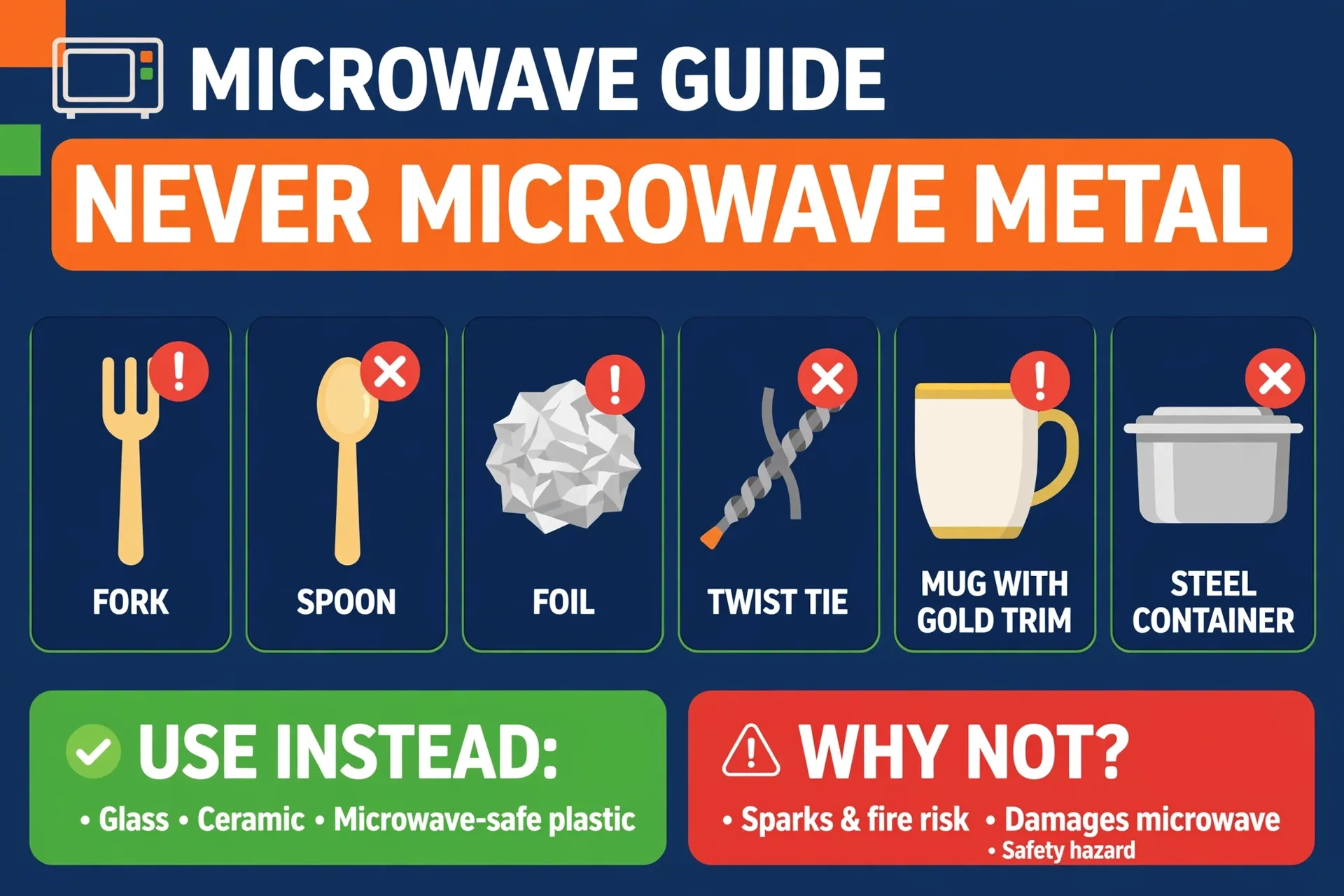
No. Do not put metal in your microwave. The USDA’s food safety guidance treats metal as a hard no, and the reason is simple: metal can spark, start a fire, and damage your oven.
The USDA’s Microwave Ovens and Food Safety guide explains that sparks, a process called arcing, happen when microwaves react with metallic materials such as twist ties and the gold paint on dishes. The guide warns that prolonged arcing can damage the oven or the utensil, which is why it tells you to turn the oven off the moment you see sparks.
The FDA’s microwave oven guidance says the same thing in different words: metal pans and aluminum foil should not be used because microwaves reflect off them, which heats food unevenly and can damage the oven. The agency recommends glass, ceramic, and plastic containers labeled for microwave use instead.
Independent testing backs this up. A Consumer Reports engineer explains that microwave radiation can produce a concentrated electric field at the ends, corners, or edges of metal objects, which can heat the object, ionize the surrounding air, or let sparks jump between points. As Consumer Reports’ guide to things you should never microwave puts it, any of those effects can start a fire inside your oven.
So the rule for your kitchen is simple. No forks, no spoons, no foil, no travel mugs, no plates with metallic trim. When you are not sure about an item, check the label, and when there is no label, keep it out.
That is the complete answer to “can you microwave metal” as a general rule: no. For a quick yes-or-no lookup on dozens of everyday materials, see our Can You Microwave It? The Complete Safety Chart. If you often reach for a disposable option instead, check our guide to whether you can microwave paper plates so you know which ones are safe.
Why Does Metal Spark in the Microwave? The Science in Plain Words
Metal sparks because microwaves shove the loose electrons inside it back and forth, and those electrons pile up at sharp points until the air itself starts conducting electricity. That spark is called arcing, and it is basically miniature lightning in your microwave.
Your microwave cooks by sending out waves that make water, fat, and sugar molecules vibrate, which is what heats your food. Metal does not absorb those waves. It reflects them. That is actually why the inside walls of your microwave are made of metal: they bounce the waves around so your food gets hit from all sides instead of letting the energy escape into your kitchen.
Now picture what happens when a piece of metal sits in that storm of bouncing waves. Metal is packed with electrons that move freely. The waves push those electrons back and forth tens of millions of times per second.
On a smooth, rounded surface, the electrons spread out evenly and nothing dramatic happens. But on a sharp point, like a fork tine or a crinkle of foil, the electrons crowd together into a tiny area, and the electric field there becomes extremely intense.
What “Arcing” Actually Means
When the electric field at a sharp point gets strong enough, it rips electrons off the air molecules nearby. Those freed electrons crash into more air molecules and free even more electrons, in a chain reaction that takes a fraction of a second. The glowing spark you see is a tiny pocket of plasma, which is an electrically conductive gas. The USDA calls this arcing and says to turn the oven off immediately when you see it, because the sparks are hot enough to scorch food and ignite paper or grease.
Why Shape Matters More Than Size
A big, smooth serving spoon is far less likely to spark than one tiny twist tie, and that confuses a lot of people. Thin metal heats up extremely fast because the electric current has very little material to spread through, which is why foil can go from fine to flaming in seconds. Thick, smooth metal heats slowly and spreads the charge evenly, so it often survives without a single spark.
This is exactly why the “I microwaved a spoon once and nothing happened” story survives. The person got lucky with physics, not a safety rule. It is also why “can you microwave metal” gets such confusing answers online: people report their lucky outcomes as if they were rules.
As NPR’s science explainer on why metal sparks puts it, smooth metal objects without pointed ends can sometimes escape the microwave unscathed, but forks, twist ties, and crinkled foil are asking for trouble. Luck is not a safety standard, so the rule stays the same: keep all metal out.
Metal Items You Should Never Put in a Microwave
Treat every item below as a hard no. Thin or sharp-edged metal is the worst offender, but thick and smooth metal does not get a free pass either. None of these belong in your microwave. If you searched “can you microwave metal” because of one specific item on this list, the answer is the same for all of them.
| Metal item | Why it is risky in a microwave | Danger level |
|---|---|---|
| Fork | Thin, pointed tines concentrate electric charge and invite sparks | Very high |
| Aluminum foil | Paper-thin and crinkles into sharp edges; can ignite within seconds | Very high |
| Twist tie | Thin wire acts like an antenna for sparks | Very high |
| Mug or plate with gold or silver trim | Even a thin line of metallic paint can arc | High |
| Takeout box with metal handle | Thin wire handle sits close to the oven walls | High |
| Stainless steel container or lid | Blocks microwaves so food heats unevenly; strains the oven | High |
| Metal can or tin | Sealed metal blocks heating and can trap pressure | High |
| Spoon | Smooth, thick, and rounded, so it sparks less often | Lower, but still not recommended |
Aluminum Foil Deserves Its Own Warning
Foil is the item people argue about the most, so let us settle it. For everyday reheating, do not put foil in the microwave. It is one of the worst offenders because it is thin, it crinkles into sharp edges, and it can go from calm to flaming in seconds.
The USDA allows exactly one narrow exception: small, smooth pieces of new foil used to shield parts of food from overcooking. Even then, the rules are strict. Cover no more than one quarter of the food, shape the foil smoothly so no edges stick out, keep it at least one inch from the oven walls, and remove it the moment you see any sparking.
For normal leftovers, none of this is worth the trouble. We cover every foil scenario, including the shielding rules, in our guide to whether you can microwave aluminum foil.
The Sneaky Ones: Twist Ties, Trim, and Handles
The most common metal accidents do not involve a fork at all. They involve the metal you forgot was there: the twist tie on the bread bag, the staple on the takeout bag, the wire handle on the oyster pail, the gold rim on a wedding-gift plate.
LSU AgCenter’s microwave safety list names twist ties, poultry pins, gold-rimmed dishes, stapled bags, and forks and knives as items that should never go in a microwave, noting that metal causes the sparking known as arcing. These are the accidents that catch careful people off guard, because nobody thinks of a bread tie as “metal.” Before you press start, give your food a five-second scan for anything shiny, wiry, or metallic.
Can You Microwave Metal Cutlery Like Forks and Spoons?
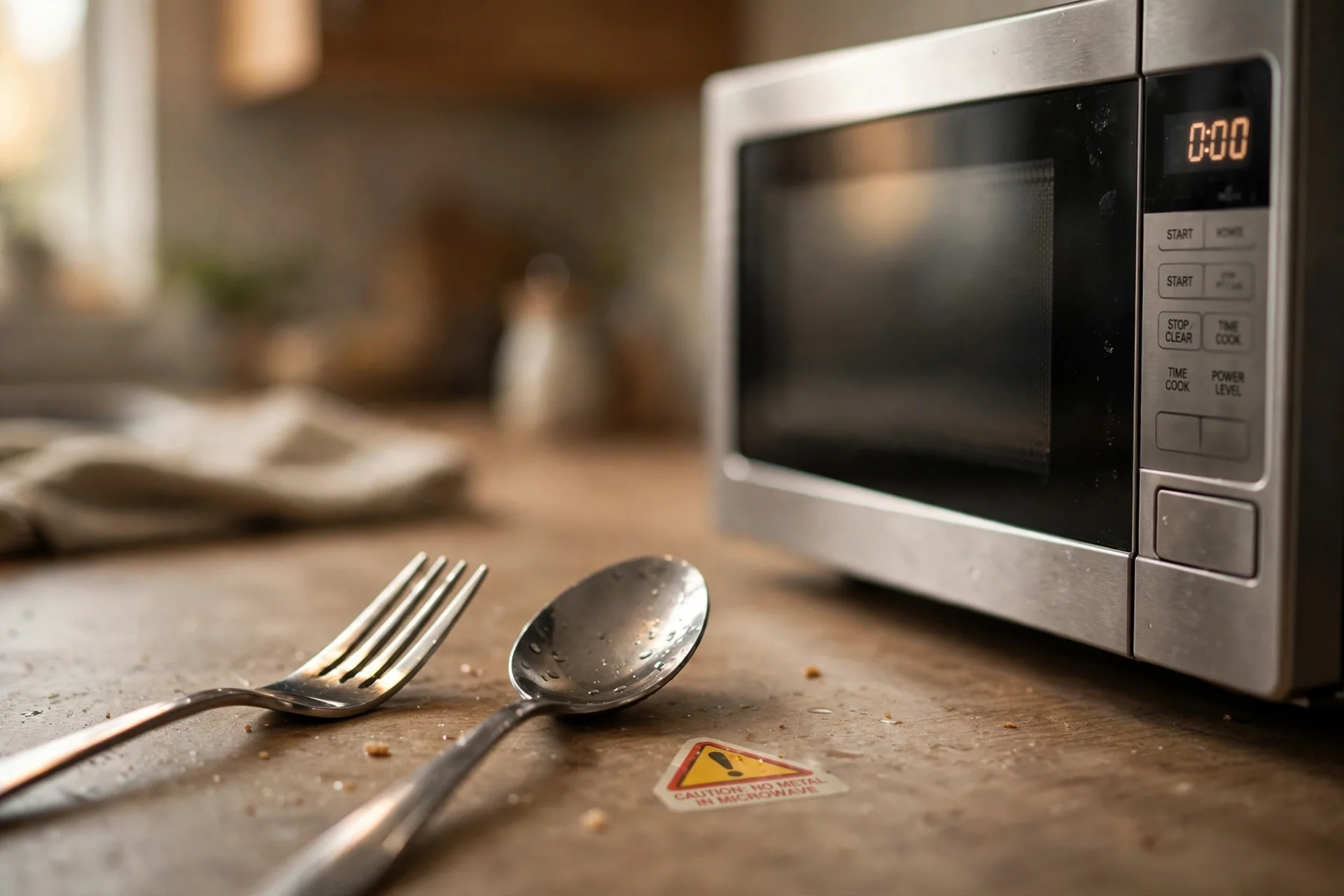
No. Do not microwave forks or spoons. Forks are among the most dangerous items you can put in a microwave, and spoons are only “less likely” to spark, which is not the same as safe.
Cutlery causes more microwave scares than any other metal because it ends up in the bowl by accident. You stir the soup, you get distracted, the spoon stays in. It happens to everyone.
But understanding the difference between a fork and a spoon will help you judge how worried to be when it happens. Most people who ask “can you microwave metal” are really asking about cutlery, so let us cover both properly.
What Happens When You Microwave a Fork
A fork is close to the worst-case shape for a microwave. The body of the fork is thick, but the tines taper to thin, pointed tips, and sparks love to form at those tips or jump between two tines sitting close together. The result is loud crackling and bright blue-white sparks, sometimes within seconds.
The sparks can scorch your food, leave burn marks on the oven walls, and ignite anything flammable nearby, like a paper towel or dry pasta edges. People who have filmed this (so you do not have to) consistently find that the fork sparks fast and aggressively. If you ever see it happen, press stop immediately and do not open the door until the sparking stops.
What About a Spoon?
A spoon is the reason the “some metal is fine” myth refuses to die. Its thick, smooth, rounded bowl spreads the electric charge evenly, so it usually rides out a short microwave trip without a single spark. Many people have done it by accident and noticed nothing at all.
But “usually fine” is doing a lot of heavy lifting in that sentence. A spoon sitting close to the metal oven wall can still arc, because the charge can jump the small gap between two pieces of metal. A spoon also reflects the microwaves, which means the food around it heats unevenly while the oven works harder. The fix takes five seconds: take the spoon out before you press start, and the question never comes up.
When Can You Microwave Metal? The Rare Exceptions
Almost never. The only metal that belongs in a microwave is metal that the manufacturer specifically designed and labeled for microwave use. Ordinary metal from your kitchen drawer is never an exception, no matter how smooth or thick it looks.
This is the part other articles get wrong by being too clever. Yes, metal physics has nuances, and yes, some metal items are engineered to be safe. But those engineered items come with a label that says so. Your job is not to judge metal by its shape.
Your job is to check the label.
Microwave Crisper Trays and Browning Sleeves
Crisper trays and browning sleeves are the most legitimate exception. They contain thin layers of metal that are designed to absorb microwave energy and get hot, which crisps the bottom of a pizza or browns a pastry. They are engineered for this exact job, tested by the manufacturer, and labeled microwave-safe.
A random metal tray or sheet pan is not the same thing, even if it looks similar. The difference is not the metal; it is the engineering and the testing behind it. If the packaging says microwave-safe, trust the maker. If it does not say so, keep it out.
The Metal Rack That Came With Your Microwave
Some microwaves ship with a metal rack for two-level cooking, and using it is perfectly fine. That rack was designed with smooth, rounded shapes that will not arc inside that specific oven, and the manufacturer tested it there.
This exception confuses people into thinking “metal racks are safe,” and then they put a cooling rack or an oven shelf in the microwave. Do not do that. Only the rack that came with your microwave, used exactly the way your manual describes, counts as safe. When in doubt, check the label or the manual.
Products With Metal Parts Labeled Microwave-Safe
A few cookware makers sell products with metal parts that they specifically label microwave-safe, such as lids with a metal rim that holds a silicone seal in place. In microwave cookware maker Anyday’s guide to metal and arcing, the company explains that smooth, thick, rounded metal is unlikely to arc, and it designs its lids around that principle while warning that thin or sharp-edged metal is unsafe.
Notice the pattern across every real exception: the maker did the engineering, did the testing, and put the claim in writing on the label. Your fork, your travel mug, and your grandmother’s gold-rimmed plate never got that treatment. When uncertain, the label decides, and no label means no microwave.
You Already Microwaved Metal. Here Is What to Do
Stop the microwave right away, keep the door closed until the sparking stops, and then check the oven for damage. In most cases, if you caught it within a few seconds, your microwave is completely fine. After a scare like this, many people search “can you microwave metal” again hoping for a softer answer. The answer is the same, but the damage is usually minor.
First, take a breath. This happens in thousands of kitchens every single day, and it rarely ends in disaster. Panicking and yanking the door open mid-spark is the one thing that can make it worse, because opening the door gives a fire fresh oxygen. Follow the steps below instead.
Step by Step: After the Sparks
- Press stop or cancel on the microwave immediately.
- Keep the door closed until all sparking and crackling has fully stopped.
- If you see actual flames, keep the door closed, turn the oven off, and unplug it. A closed door starves the fire of oxygen.
- Wait a few minutes for everything to cool down before you touch anything.
- Remove the metal item with an oven mitt or a dry towel, since it may be hot.
- Wipe down the interior and look for scorch marks, melted spots, or damage to the waveguide cover, which is the small mica or cardboard-like panel on the inside wall.
- If the oven sparks again with no metal inside it, stop using it and have it checked by a qualified technician.
How to Tell If Your Microwave Is Damaged
The USDA’s guidance is reassuring here: if arcing is caught at once, it should not damage the oven, but prolonged arcing can damage the oven or the utensil. A few seconds of sparks with a quick stop almost never kills a microwave. Several minutes of sparking is a different story.
Run this simple test. Put a microwave-safe mug of water inside, with no metal anywhere, and heat it for one minute. If the water heats normally and you see no sparks, smell nothing strange, and hear no odd buzzing, you almost certainly dodged the bullet. If the oven sparks while empty of metal, makes a new rattling or buzzing sound, or the turntable stops turning, unplug it and call for service instead of running it again.
How to Check If a Dish Has Hidden Metal
Use the USDA’s one-minute water test: microwave the empty dish next to a cup of water for one minute, and if the dish comes out warm, it contains metal and is not microwave safe.
Some dishes hide metal where you cannot see it, in the glaze, the paint, or a decorative band under the surface. You cannot always tell by looking, and “it looks like plain ceramic” is not a safety test. The USDA’s test is simple and reliable, and it takes sixty seconds. This is the quiet corner of the “can you microwave metal” question: sometimes you do not even know metal is there.
Put one cup of tap water in a glass measuring cup. Place it in the microwave next to (but not touching) the dish you want to test. Microwave on high for one minute.
If the dish feels warm or hot afterward, it contains metal in the material or glaze, so do not use it in the microwave. The dish or the bottom of the oven could even crack, according to the USDA’s Microwave Ovens and Food Safety guide. Learning the standard microwave-safe symbols also helps you spot safe dishes at a glance when you shop.
Everyday Items People Forget Contain Metal
Build a habit of scanning for these before you press start. Twist ties on bread and produce bags, staples on takeout bags and some tea bags, the wire handle on a Chinese takeout oyster pail, metallic ink or trim on fancy plates, and insulated travel mugs with hidden steel walls all count as metal.
Consumer Reports gives the same advice for takeout in particular: give the food a once-over before you press start, because handles, staples, and trim are easy to miss. Transferring food to a plain glass or ceramic dish takes ten seconds and removes every guess. For the full rundown of kitchen hazards beyond metal, see our list of things you should never put in a microwave.
Frequently Asked Questions
Here are direct answers to the questions people ask most about microwaving metal, based on official food safety guidance and real kitchen experience.
Can you microwave metal at all?
No. As a rule, do not put metal in the microwave.
Official food safety guidance treats metal as unsafe because it can cause sparks, start a fire, and damage the oven. The only exceptions are items the manufacturer specifically designed and labeled for microwave use, like certain crisper sleeves. If the label does not say microwave-safe, keep the metal out.
What happens if you put metal in the microwave?
The metal reflects the microwaves instead of absorbing them, and electric charges build up on its surface, especially at sharp edges.
When the charge gets strong enough, it jumps through the air as sparks, a process called arcing. Those sparks can scorch food, burn the inside of your oven, and start a fire if paper or grease is nearby. Prolonged arcing can also damage the magnetron, the part that generates the microwaves. This chain reaction is the core reason the answer to “can you microwave metal” is no.
Will a fork in the microwave explode?
Almost certainly not like a bomb, but that is the wrong thing to worry about.
A fork is one of the most spark-prone items because its thin, pointed tines concentrate electric charge. What you will actually see is loud crackling and bright sparks, which can ignite nearby paper or damage the oven’s interior. Turn the microwave off the moment you see sparks, and keep the door closed until they stop.
Can you microwave a spoon?
You should not, even though a smooth spoon is less likely to spark than a fork.
A spoon’s thick, rounded shape spreads the electric charge out, so it often survives a short trip with no drama. But “less likely” is not the same as safe: a spoon near the oven wall can still arc, and it shields your food from the microwaves. Just take the spoon out. It takes five seconds.
Can you put aluminum foil in the microwave?
For everyday cooking, no.
Foil is thin and crinkles into sharp edges, which makes it one of the worst offenders for sparks and even flames. The USDA allows one narrow exception: small, smooth pieces used to shield parts of food, covering no more than a quarter of the food and kept at least an inch from the oven walls. If you see any sparking, remove the foil immediately.
We cover every foil scenario in our guide to whether you can microwave aluminum foil. Foil is the item behind the most “can you microwave metal” searches, and the everyday answer stays no.
Why does metal spark in the microwave?
Because microwaves push the loose electrons inside metal back and forth, and those electrons pile up at sharp points and thin edges.
When the buildup gets strong enough, it ionizes the surrounding air and the charge jumps as a spark, which scientists call arcing. Smooth, thick metal spreads the charge evenly and rarely sparks, while forks, twist ties, and crinkled foil concentrate it. That is why shape matters more than size.
I accidentally microwaved metal. Is my microwave ruined?
Probably not, if you stopped it within seconds.
The USDA notes that arcing caught at once should not damage the oven, though prolonged arcing can damage it. Let the oven cool, remove the metal, and look for scorch marks or melted spots inside. Then heat a mug of water for one minute as a test. If it heats normally with no sparks, smells, or odd noises, your microwave is almost certainly fine.
Is stainless steel microwave safe?
No. Stainless steel containers, bowls, and lids should not go in the microwave.
The steel reflects microwaves, so your food heats slowly and unevenly while the oven works harder than it should. Travel mugs are a common trap because many have steel walls hidden under a plastic shell. Unless the product is explicitly labeled microwave-safe, keep stainless steel out of the microwave. If your “can you microwave metal” question came from a travel mug, check the base for a microwave-safe label before you trust it.
Can you microwave dishes with gold or silver trim?
No. Even a thin line of metallic paint or trim can arc, and the USDA specifically names gold paint on dishes as a cause of arcing.
The trim can also get hot enough to damage the dish or leave permanent burn marks. Save the fancy plates for serving at the table, and reheat food on plain microwave-safe dishes instead.
Are twist ties safe in the microwave?
No. A twist tie is a thin metal wire, which is about the worst shape metal can take inside a microwave.
It arcs easily and can ignite paper bags or food packaging nearby. Cut twist ties off bread bags and produce bags before reheating, and cover the food with a microwave-safe lid or paper towel instead. When it comes to “can you microwave metal,” twist ties prove there is no safe minimum size.
Can you microwave metal takeout containers?
No. Transfer the food to a microwave-safe dish first.
Many takeout containers hide metal: wire handles on oyster pails, metal staples, or foil-lined cardboard. The thin metal parts spark easily, and foil linings block the microwaves so your food stays cold in spots. Moving the food to a glass or ceramic dish takes ten seconds and removes all the risk.
What about microwave crisper trays and sleeves?
Those are fine, but only because they are not ordinary metal.
Crisper trays and browning sleeves contain engineered metal layers designed to heat up safely, and the manufacturer labels them for microwave use. The rule is simple: if the packaging or product says microwave-safe, trust the maker. If it does not say so, treat the item like any other metal and keep it out. These engineered products are the only honest “yes” in the entire “can you microwave metal” debate.
How do I know if my bowl or mug has metal in it?
Run the USDA’s one-minute water test.
Place one cup of water in a glass measuring cup in the microwave, set the dish you want to test next to it without touching, and microwave on high for one minute. If the dish feels warm or hot afterward, it contains metal in the material or glaze and is not microwave safe. Learning the standard microwave-safe symbols helps you spot safe dishes at a glance.
Can metal in the microwave start a fire?
Yes.
The sparks from arcing are hot enough to ignite paper, paper towels, grease, or dry food inside the oven. That is why safety experts say to stay near the microwave while it runs and to stop it immediately if you see sparks. If flames appear, keep the door closed, turn the oven off, and unplug it.
A closed door starves the fire of oxygen and usually puts it out. Fire risk is the biggest reason the “can you microwave metal” answer is a firm no rather than a “probably not.”
Conclusion
So, can you microwave metal? No, and now you know exactly why. Metal reflects microwaves instead of absorbing them, and thin or sharp-edged pieces like forks and foil turn that reflected energy into sparks that can start a fire or damage your oven.
Three things are worth remembering. First, the exceptions are rare and they always come with a manufacturer’s microwave-safe label, so when in doubt, check the label or leave the metal out. Second, if it already happened, stop the oven fast and keep the door closed. Third, build the five-second scan habit: cutlery, foil, twist ties, and trim before you press start.
If you want a quick yes-or-no answer for any other material in your kitchen, our Can You Microwave It? The Complete Safety Chart has you covered. The next time someone asks you “can you microwave metal,” you will know exactly what to tell them.
