

Picture this. It is 7:40 in the evening, dinner is on the plate, and you are standing in front of the microwave with a roll in each hand. One box says parchment paper. The other says wax paper. The rolls look like twins, and most people cannot tell which is which without squinting at the packaging. If you have ever wondered about parchment paper vs wax paper microwave safety, you are asking the right question, because grabbing the wrong roll can mean the difference between perfectly reheated leftovers and a waxy mess soaked into your dinner.
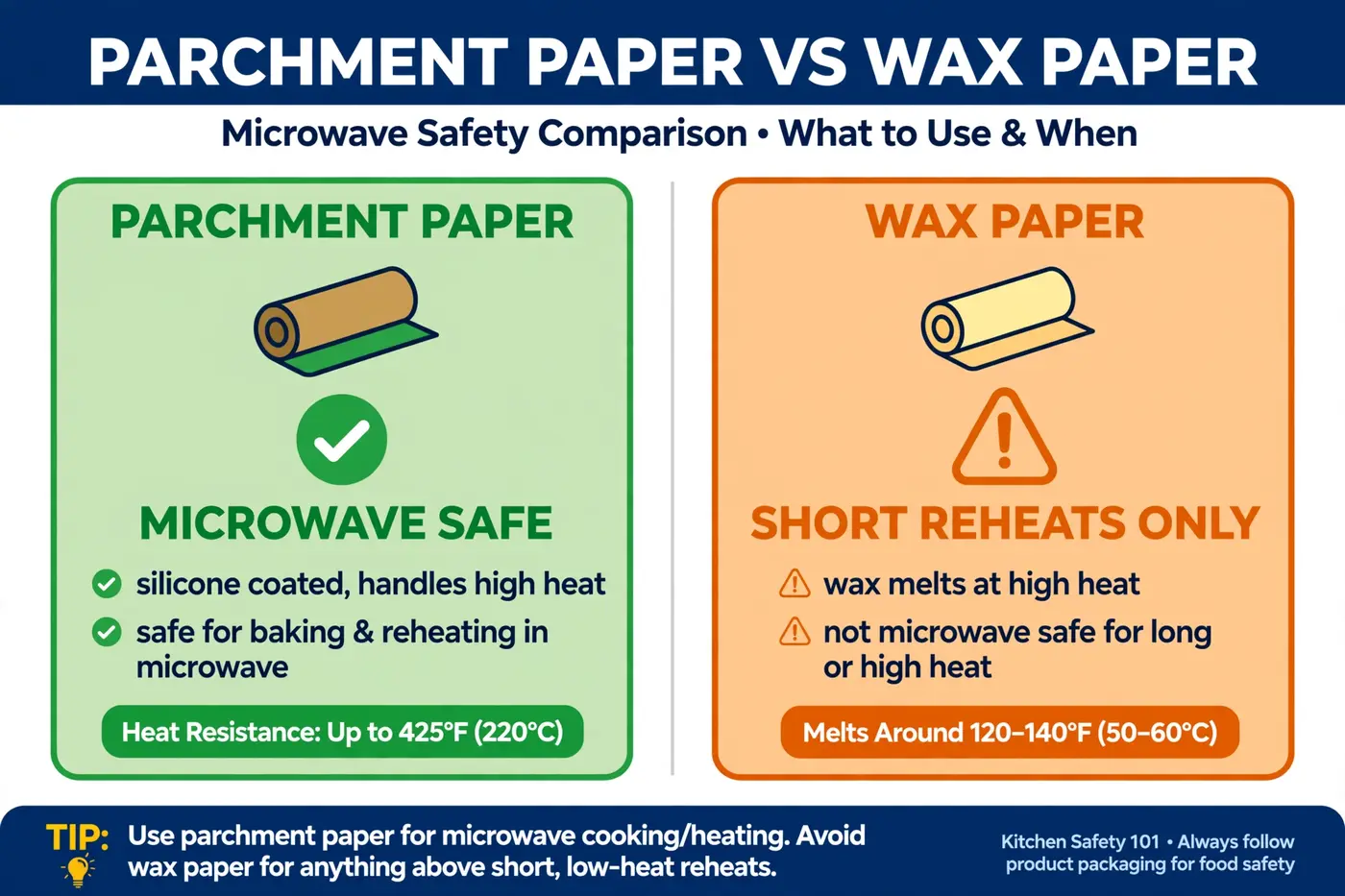
Here is the short version before we get into the details. Parchment paper is coated with heat-resistant silicone, so it handles microwave heat with ease. Wax paper is coated with actual wax, which softens and melts when things get hot. The USDA lists wax paper as safe for covering food during short reheats, but it has strict limits that parchment paper never worries about.
This guide walks you through the real difference between the two papers, their heat ratings, and exactly which roll to grab for every common microwave job. By the end, you will never stand in front of the microwave guessing again.
Parchment Paper vs Wax Paper Microwave: What Is the Real Difference?
The real difference is the coating, and the coating decides everything about heat. Parchment paper carries a thin layer of food-grade silicone baked onto the paper fibers. That silicone layer is what makes it non-stick, moisture-resistant, and the reason parchment dominates the parchment paper vs wax paper microwave heat test. Wax paper carries a thin layer of paraffin wax or soybean-based wax on both sides. That wax layer makes it non-stick and moisture-resistant too, which is exactly why the two papers look and feel so similar in your hands.
So when you ask which one wins the parchment paper vs wax paper microwave question, the answer starts with a simple fact: silicone survives heat, wax does not. Everything else, including the heat ratings, the safe uses, and the mistakes, flows from that one difference.
The Coating Tells the Whole Story
Parchment paper gets its power from silicone. Silicone is the same family of material used in oven mitts and baking mats, and it is stable at temperatures far beyond anything a microwave produces. Manufacturers rate most parchment paper to about 420 to 450 degrees Fahrenheit, which is why it goes into hot ovens without a problem. In the microwave, where food rarely pushes past the boiling point of water, parchment paper is comfortably inside its safety zone.
Wax paper gets its non-stick surface from wax. Paraffin wax and soybean-based wax are food-safe, and they do a fine job at room temperature or in the fridge. But wax softens at low heat and melts at temperatures a hot meal can easily reach, which is why wax paper loses every parchment paper vs wax paper microwave heat comparison. Once the wax starts to liquefy, the paper loses its non-stick surface, the wax can soak into your food, and the bare paper underneath can start to scorch. This is the core of the parchment paper vs wax paper microwave debate, and it is why you cannot treat the two rolls as interchangeable.
Heat Ratings Are Not Even Close
Put the numbers side by side and the gap is obvious. Parchment paper is typically rated to about 420 to 450 degrees Fahrenheit. Most microwave reheating keeps food at or below 212 degrees Fahrenheit, the boiling point of water. Parchment paper therefore has a huge safety margin in the parchment paper vs wax paper microwave heat comparison. You would have to try very hard, like running the microwave empty with dry paper inside, to push it into trouble.
Wax paper has no published high-heat rating because it is not built for heat at all. Its wax coating softens at low temperatures and can melt somewhere in the range of roughly 120 to 200 degrees Fahrenheit, depending on the wax blend. A plate of reheated pasta can hit those temperatures in spots, and fatty or sugary foods can climb even higher. That is why the USDA treats wax paper as a short-reheat cover only, while parchment paper gets the full green light for real cooking jobs.
Is Parchment Paper Safe in the Microwave?
Yes, parchment paper is fully safe in the microwave. The silicone coating handles microwave heat with ease, the paper does not spark, it does not melt, and it does not release anything unpleasant into your food. If you can only remember one rule from this article, make it this one: when heat is involved, parchment paper is always the safe pick in the parchment paper vs wax paper microwave debate.
Food safety guidance backs this up. The USDA’s microwave safety guidance, quoted by Kansas State University Extension, lists parchment paper alongside wax paper, cooking bags, and microwave-safe plastic wraps as materials that should be safe to use when microwaving food. Parchment is the most heat-forgiving option on that list, which makes it the best default in any parchment paper vs wax paper microwave comparison for covering, wrapping, and steaming.
The Best Ways to Use Parchment Paper in the Microwave
The simplest use, and the most common parchment paper vs wax paper microwave scenario, is covering a plate of leftovers. Tear off a sheet, lay it loosely over the plate, and microwave as usual. The paper catches splatters, holds in a little steam so food does not dry out, and peels away cleanly because of the silicone coating. For a broader look at what belongs in your microwave, our Can You Microwave It? The Complete Safety Chart covers dozens of common kitchen items.
For steaming, the parchment paper vs wax paper microwave answer is one-sided: parchment paper works beautifully. You can fold a sheet into a loose pouch, add vegetables or fish with a spoonful of water, crimp the edges, and microwave for two to three minutes. The steam builds inside the pouch and cooks the food gently and evenly. This is the same idea as the French en papillote method, just done in the microwave instead of the oven.
You can also settle the parchment paper vs wax paper microwave question for mug cakes by lining a microwave-safe mug or bowl with parchment paper before adding batter. The batter will not stick, and cleanup becomes a one-second job. Just make sure the paper sits inside a microwave-safe dish, not directly on the microwave floor, and keep it away from the walls.
How Long Can Parchment Paper Stay in the Microwave?
For normal reheating and cooking, parchment paper can stay in as long as the food needs, which usually means one to five minutes. The paper is rated for far more heat than the microwave produces during normal use, so time is not really the enemy here. Dryness is the thing to watch instead.
The one parchment paper vs wax paper microwave rule that applies to both papers: never microwave paper by itself with no food. Paper with nothing to absorb the energy can dry out, scorch, and in extreme cases catch fire. Always use parchment paper with food on it or under it, keep cooking times reasonable, and never walk away while the microwave is running. If you ever see the edges browning or smell something burning, stop the microwave, keep the door closed, and let everything cool down before you open it.
Can You Put Wax Paper in the Microwave?
Yes, but only for short reheats, and only as a loose cover, never as a wrapper or liner for hot food. This is where the parchment paper vs wax paper microwave question gets its nuance. Wax paper is not banned from the microwave, but it is on a short leash. That sentence is the entire parchment paper vs wax paper microwave rule for wax paper: use it to cover a plate for a quick reheat, keep the time short, and switch to parchment paper for anything longer, hotter, or greasier.
The confusion in the parchment paper vs wax paper microwave debate comes from oversimplified answers online. Some sources say wax paper is completely fine in the microwave. Others say never use it at all. The truth sits in the middle, and it comes straight from food safety guidance: short, gentle reheating as a cover is fine, but high heat, long cook times, and direct contact with very hot or fatty foods are where wax paper fails.
What the USDA Says About Wax Paper in the Microwave
The USDA’s answer to the parchment paper vs wax paper microwave question is clear and practical. It states that microwave-safe plastic wraps, wax paper, cooking bags, parchment paper, and white microwave-safe paper towels should be safe to use in the microwave. In the same guidance, it warns never to use brown paper bags, newspapers, or thin plastic bags. The full breakdown is quoted in this Kansas State University Extension article on safe microwave containers.
Notice what the guidance is really saying. Wax paper earns its place as a covering material for reheating, not as a cooking surface. It is in the same category as paper towels: fine for short, low-stress jobs, not built for serious heat. And interestingly, food safety experts consider wax paper a better cover than plastic wrap for reheating, because wax paper is just paper plus food-safe wax, while heated plastic can carry chemical migration concerns. As one food publication reported on the USDA’s position, wax paper is actually the safer cover choice compared to plastic wrap.
When Wax Paper Turns Into a Problem
In the parchment paper vs wax paper microwave safety picture, wax paper crosses from safe to risky in three situations. First, long cook times. A 30-second reheat is nothing; a six-minute cook gives the wax plenty of time to soften and melt. Second, high heat. Fatty foods like cheese, bacon, and butter get much hotter than watery foods, and they can push the wax past its melting point fast. Third, direct contact with very hot food. A loose cover floating above the plate is one thing; wax paper pressed against sizzling hot cheese is another.
If you are unsure whether your job counts as gentle, the parchment paper vs wax paper microwave rule of thumb is to ask one question: would the food burn my fingers badly if I touched it? If yes, the wax paper is at risk. When in doubt, reach for the parchment paper instead. It costs a little more per roll, but it never makes you do this kind of risk math.
What Happens If Wax Melts Into Your Food?
If the wax coating melts, it can soak into the food sitting under or against the paper. The food may pick up a slightly waxy taste or a greasy film. The good news is that the wax used on food-grade wax paper, paraffin or soybean-based wax, is considered safe to ingest in small amounts. The same family of wax is used as a coating on cheese, which is why food experts note that melted wax on food is unpleasant but not a poisoning emergency.
That said, unpleasant is still unpleasant, and melted wax also exposes the bare paper fibers underneath. Those exposed fibers can scorch or smoke if the heat continues, which is a real mess and a potential fire concern. So while a little melted wax will not send you to the hospital, it ruins the meal and creates a cleanup job nobody wants. In the parchment paper vs wax paper microwave tradeoff, the smart move is to prevent wax melting, not to clean it up.
Parchment Paper vs Wax Paper Microwave: Side-by-Side Comparison
Which paper wins overall? Parchment paper. It handles every microwave job safely, while wax paper only works as a short-reheat cover. You have seen the details of the parchment paper vs wax paper microwave comparison; now here is the whole picture in one place. This table covers every feature that matters in a real kitchen. Bookmark this section if you just need a quick reference before you cook.
| Feature | Parchment Paper | Wax Paper |
|---|---|---|
| Coating | Food-grade silicone | Paraffin wax or soybean-based wax |
| Heat resistance | Typically rated to about 420 to 450 F | Wax softens at low heat, melts around 120 to 200 F depending on blend |
| Microwave safety | Yes, fully safe for covering, wrapping, and steaming | Yes for short reheats as a loose cover only |
| Oven safety | Yes, up to its rated temperature | No, the wax melts and can smoke |
| Covering leftovers to reheat | Excellent | Fine for short reheats |
| Wrapping hot, greasy, or cheesy food | Excellent | Not recommended, fat gets very hot |
| Steaming food in a pouch | Excellent | Not recommended |
| Effect on food flavor | None | Can add a waxy taste if the wax melts |
| Price per roll | Higher | Lower |
| Best microwave use | The default for any heating job | Quick splatter cover for gentle reheats |
Read the table as a decision tool, not just a fact sheet. In the parchment paper vs wax paper microwave decision, if the job involves real heat, real time, or real fat, the left column wins every time. If the job is a 60-second reheat of something mild and you only have wax paper, the right column will do the job just fine. Most kitchens keep both rolls, and now you know exactly when each one earns its place.
Which Paper Should You Grab? Five Real Kitchen Scenarios
For most jobs, grab parchment paper; use wax paper only for quick, gentle reheats. Theory is nice, but you cook in real life. Here are the five situations where the parchment paper vs wax paper microwave question actually comes up, with a clear pick for each one.
Scenario 1: Reheating Leftovers on a Plate
You have a plate of last night’s pasta and you want to stop the sauce from redecorating the microwave walls. In the parchment paper vs wax paper microwave matchup for simple leftovers, either paper works, as long as the reheat is short and the food is not extremely hot or fatty. Tear off a sheet, lay it loosely over the plate, and heat for one to three minutes.
If the leftovers are cheesy, buttery, or oily, pick parchment paper without thinking twice. That is the parchment paper vs wax paper microwave rule for fatty foods. Fat holds heat longer and climbs to higher temperatures than water-based sauces, which puts wax paper at risk of melting. Parchment paper does not care how greasy the food is. For other covering options, see our guide on microwaving paper towels for covering food.
Scenario 2: Steaming Vegetables or Fish
For steaming, the parchment paper vs wax paper microwave verdict is one-sided: parchment paper wins by a mile, and wax paper should sit this one out. Steaming means sustained heat plus trapped moisture for two to four minutes, which is exactly the combination that softens wax. A parchment pouch holds up through the whole cook, traps the steam that cooks your broccoli or salmon, and opens without sticking.
To build the pouch, place your vegetables or fish in the center of a parchment sheet, add a spoonful of water or broth, fold the paper over, and crimp the edges to seal it. Leave a tiny vent so pressure does not build up. Microwave for two to three minutes, then let it rest for a minute before opening. The steam inside is extremely hot, so open the pouch away from your face.
Scenario 3: Covering Greasy, Cheesy, or Buttery Food
Greasy food is the danger zone in the parchment paper vs wax paper microwave debate, so grab the parchment roll. Foods like mac and cheese, pizza slices, bacon, and buttered vegetables get significantly hotter than plain watery foods. Microwaves heat fat very efficiently, and the surface of melted cheese can far exceed the temperature where wax softens.
Parchment paper handles all of it calmly. Lay a loose sheet over the dish and heat normally. The silicone coating shrugs off the heat and the grease, and the paper will not stick to the cheese if it happens to touch it. This is the scenario where the wrong choice most often ends with a waxy film on dinner, so make the parchment roll your habit for anything greasy.
Scenario 4: Reheating Pizza, Burritos, and Sandwiches
For pizza and sandwiches, the parchment paper vs wax paper microwave answer is parchment paper again. A burrito or sandwich wrapped in parchment paper reheats evenly, the tortilla or bread stays softer because the paper holds in a little steam, and nothing sticks. For pizza slices, a loose parchment cover keeps the cheese from splattering while letting enough steam escape that the crust does not turn soggy.
Wax paper can technically cover a sandwich for a quick warm-up, but the moment cheese or grease gets seriously hot, you are back in the melting zone. Since these foods are almost always cheesy or greasy, parchment paper is simply the safer default. Keep the wax roll for jobs that involve no heat at all, like wrapping a cold sandwich for lunch.
Scenario 5: The Oven Trap, Where the Mix-Up Hurts Most
The microwave is forgiving, but the oven is not, and this is where the parchment paper vs wax paper confusion causes real damage. Parchment paper goes into the oven safely up to its rated temperature, usually around 420 to 450 degrees Fahrenheit. Wax paper must never go into the oven. The wax melts quickly, smokes, and can ruin both your food and your baking sheet.
This matters for the microwave question because the habit carries over. If you train yourself to treat the rolls as interchangeable in the microwave, you may grab the wrong one for the oven out of habit. The safest household rule is simple: parchment paper is the heat paper, wax paper is the cold paper. Wax paper is perfect for wrapping cold sandwiches, lining the counter when you roll out dough, or separating layers of cookies for storage. Heat is parchment’s job.
Mistakes People Make With Parchment Paper and Wax Paper
Most microwave paper accidents come from four mistakes, and every one of them is easy to avoid once you know what to watch for.
Mistake 1: Using Wax Paper in the Oven
This is the big one. Wax paper looks like parchment paper, so people line baking sheets with it out of habit. In a hot oven, the wax melts within minutes, smoke starts rising, and the food picks up a burnt waxy taste. The cleanup is miserable, and the smoke is unpleasant to breathe.
The fix for this classic parchment paper vs wax paper microwave mistake is a kitchen rule, not a product change. Store the rolls in different spots, or mark the wax paper box with a big “NO OVEN” note. And if a recipe says parchment paper, it means parchment paper. Wax paper is never a substitute for high-heat cooking, no matter how similar the rolls look. If you are ever unsure about an oven job, check the label on the box before the paper goes near the heat.
Mistake 2: Grabbing a Brown Paper Bag or Newspaper
When people run out of proper covers during a parchment paper vs wax paper microwave moment, they improvise with whatever paper is nearby. Brown paper grocery bags, newspapers, and recycled paper products should never go in the microwave. Brown bags can contain recycled fibers, glues, and inks, and they are a known fire risk in the microwave. Newspapers carry printing inks that can transfer to food and release fumes when heated.
The USDA guidance is explicit on this point: never use brown paper bags or newspapers in the microwave. If you have no parchment or wax paper, a plain white paper towel or a microwave-safe plate turned upside down over your dish works far better. Printed cardboard takeout containers have their own microwave rules, covered in our guide to microwaving cardboard takeout boxes. For the full list of dangerous items, see things you should never put in the microwave.
Mistake 3: Heating Dry Paper With No Food in the Microwave
Any paper, including parchment paper, can scorch or catch fire if microwaved dry and alone, which is a parchment paper vs wax paper microwave rule with no exceptions. The food is what absorbs the microwave energy and keeps temperatures reasonable. Without food, the energy has nowhere productive to go, and the paper itself becomes the target.
Always use paper with food present, keep it inside a microwave-safe dish, and do not run long cycles with paper and nothing else. This rule also applies to paper towels, which can dry out and scorch faster than parchment. Short times, food present, and an eye on the microwave will keep every paper product safe.
Mistake 4: Reusing the Same Sheet Again and Again
Parchment paper is not designed for repeat microwave duty. Each heating cycle wears down the silicone coating a little, and a sheet that has already been through a long reheat will not protect as well the second time. It can also pick up food residues that scorch on reheating.
In the parchment paper vs wax paper microwave routine, tear off a fresh sheet each time. Parchment paper is inexpensive per use, and a fresh sheet gives you the full heat resistance and non-stick performance every time. The same goes for wax paper: once the wax has softened even slightly, the sheet is done. Fresh paper is always the safer paper.
How to Tell Parchment and Wax Paper Apart in Your Drawer
Use the touch test and read the box. Parchment paper feels dry and slick, and its box states an oven-safe temperature rating; wax paper feels waxy and its box warns against oven use. The whole parchment paper vs wax paper microwave problem starts with mistaken identity. The rolls look alike, the boxes use similar colors, and in a busy kitchen you grab whatever is closest. Two quick checks will end the parchment paper vs wax paper microwave guessing game and make sure you always know which roll is in your hand.
The Touch and Look Test
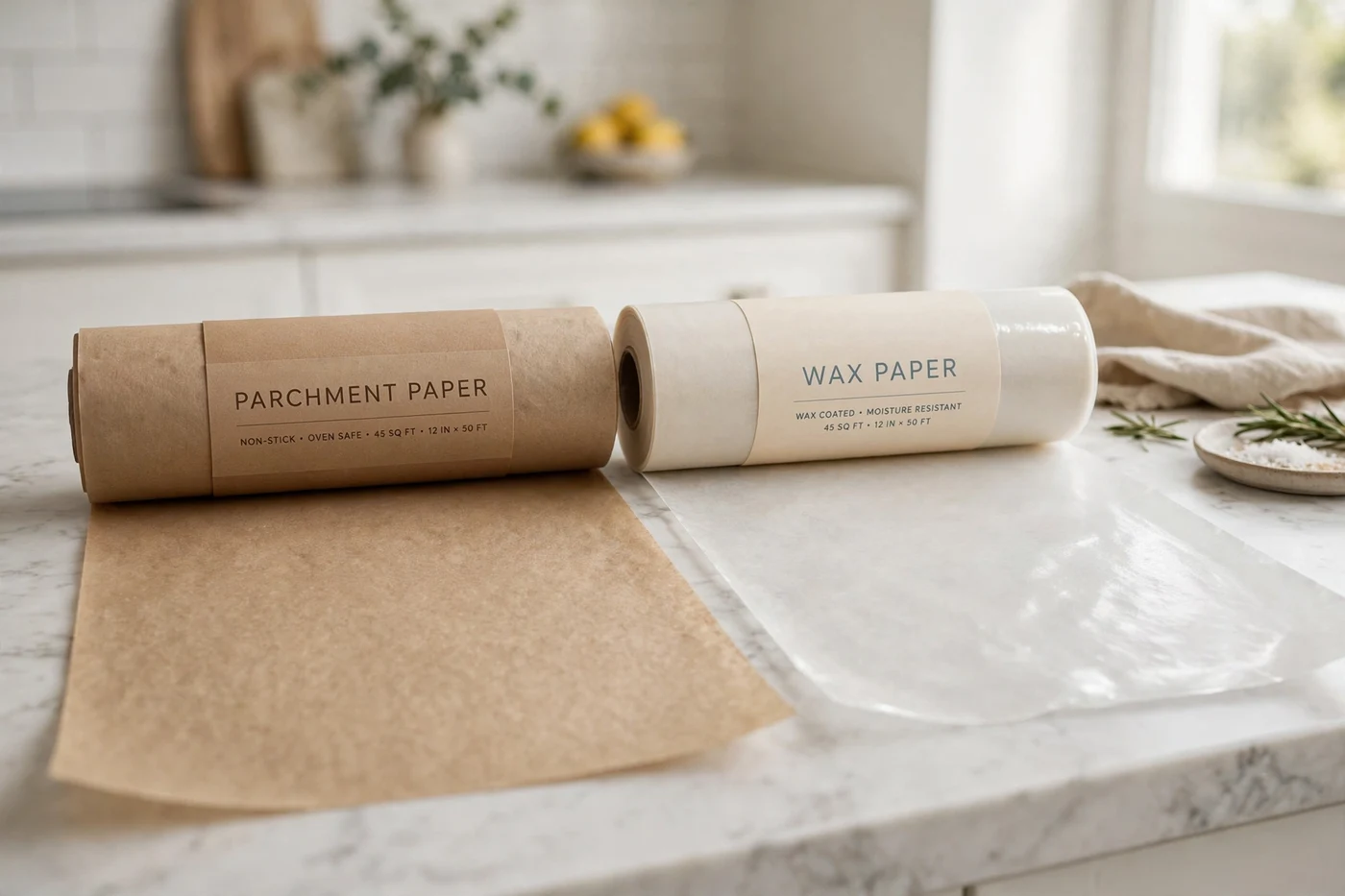
Parchment paper feels dry and slightly slick, with a matte finish that does not leave residue on your fingers. Wax paper feels noticeably waxier and a little tacky, and it has a slight sheen that catches the light. If you rub a corner between your fingers, wax paper can leave a faint waxy film, while parchment paper leaves nothing.
Color can help too, but it is not reliable on its own. Parchment paper is often a light tan or off-white, while wax paper is usually brighter white, but brands vary. Use the touch test as your primary check and the color as a backup hint. After a week of checking, you will be able to tell them apart blindfolded, and the parchment paper vs wax paper microwave confusion ends for good.
Read the Label Before You Heat
The most reliable check is the box itself. Parchment paper boxes almost always state a maximum temperature and often say “oven safe.” Wax paper boxes say things like “not for oven use” or list only cold uses like wrapping and lining. Many brands also carry a microwave-safe symbol, and learning to read those markings takes the guesswork out of every paper product in your kitchen. Our guide to microwave-safe symbols decoded shows you exactly what each marking means.
Make it a household habit: when a new roll comes home from the store, read the box once and store the rolls in separate, labeled spots. Thirty seconds of organization prevents every parchment paper vs wax paper microwave mix-up described in this article.
Parchment Paper vs Wax Paper Microwave: The Bottom Line
The parchment paper vs wax paper microwave question has a clear answer once you know the coating story. Parchment paper is coated with heat-resistant silicone and rated to about 420 to 450 degrees Fahrenheit, which makes it fully safe for every microwave job, from quick reheats to steaming pouches. Wax paper is coated with paraffin or soy wax that softens and melts at low heat, so the USDA approves it only as a loose cover for short, gentle reheats.
Your kitchen rule is simple: parchment paper is the heat paper, wax paper is the cold paper. Grab parchment for anything hot, long, or greasy. Use wax paper only for quick covers and cold wrapping, and never let it near your oven. Keep both rolls, learn the touch test, and check the label when unsure. For anything else in your kitchen, bookmark Can You Microwave It? The Complete Safety Chart.
Frequently Asked Questions
Is wax paper microwave safe?
Yes. In the parchment paper vs wax paper microwave question, wax paper is the limited yes: it is microwave safe for short reheats when used as a loose cover over food. The USDA lists wax paper among the materials that should be safe to use in the microwave, alongside parchment paper and cooking bags. But it is not safe for long cook times, high heat, or direct contact with very hot or fatty foods, because the wax coating softens and melts.
Can you put parchment paper in the microwave?
Yes. Parchment paper is the clear winner in the parchment paper vs wax paper microwave comparison: it is completely safe in the microwave. Its silicone coating is rated to about 420 to 450 degrees Fahrenheit, far above anything normal microwaving produces. You can use it to cover plates, wrap sandwiches, line mugs for mug cakes, and build steaming pouches. Just use it with food present and keep it away from the microwave walls.
What happens if wax paper melts in the microwave?
The wax coating liquefies and can soak into the food, leaving a waxy taste or greasy film on the meal. Once the wax melts away, the bare paper fibers underneath are exposed and can scorch or smoke if heating continues. The food is generally still safe to eat, since food-grade wax is non-toxic, but the meal is usually ruined and the cleanup is unpleasant.
Is it safe to eat food that touched melted wax paper?
In most cases, yes, it is safe, though it will not taste good. The paraffin or soybean-based wax on food-grade wax paper is considered safe to ingest in small amounts, and similar wax is used as a coating on cheese. That said, melted wax is a sign the paper was overheated, so check for any scorching or off smells, and when in doubt, throw the affected portion out.
What is the difference between parchment paper and wax paper?
The difference is the coating. Parchment paper is coated with heat-resistant silicone and rated to about 420 to 450 degrees Fahrenheit, so it is oven-safe and microwave-safe. Wax paper is coated with paraffin or soy wax that melts at low heat, so it is not oven-safe and only handles short, gentle microwave reheats. They look similar, but the parchment paper vs wax paper microwave difference comes down to how they behave around heat.
Can you use wax paper instead of parchment paper in the microwave?
Only for quick, gentle reheats as a loose cover. That is the whole parchment paper vs wax paper microwave substitution rule in one sentence: wax paper is not a substitute for parchment paper in steaming, wrapping hot food, or any longer cooking job. The wax coating cannot handle sustained heat or contact with very hot, fatty foods. If the recipe or the job involves real heat, use parchment paper instead.
How long can parchment paper stay in the microwave?
For normal cooking, parchment paper can stay in as long as the food needs, typically one to five minutes, without any problem. Time is not the concern; dryness is. That generous time window is a big part of why parchment wins the parchment paper vs wax paper microwave comparison. Never microwave parchment paper alone with no food, since dry paper can scorch or catch fire. Always use it with food present and keep an eye on the microwave during longer cooks.
Can wax paper catch fire in the microwave?
It is unlikely during a short, normal reheat, but the risk rises with long cook times, very hot or fatty foods, and dry paper with no food to absorb energy. Once the wax melts off, the exposed paper fibers can scorch and smoke. To stay safe, keep wax paper use short, use it only as a loose cover, and never leave the microwave unattended.
Can you steam vegetables in parchment paper in the microwave?
Yes, and this is one of the clearest parchment paper vs wax paper microwave differences: parchment paper is excellent for steaming vegetables in the microwave. Fold a sheet into a loose pouch, add your vegetables with a spoonful of water or broth, crimp the edges with a small vent left open, and microwave for two to three minutes. The trapped steam cooks the vegetables gently and evenly. Do not try this with wax paper, which cannot handle the sustained heat.
Does parchment paper change the taste of food?
No, parchment paper does not change the taste of food. The silicone coating is stable and flavorless at microwave temperatures, and it does not melt or transfer anything to the meal. This is one of its advantages over wax paper, which can leave a waxy taste if its coating melts into hot food.
Is wax paper safe for covering food when reheating?
Yes, covering food loosely with wax paper for a short reheat is exactly what the USDA guidance approves. It catches splatters and holds in a little moisture. Keep the reheat to a few minutes, do not let the paper press directly onto very hot or greasy food, and switch to parchment paper if the food is cheesy, buttery, or needs a longer cook time.
Can you put wax paper in the oven?
No, and this is the most dangerous parchment paper vs wax paper microwave mix-up: never put wax paper in the oven. The wax coating melts quickly at oven temperatures, produces smoke, and can ruin your food and your baking sheet. Wax paper boxes themselves usually warn against oven use. If a recipe calls for lining a pan for baking, use parchment paper, which is rated for oven heat.
What papers should you never put in the microwave?
Never microwave brown paper grocery bags, newspapers, or recycled paper products. The parchment paper vs wax paper microwave debate only covers food-grade rolls; these other papers can contain inks, glues, and recycled fibers that release fumes or catch fire. The USDA explicitly warns against brown paper bags and newspapers in the microwave. Stick to parchment paper, wax paper for short covers, and plain white paper towels.
Is all parchment paper microwave safe?
Nearly all standard parchment paper sold for kitchen use is microwave safe, but it is still smart to check the label. Look for a microwave-safe marking or a stated temperature rating on the box, which is usually around 420 to 450 degrees Fahrenheit. If the box gives no heat information at all, or the paper is an unbranded import with no markings, check the label or choose a brand that states its rating clearly.
