

You reach for the honey bear and nothing comes out. The golden liquid you bought last month has turned into a stiff, grainy lump, and the squeeze bottle barely moves. Your first instinct is to stick the whole thing in the microwave for a minute and be done with it. After all, it is just honey, and heat melts it. Right?
Mostly right, but the microwave is the worst heat source you could pick for this job. Honey is sensitive to temperature in a way that sugar syrup is not, and a microwave heats unevenly, creating hot spots that can climb far past the point where honey’s delicate enzymes break down. The good news is that if you are in a hurry, there is a careful way to do it that keeps most of the damage away. The better news is that there is a gentler method that works just as well and takes only a little longer.
This guide answers every version of the question: whether you can microwave honey at all, what microwaving does to the enzymes and flavor, how to decrystallize a jar safely in the microwave step by step, why the plastic squeeze bottle should never go in, how long to heat it, and the warm water method that beekeepers actually recommend. You will also learn why crystallization is a sign your honey is real, how to store honey so it stays liquid longer, and the one safety rule about honey and babies that every parent should know.
The Short Answer
Yes, you can microwave honey, but it is far from the best way to decrystallize it. Microwaves heat unevenly, and the hot spots they create can easily push parts of the honey past the temperatures that destroy its enzymes and alter its flavor. If you must use the microwave, the safe version of the method is strict: transfer the honey to a microwave-safe glass or ceramic container, use half power, heat in 10 to 20 second bursts, stir between bursts, and stop before the honey passes about 104 degrees Fahrenheit.
The method beekeepers and food scientists recommend instead is a warm water bath. Place the closed jar in warm water between 95 and 110 degrees Fahrenheit for 10 to 15 minutes, and the crystals dissolve gently without the risk of hot spots. Never microwave honey in its plastic squeeze bottle, because the heat can warp the plastic and let chemicals migrate into the honey.
One more reassurance before we go further: crystallized honey has not gone bad, and crystallization is actually a sign that your honey is genuine. The grains will dissolve right back into the honey with gentle heat, and if you would rather skip the trouble entirely, crystallized honey is perfectly safe to eat as is.
Why Honey Crystallizes in the First Place
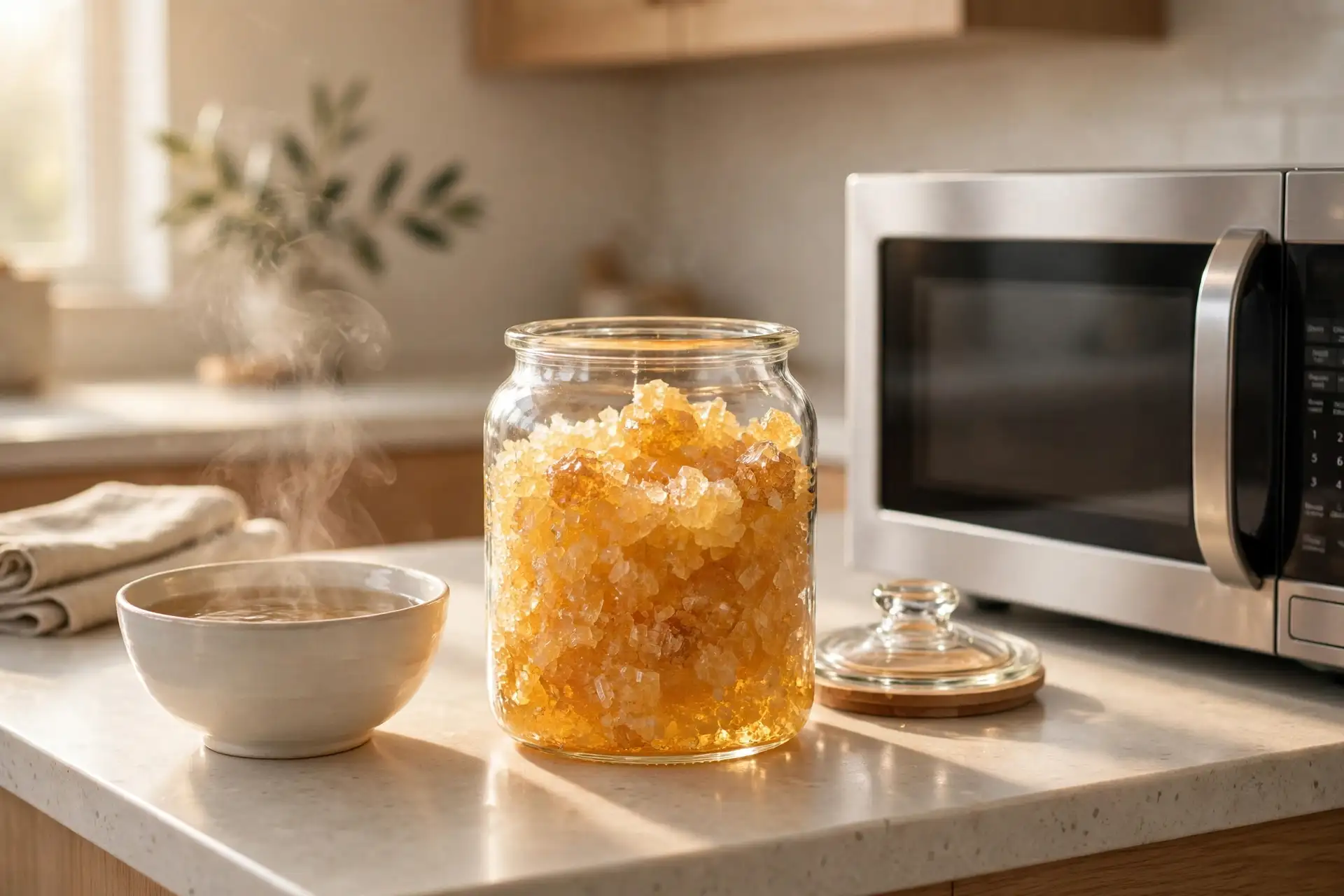
Crystallization looks like spoilage, but it is simple chemistry. Honey is a supersaturated sugar solution, roughly 70 percent sugar and under 20 percent water, which means it holds more dissolved sugar than water can normally keep in solution. Over time, the glucose portion of that sugar starts to separate from the liquid and stack into crystals, and those crystals spread through the jar until the whole thing turns thick and grainy. Fructose stays dissolved more easily, so honeys with more fructose, like acacia, can stay liquid for a year or more, while high-glucose honeys set within weeks.
Temperature plays a big role. Cool storage speeds up crystallization, which is why a jar in a chilly pantry turns grainy faster than one in a warm kitchen. Cold does not damage honey, it just nudges the glucose out of solution faster. Exposure to light and frequent stirring can also encourage it. None of this means the honey is fake or contaminated. In fact, real, minimally processed honey crystallizes faster than heavily filtered honey, because tiny particles of pollen in raw honey give the crystals a place to start forming. That jar of concrete-hard honey on your shelf is evidence that your honey is the real thing.
This matters because it changes the goal. You are not fixing spoiled food, you are simply reversing a natural process. That means the method you choose should be gentle enough to respect what makes honey worth eating in the first place, which brings us to the temperature rules.
What Heat Does to Honey: The Temperature Rules
Honey has a set of temperature thresholds, and once you know them, every decision about heating it becomes easy. Think of 104 degrees Fahrenheit (40 degrees Celsius) as the ceiling for gentle handling. Below this temperature, honey’s enzymes and delicate floral aromatics stay intact. This is the target for decrystallizing, and it is why careful sources recommend keeping the honey under 104 degrees during the process.
Between about 110 and 120 degrees, honey liquefies smoothly. This is the range beekeepers use when they deliberately warm honey, and it dissolves crystals completely without cooking the honey. Lab tests cited in reviews of raw honey found that warming raw honey to 113 or 131 degrees Fahrenheit left its antibacterial activity intact, which tells you that gentle, even heat in this range preserves the properties people value in raw honey. For the details of that research discussion, see the breakdown of raw versus processed honey benefits at Dr. Axe’s honey guide.
Past 118 degrees or so, negative chemical changes begin. Research on heated honey found that at 140 degrees, the honey’s quality degrades noticeably, its flavor darkens, and a compound called hydroxymethyl furfural (HMF) rises. HMF is a natural byproduct of heating sugars, and while it appears in many heated foods, its rise is the marker that the honey is being cooked rather than warmed. At 160 degrees the sugars caramelize, and once caramelization sets in, what you have in the jar is sweet, but it is no longer really honey in any meaningful sense.
Now here is the microwave’s problem. A microwave does not heat to one temperature, it heats in patches. The outside of the honey can feel warm while a pocket deep inside has shot past 150 degrees, and you would never know from touching the jar. Those hot spots are exactly where enzymes get destroyed and flavor changes, even when the overall heating time was short. This unevenness is the single biggest reason experienced beekeepers tell you to skip the microwave entirely.
What the Experts Say About Microwaving Honey
The consensus across beekeeping and food sites is remarkably consistent: avoid the microwave if you care about quality. Chef’s Resource advises avoiding the microwave entirely for decrystallizing, noting that hot spots can easily climb well above 150 degrees in seconds, effectively cooking the honey and destroying its raw properties. MasterClass lists three water-based methods for decrystallizing honey and explicitly warns against the microwave, which causes the liquid in the honey to boil and damages its quality and taste. The full comparison of methods is laid out in MasterClass’s decrystallizing guide.
The American Bee Journal, in a March 2007 study discussed by honey sellers, found that microwaving honey may destroy the beneficial enzymes that contribute to its nutritional value. That enzyme concern is the heart of the matter for raw honey fans. Honey’s antibacterial activity comes from enzymes like glucose oxidase, and those enzymes are exactly what uneven microwave heat destroys.
There are also two practical problems that have nothing to do with nutrition. First, microwaves drive off moisture as they heat. Since crystallization is a water-to-sugar balance problem, evaporating water from the honey can actually make it crystallize again faster after you liquefy it, which means the microwave can make the problem worse over time if you do not use the honey up quickly. Second, superheated honey can erupt. Honey heated unevenly can develop pockets hot enough to burst upward when disturbed, which is a genuine burn risk, and there are reports of honey exploding out of overheated containers. The Sidr honey care page collects these risks in one place and strongly advises against microwaving.
None of this means the microwave will poison you. Heated honey is not toxic in the normal sense, and a jar you warmed in the microwave is still safe to eat. The honest framing is quality, not safety: the microwave is safe to use, but it is the roughest tool for the job, and if your honey is raw and you bought it for its natural properties, the microwave works against your own reason for buying it.
How to Microwave Honey the Safer Way (If You Must)
Sometimes you need pourable honey right now and the water bath feels too slow. If that is your situation, follow this method exactly, because every step exists to control the temperature.
First, get the honey out of any plastic. Scoop the amount you need into a microwave-safe glass or ceramic bowl or mug, and leave it uncovered. Never put the plastic squeeze bottle or jar in the microwave, and take the lid off anything you do heat. Glass and ceramic heat more predictably and cannot leach anything into the honey. If you are unsure whether a dish is microwave-safe, check for the wavy-lines symbol using our guide to microwave-safe symbols.
Second, drop the power to half. If your microwave lets you set power levels, use 50 percent, or roughly 360 to 600 watts. Full power is what creates the violent hot spots, and half power gives the heat time to spread between bursts.
Third, heat in 10 to 20 second bursts, no longer. After each burst, take the honey out and stir it thoroughly with a clean, dry spoon. Stirring is the only way to break up the hot spots, so do not skip it. For a small amount, one or two bursts may be enough. A larger jar can take 1 to 2 minutes of total heating this way.
Fourth, check the temperature if you have a thermometer, and stop at 104 degrees Fahrenheit. If the honey is getting close to that ceiling, let it cool before continuing. If you do not have a thermometer, stop when the crystals are mostly dissolved and the honey flows, then let residual warmth finish the job as it sits.
Fifth, use the honey soon. Because the microwave drives off a little moisture, microwaved honey can recrystallize faster than honey liquefied gently, so this method is best when you plan to use the honey within a day or two. Only decrystallize the portion you need rather than the whole jar, because repeated heating and cooling cycles fade the flavor and aroma a little more each time.
Why You Should Never Microwave a Plastic Honey Bottle
The plastic squeeze bear is the most common honey container in American kitchens, and it is the one container that must never go in the microwave. The heat can warp or melt the plastic, and softened plastic can release chemicals into the honey, which ruins the honey and makes it unusable. Even if the bottle looks fine afterward, heat speeds up chemical migration from plastic into food, and honey’s sugars and acidity do not make that better.
This is not just a honey rule. The same caution applies to reheating food in any plastic that is not labeled for the microwave, which is why our guide to microwaving plastic walks through which plastics are actually tested for heat. The label rule is simple: no microwave-safe mark, no microwave.
There is also a mechanical risk. A sealed plastic bottle with hot honey inside can build pressure, and squeezing a warm bottle can squirt scalding honey. If your honey is stuck in a crystallized plastic bottle, use the warm water method from the next section instead. Hot tap water is warm enough to soften the honey without any risk to the plastic.
The Water Bath: The Better Way to Decrystallize Honey
The warm water bath is the method every beekeeper recommends, and it is barely more work than the microwave. Fill a bowl or pot with warm water between 95 and 110 degrees Fahrenheit. It should feel hot to the touch but comfortable, roughly the hottest setting on your tap. Stand the closed jar or bottle upright in the water, with the water level just reaching the lid, not covering it.
Leave it for 10 to 15 minutes, then check. Stir the honey with a clean, dry spoon to help the last crystals dissolve, and replace the water if it has cooled. For a badly crystallized jar, repeat once. Tasting Table’s method for plastic bottles follows exactly this approach and notes that temperatures over 104 degrees can destroy the enzymes behind honey’s health benefits, so hot tap water, not boiling water, is the right call. Their step-by-step is worth reading at Tasting Table’s plastic-bottle guide.
A few variations work just as well. A slow cooker filled halfway with water on its lowest setting, kept at or under 130 degrees, handles large jars over a few hours. On a warm day, setting the bottle in sunlight or a warm car for 30 to 60 minutes does the job with zero effort, as long as the temperature stays under 104 degrees. Whatever you do, never use boiling water, which destroys enzymes on contact, and never heat the same jar over and over. Decrystallize only what you need, because each heat-and-cool cycle dulls the flavor a bit more.
Storing Honey So It Crystallizes Less Often
You cannot stop crystallization forever in real honey, but you can slow it down a lot. Store honey at room temperature, ideally between 50 and 70 degrees, in a cool, dark cupboard. Cold accelerates crystallization, so the refrigerator is the worst place for honey, even though it feels like the safe choice. Heat and sunlight degrade quality over time, so a dark pantry shelf beats a sunny countertop.
Keep the container sealed airtight. Honey absorbs moisture from the air, and extra water changes the sugar balance in ways that encourage crystallization and can even allow fermentation in very wet conditions. A tight lid also keeps out pantry odors, which honey picks up easily.
Buy honey in glass when you have the choice. Glass is inert, it handles the warm water bath perfectly, and it never raises the plastic question. If you buy in bulk plastic jugs, consider transferring a working jar’s worth into glass for the counter and keeping the rest sealed. And remember the freezer trick for bulk buyers: honey freezes beautifully without damage, and a frozen portion thawed at room temperature for 30 minutes comes back pourable.
Honey and Babies: A Safety Rule Every Parent Should Know
This has nothing to do with the microwave, but no honest honey guide should skip it. The CDC says plainly: do not give honey to children younger than 12 months, and do not add it to a baby’s food, water, formula, or pacifier. Honey can contain spores of Clostridium botulinum, which can grow in an infant’s immature gut and produce a toxin that causes infant botulism, a serious illness that starts with constipation, weak crying, and poor feeding. The CDC’s guidance on foods to avoid for infants lists honey before 12 months as a food to avoid entirely.
Note that heating does not fix this. Microwaving, boiling, or baking does not destroy the spores, so cooked honey in baked goods is also off limits for babies under one. After the first birthday, a child’s digestive system can handle the spores, and honey becomes safe. This rule is absolute and worth memorizing, because honey feels like the most natural baby food in the world, and it is the one natural food with this specific risk.
Frequently Asked Questions
Got a specific question about honey and the microwave? Here are the answers people search for most, each answered directly first and then explained.
Can you microwave honey?
Yes, but it is the roughest way to warm it. Microwaves heat unevenly and create hot spots that can exceed 150 degrees in seconds, destroying enzymes and altering flavor. If you must, use a microwave-safe glass container at half power in 10 to 20 second bursts with stirring, and stop before the honey reaches 104 degrees Fahrenheit. A warm water bath between 95 and 110 degrees is the gentler method beekeepers recommend.
Does microwaving honey destroy enzymes and nutrients?
It can. Honey’s beneficial enzymes, including glucose oxidase, which gives raw honey its antibacterial activity, break down with heat, and the microwave’s uneven hot spots make that damage hard to control. Lab testing discussed in honey nutrition reviews found that gentle warming to 113 or 131 degrees left antibacterial activity intact, while microwaving wiped it out. Below 104 degrees, the enzymes survive, which is why temperature control matters more than the heat source itself.
How do you decrystallize honey in the microwave safely?
Scoop the honey into an uncovered microwave-safe glass or ceramic bowl, set the microwave to 50 percent power, and heat in 10 to 20 second intervals, stirring thoroughly between each one. Check the temperature with a thermometer if you have one and stop at 104 degrees Fahrenheit. Small amounts may need only one or two bursts, while a large jar can take 1 to 2 minutes of total heating. Use the honey soon, since microwaved honey can recrystallize faster.
Can you microwave a plastic honey bottle?
No. Never put a plastic honey bottle or squeeze bear in the microwave. The heat can warp or melt the plastic and allow chemicals to migrate into the honey, ruining it. If your crystallized honey is in plastic, stand the bottle in warm tap water for about 10 minutes instead, which softens the honey without any risk to the container. For a full breakdown of which plastics handle heat, see our guide to microwaving plastic.
How long do you microwave crystallized honey?
In 10 to 20 second bursts at half power, for 1 to 2 minutes total for a large jar, and often under a minute for a small amount. There is no single safe time because microwaves vary in wattage, so stir between bursts and stop as soon as the crystals dissolve and the honey flows. Going longer than needed only drives off moisture and damages enzymes, so shorter is always better.
Is crystallized honey safe to eat?
Completely safe. Crystallization is a natural process where glucose separates from the water in the honey, and it does not mean the honey has spoiled or gone bad. The crystals dissolve on your tongue, stir into hot tea or oatmeal easily, and spread nicely on toast. In fact, crystallization is a sign of genuine, minimally processed honey, because heavily filtered honey crystallizes more slowly. Never throw out crystallized honey.
Does crystallization mean my honey is fake?
No, it means the opposite. Real honey crystallizes because it is a supersaturated solution of glucose and fructose, and the glucose naturally comes out of solution over time. Pollen particles in raw honey give crystals a starting point, so raw honey sets faster than ultra-filtered honey. Honey that stays perfectly clear on the shelf for years has usually been heated and filtered, which removes the very properties raw honey buyers want.
What temperature destroys the good stuff in honey?
Damage starts around 104 degrees Fahrenheit, which is why careful decrystallizing stays below it. Negative chemical changes begin near 118 degrees, quality degrades and a compound called HMF rises at 140 degrees, and the sugars caramelize at 160 degrees. For perspective, boiling water is 212 degrees, so dropping a jar in boiling water cooks the honey instantly. Keep every warming method under 104 degrees and the honey keeps its character.
Can you boil honey to decrystallize it faster?
You can, but you should not if you care about quality. Boiling water at 212 degrees destroys enzymes on contact, darkens the flavor, and pushes the honey toward caramelization. A rolling boil is the fastest way to turn raw honey into expensive sugar syrup. If speed is the goal, the microwave at half power in short bursts is still gentler than boiling water, and the warm water bath is gentler than both.
Is heated honey toxic?
No, heated honey is not toxic in the normal sense, and honey you warmed in the microwave or baked into food is safe to eat. What heat does is degrade quality: enzymes break down, flavor darkens, and at high temperatures the sugars caramelize. Some traditional medicine systems warn against heating honey, and modern research does show chemical changes with heat, but those changes are about lost benefits, not created poisons. The one hard safety rule is for babies, covered below.
Does microwaving honey make it crystallize again faster?
It can. Microwaves heat by agitating water molecules, and that process drives some moisture out of the honey as it warms. Since crystallization is about the balance of sugar to water, losing water nudges the honey back toward crystallizing sooner. Honey liquefied in a gentle water bath keeps its moisture and tends to stay liquid longer. Either way, only decrystallize the portion you plan to use soon.
What is the best way to decrystallize honey without a microwave?
Stand the closed jar in a bowl of warm water between 95 and 110 degrees Fahrenheit for 10 to 15 minutes, stirring once with a clean, dry spoon. Hot tap water works perfectly and needs no stove. For large jars, a slow cooker half filled with water on its lowest setting, kept under 130 degrees, handles the job over a few hours. Both methods heat evenly, which is exactly what the microwave cannot do. For the full container safety picture, browse the complete microwave safety chart.
How should I store honey to keep it from crystallizing?
Keep it at room temperature, between 50 and 70 degrees, in a cool, dark cupboard with the lid sealed airtight. Do not refrigerate honey, because cold speeds up crystallization. Keep it out of direct sunlight and away from heat sources like the oven, which degrade quality over time. Buy in glass when you can, since glass is inert and handles the warm water bath perfectly. For bulk buyers, freezing works: honey thaws at room temperature in about 30 minutes with no damage.
Can babies have honey that has been microwaved?
No. Heating does not make honey safe for babies. The risk is spores of Clostridium botulinum, which survive microwaving, boiling, and baking, and can cause infant botulism in children under 12 months. The CDC says no honey in any form, including honey in baked goods or on a pacifier, before the first birthday. After 12 months, a child’s digestive system handles the spores and honey becomes safe.
Can you microwave honey in the container it came in?
Only if that container is glass or ceramic and microwave-safe, and you remove the lid first. Most honey sold in stores comes in plastic squeeze bottles, which should never go in the microwave. Even with a glass jar, take the lid off, since a sealed jar can build pressure, and transfer to a bowl if you want the most even heating. When in doubt, the container rule from our microwave-safe symbols guide applies: check the bottom for the wavy-lines mark.
The Bottom Line
Can you microwave honey? Yes, and if you are in a hurry, short bursts at half power in a glass bowl with stirring between will get you pourable honey without disaster. But the microwave is the roughest tool for this job, and it works against everything that makes good honey worth buying: uneven hot spots destroy enzymes, drive off moisture, and push parts of the honey past the temperatures where flavor changes. The warm water bath takes 10 to 15 minutes, costs nothing, and treats the honey the way beekeepers treat their own.
Remember the three numbers that matter: stay under 104 degrees to protect the enzymes, never microwave the plastic bottle, and never give honey, heated or not, to a baby under 12 months. Crystallization is not spoilage, it is proof your honey is real, and a jar of grainy honey is a small warm bath away from golden and pourable again. Treat it gently and it will taste like it should.
