

It is halftime. The game is back on in ten minutes, the kids are already circling the kitchen, and you just pulled a pack of hot dogs out of the fridge. The grill is too much work. The pot for boiling feels like a project. So you look at the microwave and wonder: can you microwave hot dogs, or is that a shortcut you will regret?
Here is the honest answer up front. Yes, you can microwave hot dogs, and millions of people do it every week. But this shortcut has two things working against it that most quick answers never mention. First, a hot dog can burst open in the microwave if you heat it wrong. Second, hot dogs carry a food-safety catch that matters a lot more than the texture, and it comes straight from the USDA and the CDC.
This guide covers all of it. You will get the science of why hot dogs explode, an honest timing chart for different microwave wattages, the safety rules for kids and pregnant women, how frozen hot dogs change the math, and the mistakes that turn a good hot dog rubbery. No fluff, no guessing, and every safety claim tied to a real source.
Can You Microwave Hot Dogs? The Short Answer
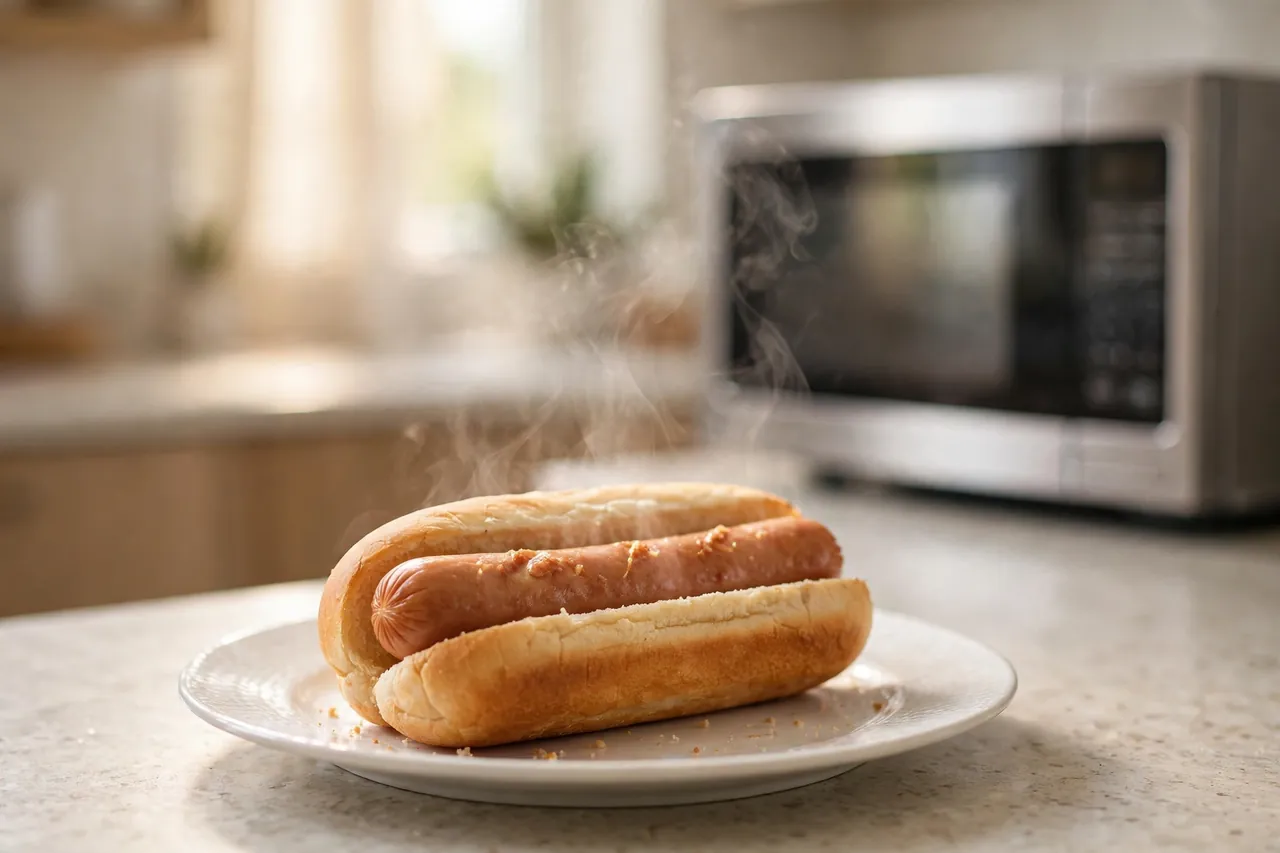
Yes, you can microwave hot dogs. Place one on a microwave-safe plate, pierce the skin a few times with a fork so steam can escape, and heat it on high for 30 to 60 seconds depending on your microwave’s wattage. Let it rest for half a minute before you eat it. That is the whole method, and it works.
The catch is in the details. A hot dog is basically a sealed tube of meat, and microwaves heat food by turning water into steam. That steam has nowhere to go inside the casing, so pressure builds until the skin splits or the whole thing bursts. Piercing the skin gives the steam an escape route, and that one habit prevents almost every microwave hot dog disaster.
The other catch is safety. Hot dogs are fully cooked when you buy them, but the USDA and CDC warn that they can still carry Listeria, a bacteria that survives refrigeration and can make pregnant women, older adults, and people with weakened immune systems seriously ill. The guidance is clear: reheat hot dogs until they are steaming hot, which means an internal temperature of 165°F (74°C). For most healthy adults, a quick reheat does the job. For anyone in a high-risk group, “steaming hot” is not optional, it is the rule.
If you are working through the whole world of microwave questions, the main hub page at Can You Microwave It? is a good place to keep open while you read, since hot dogs are just one of dozens of foods people ask about every day.
The Safety Fact Almost Nobody Mentions
Almost every “can you microwave hot dogs” article online talks about timing and texture. Almost none of them mention Listeria. That is strange, because the Listeria warning is the single most important thing the USDA says about hot dogs, and it directly affects how you should heat them.
Here is what the science says. Hot dogs are cooked at the factory, but contamination with Listeria monocytogenes can happen during packaging and processing, after the cooking step. This bacteria is unusual because it keeps growing at refrigerator temperatures, which means the cold of your fridge does not protect you the way it does with most germs. The only reliable way to kill it is heat.
The CDC lists hot dogs among the foods that pregnant women should heat to 165°F or until steaming hot before eating. You can read their full guidance on safer food choices for pregnant women, and their page on who is at risk from Listeria explains that the bacteria hits pregnant women, newborns, adults over 65, and people with weakened immune systems the hardest. The CDC estimates that about 1,600 people get sick from Listeria each year in the United States, and roughly 260 die from it. Pregnant women are about 10 times more likely to get a Listeria infection than other healthy adults.
None of this means healthy adults should be afraid of hot dogs. It means everyone should take the “steaming hot” rule seriously, and anyone cooking for a pregnant woman, a grandparent, or a young child should treat it as non-negotiable. A microwave can absolutely get a hot dog to 165°F. You just have to heat it long enough, which is exactly what the timing chart below is for.
Why Hot Dogs Explode in the Microwave
If you have ever heard a loud pop from the microwave followed by a mess, you know what this section is about. Hot dogs explode for a simple physical reason, and once you understand it, the fix is obvious.
A microwave heats food by making water molecules vibrate, which turns the water inside the hot dog into steam. A hot dog with its casing on is a sealed pressure vessel. The skin is designed to hold everything together, which means the steam builds up with no way out. Pressure rises, the weakest point of the skin gives way, and you get a burst that can split the hot dog end to end or send pieces flying.
Natural-casing hot dogs (the snappy kind, often labeled as having sheep or hog casings) are the most likely to burst, because the casing is tough and holds pressure longer before failing. Skinless hot dogs, which are the most common kind in American grocery stores, are cooked in a casing that is removed at the factory, so they have a thinner outer skin. They can still split, but they are less dramatic about it. Turkey and chicken dogs behave the same way as beef ones, since the physics does not care what meat is inside.
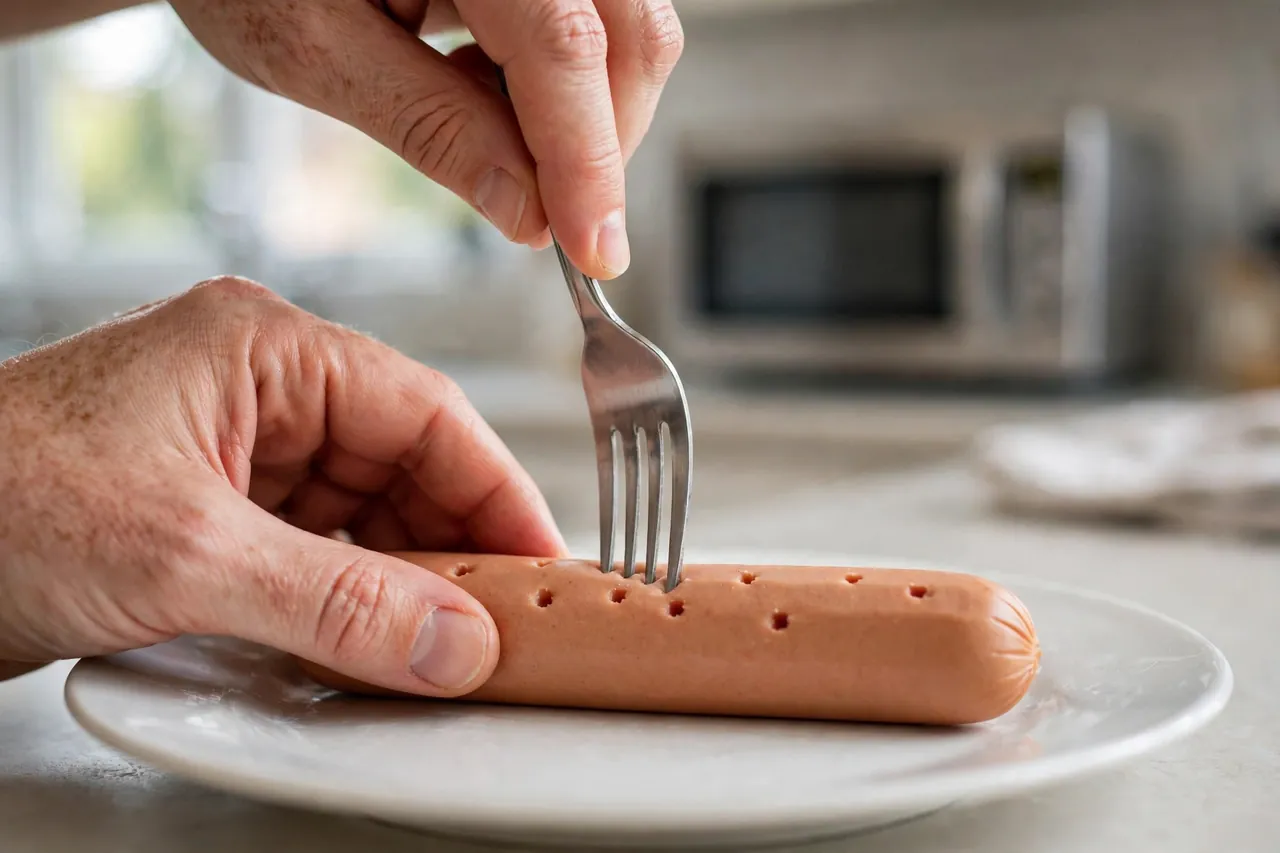
The fix is to give the steam an exit. Pierce the hot dog three or four times with a fork, or cut two or three shallow slits along the top with a knife, before it goes in. You are not cutting it open. You are making small vents. This one habit, which takes five seconds, prevents the burst almost every time.
Should You Pierce a Hot Dog Before Microwaving It?
Yes. Pierce it every single time. This is the most useful habit in this entire guide, and it costs you nothing.
Use a fork and poke the hot dog in three or four spots, pressing just through the skin. Or take a sharp knife and make two or three shallow diagonal cuts along the top, about a quarter inch deep. Either method works. The goal is to break the sealed surface so steam can escape while the hot dog heats.
There is a second benefit most people do not expect. A pierced hot dog heats more evenly, because the vents let steam circulate instead of trapping a hot pocket in the middle while the ends stay lukewarm. You also get fewer of those wrinkled, shriveled skins, since the skin is not being stretched by trapped steam.
One thing to avoid: do not cut the hot dog in half lengthwise unless you are doing it for a child (more on that in the kids section). Halved hot dogs dry out faster in the microwave and lose that classic bite. For an adult’s hot dog, small piercings are the better move.
How Long to Microwave a Hot Dog: The Timing Chart
Every microwave is different, and that is why single-number answers (“microwave it for 45 seconds”) fail so many people. A 700-watt compact microwave and an 1100-watt full-size model heat at very different speeds. The chart below is a practical starting point based on common kitchen experience, not lab data, so always start at the low end of the range and add time in 10-second bursts if needed.
| Your microwave | One fridge-cold hot dog | Two hot dogs |
|---|---|---|
| 700 W (compact) | 50 to 60 seconds | 1 minute 40 seconds to 2 minutes |
| 900 W (standard) | 40 to 50 seconds | 1 minute 20 seconds to 1 minute 40 seconds |
| 1100 W and up (full size) | 30 to 40 seconds | 1 minute to 1 minute 20 seconds |
A few notes on using this chart. First, these times assume the hot dog came from the refrigerator, not the freezer. Frozen hot dogs need a different approach, which is covered below. Second, two hot dogs do not take twice as long as one, because the microwave’s energy is shared but the food also holds heat better in a pair. Third, if your microwave has no wattage label (check inside the door or the back panel), assume it is a standard 900-watt model and start in the middle of the range.
After microwaving, let the hot dog rest on the plate for 30 to 60 seconds. This is not just about avoiding a burnt mouth. Microwaves heat unevenly, and the rest lets the heat spread through the hot dog so you do not bite into a cold center. For anyone in a high-risk group, this rest also gives you a moment to check that the hot dog is steaming hot all the way through, which is the CDC’s actual standard.
The basic method, step by step
Start with a microwave-safe plate. A ceramic plate or a paper plate both work. If you are using a paper plate, it helps to know what the label means, so check our guide to microwave-safe symbols if the plate has markings you do not recognize.
Place the hot dog on the plate and pierce it three or four times with a fork. Cover it loosely with a damp paper towel. The towel traps a little steam around the hot dog, which keeps the skin from drying out and wrinkling. A plain paper towel works fine here, and our guide on whether you can microwave paper towels explains exactly which kinds are safe to use as a cover.
Microwave on high using the chart above as your starting point. When the time is up, let the hot dog sit for 30 to 60 seconds, then check it. It should feel hot all the way through and release steam when you bite or cut into it. If it is only warm, give it another 10 to 15 seconds. That is the entire method, and it takes about two minutes door to door.
Can You Microwave Frozen Hot Dogs?
This is the one question where honest sources disagree, so here is both sides. Some food writers say microwaving from frozen is fine if you adjust the method. Others say you should never microwave a hot dog straight from the freezer. The truth sits in the middle: you can do it, but the margin for error shrinks, and there is a food-safety reason to be careful.
The problem with frozen hot dogs is uneven heating. A microwave heats the outside of a frozen hot dog much faster than the frozen core, so you can end up with a hot dog that feels done on the outside while the center is still cold. A cold center is a food-safety risk, because the whole point of reheating is to get the entire hot dog steaming hot to kill any Listeria that might be present. If the middle never gets hot, you did not actually reheat it.
If you are going to microwave from frozen, use the defrost setting or 50 percent power for 60 to 90 seconds first, then flip the hot dog and finish it on high in 20-second bursts until it is steaming hot throughout. The lower power gives the heat time to reach the center instead of just blasting the outside. Pierce the skin before you start, as usual.
The safer and honestly better option is to thaw the hot dogs first. Move them from the freezer to the refrigerator the night before, or run the sealed package under cold water for 15 to 20 minutes if you forgot. A thawed hot dog microwaves in under a minute, heats evenly, and tastes noticeably better. If you are feeding kids, pregnant women, or older adults, thaw first. The extra planning is worth it for the even heating alone.
Do Turkey, Chicken, and Veggie Hot Dogs Work the Same Way?
Mostly yes, with a few differences worth knowing. The microwave method (pierce, cover, short burst on high, rest) works for all of them, because the steam-pressure problem is about shape and water content, not the type of meat. But the details change a little by type.
Beef hot dogs are the classic, and they tend to have the most fat, which means they stay juicy and are the most forgiving of an extra 10 seconds. Pork and beef-pork blends behave the same way. Turkey and chicken hot dogs are leaner, so they dry out faster and turn rubbery sooner. If you are microwaving a turkey dog, stay at the low end of the timing chart and do not walk away from the microwave.
Veggie and plant-based hot dogs (soy, pea protein, and similar) heat through faster than meat dogs because they are less dense, and they can get mushy if you overdo it. Start with 30 seconds on high for one veggie dog and check it before adding more time. Cocktail franks and mini hot dogs, the little ones people serve at parties, need only 20 to 30 seconds for a handful, arranged in a single layer so they heat evenly.
One more type worth a mention: hot dogs in natural casings, the snappy kind sold at delis. These have the toughest skin and the highest burst risk, so piercing is especially important for them. The Clemson University extension guide on safe handling of sausages and hot dogs notes that most popular hot dogs are actually skinless varieties with the casing removed after cooking, which is why the average grocery-store dog is less explosive than a deli frank.
The 7 Mistakes That Ruin Microwaved Hot Dogs
Most bad microwave hot dogs come from the same small set of mistakes. Fix these and the result is consistently good.
Cooking it too long
This is mistake number one by a wide margin. A hot dog goes from perfectly hot to rubbery in about 10 to 15 extra seconds. The proteins tighten, moisture squeezes out, and you get the texture people describe as a hockey puck. The fix is the timing chart above plus the discipline to start low. You can always add 10 seconds. You cannot un-cook a rubbery hot dog.
Skipping the pierce
Covered above, but worth repeating because it is the mistake behind most microwave messes. An unpierced hot dog is a small pressure bomb. Pierce it every time, even the skinless ones, even if you are in a hurry. Five seconds of prevention beats cleaning the microwave.
Heating it in the original packaging
Vacuum-sealed hot dog packaging is not made for the microwave. It can melt, warp, or release chemicals when heated, and the tight plastic traps steam against the food in unpredictable ways. Always take the hot dogs out of the package and put them on a plate. If the packaging has a microwave-safe label (rare for hot dog packs, more common for some frozen meals), follow the label, but the default rule is simple: unpack first.
Using plastic wrap the wrong way
There is a lot of confusion about plastic wrap in the microwave, and it comes from the fact that some wraps are fine and others are not. Only use plastic wrap that is specifically labeled microwave-safe, and never let it touch the hot dog directly while heating, since the plastic can melt into the food. Keep it loose so steam can vent. Honestly, a damp paper towel is simpler and safer for this job, and it does the same thing: it holds a little steam around the food without any of the plastic questions.
Microwaving the bun with the hot dog
The bun and the hot dog need different treatment, and putting them in together gives you the worst of both. The hot dog needs 30 to 60 seconds to get steaming hot. A bun needs about 10 seconds before it turns soggy and gummy from the steam. Microwave the hot dog first, rest it, then warm the bun separately for 10 seconds or less. Better yet, toast the bun or warm it in a dry skillet for a minute. If you want the full breakdown, our guide on whether you can microwave bread covers why buns go soggy and how to fix it.
Stacking hot dogs on top of each other
Two hot dogs piled in a heap heat unevenly, with cold spots where they touch. Arrange them side by side in a single layer with a little space between them. For three or four hot dogs, arrange them like spokes on a wheel or in a circle, which heats more evenly than a straight row in most microwaves.
Ignoring sparks
If you see sparks while microwaving a hot dog, stop the microwave immediately. This is a warning, not a curiosity to watch. Sparks usually mean a tiny piece of metal got in there, sometimes a fragment from processing equipment, or a mineral deposit on the hot dog’s surface interacting with the microwaves. Take the hot dog out, check the plate and the microwave cavity for anything metallic, and inspect the hot dog before deciding whether to continue with a fresh plate. This is rare, but when it happens, the only correct response is to stop and check. For the broader list of things that should never go near your microwave, see things you should never put in a microwave.
Can You Microwave Hot Dogs in Their Original Packaging?
No. Take them out of the package first. This is one of the clearest rules in this guide, and it has two reasons behind it.
The first reason is the packaging itself. Hot dogs come in vacuum-sealed plastic that is designed for cold storage, not for heat. When that plastic gets hot, it can soften, warp, and in some cases break down in ways that let chemicals migrate into the food. The package was never tested for microwave temperatures, so heating food in it is a gamble with no upside.
The second reason is practical. The vacuum seal holds the hot dogs tight against the plastic with no room for steam to move, which makes uneven heating worse and can cause the package to balloon or burst. You also cannot pierce the hot dogs through the sealed plastic, which means you lose the single most important safety step.
The routine is simple: open the package, put what you need on a microwave-safe plate, and reseal the rest. Which brings up the storage rules, covered in their own section below.
Should You Microwave the Hot Dog With the Bun?
Do them separately. This is the answer to one of the most common follow-up questions, and the reason is timing. A hot dog needs 30 to 60 seconds to reach steaming hot. A bun needs about 10 seconds, and every second after that makes it soggier.
When you heat them together, the steam coming off the hot dog soaks straight into the bun. You end up with a bun that is gummy on the inside and oddly tough on the outside, wrapped around a hot dog that might not even be fully heated yet. It is the worst version of both foods.
The better method takes barely more time. Microwave the hot dog using the steps above and let it rest. While it rests, warm the bun on its own for 10 seconds, just enough to take the chill off. If you have another minute, split the bun and warm it cut-side down in a dry skillet or toaster oven, which gives you a lightly crisp surface that holds up to toppings. Assemble after both are ready, and the whole thing eats like it came off a grill instead of out of a microwave.
Hot Dogs and Kids: The Choking Risk You Should Know
This section matters more than the timing chart. Hot dogs are one of the top choking hazards for young children, because their round shape and compressible texture can completely block a small airway. This is not a microwave-specific problem, but since microwaved hot dogs are such a common kid snack, it belongs in this guide.
The American Academy of Pediatrics advises that for children under 4, hot dogs should be cut lengthwise and then into small pieces before serving, and any casing should be removed first. Cutting a hot dog into coin-shaped rounds is not enough, because the rounds are still the perfect size and shape to lodge in a throat. Cut it lengthwise first, which breaks the dangerous round shape, then chop it into small pieces. This advice comes from federal food-safety guidance on hot dog safety for families, which cites the pediatric recommendation directly.
Two more rules for kids. First, the hot dog must be steaming hot all the way through, since young children are in a higher-risk group for foodborne illness too. Use the rest time to check. Second, supervise. Cut-up hot dog pieces are safer, but “safer” is not “safe,” and a child eating while running around or laughing is at higher risk no matter how you cut the food. Sit them down, cut the hot dog right, heat it through, and stay nearby.
How Long Do Hot Dogs Last? Storage Rules That Matter
Good microwaving starts before the microwave, with hot dogs that were stored properly. The Clemson University extension’s sausage and hot dog handling guide gives storage times that are worth memorizing.
An unopened package of hot dogs keeps for about 2 weeks in the refrigerator. Once you open the package, that drops to 7 days. For longer storage, freeze them, where they keep their best quality for 1 to 2 months. And the rule that covers everything perishable: never leave hot dogs at room temperature for more than 2 hours, or more than 1 hour if the temperature is above 90°F, like at a summer cookout.
These numbers matter for microwaving because a hot dog that sat too long is not saved by heating. Reheating kills bacteria, but it does not undo spoilage, and it does not fix off smells or slimy texture. If the hot dogs smell wrong, feel slimy, or are past their safe storage time, throw them out. The microwave is a reheating tool, not a rescue tool.
One practical tip: if you usually cook one or two hot dogs at a time, freeze the rest in pairs in a freezer bag the day you open the package. Then you can thaw exactly what you need overnight in the fridge and skip the frozen-microwave gamble entirely.
Microwave vs. Boil: Which Is Better?
Both methods get the job done, and the honest answer is that it depends on what you care about most. Here is how they compare on the things that actually matter.
Speed goes to the microwave, and it is not close. A microwaved hot dog is ready in about two minutes including rest time. Boiling takes 5 to 6 minutes once the water is going, plus the time to bring the pot to a boil. On a busy weeknight, that difference is the whole reason people ask this question.
Even heating goes to boiling. A pot of simmering water surrounds the hot dog completely and brings the entire thing, center included, to the same temperature. The microwave heats unevenly by nature, which is why the rest step exists. If you are cooking for someone in a high-risk group and you want the most reliable path to steaming hot throughout, boiling is the more forgiving method.
Texture is a matter of taste. Microwaving gives you a firmer bite with a slightly snappier skin, closer to a grilled dog. Boiling gives you a softer, plumper hot dog, but some flavor leaches into the water, which is why boiled hot dogs can taste a little milder. Neither is wrong. It is a preference.
Cleanup goes to the microwave: one plate, one paper towel. Boiling means a pot, water, and a slotted spoon. For one hot dog on a Tuesday night, the microwave wins on effort. For a crowd, or when food safety needs to be bulletproof, the pot earns its keep.
Frequently Asked Questions
These are the questions people actually type into Google about microwaving hot dogs. Each answer starts with the direct answer, then the short explanation behind it.
Is it safe to microwave hot dogs?
Yes, it is safe as long as you heat the hot dog until it is steaming hot all the way through. Hot dogs are fully cooked at the factory, but they can carry Listeria, a bacteria that survives refrigeration, so the CDC advises heating them to 165°F or until steaming hot before eating. Use a microwave-safe plate, pierce the skin so steam can escape, and let the hot dog rest for 30 to 60 seconds after heating so the temperature evens out.
How long should you microwave a hot dog?
Microwave one fridge-cold hot dog on high for 30 to 60 seconds, depending on your microwave’s wattage: about 30 to 40 seconds in an 1100-watt microwave, 40 to 50 seconds at 900 watts, and 50 to 60 seconds at 700 watts. Add time in 10-second bursts if it is not steaming hot yet. Two hot dogs take roughly 1 to 2 minutes. Always start at the low end of the range, since 10 to 15 extra seconds is enough to turn a hot dog rubbery.
Why do hot dogs explode in the microwave?
Hot dogs explode because steam builds up inside the sealed casing with nowhere to escape. Microwaves heat food by turning water into steam, and a hot dog’s skin traps that steam like a pressure vessel until the weakest point gives way. Natural-casing hot dogs burst the most dramatically because their skin is toughest. Piercing the hot dog three or four times with a fork before microwaving gives the steam an exit and prevents the burst.
Should you pierce a hot dog before microwaving it?
Yes, pierce it every time. Poke three or four holes with a fork or cut two or three shallow slits along the top with a knife before the hot dog goes in the microwave. This vents the steam that would otherwise split the casing, and it also helps the hot dog heat more evenly. It takes five seconds and prevents the most common microwave hot dog disaster.
Can you microwave hot dogs in their original packaging?
No. Hot dog packaging is vacuum-sealed plastic designed for cold storage, not for microwave heat. It can soften, warp, or break down when heated, and the tight seal traps steam unpredictably. Always remove the hot dogs from the package and place them on a microwave-safe plate before heating. Reseal the package and refrigerate or freeze whatever you do not use.
Can you microwave frozen hot dogs?
You can, but thawing first is safer and gives a better result. Frozen hot dogs heat unevenly in the microwave, so the outside can feel done while the center stays cold, which defeats the purpose of reheating to a safe temperature. If you microwave from frozen, use 50 percent power for 60 to 90 seconds first, then finish on high in 20-second bursts until steaming hot throughout. Better: thaw overnight in the fridge or under cold water for 15 to 20 minutes, then microwave normally.
What internal temperature should microwaved hot dogs reach?
Microwaved hot dogs should reach 165°F (74°C) inside, or be steaming hot throughout. This is the CDC’s guidance for reheating hot dogs, aimed at killing Listeria, which can survive refrigeration. For healthy adults, “steaming hot all the way through” is the practical test: cut or bite into the thickest part and check for steam and even heat. For pregnant women, older adults, and anyone with a weakened immune system, hitting the full temperature matters most.
Why do microwaved hot dogs turn rubbery?
Rubbery hot dogs are overcooked hot dogs. About 10 to 15 seconds past done is enough for the proteins to tighten and squeeze out moisture, leaving a tough, bouncy texture. Turkey and chicken dogs turn rubbery fastest because they are leaner. The fix is to start at the low end of the timing chart, heat in short bursts, and let the hot dog rest after microwaving instead of adding “just a few more seconds” while it is already hot.
How do you keep hot dogs from drying out in the microwave?
Cover the hot dog loosely with a damp paper towel before microwaving. The towel traps a small amount of steam around the hot dog, which keeps the skin from drying and wrinkling. Do not overcook it, since most dryness comes from extra seconds rather than from the microwave itself. Letting the hot dog rest for 30 to 60 seconds after heating also helps, because it lets moisture redistribute instead of escaping as surface steam.
Can you microwave hot dogs with the bun?
You can, but you should not. The hot dog needs 30 to 60 seconds to get steaming hot, while a bun needs about 10 seconds before it turns soggy from the steam coming off the meat. Heat the hot dog first and let it rest, then warm the bun separately for 10 seconds or less. For a better result, warm the bun cut-side down in a dry skillet or toaster for a minute instead.
Should you add water when microwaving hot dogs?
You do not need to, but a little moisture helps. The simplest method is covering the hot dog with a damp paper towel, which creates a small steam pocket without any extra dishes. Some people microwave the hot dog in a shallow bowl with a spoonful of water, which works too but takes slightly longer. Either way, the goal is the same: a bit of steam around the hot dog so the skin stays tender instead of drying out.
Can kids eat microwaved hot dogs?
Yes, with two precautions. First, the hot dog must be steaming hot all the way through, since young children are more vulnerable to foodborne illness. Second, cut it safely: for children under 4, the American Academy of Pediatrics advises cutting hot dogs lengthwise and then into small pieces, and removing any casing first, because whole or coin-cut hot dogs are a serious choking hazard. Always supervise young children while they eat.
Is it better to microwave or boil hot dogs?
It depends on your priority. The microwave is faster (about 2 minutes total) and means less cleanup, with a firmer, snappier result. Boiling takes 5 to 6 minutes plus the time to heat the water, but it heats more evenly and is the more forgiving method for reaching a safe temperature throughout. For a quick single hot dog, the microwave wins. For a crowd, or when cooking for someone in a high-risk group, boiling is the safer-feeling choice.
Can you microwave turkey, chicken, or veggie hot dogs the same way?
Yes, the same method works: pierce, cover with a damp paper towel, heat on high in short bursts, and rest. Adjust for the type, though. Turkey and chicken dogs are leaner, so they dry out and turn rubbery faster; stay at the low end of the timing chart. Veggie and plant-based dogs are less dense and heat through faster, so start with 30 seconds and check. Cocktail franks and minis need only 20 to 30 seconds for a handful in a single layer.
Why do hot dogs sometimes spark in the microwave?
Sparks mean something in there is reacting badly to the microwaves, and the correct response is to stop the microwave immediately. The usual cause is a tiny piece of metal, sometimes a fragment from processing equipment, or a mineral deposit on the hot dog’s surface. Take the hot dog out, check the plate and microwave for anything metallic, and inspect the hot dog before continuing with a fresh plate. Sparking is rare, but it is always a warning sign, never something to watch and wait out.
The Bottom Line
Can you microwave hot dogs? Yes, and it is one of the fastest ways to get dinner on the table. Pierce the skin, use the timing chart for your wattage, cover with a damp paper towel, and let it rest. Do the bun separately. Thaw frozen dogs first when you can.
And keep the safety part front and center, because it is the part most articles skip. Heat every hot dog until it is steaming hot, aim for 165°F inside, and treat that rule as mandatory when you are cooking for kids, pregnant women, or older adults. A two-minute shortcut is only a good shortcut when it is a safe one.
