

You are standing in the kitchen at 6:40 in the morning, half asleep, and all you want is a cup of tea. The kettle is in the cabinet behind three other things, or maybe you do not own a kettle at all, and the microwave is right there, humming its quiet offer of a two-minute shortcut. So you fill a mug, set the timer, and hope for the best. Millions of people do exactly this every single day, and almost all of them walk away fine. But water in a microwave has one nasty trick that almost no other reheating job has, and it has a name: superheating.
Superheated water looks perfectly calm and then erupts like a tiny volcano the moment you touch it, and it can cause serious burns. That is the one real danger behind this question, and the good news is that it is easy to avoid once you know the rules. This guide walks you through everything: what superheating actually is, how long to heat water for tea and coffee, which mugs are safe, the wooden-stick trick that scientists and microwave makers recommend, and the special case of distilled water. By the end, you will be able to microwave water with total confidence, and you will know exactly when to reach for the kettle instead.
The Short Answer
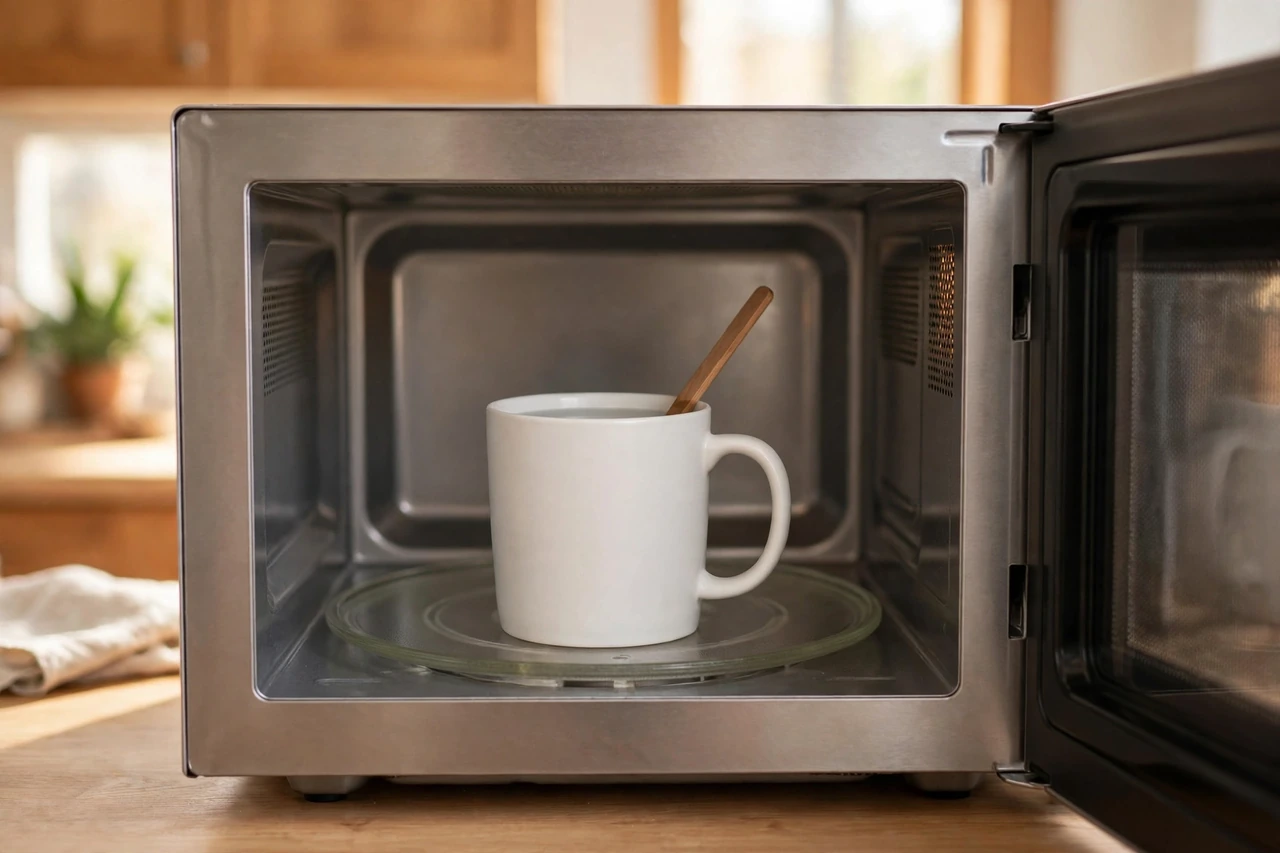
Yes, you can microwave water, and it is generally safe as long as you follow a few simple precautions. Use a microwave-safe glass or ceramic mug, heat in short one-to-two-minute intervals, and never heat a full cup for more than two minutes straight, because overheating is what creates the superheating risk.
The single most important habit is to give the water something to form bubbles on. Drop a wooden chopstick, a wooden coffee stirrer, or a wooden skewer into the mug before you press start. That rough wooden surface gives steam bubbles a place to form, so the water boils normally instead of building up trapped heat and erupting later. This one trick, recommended by microwave manufacturers and physics educators alike, turns the one real danger of microwaving water into a non-issue. For a broader view of what belongs in your microwave and what does not, see Can You Microwave It? The Complete Safety Chart.
What Superheating Is (And Why Water Can “Explode” in the Microwave)
To understand the risk, you need to understand what boiling actually is. Water boils when tiny bubbles of water vapor form inside the liquid, grow, and rise to the surface. Those bubbles need a starting point, a little scratch on the cup wall, a speck of dust, a dissolved gas pocket, something scientists call a nucleation site. Without nucleation sites, the water can keep absorbing heat past its normal boiling point without ever visibly boiling. That is superheating: liquid water heated beyond 212 degrees Fahrenheit (100 degrees Celsius) that looks deceptively calm.
A microwave makes superheating more likely than a stove or kettle, for two reasons, and this plain-English explainer of the physics walks through the mechanism step by step. First, microwaves heat water molecules directly and very fast, so the water can outrun the slow process of bubble formation. Second, a microwave does not jostle the water the way a rolling boil on a stove does. The result is a mug of water that looks cool and still but is holding far more heat than it should, and it is completely unstable.
Then something small disturbs it. You lift the mug. You tap the side. You drop in a tea bag or a spoonful of sugar. And all at once, bubbles form everywhere, the trapped heat releases in a rush, and the water erupts violently out of the mug. It looks like an explosion, and the scalding water can cause first and second degree burns on your face, hands, and arms. Science educator Steve Spangler has explained the mechanics in plain terms: the water heats faster than vapor bubbles can form, the liquid keeps heating past its boiling point without releasing heat, and a bump or a jolt is all it takes to trigger the eruption.
Here is the honest balance, though. Superheating is real, but it needs specific conditions to happen, and most everyday mugs do not meet them. Your well-used coffee mug is full of microscopic scratches, and those scratches are full of nucleation sites, so your water usually boils normally. Superheating is most likely with brand-new smooth cups, very clean glass, small amounts of water, and long uninterrupted heating times. The Kitchn tested this popular claim and found the phenomenon technically real but rare in everyday mugs, which matches the physics. The danger is rare but genuinely serious, which is exactly why the precautions below exist. They cost you nothing and they remove the risk entirely.
Can You Boil Water in the Microwave?
Yes, you can bring water to a boil in a microwave, and according to current research there are no known negative health effects from doing it. Healthline’s review of the topic notes that boiling water in the microwave is convenient and safe when you use approved containers and sensible heating times. The water itself is not changed in any harmful way by microwaves; the concern is purely physical, meaning superheating and burns, not anything chemical or radiation-related.
That said, boiling water in a microwave is not the same experience as boiling it in a kettle, and knowing the difference helps you pick the right tool. A kettle heats from the bottom, so hot water rises and cool water sinks, creating natural circulation that mixes the heat evenly through the whole volume. A microwave heats in standing-wave patterns, which means some spots get hotter than others. Your microwaved mug often has hot and cold zones, which is why tea made with microwave water sometimes tastes uneven. A quick stir after heating fixes this completely, and if your microwave has a turntable, keeping it on helps too.
There is one more honest caveat about boiling: the microwave is slower and more awkward than a kettle for large amounts. Heating a full quart of water for pasta will take many minutes of start-stop heating, and you will spend the whole time worrying about handling a heavy, hot container. For one or two mugs, the microwave is a perfectly good tool. For bigger jobs, the kettle wins, and that is a convenience judgment, not a safety one.
How Long to Microwave Water
Time depends on how much water you are heating and how powerful your microwave is, and most kitchen microwaves run somewhere between 700 and 1,200 watts. Here is a practical starting table for a standard 1,000-watt microwave. If yours is lower wattage, add time; if it is higher, subtract.
| Amount of water | Starting time (1,000W) | What you are probably making |
|---|---|---|
| Half a cup (4 oz) | 1 to 1 and a half minutes | Instant coffee, small tea |
| 1 cup (8 oz) | 2 to 2 and a half minutes | One standard mug of tea |
| 2 cups (16 oz) | 3 and a half to 4 minutes | Two mugs, or a bowl of instant oatmeal |
| 4 cups (1 quart) | 6 to 7 minutes | Cooking, not recommended in one go |
General Electric, one of the biggest microwave manufacturers, gives a widely quoted safety guideline for this exact question: do not heat any liquid for more than two minutes per cup, and after heating, let the cup stand in the microwave for thirty seconds before moving it or adding anything to it. That thirty-second rest is your safety margin. If the water was on the edge of superheating, the rest period lets it settle while the closed microwave door is between you and any eruption.
For tea specifically, here is the routine that works. Fill your mug, drop in a wooden stir stick or just your tea bag, and heat for about two minutes at full power for one standard mug. Let it stand for thirty seconds, give it a stir, and check the temperature before you sip. If you prefer to add the tea bag after heating, that is fine too, just do the thirty-second rest first, stir, and then add the bag gently rather than dropping it in from a height.
One more timing rule that matters: do not reheat the same water over and over. Boiling drives dissolved gases out of the water, and those gases were helping bubbles form. Water that has been boiled, cooled, and boiled again has fewer nucleation sites, which makes superheating more likely the second time around. If you need hot water again, start with fresh cold water from the tap. It is a small habit and it meaningfully reduces the risk.
The 7 Rules for Microwaving Water Safely
These are the complete rules, gathered from manufacturer guidance, physics explainers, and food-safety writers. Follow all seven and you have removed essentially all of the risk.
-
Use a microwave-safe glass or ceramic mug. These materials handle heat well and are easy to check for the microwave-safe symbol. Never use metal, and never use a container with metallic trim or gold rims, which can arc and spark. For the full symbol guide, read Microwave-Safe Symbols Decoded.
-
Do not seal the container. Leave the mug open or cover it loosely. A sealed container traps steam, and trapped steam is a pressure problem.
-
Put a wooden stir stick, chopstick, or skewer in the mug before heating. This is the single best anti-superheating trick there is. The wood gives bubbles a surface to form on, so the water boils normally. A tea bag in the water does the same job. Never use anything metal for this.
-
Heat in short intervals and stir between them. One-to-two-minute bursts with a stir in between beat one long session, because stirring mixes the hot and cold spots and releases any heat that is building up unevenly. General Electric’s rule of thumb is a maximum of two minutes per cup of liquid.
-
Let the water stand for thirty seconds in the microwave after the timer stops. This is your built-in safety pause. Do not skip it to save time.
-
Tap the side of the mug or swirl the water before you lift it out. Tapping disturbs the water gently and releases trapped heat in a controlled way while the mug is still sitting safely inside the microwave. Healthline recommends this tap test as a simple superheating check.
-
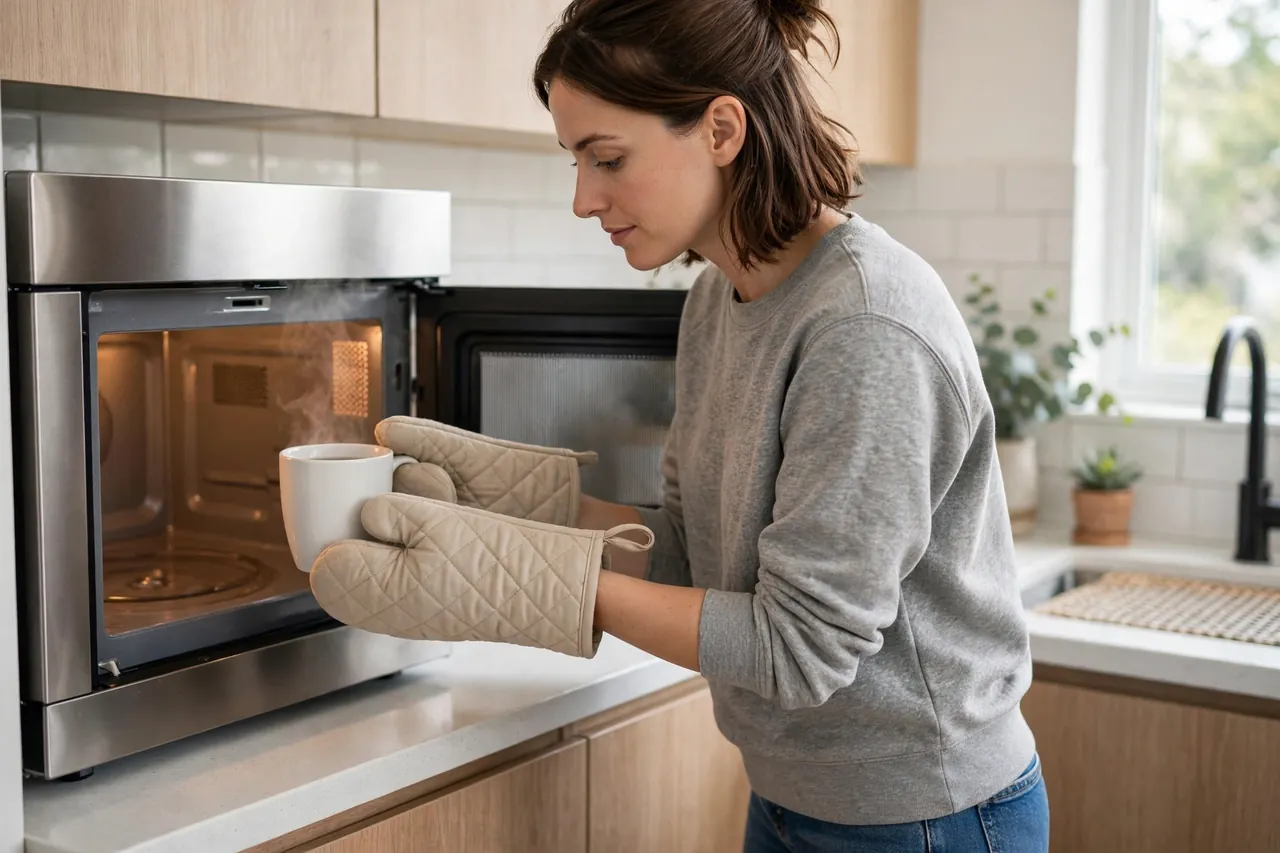
Handle it like the hot thing it is. Use a hot pad or oven mitt to lift the mug, keep your face away from the opening, and do not put your hand directly over the top of steaming water. Steam burns are real burns.
If all of that sounds like a lot, notice that it collapses into one sentence for daily life: mug plus wooden stick, two minutes, thirty-second rest, stir, drink. After a week it is automatic.
Which Cups Are Safe (And Which Ones Are Not)
The best containers for microwaving water are plain glass and glazed ceramic mugs, ideally ones labeled microwave-safe. Glass is non-porous, does not react with water, and lets you see whether the water is bubbling, which is a genuinely useful safety feature. Ceramic mugs work the same way as long as the glaze is intact and the mug has no metallic decoration.
Be careful with plastic. Many plastic cups and bottles are not rated for the temperatures that near-boiling water reaches, and hot water speeds up the movement of chemicals from plastic into liquid. Only use plastic that is explicitly labeled microwave-safe, and even then, glass or ceramic is the better choice for hot water. If you are unsure about any plastic container, the label rule in Can You Microwave Plastic? walks through exactly what to check.
Also skip anything with a narrow neck or a tiny opening, like a thermos-style bottle or a vase-shaped cup. A narrow opening concentrates steam and gives an eruption nowhere to go but straight up toward your face, and it makes the tap-and-stir safety steps hard to do. A wide, open mug is the safest shape by far. And as always, metal of any kind stays out of the microwave, no spoons, no travel mugs with metal liners, no exceptions.
Can You Microwave Distilled Water? The Special Risk
Distilled water deserves its own section because it is the one type of water most likely to superheat. Distillation removes the dissolved minerals and impurities from water, and those impurities were acting as nucleation sites. With fewer sites for bubbles to form, distilled water in a smooth container is the textbook setup for superheating, and multiple food-safety writers single it out as the highest-risk case.
The practical advice is simple: avoid microwaving distilled water if you have any alternative. If you must heat it, use every precaution in the book, a wooden stir stick is not optional here, it is mandatory, plus short intervals, plus the thirty-second rest, plus the tap test. Better yet, heat distilled water on the stove or in an electric kettle, where the bubbling is visible and the risk profile is completely different. Distilled water is mostly used for appliances, humidifiers, and medical devices anyway, so in most cases you do not need it hot at all.
Regular tap water, filtered water, and spring water all contain enough dissolved minerals to make normal boiling far more likely, which is one reason everyday tea-making is low risk. The risk ladder goes: distilled water at the top, then very pure filtered water, then ordinary tap water at the bottom. Wherever your water sits on that ladder, the wooden-stick habit covers you.
Microwave vs Kettle: Which Is Better for Heating Water?
For a straight comparison, the electric kettle wins on almost every axis except the one where the microwave has no competition, which is that the microwave is already sitting in your kitchen and takes zero setup.
Speed goes to the kettle for anything over a mug or two. A decent electric kettle boils a liter in about three minutes with no babysitting. A microwave needs roughly six to seven minutes for the same amount, broken into intervals with stirring, which is more total effort, not less.
Evenness goes to the kettle too. The rising-and-sinking circulation in a kettle mixes heat through the whole volume, while a microwave leaves hot and cold spots that you have to stir away yourself.
Safety is where it gets interesting. The kettle has one big advantage: you can see and hear the water boiling, so there is never any mystery about its temperature. The microwave’s danger is invisible, which is why this whole guide exists. But with the precautions above, microwaved water is genuinely safe, and plenty of people do it daily for years without incident.
Energy and cleanup are roughly a wash for a single mug. The microwave edges ahead on convenience if you are heating water as one step in a bigger microwave task, like making instant oatmeal or rehydrating dried mushrooms right in the bowl you will eat from. If you want the full picture of using hot water for instant meals, see Can You Microwave Cup Noodles?.
The honest verdict: if you own a kettle and you just want hot water, use the kettle. If the microwave is what you have, use the microwave with the seven rules. Both give you hot water. Only one of them can surprise you, and now it cannot.
What to Do If You Suspect Superheating
Sometimes you open the microwave door and something feels off. The water has been in there a long time, it looks strangely still, and it is hotter than the lack of bubbling suggests it should be. Treat that suspicion seriously, because this is the exact situation where eruptions happen.
First, do not touch the mug yet. Leave it sitting in the microwave with the door open. Reach in with a long-handled wooden spoon and gently touch the spoon to the surface of the water, or give the water one slow stir from arm’s length. If the water was superheated, this will trigger the eruption while the mug is still safely inside the microwave and your face is nowhere near it. The water may foam up dramatically and then settle. Let it sit for a full minute after that, then handle it normally with a hot pad.
Second, if the eruption already happened and you got splashed, treat it as a burn. Run cool (not ice-cold) water over the skin for at least ten minutes, remove any rings or tight clothing near the area, and do not pop blisters. Seek medical care for any burn on the face, any burn larger than your palm, or any burn that blisters badly. This is not overreacting; scald burns from superheated water have sent people to emergency rooms, and fast cooling is the single most effective first aid.
Third, learn from the incident. Note what was different that time: a new mug, a longer heating time, distilled water, no stir stick. Change that one variable next time. Superheating is a physics problem with a physics solution, not a mystery, and once you know which variable caused it, it will not catch you again.
Frequently Asked Questions
These are the questions people actually ask about microwaving water, drawn from search results, cooking sites, and forum threads. Each answer leads with the direct answer, then fills in the detail.
Can you boil water in the microwave?
Yes, you can boil water in the microwave, and it is safe when you use a microwave-safe container and heat in short intervals. Research reviews note no known health effects from microwaving water; the water itself is unchanged. The only real risk is superheating, which you prevent with a wooden stir stick in the mug, a two-minute-per-cup maximum, and a thirty-second rest before handling.
What is superheating?
Superheating is when water heats past its boiling point of 212 degrees Fahrenheit without visibly boiling, because there were no rough surfaces or impurities for steam bubbles to form on. It happens most easily in smooth new containers, with very pure water, and after long uninterrupted heating. The danger is that the water looks calm while holding far too much heat, and a small disturbance like lifting the mug or dropping in a tea bag can make it erupt violently.
How do you prevent water from exploding in the microwave?
Put a wooden chopstick, stirrer, or skewer in the mug before heating, because the wood gives steam bubbles a surface to form on so the water boils normally. Heat in one-to-two-minute intervals with stirring between them, never heat more than two minutes per cup, and let the water stand for thirty seconds in the microwave after the timer stops. This combination, recommended by microwave manufacturers and physics educators, removes essentially all of the eruption risk.
How long do you microwave water for tea?
Heat one standard mug (about 8 ounces) for two to two and a half minutes at full power in a 1,000-watt microwave, then let it stand for thirty seconds before adding your tea bag. For a half mug, one to one and a half minutes is enough. If your microwave is lower wattage, add thirty seconds at a time and stir between rounds. Put the tea bag in before heating if you want one less step, since the bag itself helps prevent superheating.
Is it safe to microwave distilled water?
It is riskier than microwaving tap water, so avoid it when you can. Distilled water has had its dissolved minerals removed, and those minerals were helping steam bubbles form, which makes distilled water the most likely type to superheat. If you must heat it, use a wooden stir stick without exception, heat in short intervals, and do the thirty-second rest and tap test. Heating it on the stove or in a kettle is the safer choice.
Can microwaving water actually hurt you?
Yes, it can, though incidents are uncommon. When superheated water erupts, it can cause first and second degree scald burns, and there are documented cases of people needing hospital treatment after water blew up in their faces. The injuries happen when someone heats water too long, often in a smooth new container, and then disturbs it by lifting the mug or adding something to it. Every one of those cases is preventable with the precautions in this guide.
Does microwaved water taste different from kettle water?
It can, slightly. Microwaved water often heats unevenly, leaving hot and cold spots that a kettle’s natural circulation avoids, and a quick stir fixes that. Some people also notice a flatter taste, which comes from microwaving driving dissolved gases out of the water without the vigorous rolling boil that re-aerates kettle water. For most tea and coffee purposes the difference is small, and stirring plus not overheating keeps it minimal.
Can you microwave water in a plastic cup or bottle?
Only if the plastic is explicitly labeled microwave-safe, and even then glass or ceramic is the better choice for near-boiling water. Many plastics soften or warp at the temperatures hot water reaches, and heat speeds up chemical migration from plastic into liquid. Single-use water bottles and disposable cups are not designed for heating at all. When in doubt, pour the water into a microwave-safe glass or ceramic mug first.
Is it safe to microwave water for baby formula?
Yes, but with extra care, because a baby cannot tell you the water has hot spots. Heat the water, then stir it thoroughly and test the temperature on the inside of your wrist before mixing the formula, since microwaves heat unevenly and the wrist test catches spots your eyes cannot see. Many pediatric sources recommend heating the water and mixing the formula afterward rather than microwaving mixed formula, and never serve anything to a baby without the temperature check.
Can you reboil water in the microwave?
You should avoid it. Boiling drives dissolved gases out of the water, and those gases were acting as nucleation sites that helped the water boil normally the first time. Reboiled water has fewer bubble-forming sites, which makes superheating more likely on the second round. If your water cooled down and you need it hot again, pour it out and start with fresh cold water from the tap.
How do you know when microwaved water is actually boiling?
Look for active bubbling and listen for it, but do not trust the absence of bubbles, since superheated water can look perfectly still while being hotter than boiling. After heating, tap the side of the mug gently while it is still in the microwave; if the water suddenly foams up, it was superheated and the tap test just saved you from a burn. The reliable routine is: wooden stick in the mug, short intervals, visible bubbling before you call it done.
Is microwaved water bad for plants?
No, this is a myth. The story comes from a chain email claiming a plant watered with microwaved water died while a plant given tap water thrived, but the experiment was never controlled and the claim has been debunked repeatedly. Water is water; microwaving does not change its chemical composition or make it toxic to plants. Let the water cool to room temperature first, because hot water of any kind will damage roots.
Why does my microwave heat water so unevenly?
Because microwaves heat in standing-wave patterns, with fixed hot spots and cold spots inside the oven cavity, instead of heating the whole volume at once the way a stove burner does. The turntable exists to move food through those spots, but a mug of water still ends up with temperature layers. Stirring between short heating intervals is the fix, and it also doubles as your superheating prevention, so the habit serves two purposes at once.
Can you microwave water with a tea bag already in it?
Yes, and it is actually one of the safer ways to do it. The tea bag gives steam bubbles a rough surface to form on, which works just like the wooden-stick trick to prevent superheating. Heat for about two minutes for a standard mug, let it stand for thirty seconds, then lift the bag out or leave it in to steep. Just make sure the bag’s staple or string tag is not metallic, since metal does not belong in a microwave.
The Bottom Line
Microwaving water is one of those everyday things that is almost entirely safe and exactly one percent dangerous, and that one percent has a name, a mechanism, and a fix. Superheating is real physics, not an urban legend, but it needs a specific setup to happen, and the wooden-stick trick plus short intervals plus a thirty-second rest takes that setup apart completely.
Make it a habit: microwave-safe mug, wooden stirrer in the water, two minutes per cup at most, rest, stir, drink. That is the whole system, and it fits on a sticky note. Keep the kettle for big jobs and for days when you want the ritual, and use the microwave without fear for the everyday mug. Now you know not just that you can microwave water, but exactly how to do it like someone who understands the machine.
