

It is 6:40 in the morning, you are already late, and there is an egg sitting on the counter. The pot for boiling takes ten minutes you do not have. The microwave is right there. So the thought lands, quiet and tempting: what if I just put the egg in the microwave, shell and all, for two minutes?
Can you microwave eggs in shell? No. A whole egg in its shell should never go into a microwave. The shell traps steam as the inside heats, pressure builds faster than it can escape, and the egg explodes. Sometimes it explodes inside the oven. Sometimes, worse, it explodes in your hand or your mouth seconds after you take it out. This is one of the few microwave questions where every food safety authority gives the same flat answer.
This guide explains exactly why eggs in shells explode, why the popular tricks (poking a hole, adding salt, submerging in water) do not make it safe, what a delayed explosion is and how to avoid burns, and the safe ways to cook eggs in the microwave that actually work. If you want the short version for every other food and container, start with Can You Microwave It? The Complete Safety Chart, then come back for the egg details.
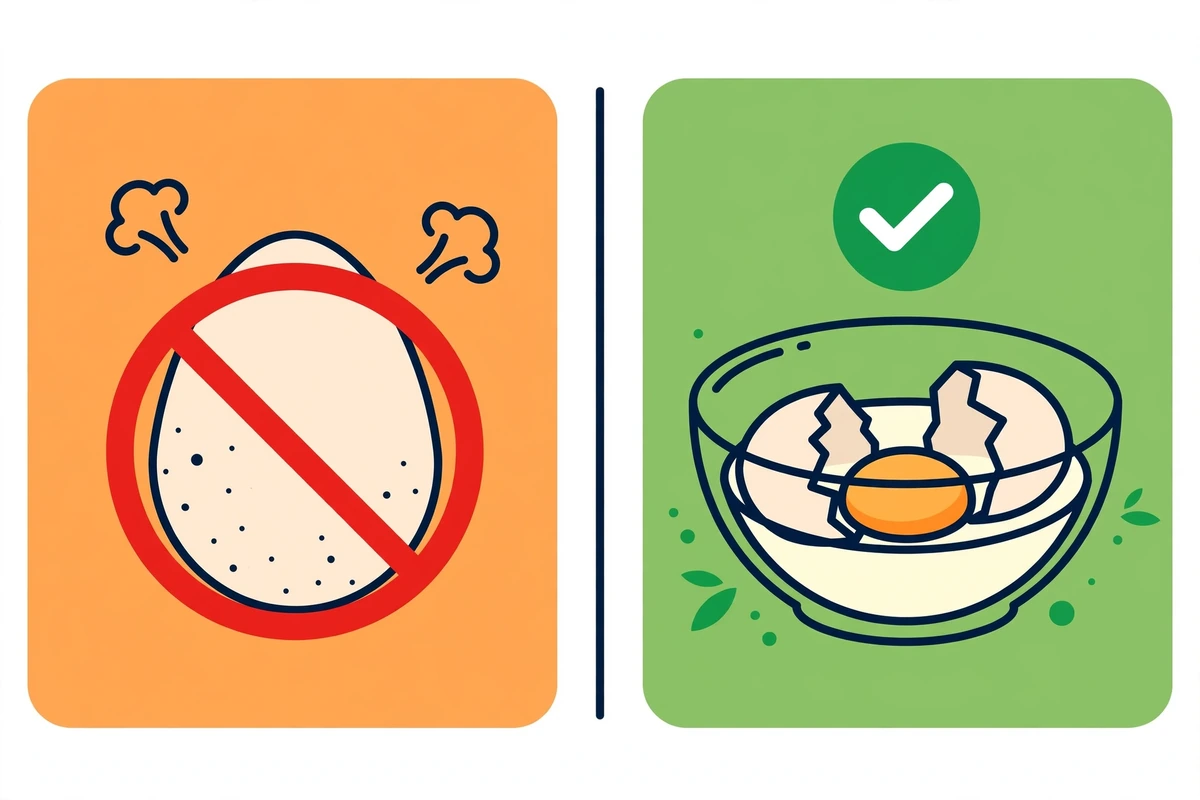
What Happens When You Microwave an Egg in Its Shell
Direct answer: the water inside the egg turns to steam, the shell and its inner membranes seal that steam in, pressure climbs until the shell fails, and the egg bursts apart, often violently.
A microwave heats food by making water molecules vibrate, which is exactly what the FDA explains in its guide to microwave oven radiation. An egg is roughly three quarters water, packed into a rigid container. On a stove, heat moves slowly from the outside in, and the shell can handle the gradual pressure change. In a microwave, energy hits the whole egg at once, and the inside heats far faster than steam can leak out through the shell’s tiny pores.
Three things stack against you at the same time. First, the shell plus the two membranes underneath it form a nearly airtight seal. Steam has almost nowhere to go. Second, microwaves heat unevenly, so hot spots form inside the egg and some pockets of water flash into steam all at once. Third, the yolk heats even faster than the white, and researchers have found that yolk can superheat past the normal boiling point while the egg still looks perfectly intact.
The result is a small pressure vessel with no release valve. When the shell finally gives way, it does not crack politely. It shatters, throwing scalding egg in every direction. Cleanup is the best case. Burns to your hands, arms, or face are the realistic worst case, and they happen more often than people expect because of what comes next: the explosion does not always happen inside the microwave.
Why Poking a Hole in the Shell Does Not Make It Safe
Direct answer: no, a pinprick cannot vent steam fast enough to keep up with how quickly a microwave builds pressure, so the egg can still explode.
This is the most common “hack” attached to this question, and it sounds logical. If pressure is the problem, give it an escape route. The problem is a matter of scale. Steam expands to roughly 1,700 times the volume of the water it came from, and it forms in a sudden rush when a hot spot flashes over. A pinhole in the shell is like trying to empty a swimming pool through a drinking straw while someone keeps the hose running.
The hole also tends to seal itself. As the egg white near the puncture starts to cook, the proteins set and can plug the tiny opening within seconds. Now you are back to a sealed container, except you feel safer than you should, which is arguably more dangerous than knowing nothing at all.
Some versions of this trick add salt to the water around the egg or fully submerge the egg in a bowl of water first. Submerging does slow things down because water absorbs microwave energy before it reaches the egg, and salt helps the white set faster if a crack leaks. But “slower” is not “safe.” The pressure inside the shell still rises, the heating is still uneven, and eggs cooked this way still explode often enough that no food safety authority endorses the method. The USDA’s microwave safety guidance is blunt about eggs: pierce yolks and whites of any egg you microwave, which you cannot do while the shell is on.
If a recipe, video, or forum post promises a safe in-shell microwave method, treat it the way you would treat someone promising a safe way to hold a firecracker after lighting it. The physics does not negotiate.
The Delayed Explosion: Why Eggs Can Blow Up After You Take Them Out
Direct answer: yes, an egg can look fine when the microwave stops and still erupt seconds later when you touch, peel, or bite it, because superheated liquid flashes into steam the moment pressure drops.
This is the part most articles skip, and it is the part that sends people to urgent care. The danger does not end when the timer beeps. Inside an intact egg, water and yolk can heat well past 212°F (100°C) without actually boiling, because the sealed shell keeps them under pressure. Scientists call this superheating. The liquid is hotter than boiling but has nowhere to form bubbles, so it just sits there, trembling on the edge.
The trigger can be tiny. You tap the egg on the counter to crack the shell. You bite into a reheated peeled egg. You slide a knife through it. Any of these drops the pressure in an instant, and the superheated liquid flash-boils into steam in a fraction of a second. The expansion is explosive, and it happens inches from your face.
Extension food scientists have documented real cases of this. In one widely cited incident, a woman reheated a peeled hard-cooked egg, found the outside merely warm, bit into it, and the yolk erupted inside her mouth, burning her lip and gums. The outside of the egg had told her nothing about the inside, because microwaves heat from within and the white insulates the yolk.
Three habits protect you from delayed explosions. First, never microwave eggs in the shell, full stop, because an intact egg is the perfect superheating chamber. Second, after microwaving any whole-yolk egg preparation, let it stand for a full 60 seconds before touching it, so temperatures can equalize. Third, when you do cut into it, point it away from your face and body, the same way you would open a shaken soda away from yourself. These sound dramatic until you compare them to a mouthful of 220-degree yolk.
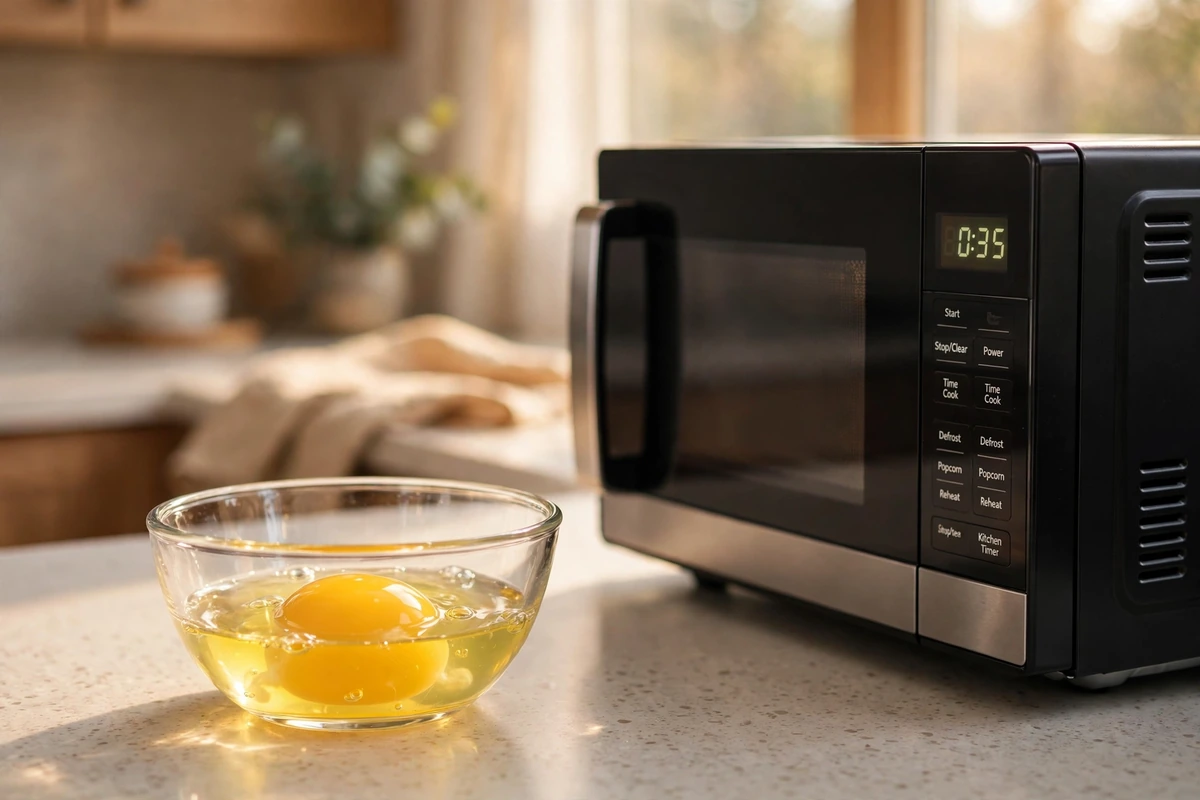
How to Safely Microwave Eggs Instead
Direct answer: crack the egg out of its shell into a microwave-safe container, always pierce the yolk, and cook in short bursts, and you get fast, safe eggs with no explosion risk.
The microwave is genuinely good at cooking eggs once the shell is out of the picture. A microwave-safe glass or ceramic bowl is your best container, and covering it with a damp paper towel or a vented microwave-safe lid keeps splatter down while letting steam escape. Here are the three methods worth knowing.
Scrambled Eggs in a Bowl
Crack two eggs into a microwave-safe bowl and whisk them well with a fork, breaking the yolks completely. A whisked egg cannot trap steam because there is no intact membrane left. Add a splash of milk if you like, plus salt and pepper. Microwave on high for 30 seconds, stir, then continue in 15 to 20 second bursts, stirring between each, until just set. Stop when they still look slightly wet, because carryover heat finishes the job in about 30 seconds. Total time is usually under two minutes, and the texture is soft and creamy if you do not overcook them.
Poached-Style Egg in Water
Fill a microwave-safe mug with about half a cup of water and add half a teaspoon of white vinegar, which helps the white wrap neatly around the yolk. Crack one egg into the water and pierce the yolk gently with a toothpick or the tip of a knife. This single step is the whole safety system, so do not skip it. Cover the mug with a small microwave-safe plate, leaving a slight gap for steam. Microwave at 50 to 70 percent power for 60 to 90 seconds, then check. The white should be set and the yolk still soft. Lift the egg out with a slotted spoon and let it rest a minute before eating.
The Closest Thing to a Microwaved Boiled Egg
You cannot truly hard-boil an egg in a microwave, but you can get close. Lightly grease a microwave-safe ramekin or mug. Separate the egg, putting the white in the container first. Pierce the yolk, then add it on top of the white. Cover with a damp paper towel. Microwave at 50 percent power in 20 second bursts, checking between each, until the white is fully set and the yolk is as firm as you like. It takes about 90 seconds total. The texture is not identical to a stove-boiled egg, but it works for egg salad, breakfast sandwiches, and grain bowls, and it is completely safe because nothing is sealed.
A note on microwave egg cooker cups: the small plastic gadgets sold for this purpose are fine to use if they carry a microwave-safe label, because they are designed with vents. Check the label, follow the fill lines, and do not use a cracked or warped one. Unlabeled plastic containers have no place in this process.
Reheating Hard-Boiled Eggs Without the Bang
Direct answer: slice or quarter the peeled egg and warm the pieces in short bursts, or submerge them in hot water, because a whole reheated egg can explode just like a raw one.
This surprises almost everyone. A hard-boiled egg has no shell, so surely it is safe? It is not. The cooked white forms a dense, rubbery seal around the yolk, and when microwaved, the yolk reheats faster than the white. Steam and superheated pockets build inside exactly the way they do in a raw egg, and the whole thing can pop apart in the microwave or in your mouth.
The USDA guidance on microwaving eggs specifically warns that reheating needs the same care as cooking, because uneven heating is the core problem. The safe method is simple. Peel the egg, cut it into halves or quarters so steam has open faces to escape from, and place the pieces in a microwave-safe dish. Warm them at 50 percent power in 20 second bursts, or skip the microwave entirely and drop the pieces into a bowl of hot (not boiling) water for two to three minutes. The water bath reheats gently and evenly, and it is honestly the better method for texture too, since microwaves turn leftover egg whites rubbery.
Never reheat a hard-boiled egg still in its shell. That is just the original problem wearing a disguise.
Microwave Egg Times and Power Settings
Direct answer: most single-egg microwave preparations take 60 to 120 seconds total at 50 to 100 percent power, always in short bursts with rest time.
Times vary with your microwave’s wattage, the size of the egg, and how you like it cooked. A 1000-watt oven runs hotter than a 700-watt one, so start with the shorter time and add 10 second bursts. The table below assumes large eggs and a 900 to 1000 watt microwave. For lower wattage, add about 20 percent more time.
| Method | Power | Time per Egg | Key Safety Step |
|---|---|---|---|
| Scrambled in bowl (2 eggs) | High (100%) | 60 to 90 sec total | Whisk yolks fully, stir every 30 sec |
| Poached in mug of water | 50 to 70% | 60 to 90 sec | Pierce yolk, cover with vented plate |
| “Boiled” style, shell off | 50% | 80 to 100 sec in bursts | Separate white and yolk, pierce yolk |
| Reheating cooked egg pieces | 50% | 20 to 40 sec | Cut into quarters first |
| Egg cooker cup (vented) | Per label | Per label | Use only labeled, undamaged cups |
Two rules apply to every row. First, let the egg stand for 30 to 60 seconds after cooking so heat evens out; this single habit prevents most delayed bursts. Second, eggs should be cooked until both white and yolk are firm if food safety is your concern, since microwaves can leave cool pockets where bacteria survive. The USDA recommends egg dishes reach 160°F (71°C) internally, and stirring plus standing time is how you get there in a microwave.
Can You Microwave Eggs in Shell? The Final Answer
Can you microwave eggs in shell? No, and that single rule covers nearly every egg disaster. The shell is a sealed pressure vessel, pinpricks do not vent it, water baths do not tame it, and the explosion can wait until the egg is in your hand. Crack the egg out, pierce the yolk, use a microwave-safe container, and cook in short bursts with standing time. Do that and the microwave becomes one of the fastest ways to cook an egg. Skip it and you are cleaning yolk off the ceiling. For the same clear yes-or-no on everything else in your kitchen, keep Can You Microwave It? The Complete Safety Chart bookmarked.
Frequently Asked Questions
Can you microwave eggs in shell?
No. You should never microwave a whole egg in its shell. The shell and its inner membranes trap steam as the inside heats, pressure builds until the shell shatters, and the egg explodes. This can happen inside the microwave or seconds later in your hand, so there is no safe version of this method.
Why do eggs explode in the microwave?
Eggs explode because microwaves heat the water inside them into steam faster than the steam can escape. The shell, or the dense cooked white of a boiled egg, acts like a sealed lid. Pressure climbs until something gives way, and the release is sudden and violent. The yolk can also superheat past boiling point, which makes the burst even more forceful when it finally happens.
Can you microwave a hard-boiled egg to reheat it?
Only if you cut it up first. A whole peeled hard-boiled egg can explode in the microwave or in your mouth, because the cooked white seals steam around the yolk just like a shell does. Slice or quarter the egg, warm the pieces at half power in short bursts, or reheat them in a bowl of hot water instead, which is gentler and safer.
What happens if you microwave an egg without piercing the yolk?
An unpierced yolk is a sealed pocket of liquid inside your food. As it heats, steam builds inside the yolk membrane until it ruptures, spraying hot yolk. This is the most common cause of microwave egg explosions after cooking in the shell. Always pierce the yolk with a toothpick or knife tip before microwaving any whole-yolk preparation, and pierce the white in a few spots too.
Can you boil eggs in the microwave?
Not truly, and not in the shell. You can get a close result by cracking the egg into a microwave-safe container of water, piercing the yolk, and cooking at half power in short bursts. The texture will be softer and less even than a stove-boiled egg. If you want real hard-boiled eggs, the pot on the stove is still faster than cleaning an exploded microwave.
How long does it take to microwave an egg?
A single egg takes 60 to 120 seconds depending on the method and your microwave’s wattage. Scrambled eggs take about 60 to 90 seconds with stirring, a poached-style egg takes 60 to 90 seconds at reduced power, and reheating cut pieces takes 20 to 40 seconds. Always cook in short bursts and add 10 seconds at a time rather than guessing one long blast.
Is it safe to microwave scrambled eggs?
Yes, scrambled eggs are one of the safest egg preparations for the microwave. Whisking breaks the yolks completely, so there is no membrane left to trap steam. Use a microwave-safe bowl, stir every 30 seconds, and stop cooking when the eggs still look slightly wet. Carryover heat finishes them in about half a minute.
Can you microwave a peeled hard-boiled egg whole?
No, do not microwave a peeled hard-boiled egg whole. The dense white traps steam around the yolk, and documented cases show these eggs erupting when bitten into, causing burns to the mouth and lips. Cut the egg into halves or quarters first, which gives steam open surfaces to escape from, and the risk disappears.
Why did my egg explode after I took it out of the microwave?
That was a delayed explosion caused by superheating. The liquid inside the egg heated past boiling point while sealed under pressure, then flash-boiled into steam the moment you disturbed it by tapping, peeling, or biting. Let microwaved eggs stand for 60 seconds before touching them, and cut into them pointed away from your face.
Can you microwave eggs in a mug?
Yes, a mug is actually one of the best vessels for microwaving eggs. Use a microwave-safe ceramic or glass mug, crack the egg in (no shell), pierce the yolk, and add water if you want a poached style. Do not use a travel mug or any mug with metallic trim, since metal in the microwave causes sparking.
Do you need to pierce the yolk before microwaving?
Yes, every time. Piercing the yolk gives steam a vent and is the single most important safety step for any microwaved egg with an intact yolk. Use a toothpick, fork tine, or knife tip, and make two or three small punctures. USDA microwave guidance likewise says to pierce yolks and whites before cooking eggs this way.
Can you microwave an egg in its shell if you put it in water?
No, submerging the egg in water does not make it safe. The water slows heating and can cushion the egg, but pressure still builds inside the shell faster than it can escape, and eggs prepared this way still explode. No food safety authority endorses the water-bath method for in-shell eggs. Crack the egg out of the shell first.
What temperature should microwaved eggs reach?
Egg dishes should reach 160°F (71°C) throughout to be safe from bacteria like Salmonella, according to USDA guidance. Microwaves heat unevenly, so stir scrambled eggs, rotate the container, and let the egg stand for a minute after cooking. The standing time lets heat spread into any cool pockets before you eat.
Can you reheat a fried egg in the microwave?
Yes, but cut it into pieces first and use gentle heat. A whole fried egg has an intact yolk that can burst, so slice it, place the pieces in a microwave-safe dish, and warm at 50 percent power in 20 second bursts. The texture will be softer than fresh, so reheated fried eggs work best chopped into fried rice, breakfast burritos, or grain bowls.
