

Picture this: it is late, you are staring at a plate of leftover pizza on a paper plate, and the last thing you want is another dish to wash. Can you microwave paper plates and just be done with dinner? It is one of the most common kitchen questions, and the good news is that the answer is mostly yes.
The USDA, the federal agency behind America’s food safety guidance, lists most paper plates as safe for microwave use. There is a catch, though. Not every paper plate is built the same way. The plain white plate from the store brand and the glittery holiday plate with gold trim are very different objects once they start spinning inside your microwave.
This guide gives you the full, honest answer. You will learn which paper plates you can microwave with confidence, how long you can safely heat them, the types to keep far away from the microwave, and a simple step-by-step routine that makes reheating leftovers safe every single time. By the end, you will never have to guess at the microwave door again.
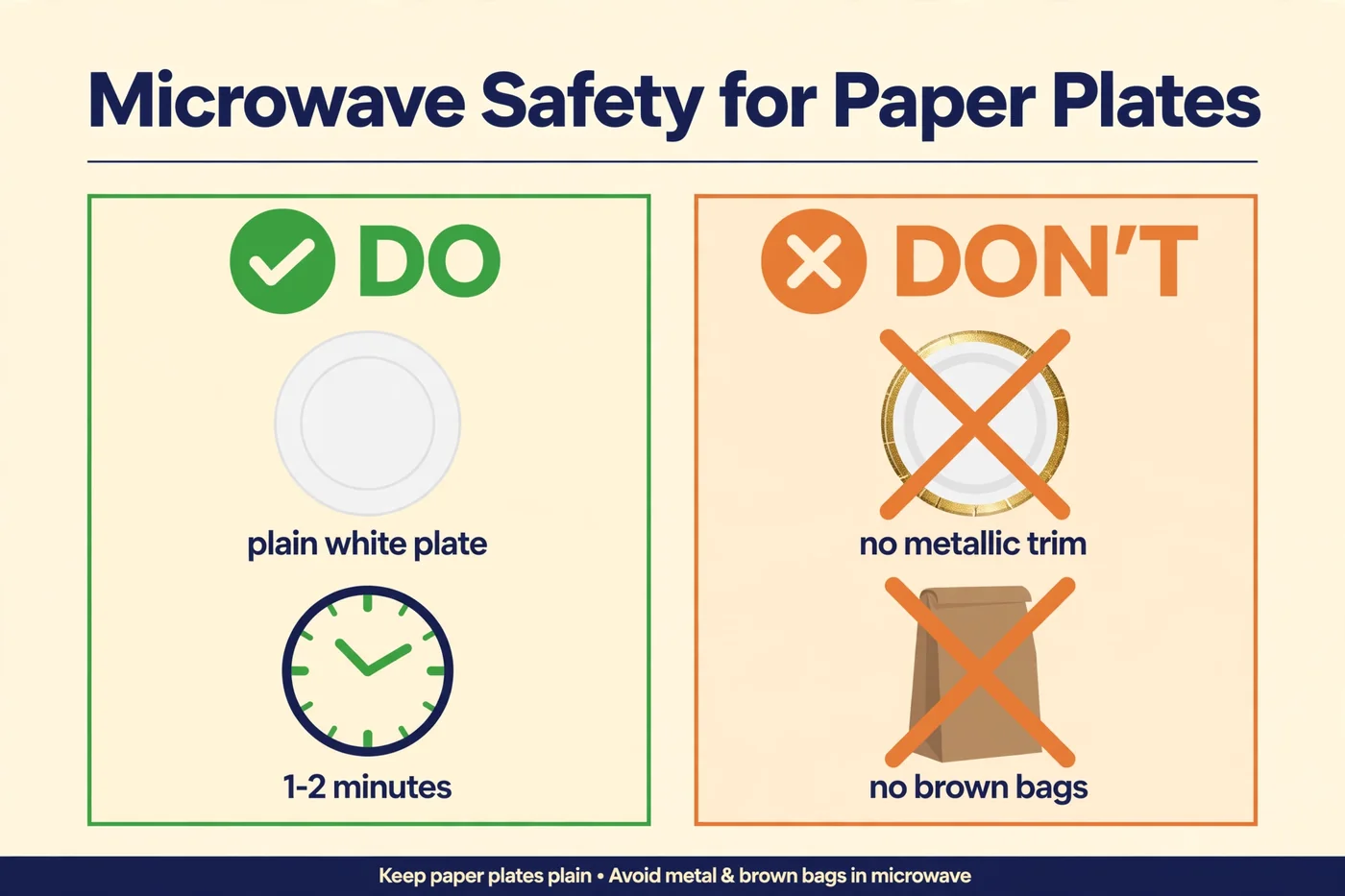
Can You Microwave Paper Plates? The Short Answer
Yes, you can microwave paper plates. The USDA lists most paper plates, along with paper towels and napkins, as safe for microwave use. That one sentence settles the question for most people, but the details matter more than you might think.
The confusion around this question is understandable. Paper and heat sound like a bad combination, and every microwave owner has heard horror stories about things sparking or catching fire. But a microwave heats food by exciting water molecules, and plain paper does not absorb microwave energy the way metal does. The real risks come from what is printed, coated, or glued onto the plate, not from the paper itself.
So the honest answer is conditional. Can you microwave paper plates? Yes, when the plate is plain, unprinted, and ideally marked microwave-safe, and when you keep the heating time short. The rest of this guide walks you through exactly which plates qualify, how long to heat them, and the warning signs that tell you to stop.
What the USDA and Manufacturers Say About Microwaving Paper Plates
The official guidance is clear: most paper plates are safe to use in the microwave, with white, unprinted materials recommended for optimal safety. That wording comes from the USDA’s Food Safety and Inspection Service, which publishes one of the most cited microwave safety fact sheets in the United States.
The USDA’s microwave safety fact sheet places paper plates, paper towels, napkins, and paper bags on its “safe to use” list, right alongside heatproof glass and ceramic. The key phrase is “most.” The agency draws a line between plain paper products and decorated or recycled ones, and it specifically recommends white, unprinted materials to keep ink from transferring into food.
The FDA’s microwave oven safety page focuses more on the appliance itself, noting that ovens meeting federal standards are safe when used according to manufacturer instructions. That instruction part matters. Your microwave manual probably tells you to use only microwave-safe containers, and the same logic applies to the plate you put inside it.
Manufacturers back this up. Dixie’s product guidance for paper plates states that its plates are microwaveable and cut-resistant, designed for reheating leftovers. If you are wondering whether you can microwave paper plates from a specific brand, the manufacturer is your second authority after the USDA. That said, the company also advises following your microwave manufacturer’s directions, because wattage, food type, and heating time all vary. The pattern is consistent across every credible source: the plate matters, the time matters, and the label is your best friend.
Why White and Unprinted Matters So Much
Ink is the quiet problem with decorative paper plates. The USDA warns that printed designs can transfer ink into food when heated, which is why it recommends white, unprinted materials for optimal safety. That floral border or cartoon print might be food-safe at room temperature, but heat changes the equation.
This is also why “check the label” is such a common piece of advice. A plain white plate from a reputable brand is almost always fine. A plate with a shiny print, gold trim, or glittery design introduces materials you cannot identify by looking at them. If the packaging does not say the plate is microwave-safe, treat an unknown decorated plate as a no and transfer your food to a ceramic dish instead.
Which Paper Plates Can You Microwave? A Type-by-Type Guide
You can microwave plain white paper plates and sturdy molded-fiber plates that carry a microwave-safe label. Coated, printed, metallic, glittery, or recycled plates are the ones to keep out of the microwave. Here is how the common types compare:
| Plate type | Can you microwave it? | Why |
|---|---|---|
| Plain white paper plate | Yes, if labeled microwave-safe | No inks or coatings to react with heat |
| Coated or wax-lined plate | Only if the label says so | Wax and plastic coatings can soften or melt |
| Printed or glossy plate | Best avoided | Inks can transfer into food when heated |
| Metallic trim or foil plate | Never | Metal causes sparking and fire risk |
| Bagasse or bamboo fiber plate | Often yes, check the label | Sturdy plant fiber handles short reheating well |
If you want to see where paper plates sit next to dozens of other foods and materials, our Can You Microwave It? The Complete Safety Chart puts everything in one place.
Plain White Paper Plates
These are your safest bet. A plain, unprinted white paper plate from a grocery store brand is exactly what the USDA guidance describes. It contains no decorative ink, no metallic accents, and usually no heavy coating. For reheating a slice of pizza or a bowl of rice for a minute or two, this is the plate to reach for.
Even here, the microwave-safe label is worth checking. Most major brands print it on the packaging, sometimes with the wavy-lines symbol. If you tossed the packaging and cannot remember the brand, a plain white plate is still a reasonable choice for short reheating, but keep the time brief and stay nearby.
Coated and Wax-Lined Plates
Many paper plates carry a thin coating that makes them resist grease and moisture. Some of these coatings are fine in the microwave, and some are not. Wax coatings can soften with heat, and plastic coatings may not be rated for microwave temperatures.
The rule is simple: only microwave a coated plate when the packaging explicitly says it is microwave-safe. If you see a visible sheen on the plate and no label to back it up, do not risk it. A shiny plate that gets too hot can warp, and in rare cases the coating can break down. When the label is missing or unclear, this is your sign to use glass or ceramic instead.
Printed, Glossy, and Decorated Plates
Birthday plates, holiday plates, and anything with a colorful printed design fall into the caution zone. The USDA’s concern about ink transfer applies directly here. Printed plates are designed to look good on a table, not to perform under heat.
Glossy plates deserve extra suspicion because that shine often comes from a plastic-based coating. Whirlpool and other appliance makers specifically advise against reheating on plates with a decorative sheen. Save the pretty plates for cold foods and parties, and reheat on a plain plate.
Bagasse, Bamboo, and Palm-Leaf Plates
Molded-fiber plates made from sugarcane bagasse, bamboo, or palm leaf have become popular as sturdier, eco-friendly alternatives to paper. Many of these are genuinely tougher than paper plates and hold up well to hot, greasy food. Most brands label them microwave-safe for short reheating.
They are not automatically safe, though. Some fiber plates include binding agents or coatings that are not microwave rated. The same label rule applies: check the packaging. If it says microwave-safe, you can use it for reheating with confidence. These plates also tend to resist going soggy, which is a nice bonus for saucy leftovers.
How Long Can You Microwave Paper Plates? Timing and Power Rules
Keep it short: one to two minutes at a time is the safe window for reheating food on a paper plate. How long you can microwave paper plates depends on three things: the plate itself, the type of food, and the power level. Longer times let heat build up in the plate, which is when problems start. Paper is safe in the microwave, but it is still paper, and it has limits.
Most reheating jobs fit comfortably inside two minutes. A plate of leftovers, a slice of pizza, or a small portion of rice usually needs 60 to 90 seconds. If your food needs more heat than that, heat it in shorter bursts and check the plate between rounds. Stirring or flipping the food halfway also helps, since it evens out hot spots that can scorch the plate.
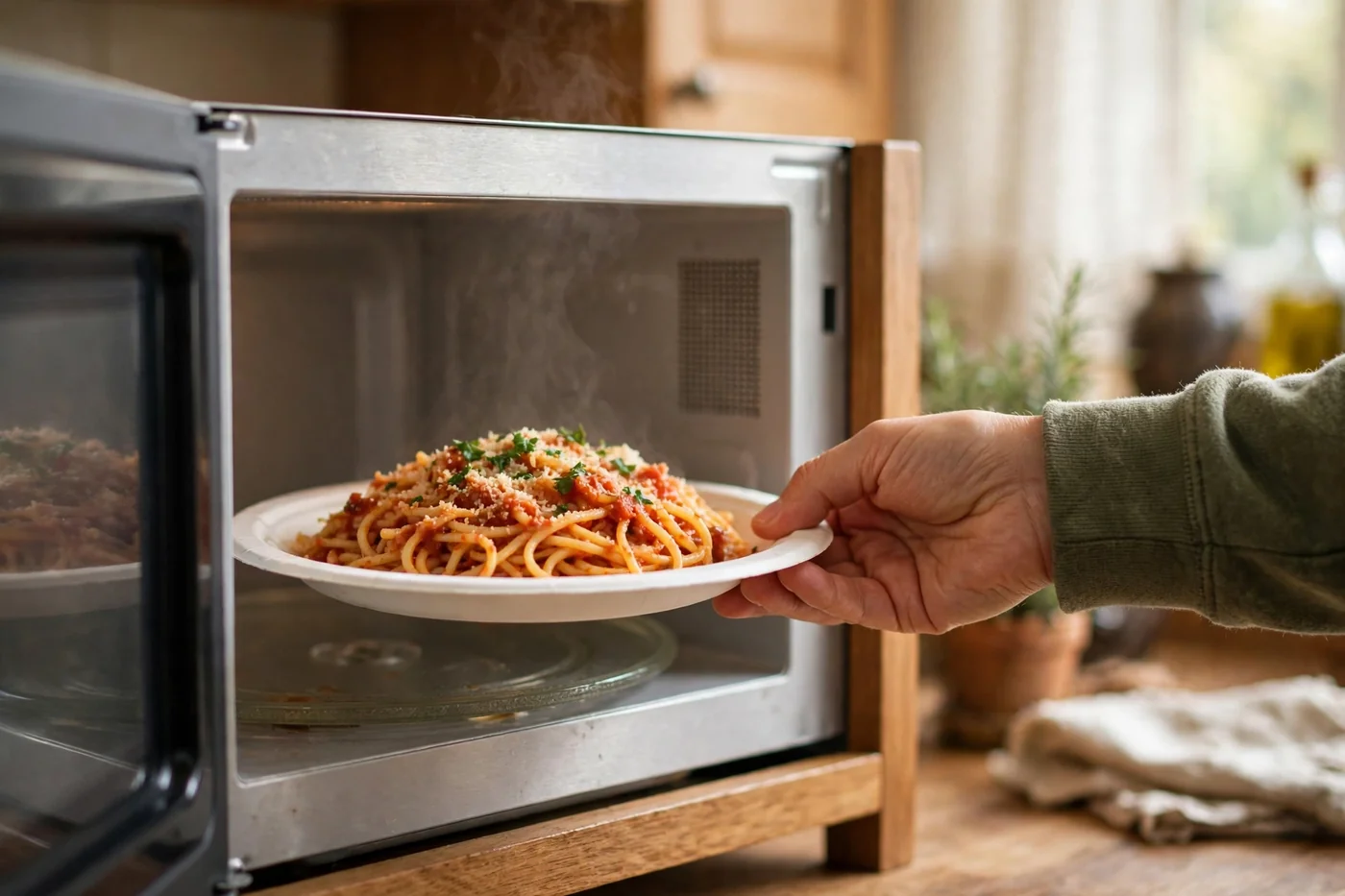
The 2-Minute Rule and Why It Exists
Two minutes is the consensus limit across manufacturers, food safety guides, and appliance makers. It is not a magic number where everything is fine at 1:59 and dangerous at 2:01. It is a practical boundary based on how paper behaves under sustained microwave energy.
When a plate heats for too long, moisture leaves the paper fibers, and the plate becomes brittle and hot. Greasy foods make this worse because hot oil soaks into the paper and holds heat against it. There are well-known experiments where a paper plate left in a microwave for five minutes caught fire. Short times keep you far away from that territory.
Power Level Matters More Than You Think
Full power is fine for short reheating, but medium power gives you a wider safety margin. Lower power heats the food more gently and gives the plate less thermal stress. If your microwave runs hot or you are reheating something oily, dropping to 70 or 80 percent power is a smart move.
Think of it this way: the goal is to heat the food, not the plate. The plate is just a vehicle. Gentler power gets the food warm while keeping the plate comfortably below the point where it softens or scorches. For delicate or greasy foods, this small adjustment makes a real difference.
Reheating Is Fine, but Cooking Is Not
Paper plates are for reheating, not cooking. Reheating means warming food that is already cooked, which takes a minute or two. Cooking means starting from raw or frozen and running the microwave for many minutes, which paper plates cannot handle.
Frozen food is a special case worth calling out. Thawing and cooking frozen food takes far longer than the 2-minute window, and long microwave sessions are exactly what damages paper plates. If your meal needs more than a few minutes, transfer it to a microwave-safe glass or ceramic dish before you start. The same goes for anything you plan to cook from scratch.
Paper Products You Should Never Put in the Microwave
Never microwave brown paper bags, newspapers, recycled paper products, or plates with metallic decoration. These are the items that cause the fires and chemical concerns people worry about. They look like ordinary paper, but they behave very differently under heat.
This distinction is important enough that it deserves its own spot in our things you should never put in the microwave guide. For now, here are the main offenders and why each one is a problem.
Brown Paper Bags and Grocery Bags
Brown paper bags are one of the most clearly warned-against items in microwave safety guidance. They can contain recycled fibers, glue, and even tiny metal fragments, and they catch fire more easily than you would expect. The USDA and fire safety experts consistently say to keep them out of the microwave.
This includes the paper bags from grocery stores and fast food. They are designed for carrying, not heating. If your leftovers came home in a paper bag, transfer the food to a proper plate before reheating. The bag stays in the trash, not in the microwave.
Newspaper and Printed Paper
Newspaper ink is not food-safe, and heat makes ink transfer worse. Old guidance sometimes suggested wrapping food in newspaper, but modern food safety advice is firmly against it. The ink can contain compounds you do not want anywhere near your food, and the paper itself is thin and flammable.
The same logic covers printed paper towels with heavy designs, paper placemats with printing, and any paper where you cannot identify the ink. Plain white paper products are the safe category. If it has print, keep it away from heat and food.
Metallic Trim, Foil Edges, and Glitter
Anything metallic is an absolute no in the microwave. Some decorative paper plates have gold or silver foil trim, metallic ink designs, or glitter glued to the surface. These will spark, and sparking can damage your microwave or start a fire.
This is not limited to plates. Metal in the microwave is dangerous in every form, from foil edges to twist ties. Before you microwave any decorated plate, run your finger along the design. If it feels metallic or you see a reflective shine, do not use it. When in doubt, the plain plate wins.
Recycled Paper Products Without a Safety Label
Recycled paper sounds eco-friendly, but recycled fibers can contain unknown inks, adhesives, and contaminants from their previous life. Unless a recycled paper plate is specifically labeled microwave-safe by its manufacturer, do not heat food on it.
This is one of those cases where “check the label” is the entire answer. A recycled plate with a clear microwave-safe mark has been tested for the purpose. A recycled plate without one is a mystery, and mysteries do not belong in the microwave.
How to Reheat Food on a Paper Plate in 6 Safe Steps
You can reheat food on a paper plate safely when you pick the right plate, keep the time short, and pay attention. This simple routine covers every reheating job and takes less than a minute to follow.
Step 1: Pick a plain, microwave-safe plate. Choose a white, unprinted paper plate. If you still have the packaging, confirm the microwave-safe label. If you need help reading the marks on the bottom of the plate, our microwave-safe symbols decoded guide explains what each one means.
Step 2: Check for decoration. Look over the plate for metallic trim, glitter, foil, or heavy printed designs. If you spot any of these, switch to a plain plate or a ceramic dish.
Step 3: Do not overload it. Spread the food in an even layer instead of piling it in the center. Even layers heat faster, which means less time in the microwave and less stress on the plate.
Step 4: Cover loosely with a paper towel. A plain white paper towel over the food catches splatters and traps a little steam, which helps food heat evenly. Paper towels are also on the USDA’s safe list for microwave use, and you can read more in our guide to microwaving paper towels.
Step 5: Heat in short bursts. Start with one minute at full or medium power. Check the food, stir if needed, and add 30-second bursts until it is hot. Never walk away while the microwave is running.
Step 6: Check the plate before you lift it. If the plate feels sturdy and only warm, you are good. If it is soggy, scorched, or too hot to touch comfortably, stop. Let the food cool for a moment, then transfer it to a sturdier dish.
Can You Reuse a Paper Plate After Microwaving It?
No, you should not reuse a paper plate after microwaving it. Toss it after one round of heating. Heat and moisture soften the paper fibers, and the plate loses structural strength even when it looks fine.
This matters because a weakened plate can fold or tear when you lift it, dropping hot food on your hands, your lap, or your floor. The risk is highest with greasy or saucy foods, which soak into the fibers and do the most damage. A plate that survived one minute of reheating might not survive being loaded and lifted a second time.
Paper plates are cheap, and your safety is worth more than saving one plate. Use a fresh plate if you need a second round, or transfer the food to a washable dish. If the plate went soft, scorched, or warped during heating, that is the plate telling you its job is done.
Frequently Asked Questions
Can you microwave a paper plate for 2 minutes?
Yes, two minutes is the widely recommended maximum for a paper plate in the microwave. Most reheating jobs finish well before that, usually in 60 to 90 seconds. If your food needs more than two minutes of heat, switch to a microwave-safe glass or ceramic dish instead of pushing the paper plate further.
Can paper plates catch fire in the microwave?
They can, but only when misused. A plain paper plate heated for a minute or two with food on it will not catch fire. Fire becomes a real risk with long heating times, empty plates, or plates with metallic decoration. The known fire experiments all involve extreme misuse, like heating a plate alone for five minutes. Short times and plain plates keep you safe.
Are Dixie paper plates microwave safe?
Yes, Dixie states that its paper plates are microwaveable and designed for reheating. The company still advises following your microwave manufacturer’s directions, since wattage and food type affect results. This applies to the standard Dixie plate lines; as always, check the specific product packaging for the microwave-safe statement.
Can you microwave coated or glossy paper plates?
Only when the packaging says they are microwave-safe. Coatings and glossy finishes can be wax-based or plastic-based, and heat affects them differently. A visible sheen with no microwave-safe label is a warning sign. When you cannot confirm the coating is microwave rated, use a plain plate or a ceramic dish instead.
Can you microwave an empty paper plate?
You should not. An empty plate has no food to absorb the microwave energy, so the plate itself takes the full load and heats up fast. This is one of the quickest ways to scorch or ignite a paper plate. Always heat food on the plate, never the plate alone.
Is it toxic to microwave paper plates?
Plain white paper plates are not toxic in the microwave. The toxicity concern applies to printed and decorated plates, where heat can transfer ink into food. The USDA specifically recommends white, unprinted materials to avoid this. If your plate has designs, metallic accents, or unknown coatings, that is where the chemical concern lives, not in plain paper.
Can you reuse a paper plate after microwaving it?
No, discard it after one use in the microwave. Heat weakens the paper fibers, and the plate may look fine while being structurally compromised. A second use risks the plate folding or tearing under hot food. Fresh plates are cheap; burns and spills are not.
Can you cook food on a paper plate, or only reheat?
Only reheat. Paper plates are designed for short warming sessions of one to two minutes, not for cooking raw or frozen food over many minutes. Long cooking times overheat the paper and can scorch or ignite it. For anything beyond quick reheating, use microwave-safe glass, ceramic, or plastic.
What does the microwave-safe symbol look like on a paper plate?
Look for the words “microwave-safe” on the packaging, sometimes alongside a symbol of wavy horizontal lines or a small microwave icon. The marking is usually on the plastic wrap or the bottom of the plate. If you cannot find any marking and the plate is decorated, treat it as not microwave-safe.
Can you microwave paper plates at full power?
Yes, full power is fine for short reheating of one to two minutes. Medium power gives you a wider safety margin, especially with greasy foods or thinner plates. Either way, keep the time short and check the plate between bursts. Power level matters less than total heating time.
Can you stack two paper plates in the microwave?
Yes, stacking two plates is a common trick for flimsy plates or heavy, greasy food. The extra layer adds strength and insulation. Both plates should be plain and microwave-safe. This is a support strategy, not a way to extend heating time, so the two-minute guideline still applies.
Are brown or recycled paper plates microwave safe?
Only if the manufacturer labels them microwave-safe. Brown and recycled paper can contain unknown inks, adhesives, or contaminants, and brown paper bags are a known fire risk. A recycled plate with a clear microwave-safe mark has been tested. Without that mark, do not heat food on it.
Can you microwave paper plates with greasy or oily food?
You can, but be extra careful. Hot grease soaks into paper fibers and holds heat against the plate, which speeds up softening and increases scorch risk. Keep the time short, consider stacking two plates for support, and check the plate before lifting. Very greasy foods are better reheated on glass or ceramic.
What should you do if a paper plate gets soggy in the microwave?
Stop the microwave and let everything cool for a moment. A soggy plate has absorbed too much moisture or grease and may tear when lifted. Slide a sturdy tray or a second plate underneath before moving it, or transfer the food to a ceramic dish with a spatula. Do not try to carry a sagging plate across the kitchen.
The Bottom Line on Microwaving Paper Plates
So, can you microwave paper plates without worry? Yes, with three simple rules. Use plain white plates that are labeled microwave-safe, keep heating to one or two minutes for reheating only, and never microwave decorated, metallic, or brown paper products. Those three habits cover nearly every situation.
The USDA’s guidance backs this up: most paper plates are safe for the microwave, with white and unprinted as the gold standard. When a plate looks questionable, the label is your tiebreaker, and a ceramic dish is always the safe fallback. Reheat smart, stay nearby, and toss the plate when you are done.
