One area of considerable focus for the Bucs this year has been addressing a front seven that generated just 37 sacks last year. Could Tampa Bay talk itself into taking another edge rusher, even after taking Rueben Bain Jr. on Thursday night?
After adding Bain and welcoming Al-Quadin Muhammad this offseason, the outside pass rush has gotten a much-needed boost and could add even more depth on Day 2 or Day 3 of the 2026 NFL Draft.
I have profiled several edge rushers this offseason.
David Bailey, T.J. Parker, Rueben Bain Jr., Akheem Mesidor, Cashius Howell, R Mason Thomas, Malachi Lawrence, Keldric Faulk, Gabe Jacas, Nadame Tucker
The last edge I will get to in this year’s draft cycle is Zion Young from Missouri.
Zion Young Background And College Career
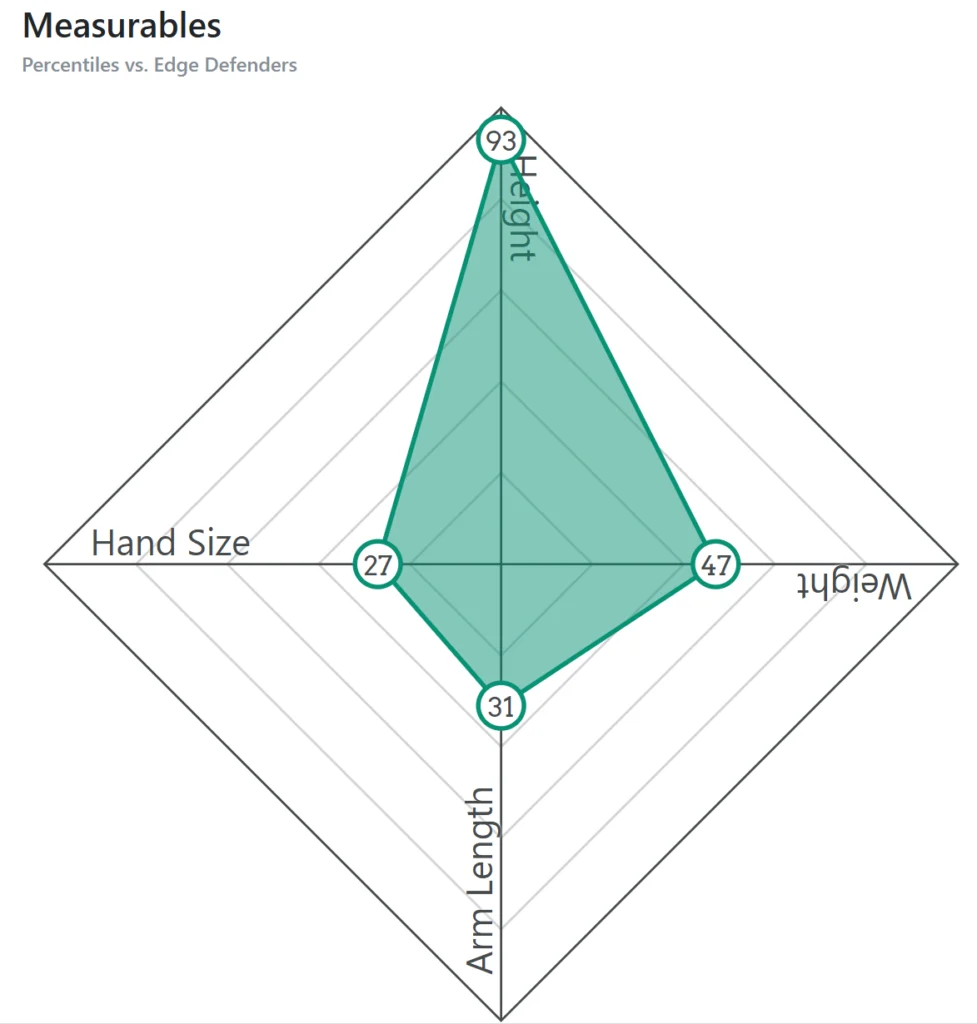
Zion Young was a three-star prospect out of Westlake High School in Atlanta, GA according to 247 Sports. He committed to Michigan State and spent two seasons with the Spartans producing modest numbers – 47 tackles and 2.5 sacks over 20 games.
Then came the transfer to Missouri, and something clicked.
In two seasons with the Tigers, Young posted 84 tackles, 22 tackles for loss, and 9 sacks, with 16.5 of those TFL’s and 6.5 of those sacks coming in 2025 against SEC competition. The 2025 production profile tells the rest of the story: 95th percentile TFL rate, 93rd percentile pressure rate, 92nd percentile stop rate, 88th percentile pass rush win rate. Those are elite numbers by any standard. The conversion rate at the 50th percentile is where the evaluative tension lives.
That’s Zion Young’s draft profile in short. The numbers say elite disruptor. The film says something quite different and belies a frustrating floor.
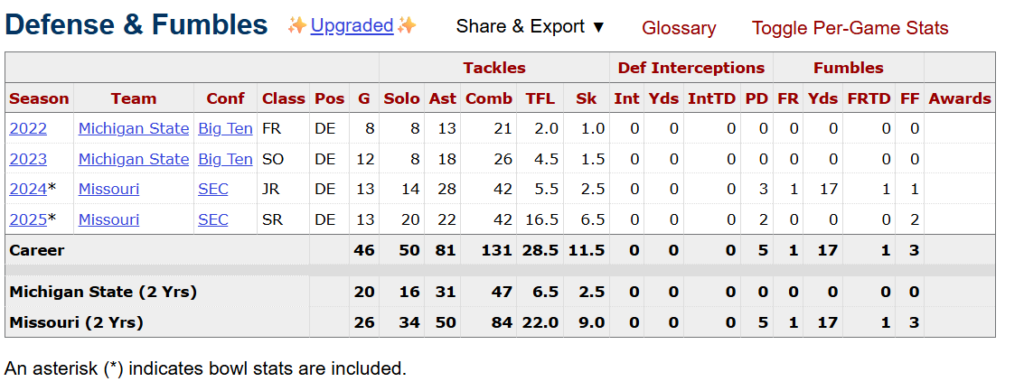
- Off-Ball Rate – 24th percentile
- Coverage Rate – 17th percentile
- Tackle Rate – 45th percentile
- TFL Rate – 95th percentile
- Stop Rate – 92nd percentile
- Pass Rush Win Rate – 88th percentile
- Pressure Rate – 93rd percentile
- True Pass Rush Pressure Rate – 80th percentile
- Sack Conversion Rate – 50th percentile
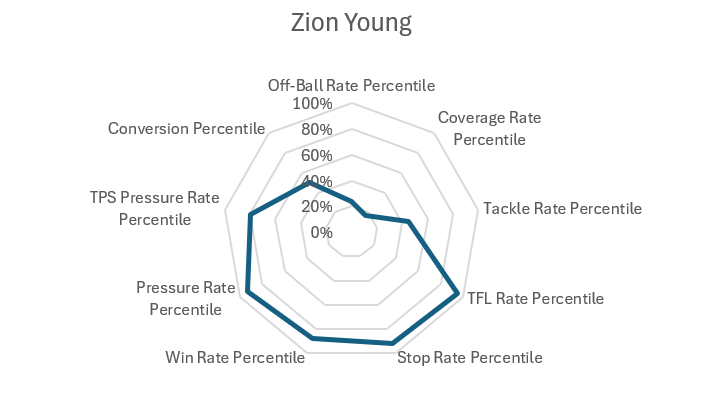
Measurables
Per Mockdraftable:
Young did not participate in many combine drills, so his Mockdraftable profile is thin.
- Height – 6’6 (93rd percentile)
- Weight – 262 lbs (47th percentile)
- Arm length – 33” (31st percentile)
- Hand size – 9.5” (27th percentile)
He did participate in athletic drills during his Pro Day and followed up his physical measurements with the following testing measurables.
- Broad Jump – 117” (54th percentile)
- Vertical Jump – 31” (22nd percentile)
- 40-yard dash – 4.75 seconds (60th percentile)
- 10-yard split – 1.72 seconds (13th percentile)
Zion Young is a DE prospect in the 2026 draft class. He scored a 7.68 RAS out of a possible 10.00. This ranked 524 out of 2257 DE from 1987 to 2026.https://t.co/MFskIdshyG pic.twitter.com/PHSy7Fy2at
— RAS.football (@MathBomb) April 19, 2026
Scouting Report
Games watched: 2025 Arkansas, 2025 South Carolina, 2025 Texas A&M
Athleticism
Watching Zion Young on tape and your first impression is usually a good one. He’s 6-foot-6, 262 pounds, and he moves like he’s 240 pounds. The looping ability, the smoothness across the line, the balance through contact. At his size, those traits are genuinely rare.
The 93rd percentile height creates natural leverage that you can see on film even when he’s not executing his technique correctly, which happens more than it should.
The issue is the inconsistency of accessing what he has. Young’s get-off is an excellent example. There are a few snaps where he fires immediately off the ball and he’s past the tackle’s initial kick before the block is set. But the vast majority of snaps he’s late, flat-footed and reactive. It’s the same player in the same game, and the gap between those two versions is wide enough to be a real NFL concern.
The 1.72-second 10-yard split (13th percentile) tells you what the film suggests. Namely, that Young doesn’t accelerate cleanly out of his stance, and when the get-off is late, the arc speed (4.75, 60th percentile) isn’t fast enough to compensate.
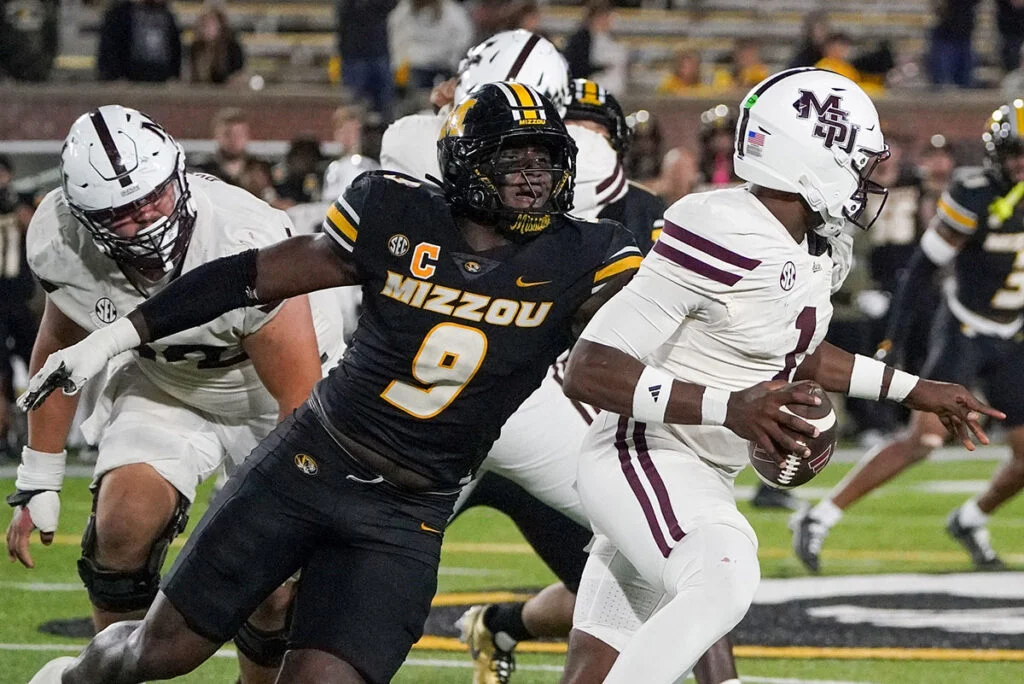
Missouri Edge Rusher Zion Young – Photo by IMAGN Images – Denny Medley
When he does leverage his length correctly, it creates problems for offensive linemen that money can’t solve. A 6’6″ pass rusher who can dip under the corner and lock out those 33-inch arms is a mismatch waiting to happen. The problem is doing it with any regularity.
Pass Rush
Zion Young’s toolbox is decent. But I still came away uninspired by what he actually does. On tape you’ll see flashes. A hump move he uses to throw tackles off his frame here. A solid spin-move there. An occasional strong one-handed swipe/chop. There’s an average inside lateral step mid-rush. But honestly, his best reps are when he jumps gaps at the snap to gain leverage on interior linemen.
Missouri edge rusher Zion Young – Photo by: IMAGN Images- Kirby Lee
But these all feel isolated and never strung together as part of a plan. The delivery on that bag is where the problems pile up. His speed-to-power conversion is inconsistent. On some reps, Young arrives with real violence at the point of attack. But most other reps the contact is soft and the bull rush fizzles before it generates any push.
He rarely initiates contact, which means he’s typically reacting to what the blocker gives him rather than imposing his own plan. He’s late to turn the corner. He doesn’t get to his bend early enough around the arc, and once tackles feel that hesitation, they’re already in position to redirect him. He slows his feet too often, which neutralizes whatever he’s built in his approach.
I used to say of Michael Bennett that he weighs 260, moves like he’s 240, and hits like he’s 280.
Zion Young could become that kind of player. pic.twitter.com/Oz0jegOOdj
— Doug Farrar ✍ (@NFL_DougFarrar) March 30, 2026
The closing speed is more average than good on tape. When Young’s rush path is clean, he closes decently fast. The problem is that he struggles to clear blockers, and when they latch on at the end of a rush, he doesn’t have the counter to shed and convert. That’s where the 50th percentile conversion rate lives: good at disrupting, below average at finishing.
The most interesting wrinkle is the interior capability. He has enough strength to kick inside on NASCAR packages and win, and he flashes the ability to lock out his long arms and drive guards and centers backward. That’s a real NFL role waiting to be developed.
Run Defense
This is where Young’s length and instincts show up most cleanly. He uses a strong double-hand swipe to keep hands off his frame, and his tall stature lets him see into the backfield and flow to plays that smaller defensive linemen can’t diagnose from their sight lines. He’s quick to read run concepts and plays ahead of the action. By the time blockers engage, he’s already processing where the ball is going.
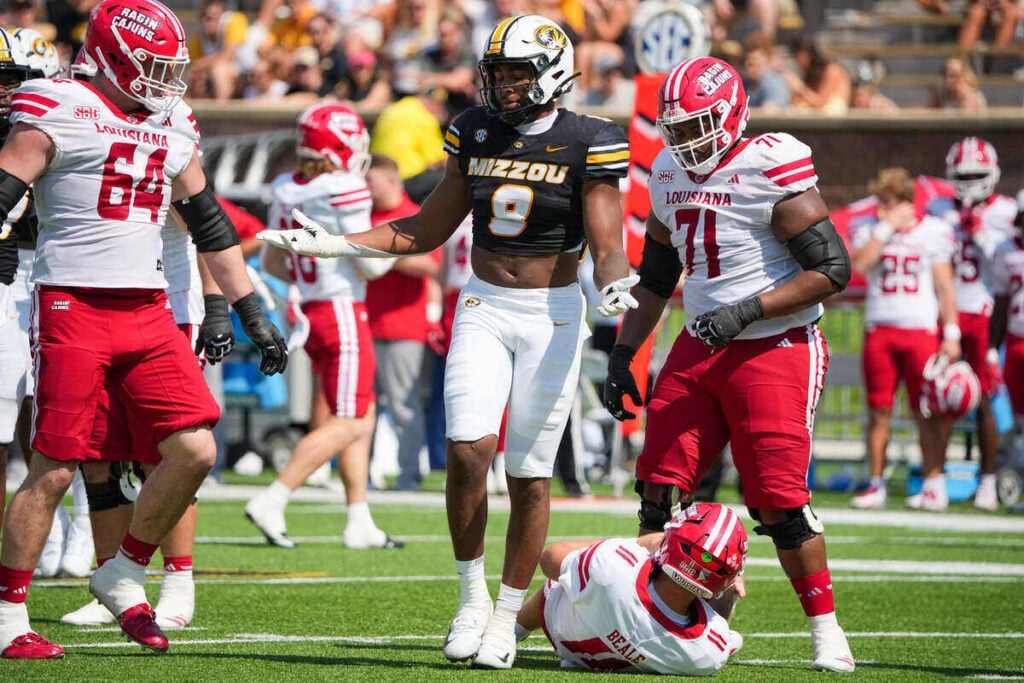
Missouri edge rusher Zion Young – Photo by: IMAGN Images – Denny Medley
The anchor is solid against pullers. He’s strong enough to stone them when his hand placement is right, which isn’t always, but the base is there. He wraps up securely with those long arms when he arrives at the ball carrier.
The negatives are structural. He can overrun the play when attacking loops. His momentum carries him past the intended gap if the play hits earlier than he expected. He also comes in too wide at times, leaving room in his gap that disciplined offenses will exploit. These are correctable technique issues more than athletic limitations, which is the more encouraging version of that concern.
IQ & Processing
Zion Young is smarter on the field than his sack total suggests. He reads run concepts quickly and prepares for them. He plays ahead of the action in the run game more consistently than most players his age with his background. His effort is never the issue, and his awareness of what’s happening around him is genuine.
The processing limitation surfaces specifically in the pass rush, on a narrow but costly window: small pocket movements. He misses clean finishing opportunities when quarterbacks manipulate the pocket with a simple hitch or subtle step. He reads the initial position and commits, and by the time the QB moves, he’s out of position to recover. These aren’t conceptual mistakes. They are micro-processing failures at the moment of truth that directly prevent sacks he’s already earned by winning the rush.
Best role And How He Fits The Bucs
Zion Young’s NFL profile is a sub-package pass rusher who does his best work as a stunter and a gap jumper, with a credible path to an every-down role if the technique development catches up to the athletic ceiling.
In the Bucs’ scheme, which deploys movement fronts, stunts aggressively and has the veteran interior presence to set those games up, Young could be the kind of beneficiary who looks better than his individual grades suggest.
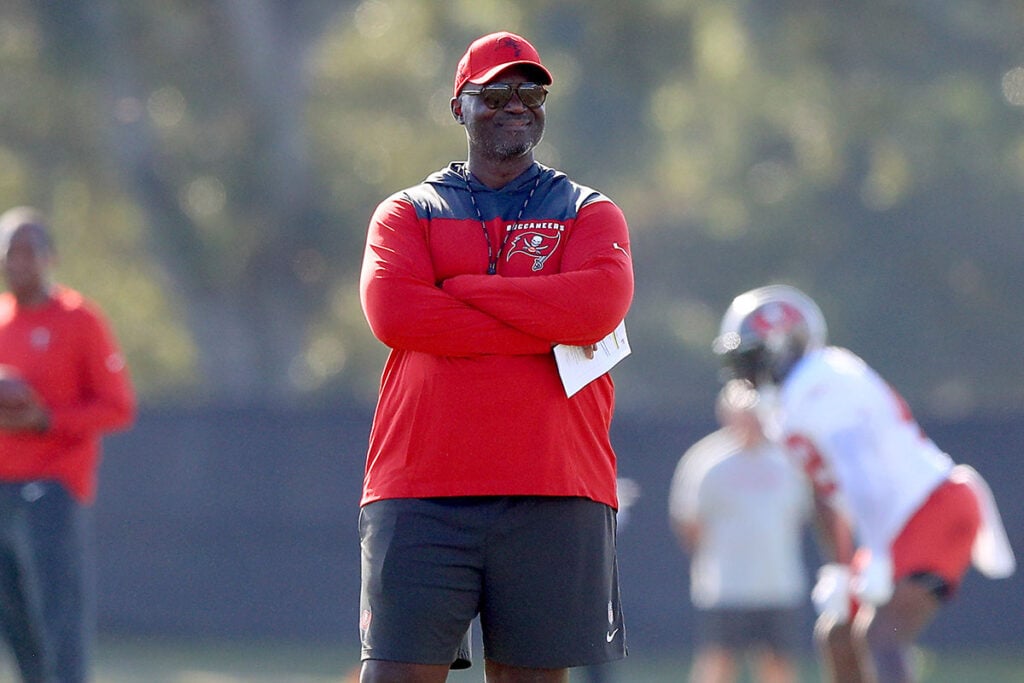
Bucs HC Todd Bowles – Photo by: Cliff Welch/PR
The 95th percentile TFL rate and 88th percentile win rate from 2025 do feel like a mirage.
Is the disruption real?
I genuinely question it.
The natural follow-up question is whether the finishing and consistency issues that follow him from film study are technique problems, which coaching can address, or athletic limitations that won’t change. At 6-foot-6 with a decent but disjointed bag and elite production metrics against SEC competition, the ceiling justifies a Day 3 investment with the expectation that you’re developing the player, not acquiring the finished product. The trouble is that Young is considered a Day 2 prospect. And that’s a rich investment for a project player.
He’s Edge7 on my board in tier four. He may become a multiple year starter, but most likely get to that point in his first two years in the NFL.