Arad, Israel — Iran and its ally the Lebanese Hezbollah group intensified their attacks on Israel on Sunday, launching strikes across the country after the United States and Iran threatened to expand their goals in the war in the Middle East, now in its fourth week.
With Israel under renewed fire, senior Israeli leaders traveled to the southern town of Arad, one of two towns near a secret nuclear research site that was struck by Iranian missiles late Saturday, wounding dozens.
Prime Minister Benjamin Netanyahu toured the devastation in Arad and said it was a “miracle” that no one was killed there. He claimed that Israel and the United States were on their way to achieving their war goals and appealed to the international community to provide more support.
A man looks at residential buildings damaged by an Iranian missile attack in Arad, southern Israel, Sunday, March 22, 2026.
AFP Photos/Ohad Zweigenberg
Earlier, US President Donald Trump warned that the United States would destroy Iranian power plants if Tehran failed to fully open the Strait of Hormuz, and set a 48-hour deadline on Saturday. The Iranian parliament speaker said that if the United States carries out its threat, Tehran would retaliate against American and Israeli energy and broader infrastructure in the region.
The developments suggested that the war on Iran, launched by the United States and Israel on February 28, was moving in a dangerous new direction, despite Trump indicating last week that he was considering “scaling back” operations. It claimed the lives of hundreds of people, shook the global economy, and led to higher oil prices.
Hezbollah claimed responsibility for an airstrike on Sunday that killed a man in northern Israel, while Gulf Arab states — including Saudi Arabia and the United Arab Emirates — said they intercepted a new barrage of new Iranian strikes.
Iran responds to Trump’s threat to close the Strait of Hormuz
Iran has virtually closed the Strait of Hormuz, the passage that connects the Persian Gulf to the rest of the world and through which nearly a fifth of global supplies pass. Attacks on ships and threats of more strikes have blocked nearly all tankers from sailing the strait, forcing some of the largest oil producers to make cuts because their crude has nowhere to go.
The blockade represents a liability for both the United States and its allies in Europe and Asia, who rely heavily on Persian Gulf supplies to meet demand for energy, power plants, vehicles, and homes. The United States has lifted some sanctions imposed on Iranian oil at sea to ease pressure on energy prices.
Trump said that if Iran did not open the Strait, the United States would destroy “its various power plants, starting with the largest first!”
Iranian Parliament Speaker Mohammad Bagher Qalibaf responded on Sunday that if Iran’s power plants and infrastructure were targeted, critical infrastructure across the region — including energy and desalination facilities — would be considered legitimate targets and “irreversibly destroyed.”
Separately, Iranian officials said they would continue to provide safe passage through the strait for ships coming from countries other than their enemies.
Nuclear concerns as war rages
Iran said its strikes in the Negev Desert were in response to a previous attack on Iran’s main nuclear enrichment site in Natanz, according to official media.
Tehran praised the attack and described it as a show of force, even as the Israeli army confirmed that the pace of Iranian missile launches had gradually decreased since the start of the war.
“If the Israeli regime is unable to intercept the missiles in the highly protected Dimona area, this is practically an indication of entering a new phase of the battle,” said Qalibaf, the Iranian parliament speaker.
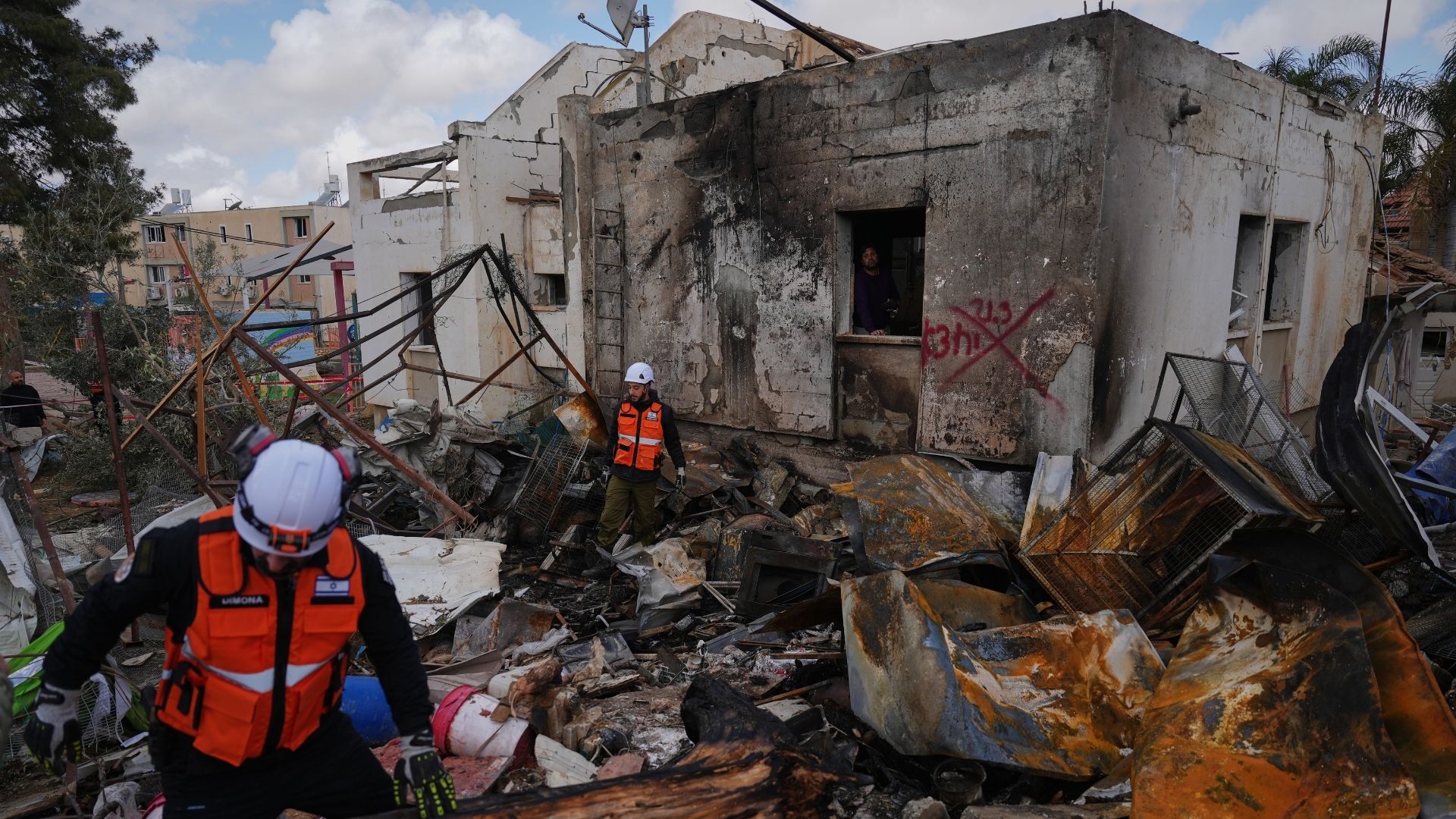
Israeli security forces inspect the site that was hit by an Iranian missile in Dimona, southern Israel, Sunday, March 22, 2026.
AFP Photos/Ariel Shalit
Dimona is located about 20 kilometers (12 miles) west of the nuclear research center, and Arad is about 35 kilometers (22 miles) to the north.
Soroka Medical Center, the main hospital in southern Israel, received at least 175 wounded from Arad and Dimona, deputy hospital director Roy Kissus told The Associated Press.
Israel is widely believed to possess nuclear weapons, although it neither confirms nor denies their existence. The United Nations International Atomic Energy Agency said on the 10th that it had not received reports of damage to the Israeli center or abnormal radiation levels.
Israel denied responsibility for the Natanz strike on Saturday, while the official news agency affiliated with the Iranian judiciary, Mizan, said there had been no leak. The Pentagon declined to comment on the strike on Natanz, which was also bombed in the first week of the ongoing war and in the 12-day war last June.
The United Nations International Atomic Energy Agency said that the bulk of the enriched uranium, whose capacity is estimated at about 972 pounds (441 kilograms), is located elsewhere under the rubble of its facility in Isfahan.
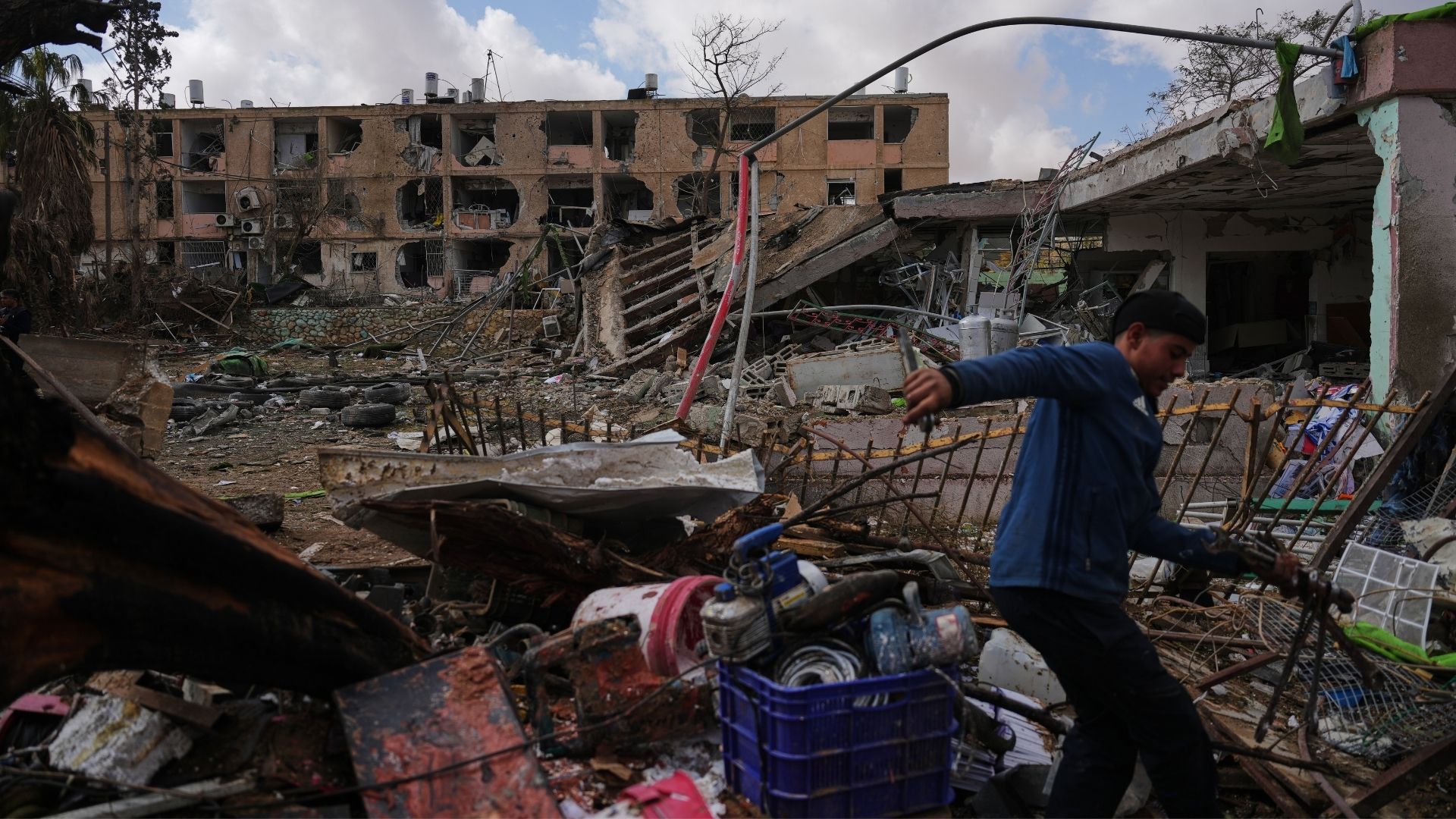
People inspect a site hit by an Iranian missile in Dimona, southern Israel, Sunday, March 22, 2026.
AFP Photos/Ariel Shalit
Iran says strikes also hit the hospital
Iran said that in addition to Natanz, the strikes also hit a hospital in Andimeshk. The Ministry of Health stated that patients and doctors were evacuated to another city.
The death toll in the war in Iran exceeded 1,500 on Saturday, state media reported, citing the ministry. In Israel, 15 people were killed in Iranian raids. More than a dozen civilians were killed in the occupied West Bank and Arab Gulf states in air strikes.
The war has also seen non-combat incidents, including the crash of a US refueling plane in Iraq that killed six US service members and the crash of a Qatari military helicopter on Saturday that was blamed on a technical failure. Qatari authorities said on Sunday that all seven people on board the plane had died.
Hezbollah attack on northern Israel results in the first death there
The Israeli civilian was killed in the northern town of Misgav Am in what the Israeli military said “appeared to be” a rocket attack. Israeli paramedics said they found the man in his car and posted a video showing two cars on fire.
Hezbollah, an ally of Iran, launched attacks on Israel shortly after the war began, saying it was in retaliation for the killing of Iran’s Supreme Leader Ayatollah Ali Khamenei. Israel responded by bombing Lebanon, targeting Hezbollah with deadly air strikes, expanding its presence in southern Lebanon and mobilizing more forces near the border.
The intensity of fighting has escalated in the towns of southern Lebanon recently as Israel continues its ground operations. Israel on Sunday expanded its target list to include all the bridges over the Litani River, which Defense Minister Israel Katz said Hezbollah is using to transport fighters and weapons into southern Lebanon. It later bombed Al-Qasimiya Bridge near Tyre.
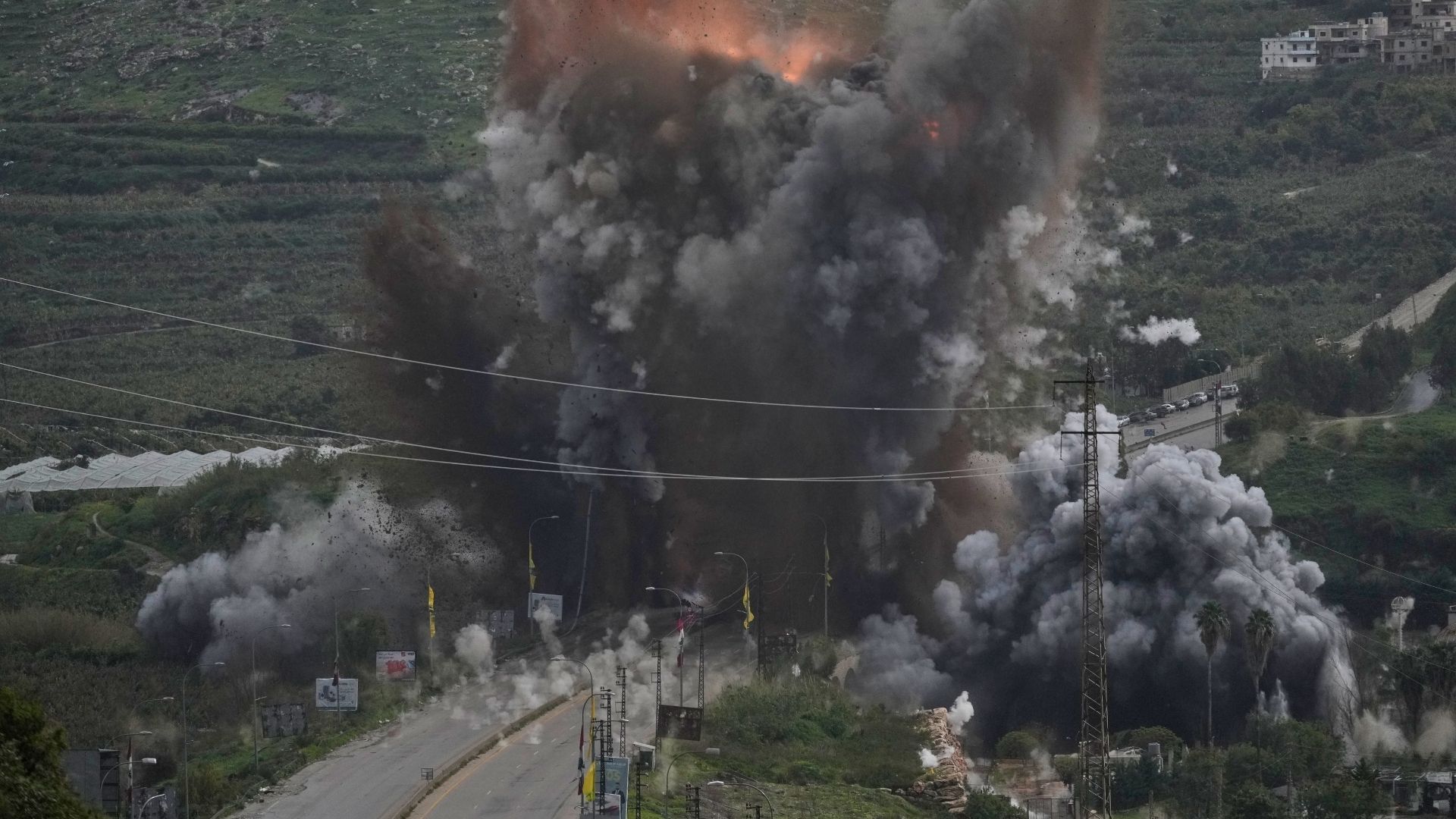
Smoke and flames rise from an Israeli air strike that struck the Qasimiya Bridge near the coastal city of Tyre, Lebanon, Sunday, March 22, 2026.
AFP Photos/Mohammed Zaatari
Katz also ordered the army to accelerate the destruction of Lebanese homes near Israel’s northern border as part of a strategy he described as being in line with the Israeli campaign against Hamas in Gaza.
After Hezbollah fired rockets into Israel on March 2, the Israeli army launched an attack that Lebanese authorities said killed more than 1,000 people and displaced more than a million. Hezbollah fired hundreds of rockets at Israel.
Israeli military spokesman Avichai Adraee issued a warning an hour before the bombing of the Qasimiya Bridge near the coastal city of Tyre.
The Lebanese authorities say that the Israeli raids resulted in the deaths of more than a thousand people and the displacement of more than a million.
___
Metz reported from Ramallah, West Bank, and Magdy reported from Cairo. Associated Press writers Melanie Liedman in Tel Aviv, Israel, Coral Said in Abu Sinan, Israel, and Isabelle Debre in Beirut contributed.
Copyright © 2026 The Associated Press. All rights reserved.