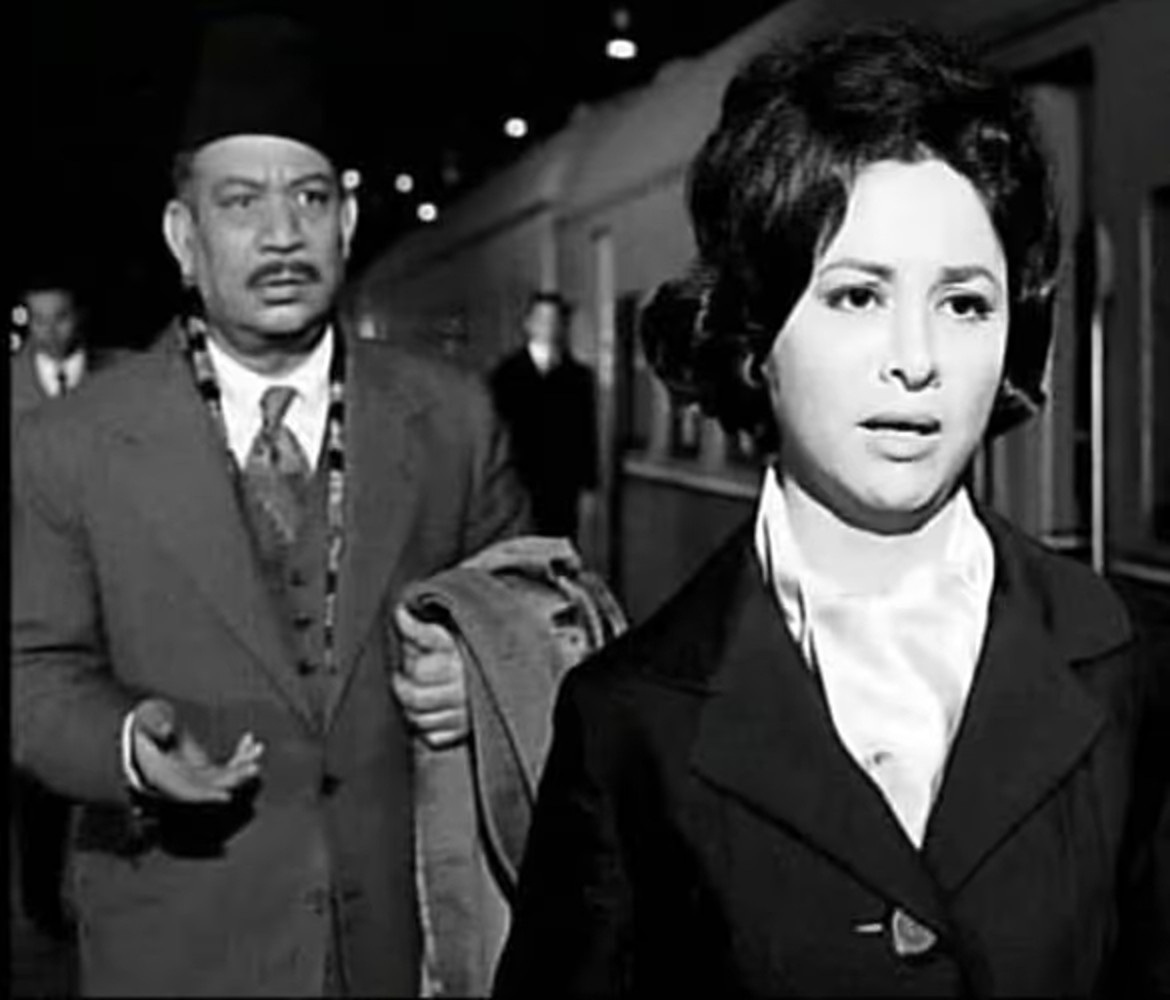
In the first five minutes of the feminist film The open door (The open door(1963), Laila, played by Faten Hamama, moves through three different states simultaneously, each symbolizing her entire story in just a few scenes.
The first scene shows her joining a school protest to fight imperialism and the oppression of women. The second photo shows her being violently beaten by her father in her home. Finally, the third scene places her inside the walls of her bedroom, unwilling to open the door to anyone.
From one scene to another, Laila becomes a different person, as if the woman in the first scene was no longer the same woman in the second. She was first presented as strong and resistant on the streets, and within seconds, she was transformed into a complete weakness within her home. By the third scene, she finds herself locked inside her bedroom, as if the “free woman” who was present at the beginning of the film either did not exist at all or died the moment she returned home.
Without relying on a long or complex story, the film’s opening moments reveal how radically a woman’s life can change, and how easily her identity can be changed, controlled, and reshaped according to the demands of each space she inhabits. Her identity itself becomes a character within the story, trapped within a conspiracy she cannot control.
“Open the door, Laila,” her brother Mahmoud, played by Kamal El-Shenawy, tells her. When Laila rises to answer him, the symbolism of the moment alone reveals the main theme of the entire film.
Just opening the door becomes a challenge; He refused to remain isolated from the world and refused to continue to be afraid of it. When she opens the door, Laila also opens the door to express herself.
It opened the door to expression, opened the door to the world outside her bedroom, and, most importantly, opened the door to a self beyond the version that society and her parents had tried to lock her inside.
When Mahmoud enters the room, Laila finally begins to speak freely, declaring forcefully: “I did not commit a crime. I simply went to protest, to express my feelings. I expressed myself as a human being, forgetting that I am a girl and not a human being.”
message
Just as the first five minutes define Laila’s character, the last ten minutes of the film become the moment in which she is finally freed from the plot imposed on her. It’s a full circle moment that finally gives meaning to what “The Open Door” truly represents; What it is, what it requires and how it slowly unfolds.
It begins precisely at the moment when it is announced that Egypt has been attacked during the tripartite aggression of 1956. The announcer calls on people to defend the homeland against invasion, and as the announcement echoes through the streets, Laila walks alone, contemplating a letter written to her by Hussein, played by Saleh Selim, the film’s progressive character, urging her to “open the door” to life, possibility, and herself.
As the nation struggles to free itself, Laila struggles to free herself as well. As the nation struggles to breathe, Laila takes her first real breath. As the nation tries to write its own destiny, Laila also begins to write her own destiny, transforming from a character trapped inside a story into the author of her own story.
Hussein writes in his letter, one of the most famous written monologues in the history of Egyptian cinema: “Do not confine yourself in a narrow circle, for it will continue to close around you until it suffocates you, or turns you into a lifeless being, devoid of thought and feeling. Connect your soul to others, to millions of others, to our land and our people. There, you will discover a love greater than you and me, a love that is vast and beautiful. The love that lives within the heart, through it.” What makes a person stronger and more perfect: love for the country, and love for its people, so go, my dear, and open the door wide, and leave it open.
The letter opens a door for Laila through her words, and in turn, it opens the door to the next chapter of her life. In this scene, she no longer just opens her bedroom door; It opens a door inside her mind, freeing it from traditions and values that no longer align with her sense of self.
While many feminist works often focus on women’s liberation as something granted by external forces, whether the state or other people, The Open Door frames liberation as equally internal work, work rooted in women’s own will.
It begins inside her mind and culminates in her learning to understand love not only emotionally, but intellectually as well.
Opening the door inside her mind allows her to open the door to intellectual freedom, and to realize that love is not just an emotion, but an act of understanding the essence of oneself.
She realized that her identity was not limited to the walls of her bedroom or her home, but that her true self, as a woman, was connected to something far greater: the wider world, her homeland, and the universe itself.
Any views expressed in this article are exclusively those of the author. To submit an opinion piece, please email [email protected].