The Bucs may be in the market for a guard next year. Ben Bredeson will be entering the final year of his contract in 2027, and Cody Mauch is a pending free agent. So being aware of guard prospects who are eligible for next year’s draft is smart. Enter Greg Johnson.
Johnson is entering his fourth season at Minnesota and has almost 2,000 college snaps under his belt. The NFL Mock Draft Database has him as the fourth highest ranked interior offensive lineman in the 2027 draft and 75th overall. I wanted to see what has him in many analysts’ top five, so I dove into the tape.
Greg Johnson
All of these are pulled from his team profile:
Height – 6-foot-6
Weight – 325 pounds
Awards – 2025 All-Big Ten Honorable Mention
High School – Two-way player. Four-star recruit (247 Sports) #20 offensive lineman recruit and #2 prospect in Minnesota.
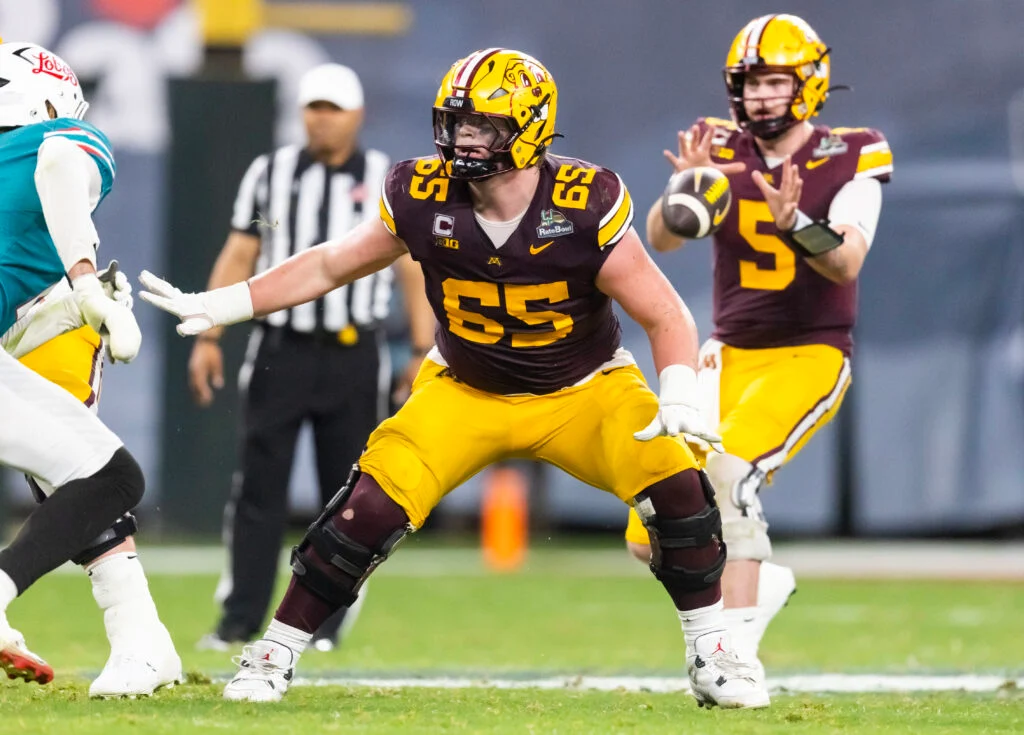
Minnesota OL Greg Johnson — Photo by: IMAGN Images — Mark J. Rebilas
Greg Johnson’s Stats
There aren’t any traditional statistical measurements for offensive linemen, so I will default to Pro Football Focus who at least have some objective production.
2023
Games – 11 (all at left guard)
Starts – 2
Snaps – 397
Pressure Rate Allowed – 6.00%
PFF Run Block Grade – 53.3
PFF Pass Block Grade – 37.6
2024
Games – 13 (all at center)
Starts – 13
Snaps – 818
Pressure Rate Allowed – 3.94%
PFF Run Block Grade – 60.7
PFF Pass Block Grade – 69.3
2025
Games – 13 (11 at left guard, one at right tackle, one at left tackle)
Starts – 13
Snaps – 757
Pressure Rate Allowed – 2.41%
PFF Run Block Grade – 73.4
PFF Pass Block Grade – 80.1
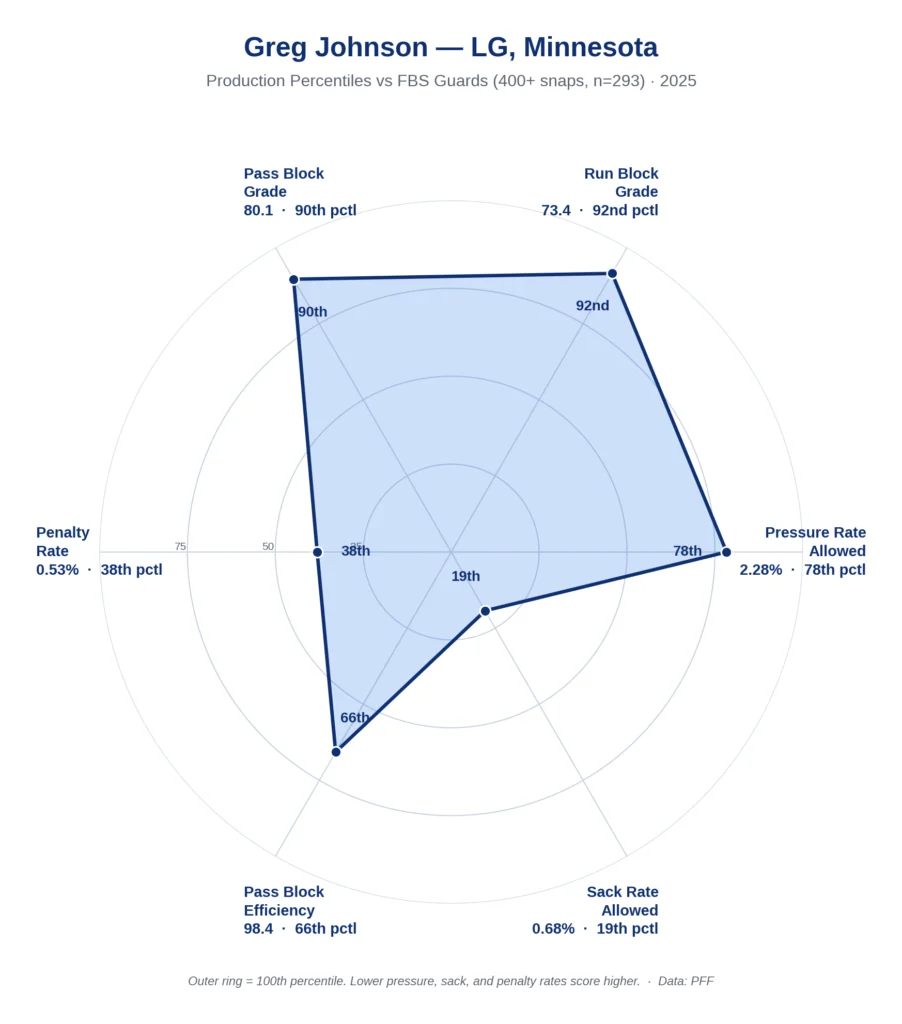
Here is his production spider chart showing his percentile ranks:
Overview
I watched three of Greg Johnson’s 2025 games: Week 5 vs. Rutgers, Week 9 @ Iowa and Week 12 @ Oregon.
Johnson is a smart, leverage-dependent interior blocker whose best trait is his processing. But he gets in trouble due to his inconsistent hands. He wins before contact by diagnosing blitzes pre-snap, passing off games, and staying connected to his opponent while his eyes continue to evaluate a changing landscape, while peeling to help with real timing.
When he wins the snap and gets underneath, his frame and drive power show up, and when he is the aggressor downhill, he finishes.
The trouble lives on the back end of the rep. When a defender beats him to the frame, he struggles to counter. And when a rusher gives him a second move – especially a lateral move – he can bend at the waist or overextend. He’s extremely reliant on winning before contact but the open question is whether he can come up with a plan B when plan A goes to hell.
Strengths
- Processing. This is his best trait by far. He reads line movement and blitzes pre-snap, builds walls, and manipulates spacing to solve games. Protection IQ is real as he sniffs out most games and blitzes post-snap. It explains why his pass block grade is as high as it is.
One hand on the nose to feel what’s happening outside his field of vision and then as the stunt/twist develops he’s ready for the switch. pic.twitter.com/faHctF1r4R
— Josh Queipo (@JoshQueipo_NFL) July 19, 2026
- Help discipline. He stays connected, scans, and peels to save reps he did not start. It’s not a flashy, highlight-reel quality, but it’s one that helps elevate an offensive line unit.
- Run-game finish. It’s not a consistent trait, but when it shows, it shows well. He dictates contact with his feet under him and buries resisting interior defenders. He will throw men to the ground, and will sustain one block while climbing to rope a second on the same rep.
Greg Johnson (OG – Minnesota) with the strong finish. pic.twitter.com/Af4uwSSKzi
— Josh Queipo (@JoshQueipo_NFL) July 19, 2026
- Functional frame. He’s listed at 325, but I will bet he’s closer to 315 and carries it well. His frame plays at the NFL level.
- Anchor and recovery. He can hold a clean solo anchor against isolated bull rushes, and re-anchors with a wide base when knocked back rather than folding. He absorbs straight-ahead power. But that is against college competition. But I have real concerns on whether that will translate fully to the NFL.
- On-the-move athleticism. His hips rotate and transition well while underway, pulls and reaches on the move, and shows screen value getting downfield to target and wall a defensive back.
- Competitive toughness. Works through reps when beaten and does not quit. His recovery jumped out early and often during my watch.
Weaknesses
- Beaten to the frame. When a defender wins the initial hand exchange, he can get stood up in pass pro or shed in the run game, and that is where his damage comes from. His counter-defense is inconsistent. He defeats and re-fits against some second moves and loses the ones where he is beaten to the punch first.
- Wide, non-compact hand strike. His hands too often travel outside-in and land wide instead of firing inside, which costs vertical ground and gets him shed. During the Iowa game he used what I can only describe as a “Clap technique” on multiple reps where his hands start much wider than the defenders frame and he brings them together like a clap hitting the outside of the defender’s shoulders. In a world where almost every OL coach is preaching inside hands, Johnson’s wind up outside way too often.
Minnesota LG Greg Johnson has some intriguing traits, but he’s going to have to improve his hand placement consistency. pic.twitter.com/ZOh52KgE5Z
— Josh Queipo (@JoshQueipo_NFL) July 19, 2026
- Length plays short. A continual limitation on tape across pass pro, second level climbs, as well as in the run game, including reps where his hands were on time and accurate and he was still stacked and driven back. Even when his timing and placement are right, he still loses ground.
- Reactive body control. An unexpected counter or redirect can produce a waist-bend or an overextension, salvaged by recovery, help, or a quick throw. The defender’s second move is the hardest thing for him to answer clean.
- Surviving against stronger competition. The best competition he faced over my three-game watch was Second Team All-Big Ten defensive lineman Bear Alexander. Alexander had several impressive wins against Johnson through superior strength, power and speed. He got into Johnson’s frame and drove him back and beat him with arm over’s and second reaction lateral moves.
Opportunities to Improve
- Improve hand strike placement and strike power. The single most coachable flaw on his tape. Firing his hands inside on a tighter path, rather than the wide outside-in strike, is standard fit-and-finish and punch-drill work, and it would directly shrink the beaten-to-the-frame losses. There is also opportunity in how he hits to give him heavier hands that pack more of a punch.
- Win the initial hand exchange. Tied to the strike above. Landing first and inside is a timing habit that NFL coaching drills hard, and it is the difference between controlling the rep and getting locked out.
- Re-anchor instead of waist-bending. When surprised, his fix is to sink his hips and move his feet rather than bend over the counter. This shows up on his second-reaction recoveries against power. He just needs to apply it on lateral recoveries.
- In-rep read of developing games. His pre-snap diagnosis is already good. Processing stunts and second-threat relocation is already strong, but there are some losses that occur. It’s reasonable to believe he can make a strength stronger.
Limitations That Will Remain
- Arm length. When a defender reaches his frame first, he cannot lengthen his way back into the rep, and no amount of coaching adds arm. It is the true ceiling-setter.
- Hip height and natural leverage. At 6’6″, he will always fight to get under shorter, lower interior players in short yardage and pure pad-level races. Better knee bend helps at the margins, but you cannot lower where his hips sit.
- Recovery burst in space. When beaten to a spot or up the arc, the burst to run it down is not there, and top-end play speed is not a trait that meaningfully grows. His functional recovery speed is near its ceiling.
Greg Johnson’s Scheme Fit
Greg Johnson would fit best in a zone and movement scheme. He wins with quickness, angles, leverage, and IQ, and those travel best in a system that lets him work on the move and in concert rather than isolating him to generate movement from a dead stop, with real value in the screen game.
A gap or power fit is riskier, because his displacement is conditional on winning the snap, and his instinct against superior power is to finesse the angle rather than anchor it head-up.
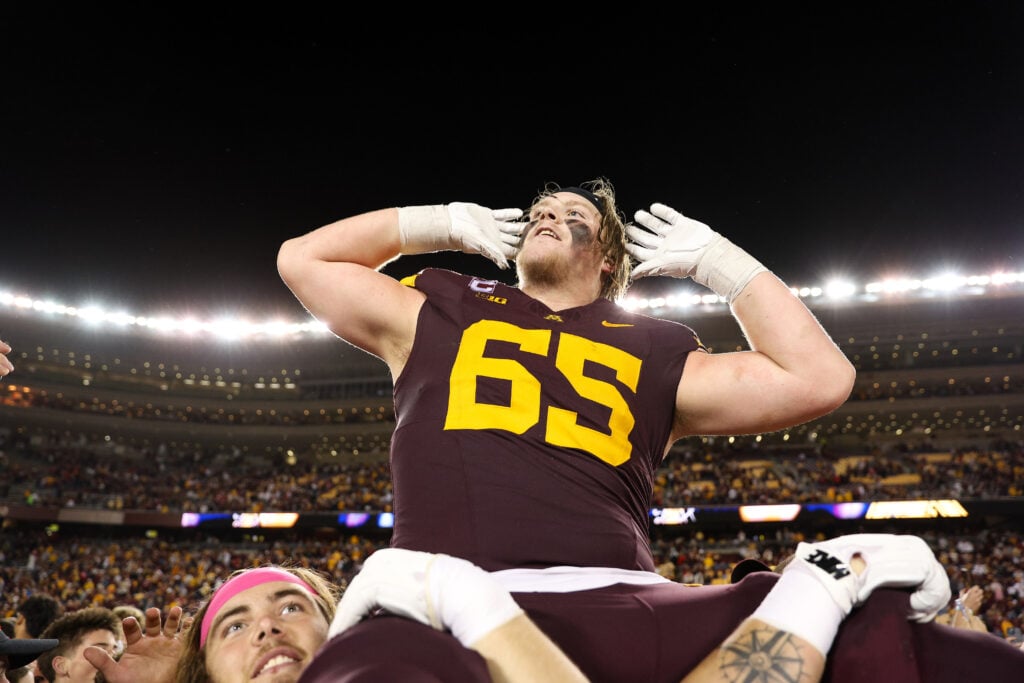
Minnesota OL Greg Johnson — Photo by: IMAGN Images – Matt Krohn
Greg Johnson’s Projection
Greg Johnson’s projection is as a developmental interior starter with a scheme-dependent profile. The IQ and the frame set a real floor. The ceiling is gated by his length, which is a live limitation, and by his hands, but the hand flaw is a coachable wide-strike problem, which keeps a starter-level ceiling in play if it tightens. He fits a zone and movement scheme, where his quickness, angles, and processing travel and his displacement can be schemed to situations where he wins the snap. The pieces that would push him up the board are the hands tightening and the length testing acceptably.
Currently I have him as a tier-4 prospect which would place him somewhere in the 65 – 85 range. This puts my eval in line with the current consensus on him. As far as how that plays for the Bucs’ potential guard need in 2027, I don’t think he’s a player who could immediately step into a starting role and reliably contribute. But I would be very interested in him as a mid-round selection to start as a backup while he built up NFL strength and power in year one.
Johnson is the fourth 2027 NFL Draft eligible player I have profiled this summer. He’s third on my early board. For more on the other three:
Brendan Sorsby – QB
Drew Mestamaker – QB
A’Mauri Washington – IDL