The Bucs enter the 2026 season with a changing of the guard at offensive coordinator. In switching out Josh Grizzard for Zac Robinson, the assumption has been that Tampa Bay’s offense will run similarly to how it did in 2024 under Liam Coen. Given that Robinson and Coen spent time together in Los Angeles with head coach and offensive guru Sean McVay and both worked with quarterback Baker Mayfield, there is already a blueprint for success.
How much of Liam Coen’s blueprint Robinson keeps – and where he puts his own stamp on the offense – will shape the Bucs’ identity.
A recent analysis into one key play-calling metric outlines what will be different, and there are other variables to consider, such as exactly what Robinson’s strategy will be.
The Zac Robinson Tendency That Separates Him From Other Play-Callers
Few things are more frustrating than watching predictable play-calling.
More specifically, watching an offense operate with run-run-pass logic on a down-to-down basis, regardless of whether things are working or not. That becomes stale, and over time an offensive coordinator has to answer for the lack of innovation. There were stretches last season when Tampa Bay’s offense became more predictable, particularly when the team leaned heavily into the running game late in the year.
Based on a chart made by NFL analyst Ryan Paganetti, that trend will stop with Zac Robinson.
Bucs OC Zac Robinson – Photo by: Matt Matera/PR
Paganetti points to Fantasy Points Data showing Robinson leads the league in pass rate on second-and-10 situations following first-down incompletions in his two seasons in Atlanta.
The NFL’s most common overcorrection:
Running on 2nd and 10 after a 1st down incompletion.
Since 2022, passes in this spot have crushed runs:
+16.6 percentage points in success rate
+0.23 EPA/play
+6.5 percentage points in eventual series success rateHere are the 2026 play… pic.twitter.com/d1YzTygEjH
— Ryan Paganetti (@RyanPaganetti) July 7, 2026
Robinson posted an 82.9% pass rate on 76 second-and-10 plays over two seasons, meaning he chose to throw more than twice per game rather than automatically turn to the running game after a failed first-down play.
It is worth noting that even with Bijan Robinson and Tyler Allgeier available in the backfield, he consistently chose to put the ball in his quarterback’s hands. Diving deeper into the numbers illustrates that it is more than just a style preference; it is a philosophical principle of a Sean McVay offense. The Rams ranked fourth on the list, while Liam Coen’s Jaguars ranked ninth. Coen’s numbers include his time with the Bucs, backing up that he used this one offensive trend to help shift the outcome of drives.
On the surface, this revelation might not seem to be much.
As Paganetti points out, there is a lot of success following what Robinson does so well. Passing on second-and-10 after incompletions leads to a 16.6% increase in success rate, 0.23 EPA/play, and a 6.5% increase in eventual series success rate.
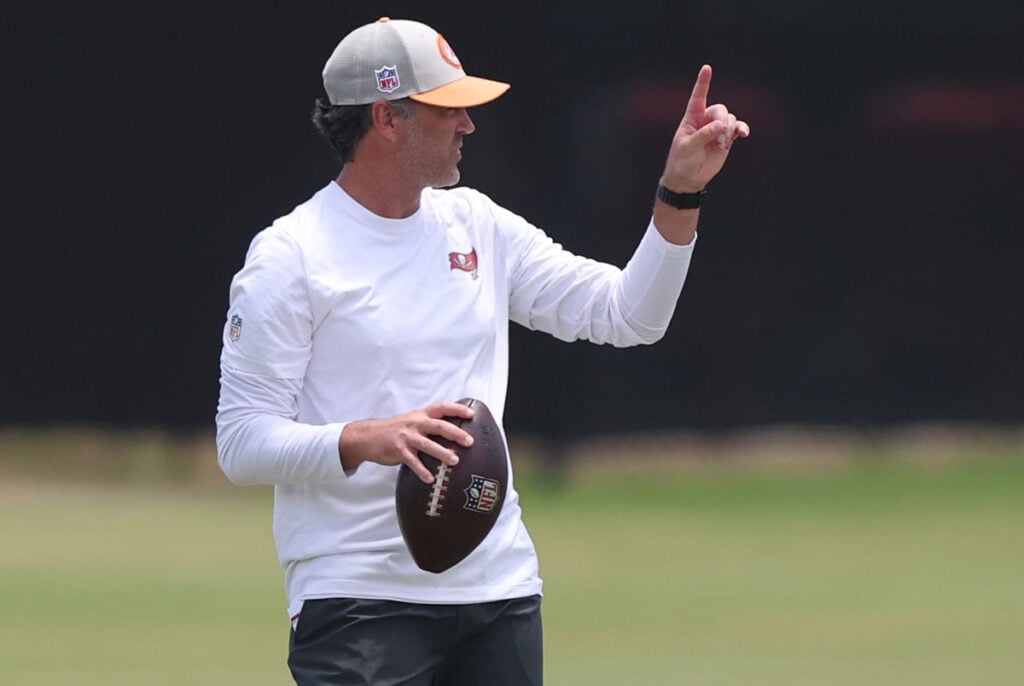
Bucs OC Zac Robinson – Photo by: Cliff Welch/PR
Second-and-10 is often considered a passing down because the offense has failed to gain yardage on first down, but many play-callers still lean toward running the ball to avoid third-and-long situations. A negative first-down play does not automatically mean the offense has to become conservative. Instead of playing for manageable third downs, his willingness to throw in that spot and keep the ball in Baker Mayfield’s hands will give the gunslinger confidence in erasing negative plays and help him establish a rhythm as the game goes on.
With Mayfield needing to have more efficiency throwing the football compared to last season, these instances line up as opportunities to bounce back from a misfire and trust in what calls Robinson is dialing up.
Breaking Down Zac Robinson Offensive Identity And Core Philosophy
After taking in everything above, one might be wondering what else the Bucs offense has in store under Zac Robinson.
To provide a closer look, I used SumerSports data to analyze how Robinson balances the pass and run, personnel groupings, formations, run concepts, and play action and red zone pass rates. This offers a glimpse into what can be expected from Tampa Bay’s offense in 2026.
2024 Falcons Offense – Establishing An Offensive Identity
In his first season calling plays for the Falcons, Zac Robinson built a balanced offense that leaned slightly toward the pass. The Falcons ran 1,086 offensive plays, throwing on 54.4% of them while running the ball on 45.6%.
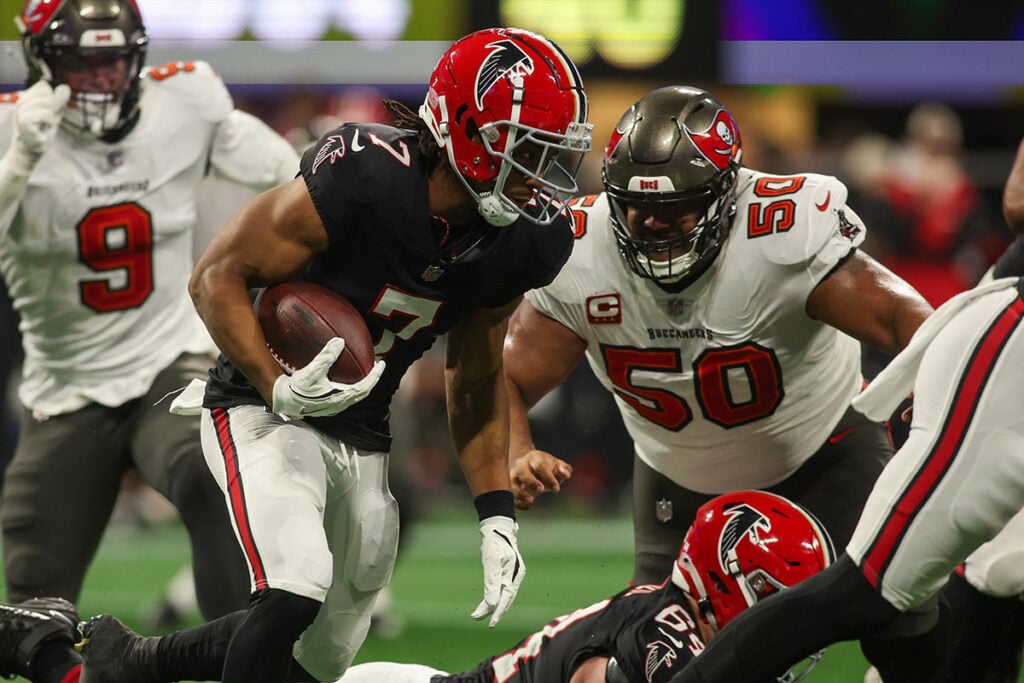
Bucs DT Vita Vea and Falcons RB Bijan Robinson – Photo by: IMAGN Images
Atlanta operated primarily out of spread formations. Robinson called 11 personnel (one running back, one tight end and three wide receivers) 86.2% of offensive snaps, making it the league’s most 11-personnel-heavy offense. He rarely ventured into heavier groupings, using 12 personnel just 10.4% of the time.
The formations reflected that philosophy. Nearly half of Atlanta’s offensive snaps came from balanced 2×2 alignments (47%), with two eligible receivers split to each side of the formation. Robinson also frequently utilized trips formations, lining up three receivers to one side and one to the other. The Falcons used 1×3 formations (22.9%), with the lone receiver on the left and three pass catchers to the right, and 3×1 formations (21%), which simply flipped that alignment.
The running game also established a clear identity from the outset. Wide zone concepts accounted for 59% of Atlanta’s rushing attempts, dwarfing man/gap schemes (16%) and inside zone (10.9%).
One area where Robinson was relatively conservative was play-action, utilizing it on just 14.4% of drop backs. Keep in mind that the Falcons used a good deal of pistol formation because they had two immobile quarterbacks in veteran Kirk Cousins and 2025 first-round pick Michael Penix Jr. Inside the red zone, Atlanta also leaned heavily on the running game, throwing on only 42% of its scoring-area plays.
2025 Falcons Offense – Same Philosophy, New Wrinkles
Although Zac Robinson’s overall offensive balance remained virtually identical in Year 2 – passing on 54.5% of 1,048 offensive plays – his approach became much more varied.
The most dramatic shift came with personnel usage.
After relying almost exclusively on 11 personnel during his first season, Robinson diversified the Falcons offense significantly. Usage of 11 personnel dropped drastically from 86.2% to 45.1%, while 12 personnel nearly quadrupled to 38.2%, which was the second-highest mark in the league. This was necessary in 2025 due to star wide receiver Drake London missing five games due to a knee injury and the Falcons’ lack of quality depth at wide receiver.
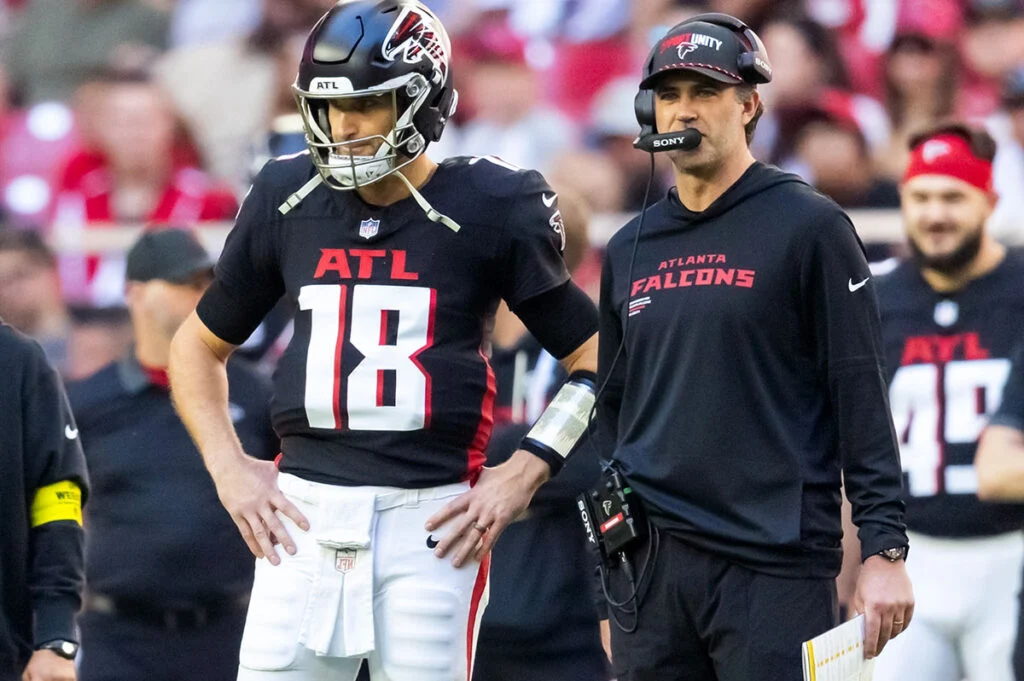
Former Falcons QB Kirk Cousins and OC Zac Robinson – IMAGN Images – Mark J. Rebilas
Atlanta also incorporated 21 personnel (two running backs, one tight end) on 9.2% of its snaps and added 13 personnel packages (one running back, three tight ends) 6.7% of the time, giving defenses a diversified set of looks before the snap.
Despite those changes, Robinson’s overall formation preferences remained largely intact. The Falcons continued to favor balanced 2×2 sets (45.8%), while 1×3 formations increased slightly to 23.2%. The 3×1 alignments dipped modestly from 21% to 17%.
Meanwhile, his rushing philosophy never changed.
Wide zone remained the foundation of Atlanta’s running game, increasing slightly to 60.4% of rushing concepts. Pewter Report’s Josh Queipo recently outlined how much of a staple it is within Robinson’s offense and how the Bucs can replicate it with their personnel. Regardless of personnel grouping, he continued to build his offense around a zone-blocking scheme.
The passing game, however, became more sophisticated.
Robinson increased his play-action usage from 14.4% to 21.7% of drop backs – a 50% increase. That makes sense as he became more comfortable marrying his wide zone running game to complementary passing concepts instead of treating them as separate pieces of the offense. The Falcons also became far less predictable in scoring territory, throwing on 48.6% of their red zone plays after leaning heavily on the run the previous season.
What All This Means For The 2026 Bucs Offense
The biggest takeaway from Zac Robinson’s two years with the Falcons is that his core philosophy does not fluctuate.
Robinson did not abandon his offensive identity between 2024 and 2025. He simply found more ways to present it, consistently maintaining an almost identical run-pass balance while relying on wide zone concepts as the backbone of the running game. Those principles appear to be non-negotiable regardless of personnel, but what did change was how Robinson packaged the offense.
His willingness to dramatically expand his personnel groupings in Year 2 shows he can tailor the scheme to the strengths of his roster rather than forcing players into one system. It is the same “players over plays” mantra Liam Coen often referenced during his time in Tampa Bay. The increased use of heavier personnel, combined with a substantial jump in play-action and a more balanced approach in the red zone, points to a play-caller who grew more comfortable layering wrinkles into his offense.
For the Bucs, those are encouraging signs.
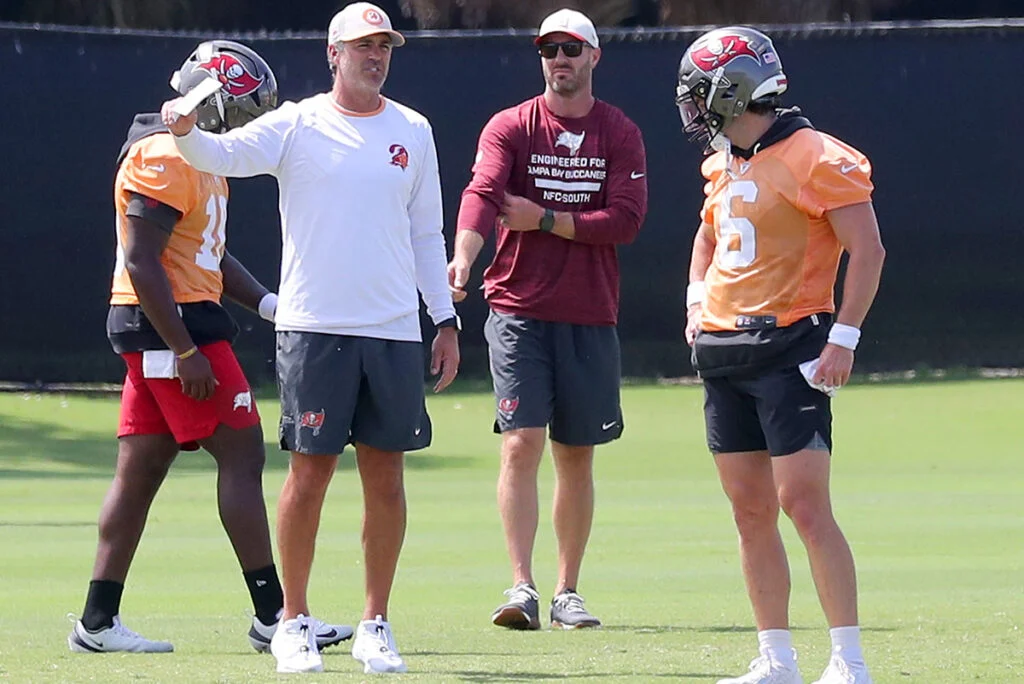
Bucs OC Zac Robinson, pass game coordinator TJ Yates and QB Baker Mayfield – Photo by: Cliff Welch/PR
Robinson’s offense has a defined backbone, but his two seasons in Atlanta suggest he is not married to one presentation. If anything, his evolution with the Falcons showed a coordinator becoming more multiple, more unpredictable and more willing to use different personnel packages to create favorable matchups while staying true to what defines his scheme.
Fortunately for him, the Bucs may already have the personnel to unlock every version of his offense.
Early indications are that Robinson has the personnel to operate effectively from spread formations, particularly in 11 personnel looks. That will make good use of one of the league’s deeper and more versatile receiver rooms.
Chris Godwin Jr. is aiming to return to form in the slot, while rookie Ted Hurst provides a true X receiver on the outside. Emeka Egbuka and Jalen McMillan can line up in various spots, giving Robinson the freedom to move them between the slot and perimeter depending on the matchup. Then there is Tez Johnson, who is another weapon capable of stretching defenses vertically and horizontally.
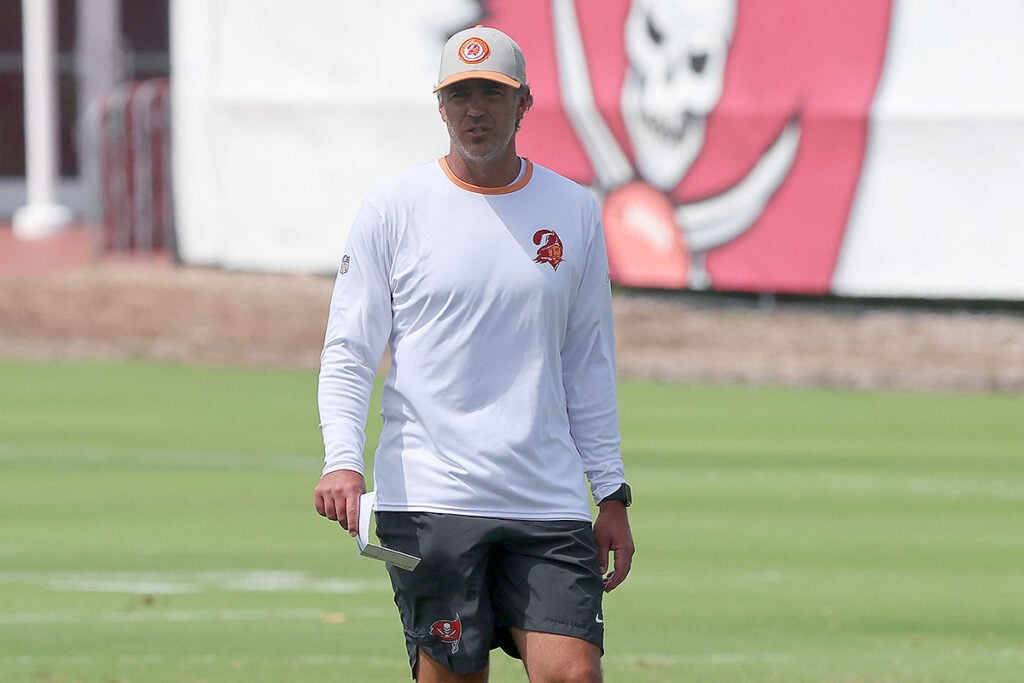
Bucs OC Zac Robinson – Photo by: Cliff Welch/PR
When it comes to the tight end room, it has enough serviceable blockers (Cade Otton, Payne Durham, and Ko Kieft) for heavier personnel packages, although it would be a disservice to prominently feature it and leave other playmakers sidelined.
Bucky Irving has proven to be an explosive running back capable of changing direction, creating explosive plays and making defenders miss while being equally dangerous catching the football. Kenny Gainwell brings many of those same traits as another capable runner and proven receiving threat, and Sean Tucker adds a power dimension in short-yardage and goal-line duties.
Imagine 21 personnel with Tucker alongside either Irving or Gainwell. Defenses would have to account for Tucker’s downhill running ability while respecting Irving’s or Gainwell’s ability to motion out wide, catch passes out of the backfield or serve as the ball carrier themselves. Those looks complement Robinson’s zone-running structure while creating ideal opportunities for play-action and matchup manipulation.
Whether Zac Robinson leans more heavily on 11 personnel again or continues the diversified approach he developed in Atlanta, one thing seems clear: Tampa Bay’s offensive roster gives him the flexibility to do both. If his time with the Falcons was about proving his offensive philosophy works, his first season with the Bucs could be about exploring just how many different ways he can deploy it.