Washington — The US military said on Tuesday it had begun strikes against Iran following the crash of a US Army Apache helicopter off the coast of Oman, which US President Donald Trump blamed on the Islamic Republic.
In a statement posted on social media, US Central Command said the strikes would be a “proportionate response to unprovoked Iranian aggression.” This comes after Trump blamed Iran for shooting down the helicopter and vowed that the United States would respond.
Iranian official media reported that explosions were heard on an Iranian island in the Strait of Hormuz.
Trump blamed Iran for shooting down a helicopter near the Strait of Hormuz and said the United States must respond. Iran’s top diplomat said that foreign military forces close to the country’s territory are “in constant danger.”
President Donald Trump speaks with reporters before boarding Air Force One at John F. Kennedy International Airport in New York, early Tuesday, June 9, 2026.
AP Photo/Mark Schiffelbein
An Apache helicopter crashed after colliding with an Iranian drone, according to a U.S. official who spoke on condition of anonymity to discuss the ongoing investigation.
It was not clear whether the collision was intentional, and official statements only said that the accident was under investigation. CNN, CBS News and other media had previously reported on the Iranian drone collision.
Trump said Iran shot down the plane while it was on patrol over the Strait of Hormuz, and declared that the United States “must, of necessity, respond to this attack,” in a social media post.
The US military later announced that it had begun strikes against Iran.
In the first known operation of its kind by the US military, a drone boat rescued the two pilots aboard an Apache attack helicopter when it went down near a vital shipping lane that Iran had effectively closed during its war with the United States and Israel.
Trump said in a social media post that military officials told him that “the Iranians shot down one of our highly advanced Apache helicopters.” He added that both soldiers were “safe and unharmed.”
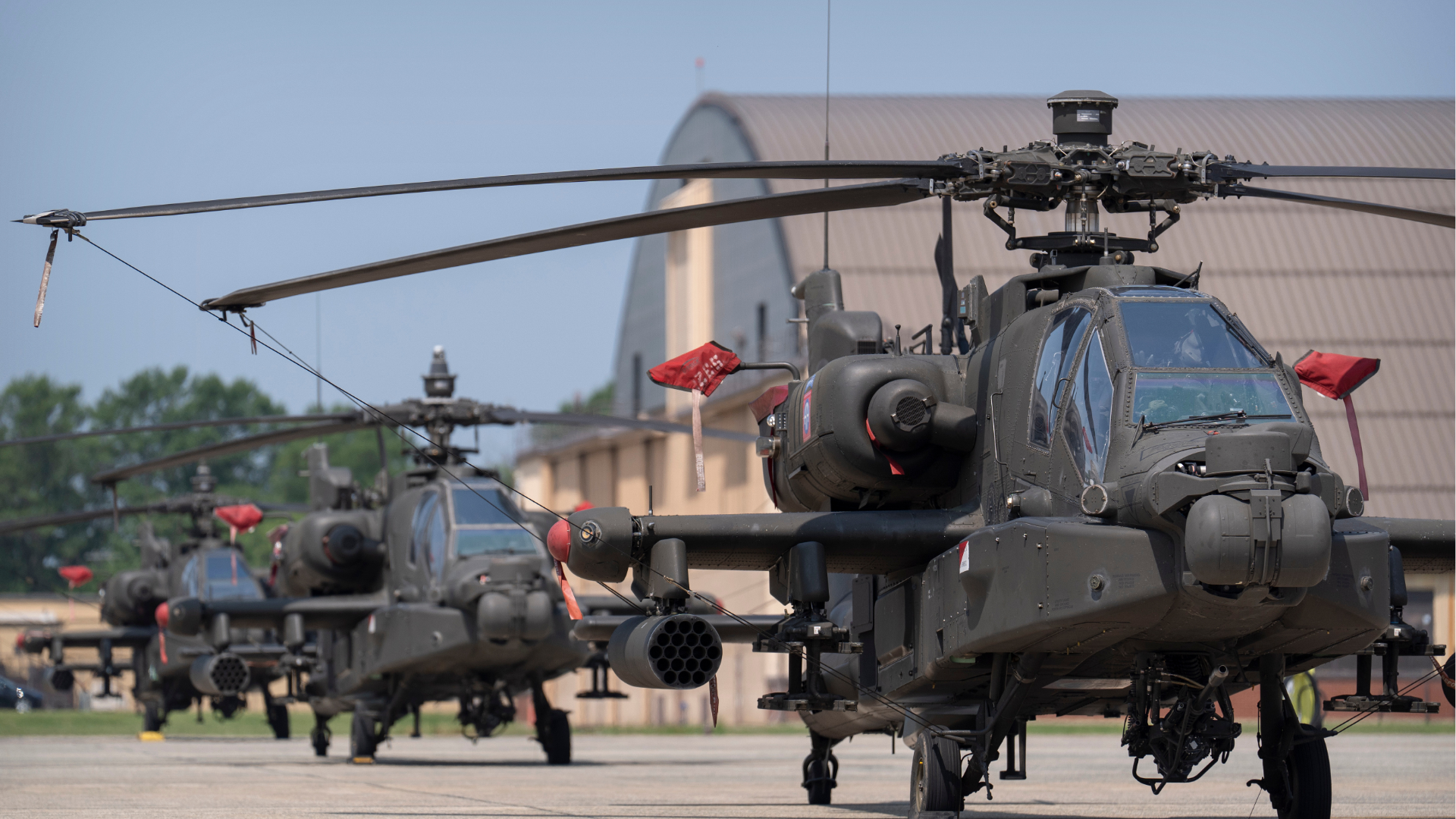
FILE – U.S. Army AH-64E Apache helicopters pictured at Joint Base Andrews, Maryland, June 12, 2025.
AP Photo/Mark Schiffelbein, file
“However, the United States must, of necessity, respond to this attack,” Trump wrote.
Shortly after Trump made his accusations, Iranian Foreign Minister Seyed Abbas Araqchi said in a social media post that the strait was “thousands of miles away from American shores.”
“Foreign forces stationed near our territory are at constant risk due to human errors, simple accidents, or the possibility of being caught in crossfire,” Araqchi wrote. “To reduce the risk, the best solution is for them to leave.”
The downing of the helicopter further aggravated the two-month-old ceasefire, a day after Iran and Israel exchanged fire for the first time since the fragile truce came into force. Iranian state television said on Tuesday that the Israeli attacks resulted in the killing of at least two members of the country’s air defense units.
Since the United States and Israel began striking Iran on February 28, the war has rocked the global economy, sent energy prices around the world soaring, and made many basics, including food, more expensive.
Officials were unable to turn the April ceasefire into an agreement to end the conflict permanently, especially as Israel intensified and expanded its military campaign in Lebanon against the Iranian-backed Hezbollah militia.
Army crew members picked up by drone boat
US Central Command said the army pilots were rescued at 3:30 a.m. local time on Tuesday, about two hours after their helicopter went down during a patrol off the coast of Oman.
The US service members were spotted and recovered by a drone boat that transported them to another location on the water, where they were picked up by a helicopter, said Captain Tim Hawkins, a spokesman for US Central Command. Hawkins initially said the drone took the two to shore, but he did not provide an updated timeline.
Hawkins said this was the first known drone rescue at sea by the US military.
AH-64 Apache helicopters have been a key asset for the US military as it enforces a blockade of Iranian crude oil shipments and tankers, seeking to pressure Tehran to reach an agreement. The UAE also used helicopters to shoot down Iranian drones.
The drone used in the rescue was a 24-foot (7.3-meter) vessel called the Corsair, Hawkins said. Manufactured by Saronic Technologies.
The drone is assigned to the Navy’s Task Force 59, which was established in 2021 as the Navy’s first unmanned artificial intelligence unit focused on maritime security in the Middle East, including the Strait of Hormuz and the Suez Canal.
Trump insists that the Iran deal is coming
Before accusing Iran of shooting down the American helicopter, Trump expressed renewed optimism about negotiations with Iran.
“We have a good chance” of signing an agreement within “two or three days,” Trump said late Monday. But he did not provide any details about why there was reason for the new optimism. In the past two months since the United States and Iran agreed to an initial ceasefire, Trump has repeatedly predicted that an agreement is close.
“We are very close to reaching a very good, strong and strong agreement,” the president said.
The mediators, mostly led by Pakistan, have been trying for weeks to reach a cross-border agreement. However, both Iran and the United States have taken hardline positions.
The United States wants to see Iran give up its stockpile of highly enriched uranium, which is believed to have been buried following US air strikes during the Twelve Day War, in 2025. But Iran rejects this and demands sanctions relief. It also wants the frozen assets to be released even before a final agreement is reached, something Trump has rejected.
Before Trump’s comments on the negotiations, Ghalibaf said on Monday that Trump’s statements so far on the potential agreement “contrary to the agreed upon terms,” indicating that the United States “is not seeking a ceasefire nor dialogue.”
The ongoing fighting between Israel and Hezbollah remains a top Iranian priority as well. The Lebanese Army Commander, General Rudolf Haykal, traveled to Pakistan on Tuesday. There he met Pakistani Army Commander Field Marshal Asim Munir, who was a key figure in the Iranian-American talks.
Heikal’s visit comes as the Lebanese government takes an increasingly hardline stance toward Hezbollah but remains unable to disarm the powerful militia. Hezbollah thanked Iran on Tuesday for attacking Israel “in defense of our Lebanese people,” noting that the Lebanese government should seize this opportunity to improve relations with Tehran.
Israel warns the Lebanese city of Tyre
At the same time, the Israeli army issued an evacuation warning for the southern Lebanese coastal city of Tyre, including the Christian neighbourhood, which has so far remained untouched by air strikes on the city.
Last week, Israel warned Christian neighborhoods in the city of Tire that it believed Hezbollah members were among them. Many Lebanese Shiite Muslims fled to those areas after Israeli strikes hit the Mediterranean coastal region over the past two weeks.
Following a warning last week, the Lebanese army deployed to the Christian area of Tyre in an attempt to prevent Israeli attacks there and to show that Hezbollah has no armed presence in the area. But Avichay Adraee, the IDF’s Arabic-language spokesman, posted on X on Monday that the IDF “will have to act against its terrorist activities in the neighborhood soon.”
___
This version corrects that the pilots’ rescue, not the helicopter crash, occurred at 3:30 a.m
___
Superville and Toropin reported from Washington. Associated Press writers Michelle L. Price in New York, Will Weissert in Washington, Bassem Mroueh in Beirut, Munir Ahmed in Islamabad, and Ross Bynum in Savannah, Georgia.
Copyright © 2026 The Associated Press. All rights reserved.