In the NFL, Cover 4 refers to a defensive coverage that aims to cover four deep zones on the field. Following that lead, I’m going to provide you with the same coverage of the Bucs – your favorite football team. Each Wednesday I’ll cover four areas as they apply to Tampa Bay: 1. a short film breakdown, 2. a finance angle, 3. a look forward at what’s to come, and 4. a bit of fun.
Film: Revisiting The David Walker Hype
With training camp now in full swing, we are starting to get a feel for who is standing out. One name that has to be exciting for the Bucs’ brass is 2025 draft pick David Walker. An early Day 3 pick last year, general manager Jason Licht and his personnel department thought Walker was a diamond in the rough. And that makes sense. Look at his production chart relative to other edge rushers from the FBS and FCS in 2024.
A torn ACL robbed Walker of his rookie season. But his recovery is going well as evidenced by all of the camp noise he is making.
David Walker with what would’ve been a sixth sack in six practices. Instead, it’s a holding penalty
— PewterReport 🏴☠️ (@PewterReport) August 5, 2026
The attention right now is deservedly on first-round draft pick Rueben Bain Jr. and veteran Yaya Diaby as the starters. But Walker is making a quick push to be the first man off the bench over free agent Al-Quadin Muhammad and roster holdover Anthony Nelson. Pewter Report’s Adam Slivon believes Walker has the inside track due to the highest ceiling of the bunch.
And I agree with him. I went back and watched several games of Walker’s last year at Central Arkansas. And it’s a fun watch.
The Pass Rush Tool Belt
It’s rare to find a college pass rusher with an advanced plan and a deep bag of tools to win. But Walker was an older prospect (25 years old during his final season in college) playing at a lower level of competition, giving him plenty of opportunity to hone his craft. And hone he did. Despite being the best athlete on the field for every game I watched (North Alabama, Lindenwood and Tarleton), he didn’t just rely on his superior physical traits.
There were plenty of reps where Walker used real clearing methods that should translate to the NFL including a double-hand swipe, a chop and a club along with a nasty rip move that left opposing tackles grasping at air.
His use of hands may be the single most important part of his game as he eyes his first live NFL reps because he doesn’t have prototypical length. His height (nearly 6-foot-1), arm length (31.875″) and wingspan (77.5″) are in the first, sixth and 11th percentiles for edge rushers, respectively. Because of that he will have to keep longer-levered tackles off his chest. An advanced hand fighting skillset will aide him in that endeavor.
What’s most encouraging is that Walker had a plan for each opponent he faced. Not each team. Each offensive tackle.
In the same game he would regularly use his hands, burst and bend to win the corner against a slower-footed tackle – winning the edge over and over. But when lined up on the opposite side his plan of attack would change, morphing into a speed-to-power bull rusher hell-bent on driving his opponent back onto his heels and into the quarterback’s lap.
Walker’s attack variation leads me to believe he’s a real film junky looking to gain the upper hand by the smallest of margins. As the level of competition he faces improves considerably, it’s this trait that has the best chance of sustaining in the NFL.
Relentless Motor And Surprising Athleticism
His size is certainly an outlier. Despite his shorter stature, at 263 pounds his weight is right dead center in the 50th percentile for edge rushers. You wouldn’t expect a player with his dimensions to be a superior athlete. And his testing says he’s more good-than-great. Surprisingly, his 10-yard split measured below average at 1.65 seconds (38th percentile). But on tape he was clearly the best athlete on the field in each of the games I observed him in, regularly winning off the line, around the arc and in a test of strength and power.
Ironically enough, Bain is his second-closest physical comp per Mockdraftables at 84%.
It’s the combination of power and finesse that is most intriguing though, as displayed on this goal line stand where he beats the tight end off the line to close the lane, plant and hold his spot as the line washes into him and then flex back to his outside to get bring down the back who is trying to bounce outside of his range.
The Concerns
What’s so interesting about Walker is there are very few concerns on tape. The biggest one I could find is that he has a penchant for stepping down the line and taking himself out of plays when he identifies a puller wrapping to his side. I understand his plan in those situations. If Walker can get the puller to break his path and try and bend back to seal him, he can disrupt the path of the whole run. But often the result is the puller bypassing him while he ends up too far inside to catch the back getting to the corner.
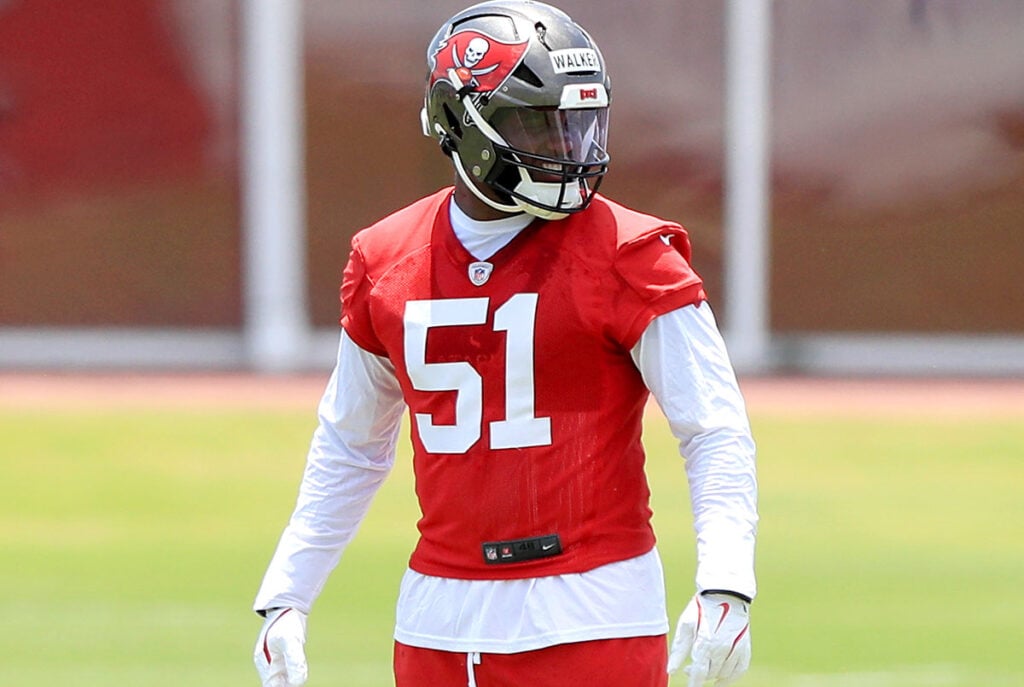
Bucs OLB David Walker – Photo by: Cliff Welch/PR
Beyond that everything else comes back to “can he translate to the NFL?” Playing in the FCS meant his regular competition was players who will never make an NFL practice squad, let alone a starting lineup. He is going from the best athlete on the field to average to a tick above. And there isn’t much room for projection at this point.
He’s 26 years old. He’s not going to get bigger, faster or more flexible. Walker doesn’t need to, though. He just has to maintain this level of athleticism while leveraging the pass rush plan and hand-fighting skills. If he can do that, he will be plenty good enough to be a major part of a talented pass rush in Tampa Bay.
Finance: Cap 101
A great debate has recently raged, sparked by Baker Mayfield’s comments about a potential $80 million cap hit the Bucs would incur should they franchise tag him in 2027. I’m not here to re-litigate the pros and cons of that specific route. If you want to hear more about my thoughts on Baker and his negotiations with the Bucs, feel free to check out this video on PewterReport’s YouTube channel, PewterReportTV.
But what I do think is helpful is reviewing the difference between cap and cash, and why NFL teams don’t “budget” for cap hits.
Cap vs. Cash
Cash is the single most important financial resource teams think about when it comes to putting a roster on the field. Most of that comes down to the fact that cash is what owners actually have to spend. This represents the real checks they write and real expenditures that leave their coffers. Cap is merely an accounting process to keep track of that cash over multiple years. Let’s use Baker Mayfield as an example.
When the Bucs originally signed Mayfield in 2023, it was for one year and $4 million with incentives that could pay him more. His cap hit that year was just $1.7 million. How could Tampa Bay get such a low cap number, especially when Mayfield earned a good portion of his incentives? They structured some of his money owed as a bonus that could be prorated over more than one season. In doing that they deferred the accounting of the money they actually paid. It didn’t magically disappear. It was just moved to a later year.
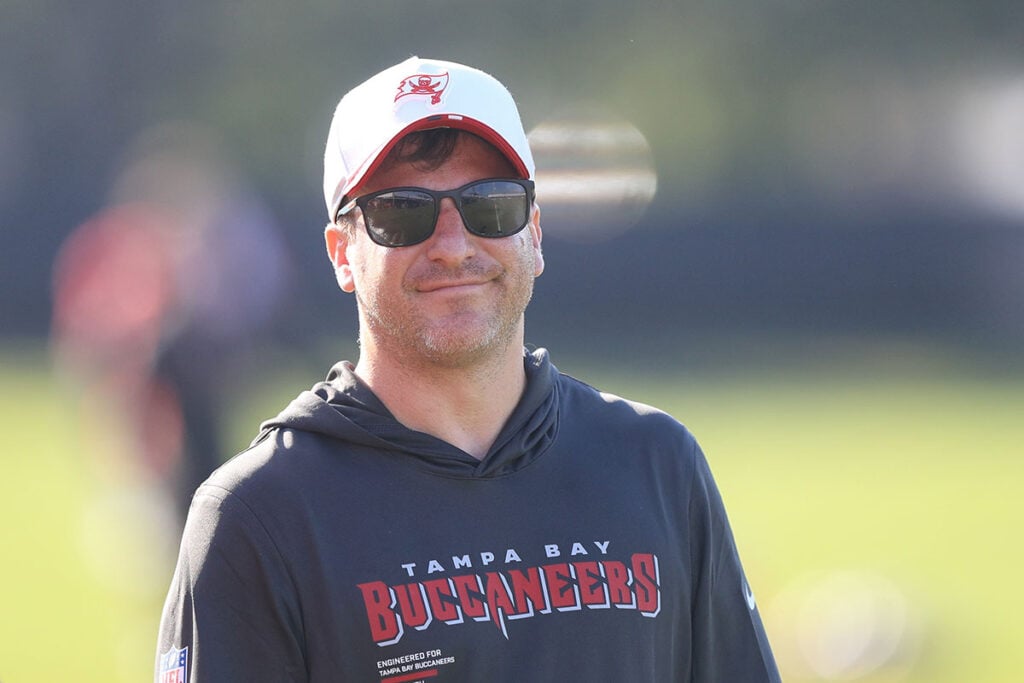
Bucs assistant GM Mike Greenberg – Photo by: Cliff Welch/PR
Deferred Accounting And “Dead Cap Hits”
Teams use this cap maneuver regularly because it acts effectively as an interest free loan of cap dollars. Because the NFL salary cap continually rises due to the ever-increasing popularity of the sport, cap dollars are cheaper in each subsequent year. The salary cap in 2023 was $224.8 million. The $2.3 million of Mayfield’s salary that was pushed to future years was 1.02% of that cap.
But since it didn’t hit until 2024, when the salary cap was $255.4 million, the percentage of cap that it represented decreased to 0.90% of the cap. Here is a hypothetical example if a team wanted to minimize a cap hit by as much as possible during the life of the contract:
Contract – Two years, $50 million – Player gets $25 million in cash each year
Year One – $25 million in cash, $2 million in base salary and a $23 million fully prorated bonus
Year Two – $25 million in cash, $2 million in base salary and a $23 million fully prorated bonus
Beyond this, the team uses four void years to park the rest rest of the prorated money.
Cap Hits
Year One – $6.6 million ($2 million salary + 1/5 of the year one bonus)
Year Two – $11.2 million ($2 million salary + 1/5 of the year one bonus + 1/5 of the year two bonus)
Year Three (Void Year One) – $9.2 million (1/5 of the year one bonus + 1/5 of the year two bonus)
Year Four (Void Year Two) – $9.2 million (1/5 of the year one bonus + 1/5 of the year two bonus)
Year Five (Void Year Three) – $9.2 million (1/5 of the year one bonus + 1/5 of the year two bonus)
Year Six (Void Year Four) – $4.6 million (1/5 of the year two bonus)
If the team extends the player prior to the contract voiding after two years, then the prorated money in years 3 through 6 stays where it is (plus the new cap hits associated with the new deal). If an extension is not agreed to before the void date, all of the prorated money accelerates to year 3 (in this case $32.2 million).
Those accounting maneuvers are why you should never compare team spending based on salary cap. For instance, the Bucs official salary cap spending, including dead cap hits from 2025, as of this article’s publication according to Over The Cap is $303,192,417. Compare that to the Eagles, who OTC has at $293,041,884 and you might think the Bucs are outspending Philadelphia when it comes to talent. This couldn’t be further from the truth.
In reality, the Eagles are outspending the Bucs in cash (which is what players care about – actual money), by about 17% this year. That’s almost $60 million! Think about what Jason Licht could add to this roster if the Glazers gave him an extra $60 million to spend!
The Bucs do defer some of their contracts and create dead cap. Just not to the extent of the biggest spending teams. Because Tampa Bay is a low-to-mid cash spending team, they can afford to take bigger cap hits on franchise tag situations like Baker, and Chris Godwin Jr. and Shaq Barrett, before him.
They don’t spend enough real cash to have to defer most of it in order to stay under the salary cap. Should it get there, a few restructures here and there will allow Tampa Bay to easily account for both his tag number as well as his dead cap acceleration from this contract.
Forecast: Trend Changes Under New Bucs Offensive Coordinator Zac Robinson
Last week I postured the Bucs would be a better offense in 2026 in a very specific situation (2nd and long). I dove into more of new offensive coordinator Zac Robinson’s tendencies as a play caller to find other changes in the offense that I expect this year.
• The Bucs will run more on first down. The Falcons ran on first down 58.5% of the time over the past two years. The Bucs ran 56% on first down last year. It’s a small change, but in my opinion it’s in the wrong direction.
• Wide zone usage will be up, but not as much as you might think. Robinson called wide zone on roughly 60% of his run calls in Atlanta. Grizzard was at 20% in Tampa Bay. The expectation is that the Bucs will be close to 60% this year. But I think Robinson is setting up for closer to a 50/50 split this year. My reasoning is simple. As players have been asked about the run game during training camp, they consistently start by talking about WZ before pivoting to a note about the gap runs. And that pivot is unprompted.
#Bucs TE Cade Otton is the latest offensive player to discuss the wide zone. Otton believes that with OC Zac Robinson’s confidence, they will have more success running it in 2026. pic.twitter.com/ayjQdyvihE
— PewterReport 🏴☠️ (@PewterReport) August 3, 2026
• Red zone running will be up significantly. Robinson ran 55% of the time in the red zone when he was calling plays in Atlanta. Grizzard was at 47%.
• The marriage of Robinson’s protections schemes with the Bucs’ offensive line should have them as a top two protection unit in the NFL. The Falcons only allowed sacks on 5.3% of their drop backs last year. That’s an elite mark despite having less than elite pass protectors on talent and a backup right tackle all year.
Robinson values strong protection plans to keep his quarterbacks clean. Pair that with Cody Mauch, Tristan Wirfs, Luke Goedeke and a talented unit full of pass block-first players and the Bucs have a chance to be an elite unit in 2026.
Fun Fourth Down
This week I wanted to revisit last weeks Who Wants to be a Millionaire questions and provide you with the answers. How did you do?
$1,000 – This former Bucs first-round pick never played a snap for the Bucs. – Bo Jackson
$5,000 – This was the last player – not Vita Vea – to publicly request a trade from the Bucs. They did not trade him, and he left in free agency the following season. – Devin White
$10,000 – How many consecutive losses did the Bucs endure before notching their first win in franchise history? – 26
$25,000 – How many Hall of Famers have played for the Bucs? – 9 – Lee Roy Selmon, Randall McDaniel, Darrelle Revis, Derrick Brooks, Warren Sapp, Steve Young, John Lynch, Ronde Barber and Tim Brown
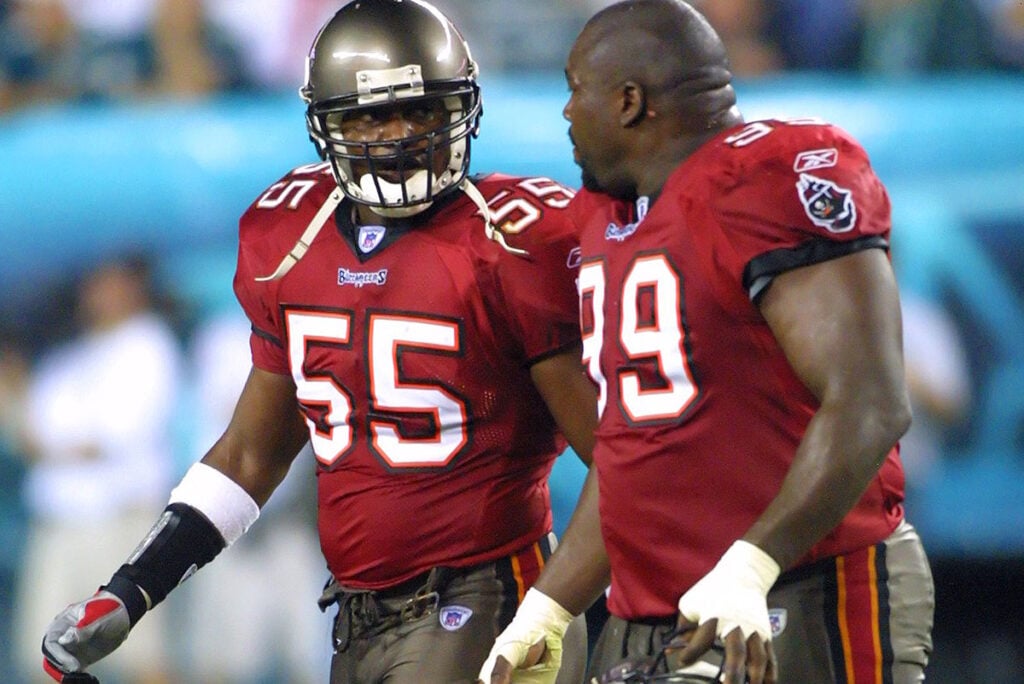
Bucs legendary LB Derrick Brooks and DT Warren Sapp – Photo by: Cliff Welch/PR
$50,000 – Shaq Barrett’s 19.5-sack 2019 season broke this player’s franchise record. – Warren Sapp (16.5)
$100,000 – Only four teams have more playoff wins than Tampa Bay since 2020. Who are they? – Kansas City (13), Buffalo (8), Los Angeles Rams (8), San Francisco (7) – Philadelphia has as many as Tampa Bay (6).
$250,000 – This Bucs player is fourth among all non-quarterback offensive skill positions in snaps over the past three seasons at 2,783. He trails only D.J. Moore, Amon-Ra St. Brown and Ja’Marr Chase (per Sumer Sports). – Cade Otton (wouldn’t be a Josh Queipo trivia game without an obligatory Cade Otton question)
$500,000 – This dynamic Bucs backfield duo combined for 2,763 yards from scrimmage in a single season. – Doug Martin/Charles Simms (2015) – 2,763 yards
$1,000,000 – In the modern draft era, this player would have been an undrafted free agent. But since he entered the NFL prior to 1994, he holds the distinguished title of best 8th-12th round pick in franchise history after playing eight seasons in Tampa Bay. – David Logan was a 12th-round pick in 1979