Local News
“He just wants to get his schooner launched and get the hell out of the town of Freeport.”
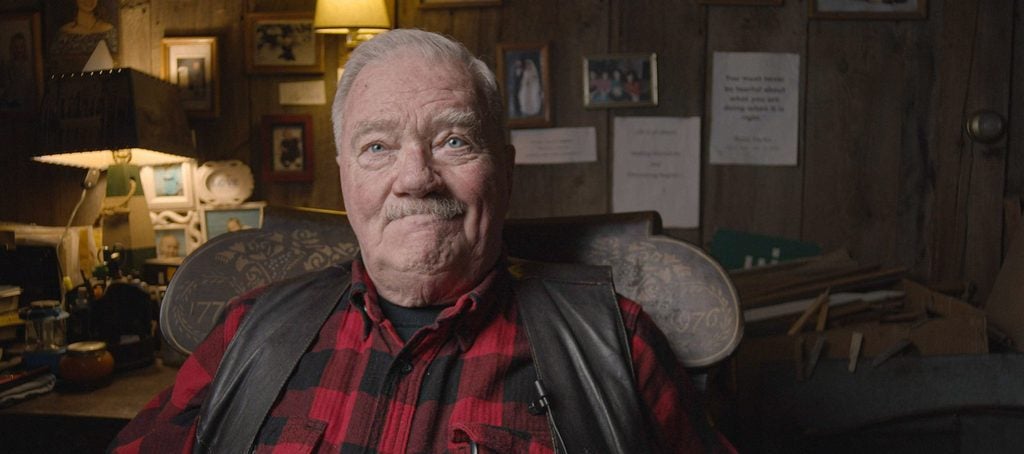
When Harold Arndt first came to the town of Freeport in 1965, he was greeted by a sign at the town’s entrance that had a silhouette of a wooden, two-masted schooner.
Arndt says the sign represents Freeport’s long maritime tradition of shipbuilding, dating back to the 1800s — a tradition he refuses to let Freeport forget.
“For whatever reason, Freeport in recent times has taken that sign down, and nobody knows why other than it showed a silhouette of something that they have sitting in their backyard,” he said.
Arndt means that literally — he built his own schooner in Freeport, except unlike the one on the sign, it’s made out of 80 tons of recycled steel. The boat towers over his backyard, an impressive feat that took decades to create.
The only problem is that the boat’s landlocked, less than half a mile away from the water. But Arndt, 83, has been in legal battles with the town since 2004 to finally get his schooner, the Island Rover, launched.
“It’s been a life obsession,” Arndt said. “I’ve spent my whole life since the late 1980s doing it for the life task.”
Most recently, at an Aug. 18 meeting, the Freeport Town Council declined to adopt a citizens’ ordinance permitting the launch. Instead, the council sent it through the referendum process. Now Arndt and his supporters have until Sept. 23 to collect 774 signatures from registered Freeport voters for the issue to appear on the November ballot.
A team of Island Rover supporters, in addition to paid signature gatherers, is scrambling to get enough signatures before the deadline to appear on the ballot. This will be the second ballot attempt for the Island Rover, with supporters having failed in June to get enough signatures for it to appear on the primary ballot.
If the ordinance does make the ballot, a public hearing will be held and the citizens of Freeport will be given the opportunity in November to vote on whether Arndt can build a temporary ramp to finally put the Island Rover in the water, over 40 years since he first began the project.
“It gives the entire Freeport voters the opportunity to say, enough is enough, let’s just launch the fu—ing boat,” Arndt said.
Building the Island Rover
Arndt was working as a waste minimization administrator for Bath Iron Works, a major shipyard in Maine, when he said he noticed a surplus of materials being discarded by companies. This gave him an idea.
“I once made the statement that I could build a boat out of what is thrown away,” he said. “I just decided that, rather than say it, I was going to do it.”
So in the 1980s, Arndt decided to get to work and build a boat entirely out of scrap materials to make a statement about industry waste. His dream is to take college students out on the boat and educate them about creative ways to reuse materials.
But Arndt had no idea how to build with steel — his only experience was building a 14-foot plywood boat with his dad.
“I sit here at 83 years old, and [when] I look back I say, ‘Wow, what the hell was I thinking?’ Because I really didn’t know a lot about boat building,” Arndt said.
To learn what he needed to know about building out of steel, Arndt went to what is now the New England School of Welding in Auburn, Maine, where the instructor took him under his wing.
Using the lessons learned from his steel instructor, his experience taking engineering classes in college, and his background as a biology professor, Arndt built a massive ship he says is ready to be launched.
Twain Braden, a Maine maritime lawyer representing Arndt, first met him in 1999 when he was a magazine writer doing a story on Arndt’s project. He said he was immediately impressed by the scope and quality of the project.
“There’s plenty of hillbilly weirdos building boats and all kinds of crazy things in their back forty,” he said. “But Harold’s project was different because of the quality and the scale of it. Plenty of people also build good quality boats in their backyard, but they might build a 25-foot boat or a 30-foot boat, but who the heck builds a full-size ship to American Bureau of Shipping standards, inspected by the Coast Guard, of this scale? It was incredible, in the true sense of the word.”
But the “incredible” boat didn’t come easily, and Arndt said what he thought might be five years of construction turned into a several-decades-long project that finally became launchable three years ago.
Even now, while the boat is currently launchable, he said it’s not exactly finished. There’s still work to be done on the boat’s interior, Arndt said, but construction’s stopped due to ongoing legal battles with the town.
Legal fight with the town
As if the task of building an 80-ton homemade boat wasn’t hard enough, Arndt has also been in legal disputes with Freeport since the early 2000s.
Arndt’s legal troubles began in 2004, after he formed the nonprofit Island Rover Foundation. Town officials accused him of violating rules against “manufacturing use” in a residential zone, according to The Press Herald.
“You can’t have a boat-building facility on a residential lot, is the bottom line,” Freeport Town Attorney Amy Tchao said.
Judges have also repeatedly found Arndt violated court-imposed deadlines to move the boat. In 2014, he agreed to move the Island Rover out of the neighborhood within two years or cede ownership to the town, according to Tchao.
But the ship still has not moved, which Braden said is because the town keeps “moving the goalposts” on Arndt and his goal of launching the Island Rover. Before Braden got involved as Arndt’s legal counsel, he’d been representing himself for nearly 12 years, which Braden said he believes the town took advantage of.
“I like to work for the underdog, and Harold is a true underdog,” Braden said. “You know that old expression, ‘You can’t fight city hall’ — well, they’ve used all the city hall resources to punish him [and] try to get him to do what they want him to do, but he’s survived.”
The boat’s ownership is also the subject of a lawsuit, as Arndt hired a local businessman, Carter Becker, in 2016 to help finish construction and champion the Island Rover’s launch. But “on the eve of the town getting title to the property,” Tchao said, Arndt mortgaged his property to Becker.
The town sued both Becker and Arndt, alleging fraudulent transfer and claiming the town has ownership of the boat. The case concerning Island Rover ownership is set to go to trial in December, Tchao said.
Albert Presgraves, former town engineer of 14 years and now a supporter of the Island Rover, said he thinks the town is most worried about the liability if something goes wrong while launching the boat.
Braden said he is frustrated by the town’s years of unwillingness to offer Arndt any support in his goal.
“What it comes down to is nobody wants to stick out their neck and help because they have nothing to gain by doing so,” Braden said.
Around 2006, Presgraves said he was in the “unfortunate position” as town engineer of having to decide what the town should do regarding Arndt’s project, which he recommended be sold for scrap.
However, since then Presgraves said he has seen the finished boat and “would never recommend it be scrapped.” He even said he plans to help gather signatures to get the boat on the November ballot.
“The boat can absolutely be moved and launched without any problems, and if there’s a problem, it can be dealt with,” Presgraves said.
Arndt said he and Becker have moved the boat recently, using hydraulically driven house-moving equipment, to prove to the town and the judge that it could be done.
If the citizens pass the referendum, it will be brought to and launched from Becker’s waterfront property on Lower Flying Point Road, where they would build a temporary launching facility. This would require the boat to be hauled from the private right-of-way it sits on onto a public road, and then to Becker’s property.
Environmental concerns
But why hasn’t the town been supportive of Arndt’s dream of launching the Island Rover? Well, there are legitimate concerns, including coastal erosion, possible harm to wildlife, and the possibility the ship could get stuck.
Tchao said in September 2025, after two years of review, the Freeport Coastal Waters Commission denied Arndt and Becker permission to build a temporary boat launching facility due to environmental concerns.
“[They] describe it as if launching a schooner on the coast of Maine is somehow an act of eco-terrorism, which is total baloney, because any halfwit scholar of Maine history knows that we’ve been launching thousands and thousands of schooners over hundreds of years from beaches exactly like this, and not committing acts of environmental degradation,” Braden said.
Braden said the commission took the “safe route” with their decision, in order to avoid pushback from the “angry neighbors”of Becker.
Braden said the Island Rover team hired its own biologist, who addressed the environmental concerns, including potential harm to horseshoe crabs and clams. The biologist found the wildlife will be dormant on the shore in the winter months, Braden said, which is when they plan to launch the Island Rover.
With permission denied by the commission, Tchao said Arndt and his supporters turned to the referendum in order to avoid being held to environmental impact standards. The town manager is currently trying to get input from the State Department of Environmental Protection on whether or not this ordinance would violate the Mandatory Shoreland Zoning Act if passed, Tchao said.
“You have to wonder about an ordinance that exempts from environmental review the launching of an 80-ton vessel into a salt marsh that, at high tide, has no more than six feet of water,” she said, especially given that “a local board, after two years of review, has already determined to deny that permit application because the applicant had not met their burden of showing that there wouldn’t be adverse environmental impact to these sensitive resources.”
Another issue, Tchao said, is that if the referendum is passed it does more than just allow the launch of the Island Rover —it grants anyone in the district permission in the next two years to build a temporary boat-launching facility without having to meet environmental standards.
But Braden argues it is highly unlikely anyone else in the district would invest their time and money into building a boat and launching facility in the two-year period it’s allowed.
Tchao also said the launching facilities may not really be temporary, since the ordinance allows the facilities to be in the water for seven months out of the year indefinitely.
But Braden said Arndt only plans to use the launching facility once, as it will be made out of wood and with expensive rented equipment that cannot stay in the water permanently.
“We’re not looking to skirt the rules,” Braden said. “We’re just looking to fast track this because it’ll never get launched.”
A ‘life task’ in a changing coastal town
What’s really the problem, Braden said, is Arndt’s an “old-school Maine guy” in a town becoming increasingly gentrified. Braden said Freeport residents have become a “not-in-my-backyard,” upper-middle-class, conservative community that doesn’t respect Maine’s shipbuilding history.
“They act as though a ship has never been built and launched on the coast of Maine,” he said. “You can imagine if this were in suburban Pennsylvania or something, but this is the coast of Maine. What town do you think you live in? What coast do you think you live on? It’s absurd.”
Early on, Braden said neighbors and friends of Arndt were impressed with his project and made verbal agreements that when the boat was ready, it could be launched off their waterfront property. But by the time the Island Rover really was ready, Braden said many of those neighbors were gone.
“As these properties started to change hands, and people from away came and built their dream homes, they were like, ‘What the hell is this guy doing in the woods behind my house?’” Braden said. “So, their vision of why they came there was anathema to somebody participating in Maine’s boatbuilding, can-do, just-get-it-done heritage. Harold was this vestige of that time, but his community changed around him.”
Despite this, Arndt manages to stay dedicated to the mission, even being in his 80s and drowning in legal disputes. He said everyone should have a life’s task, and this is his.
A former biology teacher at Bowdoin College, Arndt says the true mission of the Island Rover is educating students. He said as a reminder, he has the Walt Disney quote “If I can envision it, then I can do it” stapled to the wall above his desk.
“I set my mind to build the boat as a demonstration of what industry was throwing away,” he said. “Once I decided it, then as it turns out, all hell couldn’t get me to stop. So I am convinced that I will launch that boat, and there’s enough people surrounding me now that believe the same thing.”
Braden said Arndt’s ability to keep unwavering motivation is a “mystery” to him.
“Whatever tenacious streak that Harold has inside him that allowed him to build this boat, which is just unbelievable that he was able to do it, is the same tenacity, persistence, stubbornness, and eccentricities that keep him from being defeated emotionally by this group of people,” Braden said.
Braden said through it all, Arndt has remained positive and steadfast on his goal.
“The vehemence, the anger, the insults, the absolute mendacity that these town officials … have heaped on [Arndt],” he said. “It’s just awful, and yet he’s still this positive spirit and he just wants to get his schooner launched and get the hell out of the town of Freeport.”
Arndt was the focus of a 2024 feature documentary: “The Island Rover (Harold’s Boat Problem).“
Sign up for the Today newsletter
Get everything you need to know to start your day, delivered right to your inbox every morning.