

Do not microwave grapes. Not as a science trick, not to warm them up, not because a video made it look fun. A grape in a running microwave can erupt into a ball of plasma, scorch the inside of the oven, damage the part that generates the microwaves, and in bad cases start a fire. This is one of the few foods on this site where the answer is not “it depends.” The answer is no, and the rest of this article explains the fascinating physics behind that no.
You have probably seen the videos. A grape cut almost in two, the halves still joined by a thread of skin, goes into the microwave, and within seconds a brilliant fireball flares between the halves. It looks like a magic trick. Physicists spent years figuring out why it happens, and their answer, published in the Proceedings of the National Academy of Sciences in 2019, is genuinely interesting. But interesting does not mean safe to repeat, and every credible source on this topic ends with the same warning: do not try this at home.
This guide covers what actually happens when grapes meet microwave energy, the real science of why they spark (including the myth the internet got wrong for years), which other fruits can do the same thing, how the stunt can wreck your microwave or start a fire, what to do if it happens by accident, the safe ways to heat grapes if you want them warm, and the separate grape safety rule for young children that matters far more than any of this.
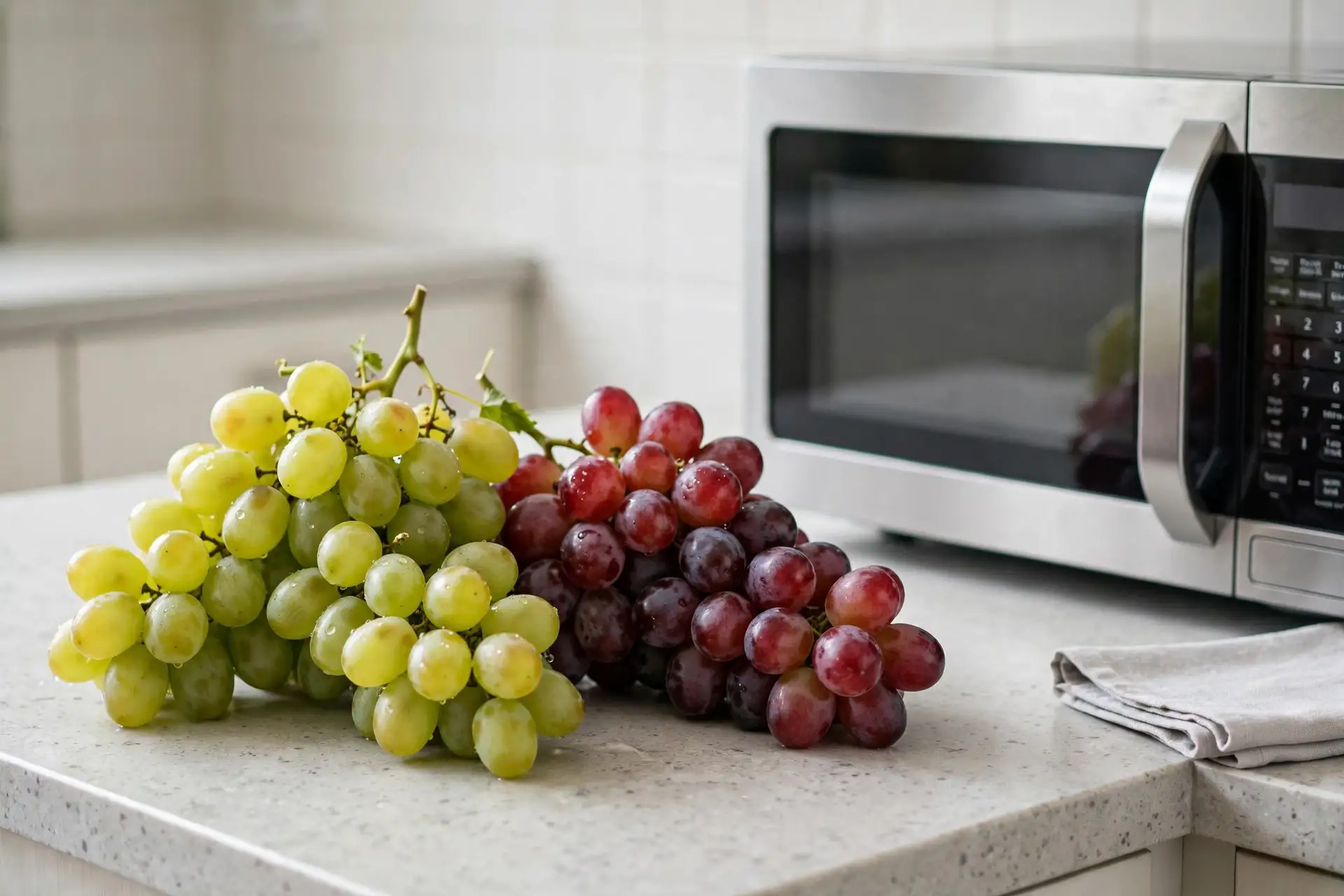
The Short Answer
No, you should never microwave grapes. When two grape-sized pieces of water-rich fruit sit close together in a running microwave, they trap the microwave energy and concentrate it into a tiny hotspot between them. That hotspot gets intense enough to strip electrons from atoms in the air and the fruit’s own salts, creating a flare of plasma, the same superheated state of matter found in lightning and stars. The discharge can scorch your microwave’s interior, damage the magnetron that generates the microwaves, and start a fire.
There is no safe version of this. Half grapes, whole grapes touching each other, or grapes heated accidentally in a dish can all produce the effect. If grapes spark in your microwave, stop the oven immediately, leave the door closed until everything cools, and inspect for damage before using the microwave again. If you want warm grapes for a recipe, roast them in the oven or warm them in a skillet on the stove instead.
What Actually Happens Inside the Microwave
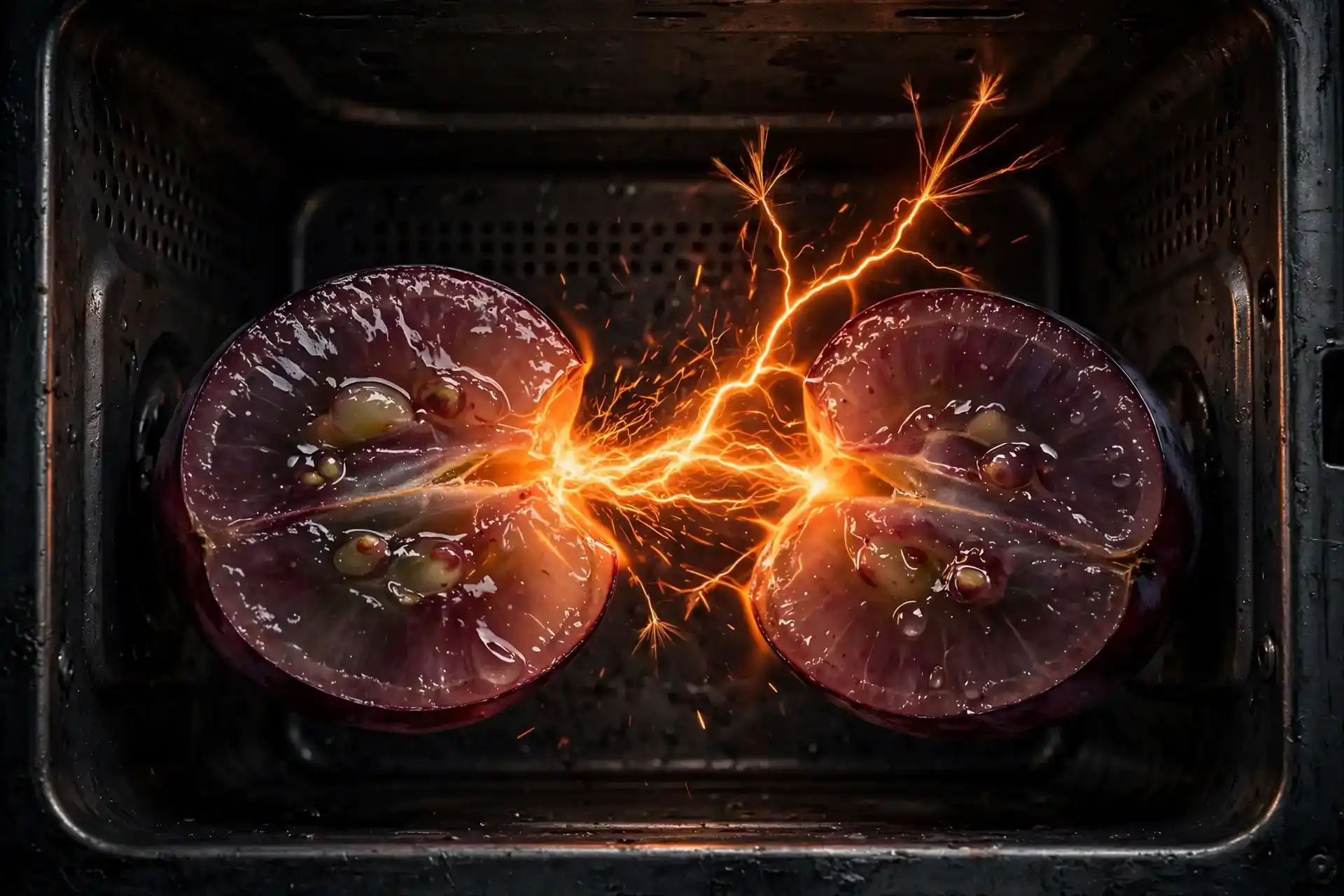
When grapes go into a running microwave, the show starts within seconds. First the grape heats from the inside, because microwaves penetrate the fruit and get trapped there. Then, if two pieces of grape are close together, a brilliant orange-white flare erupts at the point where they nearly touch. It looks like a tiny fireball, and in a sense it is: the flare is plasma, an ionized gas of free electrons and charged atoms hot enough to glow.
The flare is brief, usually lasting only a second or two, but it is violent at the scale of a microwave cavity. It can leave scorch marks on the oven walls and the turntable. Repeated stunts have been reported to damage the magnetron, the component that generates the microwaves, which effectively kills the appliance. The plasma is hot enough to ignite the grape itself or anything flammable nearby, which is how a kitchen trick becomes a fire call. As Science News put it in its coverage, the effect makes for a spectacular display, but it is one you may not want to try at home because it could damage your microwave. Their full write-up is at Science News on grape plasma.
Two things surprise most people about this. First, the grape does not need to be cut for it to happen. Two whole grapes sitting against each other can do it, though the classic cut version is more reliable because the cut faces trap energy more efficiently. Second, it is not really about grapes. It is about size, water content, and spacing, which means other foods can do it too, as you will see below.
Why Grapes Spark: The Science in Plain Language
For years, the internet’s explanation for the grape trick sounded convincing but was wrong. The popular story said that the strip of skin connecting the two grape halves acts like a wire, carrying an electrical current from one half to the other until the current burns through and arcs. It is a neat story, and it is not what happens.
The real answer came in 2019 from physicists Hamza Khattak, Pablo Bianucci, and Aaron Slepkov at McMaster, Concordia, and Trent universities in Canada. Using thermal cameras and computer simulations, they showed that a grape is almost exactly the right size to trap microwave radiation. A microwave oven runs at about 2.4 gigahertz, and the wavelength of that radiation fits nearly perfectly inside a water-rich sphere the size of a grape. Like a flute resonating with a particular note, the grape resonates with the microwaves, and the energy bounces around inside it instead of passing through.
A single grape just gets hot in the middle. But when two grapes sit within about 3 millimeters of each other, the trapped energy in each one cooperates, and the electromagnetic field concentrates into an intense hotspot in the tiny gap between them. That hotspot grows until it rips electrons off the sodium and potassium ions in the grape skin and the surrounding air, and that ionized gas is the plasma fireball. The researchers proved the skin bridge was irrelevant by getting the same effect from two whole grapes touching, from skinless hydrogel beads soaked in salt water, and even from quail eggs. It was the water inside, plus the size and the spacing, that made it happen. The original paper is published in the Proceedings of the National Academy of Sciences, and Science magazine’s plain-language summary walks through the thermal camera evidence at Science.org on grape sparks.
One honest footnote for the physics fans: a later line of experiments suggested that electrical discharge from air arcing, rather than the electromagnetic hotspot alone, may be the direct trigger of the sparks, with the resonance setting the stage. The practical takeaway does not change either way. The mechanism is real, it is powerful, and it does not belong in your kitchen.
Why the Cut-in-Half Version Looks So Dramatic
The videos almost always show the same setup: a grape sliced nearly through, with the two halves still joined by a thin thread of skin at the bottom. There is a reason this version became the standard demonstration. The two flat cut faces sit close together, which is exactly the geometry that concentrates the energy, and the skin hinge holds them at the perfect spacing without the halves rolling apart. It is the most reliable way to produce the effect, which is why demonstrators use it.
Understanding that geometry helps you see the everyday risk. You do not need a knife and a camera to create it. Two grapes touching in a bowl of oatmeal, a small cluster microwaved by accident, or grapes crowded together in a dish can create the same close spacing. The stunt version is deliberate, but the physics does not care about your intentions. Any two grape-sized pieces of water-rich fruit sitting close together in a running microwave can concentrate energy the same way, which is why the safety rule covers all grapes, not just the trick setup.
Do Blueberries and Cherry Tomatoes Do the Same Thing?
Yes. The researchers did not stop at grapes. They produced the same plasma effect with blueberries, gooseberries, grape tomatoes, and olives, and Discover Magazine’s coverage notes that any water-rich object about the size of a grape would work. The requirement is not “grapeness,” it is a water-filled sphere roughly the size of a microwave wavelength’s sweet spot, sitting close to another one. Large blueberries qualify. Cherry and grape tomatoes qualify. Olives qualify.
This widens the practical warning beyond the viral trick. Nobody is microwaving olives for fun, but people do microwave mixed dishes, oatmeal with berries, and leftover plates with tomato pieces. Two blueberries touching in a bowl of porridge are the same physics as two grapes. The effect needs the pieces to be close together and the heating to run for more than a few seconds, so a quick warm-up of a berry-topped dish is unlikely to produce a fireball. But it is one more reason to heat fruit dishes gently, stir them, and never leave the microwave running unattended with small round fruits inside. See Discover Magazine’s coverage for the full list of fruits the researchers tested.
Can Microwaving Grapes Damage Your Microwave?
Yes, and this is the part the videos never show. The plasma discharge does three kinds of damage. First, it scorches. The fireball is hot enough to mark the interior walls, the waveguide cover, and the turntable, and those scorch marks are permanent. Second, it can kill the magnetron. The magnetron is the component that generates the microwaves, and the plasma can reflect microwave energy back into it in ways it was not designed to handle. CBC reported in 2019 that repeated grape experiments appeared to damage the appliance’s magnetron over time, and a dead magnetron usually means a dead microwave, since replacing it costs nearly as much as a new oven.
Third, there is fire. The plasma reaches thousands of degrees, and it can ignite the grape, paper, or food residue inside the oven. A fire inside a microwave can spread to cabinets and walls, which is how a ten-second trick becomes a property-damage story. Electrical arcing from the discharge can also harm the oven’s internal electronics in unpredictable ways. None of this is theoretical. Fire services and appliance repair technicians both list grapes among the foods that do not belong in a microwave, alongside metal and eggs in shells. For the broader list of microwave hazards, see our guide to things you should never put in a microwave.
Whole Grapes Have Their Own Problem: Steam Explosions
Even a single grape with no partner can be trouble, for a completely different reason. Like eggs in shells and other foods with sealed skins, a whole grape traps steam as it heats. The skin holds the pressure in while the inside gets hotter and hotter, and when the pressure finally wins, the grape bursts. The result is a small explosion of scalding fruit pulp that can burn your mouth or hands and splatter the inside of the oven.
This is the same reason whole fruits with skins, from grapes to blueberries, show up on every “never microwave” list. The skin does not let the ever-hotter moisture escape, so the inner flesh overheats under pressure until it gives way. It will also ruin the fruit, since the skin scalds and blisters and the texture turns nasty. If a recipe calls for warm grapes, the oven or the stovetop gives you heat you can control, without the pressure problem. Our complete microwave safety chart covers which fruits handle the microwave and which do not.
What to Do If Grapes Spark in Your Microwave
Accidents happen. Maybe grapes ended up in a dish you were reheating, or a child tried the trick after seeing a video. If you see sparks or a flare, press stop immediately, but keep the microwave door closed. The closed door contains the heat and any flare-up, and opening it feeds oxygen to anything smoldering inside.
Wait until everything is completely cool before opening the door. Then inspect the damage. Look for scorch marks on the walls and ceiling of the cavity, check the waveguide cover (the small panel, usually on the side wall, that the microwaves pass through) for burns or holes, and look at the turntable for cracks. If the waveguide cover is damaged, do not use the microwave until it is replaced, because a damaged cover exposes the electronics to food splatter and arcing. If the microwave smells strongly of burning, trips a breaker, or behaves oddly afterward, unplug it and have it checked or replaced. A microwave that survived one grape incident is not guaranteed to survive the next one, and the magnetron damage reported from repeated experiments is cumulative.
If anything caught fire and the fire does not go out on its own within seconds of stopping the oven, treat it like any kitchen fire: keep the door closed to starve it of oxygen, and call emergency services if it spreads. Do not throw water into an electrical appliance fire.
The Safe Way to Get Warm Grapes
Sometimes you genuinely want warm grapes. Roasted grapes are a real dish, sweet and jammy, served over cheese, pork, or yogurt, and they are easy to make safely. Toss halved grapes with a little olive oil and salt, spread them on a baking sheet, and roast at around 400 degrees Fahrenheit for 15 to 20 minutes until they slump and caramelize. The oven heats them evenly, there is no trapped microwave energy, and the result tastes better than anything a microwave could produce.
For a faster option, warm halved grapes in a skillet on the stove over medium heat for a few minutes, stirring gently. The direct heat is controllable, you can see exactly what is happening, and there is no plasma physics involved. For oatmeal or porridge with berries, stir the fruit in after heating the porridge, or heat the porridge first and add the fruit for the last few seconds with the microwave stopped and the fruit stirred through. The residual heat warms the fruit without any sparking risk.
Grapes and Young Children: The Safety Rule That Matters More
The microwave is not the biggest grape danger in most kitchens. Whole grapes are one of the top choking hazards for young children, because their size and smooth shape can completely plug a small airway, and the tight seal they form makes them hard to dislodge. The American Academy of Pediatrics advises that children younger than 4 should not be given round, firm foods like grapes unless they are cut up, and specifically recommends cutting grapes into quarters. The AAP’s policy statement and its safety tips are summarized at Newswise.
The safe cut is lengthwise, not across the middle. Slice the grape from top to bottom into quarters, which changes the dangerous round shape into pieces that cannot block the throat the same way. This applies to cherry tomatoes too. And if you are warming fruit for a toddler, do it on the stove or in the oven, cut the pieces small, and always supervise. A microwaved grape is a double hazard for a small child: a burn risk from uneven heating plus the choking risk of the round shape.
Frequently Asked Questions
This is a warning-first topic, so every answer below starts with the safety point and then explains the science.
What happens if you microwave grapes?
Within seconds, grapes can produce a bright flare of plasma, a superheated ionized gas, at the point where two pieces sit close together. The flare can scorch the inside of the microwave, damage the magnetron that generates the microwaves, and start a fire. A single whole grape can also build up steam under its skin and burst. There is no safe way to microwave grapes, so do not do it in any form.
Why do grapes spark in the microwave?
Because a grape is almost exactly the right size and water content to trap microwave radiation. At 2.4 gigahertz, the microwave wavelength fits nearly perfectly inside a grape-sized sphere of water, so the energy resonates inside it like a note in a flute. When two grapes sit within about 3 millimeters of each other, the trapped energy concentrates into an intense hotspot between them that ionizes the fruit’s salts and the surrounding air into plasma. Canadian physicists proved this with thermal cameras in a 2019 study in the Proceedings of the National Academy of Sciences.
Can microwaving grapes damage the microwave?
Yes. The plasma can scorch the interior walls and turntable, reflect energy back into the magnetron and damage it over time, and start fires that harm the oven’s electronics. CBC reported that repeated grape experiments appeared to damage the magnetron, and since the magnetron is the heart of the oven, that damage can kill the appliance. A microwave that looks fine after one incident may still have cumulative damage, so repeated stunts are especially costly.
Do blueberries and cherry tomatoes do the same thing?
Yes. The researchers produced the same plasma with blueberries, gooseberries, grape tomatoes, and olives. The effect depends on size and water content, not on being a grape, so any water-rich sphere about the size of a grape can do it when two pieces sit close together. This is worth knowing for everyday cooking, since berries in oatmeal or tomatoes in a reheated dish create the same geometry by accident. For more on which fruits are risky, see our complete microwave safety chart.
Is it safe to microwave cut grapes?
No. Cutting does not make grapes safe in the microwave. The classic demonstration actually uses cut grapes, because the flat cut faces sitting close together concentrate the microwave energy most efficiently. Whether whole, halved, or quartered, grapes do not belong in the microwave. If you need cut grapes warm for a recipe, use the oven or a skillet.
Can a single grape spark in the microwave?
A single grape alone is unlikely to produce the plasma fireball, because the effect needs two pieces close together to concentrate the energy between them. But a single whole grape has its own hazard: steam builds up under the skin and the grape can burst, spraying scalding pulp. So a lone grape will not make plasma, but it can still explode and burn you, which is not much of an improvement.
Why do the videos show grapes cut almost in half with the skin still connecting them?
Because that setup is the most reliable way to produce the effect. The two flat cut faces sit at exactly the close spacing that concentrates the microwave energy, and the skin hinge keeps them from rolling apart. For years people thought the skin bridge carried an electrical current like a wire, but the 2019 research proved the bridge is irrelevant: two separate whole grapes touching each other produce the same plasma. The cut version just stages the geometry perfectly.
What is grape plasma made of?
It is ionized gas: air molecules and the grape’s own salts, mainly sodium and potassium ions, stripped of their electrons by the intense electromagnetic hotspot. Plasma is the fourth state of matter, the same state as lightning, stars, and neon signs. The flare looks like a tiny fireball because the ionized gas is hot enough to glow, reaching thousands of degrees in the discharge.
Can microwaving grapes start a fire?
Yes. The plasma discharge is hot enough to ignite the grape itself, paper, food residue, or the microwave’s internal components. A fire inside a microwave can spread to surrounding cabinets, which is why fire services treat this as a genuine hazard rather than a party trick. If you ever see flames in a microwave, keep the door closed, press stop, and call emergency services if the fire does not die out on its own.
What should I do if grapes spark in my microwave?
Press stop immediately and keep the door closed until everything is fully cool. Then inspect for scorch marks on the cavity walls, damage to the waveguide cover panel, and cracks in the turntable. Do not use the microwave again until a damaged waveguide cover is replaced, and unplug the oven and have it checked if it smells of burning, trips breakers, or behaves strangely. One incident can cause cumulative magnetron damage, so do not assume the oven is fine just because it still runs.
Are microwaved grapes safe to eat?
Do not eat grapes that have been through the plasma effect. They may be scorched, contaminated with residue from burnt interior coatings, and hot enough to burn your mouth. A grape that merely got warm in the microwave without sparking is not poisonous, but its texture will be ruined and the skin may have blistered. There is no culinary reason to microwave grapes when the oven and stovetop do the job better and safely.
Can you microwave grapes to warm them for a baby or toddler?
Absolutely not, for two reasons. The plasma and steam-burst hazards apply to any grapes in a microwave, and microwaves also heat unevenly, creating scalding hot spots in food served to small children. On top of that, whole grapes are a serious choking hazard for children under 4 and must be cut into quarters lengthwise. Warm fruit for a toddler on the stove, cut it small, and always supervise while they eat.
Do frozen grapes spark in the microwave?
Frozen grapes are still water-rich spheres of grape size, so the same physics can apply as they thaw in the microwave, especially if pieces sit close together. Frozen fruit also heats very unevenly, with some parts still icy while others superheat. Thaw frozen grapes in the refrigerator or at room temperature instead, which is safer and gives a better texture.
What other foods can spark in the microwave?
Metal is the classic one, including aluminum foil, twist ties, and dishes with metallic trim, which arc because they reflect microwaves instead of absorbing them. Eggs in shells explode from steam pressure. Leafy greens and some vegetables can spark because of their mineral content. Grapes are unusual because the cause is resonance physics rather than metal or steam, which is why they surprise people. Our guide to microwaving metal explains the arcing mechanism, and the eggs in shells guide covers the steam explosion problem.
How are scientists actually using the grape plasma discovery?
The 2019 finding was not just a party trick explained. Because grape-sized water spheres concentrate microwaves the way nanoscale metal objects concentrate light, researchers can use fruit in microwaves as an easy, visible model for phenomena that are otherwise only observable at nanoscales. The work has potential applications in nanophotonics, wireless antenna design, and better microwave imaging. It is a genuine contribution to physics, and it was made safely in a laboratory, which is exactly where it belongs.
The Bottom Line
Can you microwave grapes? No, and this is one of the rare kitchen questions with no fine print. Two grape-sized pieces of water-rich fruit near each other in a running microwave can concentrate the oven’s energy into a plasma fireball hot enough to scorch the oven, wreck the magnetron, and start a fire, and even a single grape can burst from steam pressure. The physics is fascinating, and the scientists who explained it in 2019 did genuinely useful work, but their laboratory is not your kitchen.
If grapes spark in your microwave by accident, stop the oven, keep the door closed until everything cools, and inspect for damage before using it again. If you want warm grapes, roast them in the oven or warm them in a skillet. And remember the grape rule that matters most: for children under 4, grapes get cut into quarters lengthwise, every time, because choking kills far more surely than any microwave trick. Some foods are just not microwave foods, and grapes are at the top of that list.
