salt lake city — Cameras will not be banned in the high-profile murder case of the man accused of killing Charlie Kirk, a Utah judge ruled Friday, saying coverage requests from news stations will continue to be evaluated on a case-by-case basis.
Tyler Robinson’s attorneys argued that potential jurors could be biased by biased news reports and online comments that portray the defendant as unrepentant based on his appearance and actions in court. They said the live broadcast fuels those stories and interferes with Robinson’s right to a fair process.
State District Judge Tony Graff said some media used courtroom footage “as a starting point for discussion of out-of-court comments” by government officials, to opine about the existence of evidence that was not presented in court and to “generally discredit the defendant,” but he declined to ban the cameras.
Tyler Robinson, accused of shooting Charlie Kirk, sits next to defense attorney Katherine Nester during a hearing in 4th District Court in Provo, Utah, on January 16, 2026.
Bethany Baker/Salt Lake Tribune via AP, Pool, File
“Electronic media coverage provides a way to facilitate the public’s right to access court proceedings for those who cannot occupy the limited space available in a courtroom,” Graf said. “Live streaming in particular allows the largest number of interested people to observe the justice system at work and hold our branches of government accountable.”
Media organizations, prosecutors and Kirk’s widow, Erika Kirk, urged the judge to allow the cameras to be used. They said transparency is the best defense against conspiracy theories that have spread since Kirk’s assassination on Sept. 10, when the 31-year-old conservative activist was shot in the neck while speaking at Utah Valley University in Orem.
The defense and prosecution did not immediately respond to requests for comment after Graf read the verdict via video call.
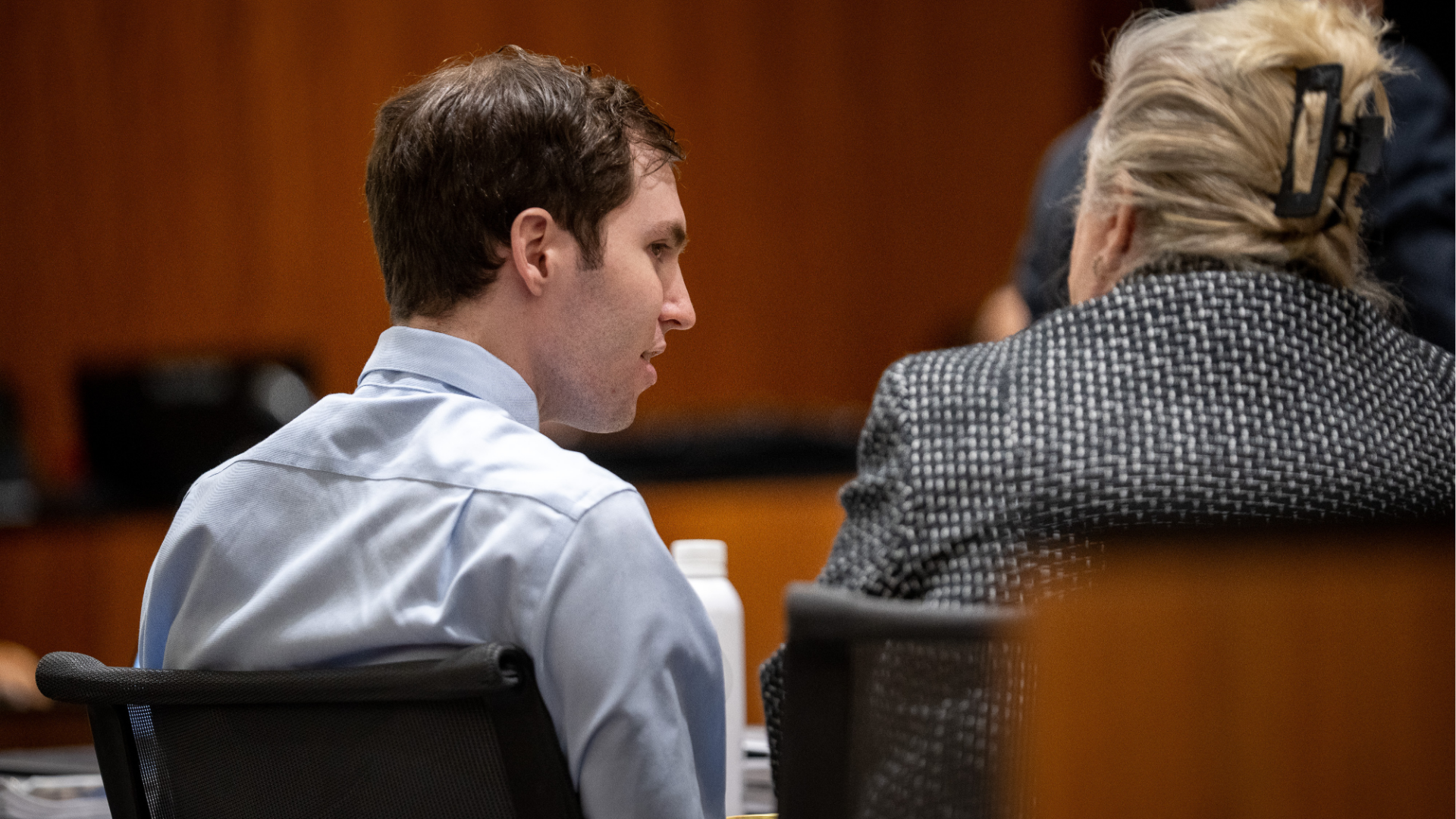
Tyler Robinson, left, speaks with his attorney, Katherine Nester, in 4th District Court in Provo, Utah, on Friday, April 17, 2026.
Trent Nelson/Salt Lake Tribune via AP, Pool
Graf has repeatedly said he cannot control the spread of misinformation outside of court, but he has taken steps to protect Robinson’s rights during the hearings. He tightened camera rules after members of a media group violated a courtroom order by showing Robinson handcuffs and taking close-ups of him speaking to his attorney. Graf moved the cameras to the back of the courtroom, behind Robinson, making it difficult to get photos of him.
The judge also granted the defense’s request to postpone Robinson’s preliminary hearing, which was scheduled for mid-May. During that hearing, scheduled for July 6-10, prosecutors must show they have enough evidence to proceed to trial. Graf said he has established a time frame that balances Robinson’s rights with those of Erika Kirk, who is entitled to a speedy resolution.
Prosecutors intend to seek the death penalty if Robinson (23 years old) is convicted. He is accused of crimes including premeditated murder and has not yet made any confession.
Before his death, Kirk and the conservative youth movement he founded, Turning Point USA, had emerged as a major force in American politics that was considered instrumental in electing President Donald Trump to a second term.
DNA consistent with Robinson’s was found on the gun’s trigger, a fired cartridge casing, two unfired cartridges and a towel used to wrap the gun, authorities said. Robinson’s lawyers argued that the preliminary hearing should not be held until federal law enforcement agencies turn over more details about their DNA analysis.
Prosecutors say they have enough evidence beyond DNA, including surveillance video and a handwritten note Robinson allegedly left for his romantic partner confessing to the crime.
Accusations that Robinson targeted Kirk because of his political views increased interest in the case, which in turn fueled the long-standing dispute over cameras within major cases.
Photos and videos reveal the inner workings of some of America’s most sensational criminal cases, from the Lindbergh child kidnapping trial to the O. J. Simpson double murder trial. They’ve also created tensions between transparency advocates and defense attorneys eager to protect clients from bad publicity.
The stakes are particularly high in death penalty cases like Robinson’s, where the jury can take into account the defendant’s character as part of its decision. Footage of Robinson smiling while speaking with his attorney during a hearing in December apparently sparked comments on Fox News that he treated Kirk “like a trophy.”
The Constitution places greater importance on the defendant’s rights to a fair trial than on the public’s right to know what is happening in the case. However, cameras have become more common in state courts in recent years.
They are generally barred from federal criminal prosecution. Under New York state law, Trump’s 2024 trial and conviction in a secret money case is known to be closed to cameras while the court is in session. Media organizations used sketch artists to capture the scene.
Judges typically retain broad discretion over what parts of a case can be broadcast and who can be filmed or photographed. ___
Brown reported from Billings, Montana.
Copyright © 2026 The Associated Press. All rights reserved.