Santiago de Cuba, Cuba – People across the northern Caribbean were recovering from the devastation of Hurricane Melissa on Thursday as the death toll from the catastrophic storm rose.
The sounds of large machinery, the whir of saws and the chopping of machetes echoed throughout southeastern Jamaica, as government workers and residents began clearing roads in an effort to reach isolated communities that took a direct hit from one of the strongest Atlantic storms on record.
Stunned residents wandered around, some staring at their roofless homes and submerged possessions scattered around them.
“I don’t have a home now,” said Sylvester Guthrie, a resident of Lacovia in southern St. Elizabeth Parish, clutching his bicycle, the only possession of value left after the storm.
“I have land in another location that I can rebuild but I will need help,” the sanitation worker pleaded.
Emergency relief flights began landing at Jamaica’s main international airport, which reopened late Wednesday, with crews distributing water, food and other essential supplies.
Jamaican Transport Minister Darryl Vaz said: “The devastation is enormous.”
Some Jamaicans wondered where they would live.
“I’m homeless now, but I have to be optimistic because I have a life,” said Cheryl Smith, who lost the roof on her house.
Authorities said they found at least four bodies in southwest Jamaica.
Prime Minister Andrew Holness said up to 90% of roofs in the southwest coastal community of Black River were destroyed.
“The Black River is what could be described as ground zero,” he said. “People are still dealing with the devastation.”
More than 25,000 people remained crowded in shelters in the western half of Jamaica, with 77% of the island without electricity.
Death and floods in Haiti
Melissa also unleashed catastrophic floods in Haiti, where at least 25 people were reported killed and 18 others missing, mostly in the country’s southern region.
Stephen Goddard, who lives in Petit Jove, said Melissa killed his entire family.
“I had four children at home: a one-month-old, a 7-year-old, an 8-year-old, and another who was about to turn 4,” he said.
Haiti’s Civil Protection Agency said Hurricane Melissa killed at least 20 people in Petit Gauves, including 10 children. It also damaged more than 160 homes and destroyed 80 others.
Officials warned that 152 people with disabilities in the southern region of Haiti require emergency food assistance. More than 11,600 people remained in shelters in Haiti due to the storm.
Slow recovery in Cuba
Meanwhile, people in Cuba began clearing blocked roads and highways with heavy equipment and even requested help from the military, which rescued people trapped in isolated communities and at risk of landslides.
No deaths were reported after Civil Defense evacuated more than 735,000 people across eastern Cuba. They are slowly starting to return home.
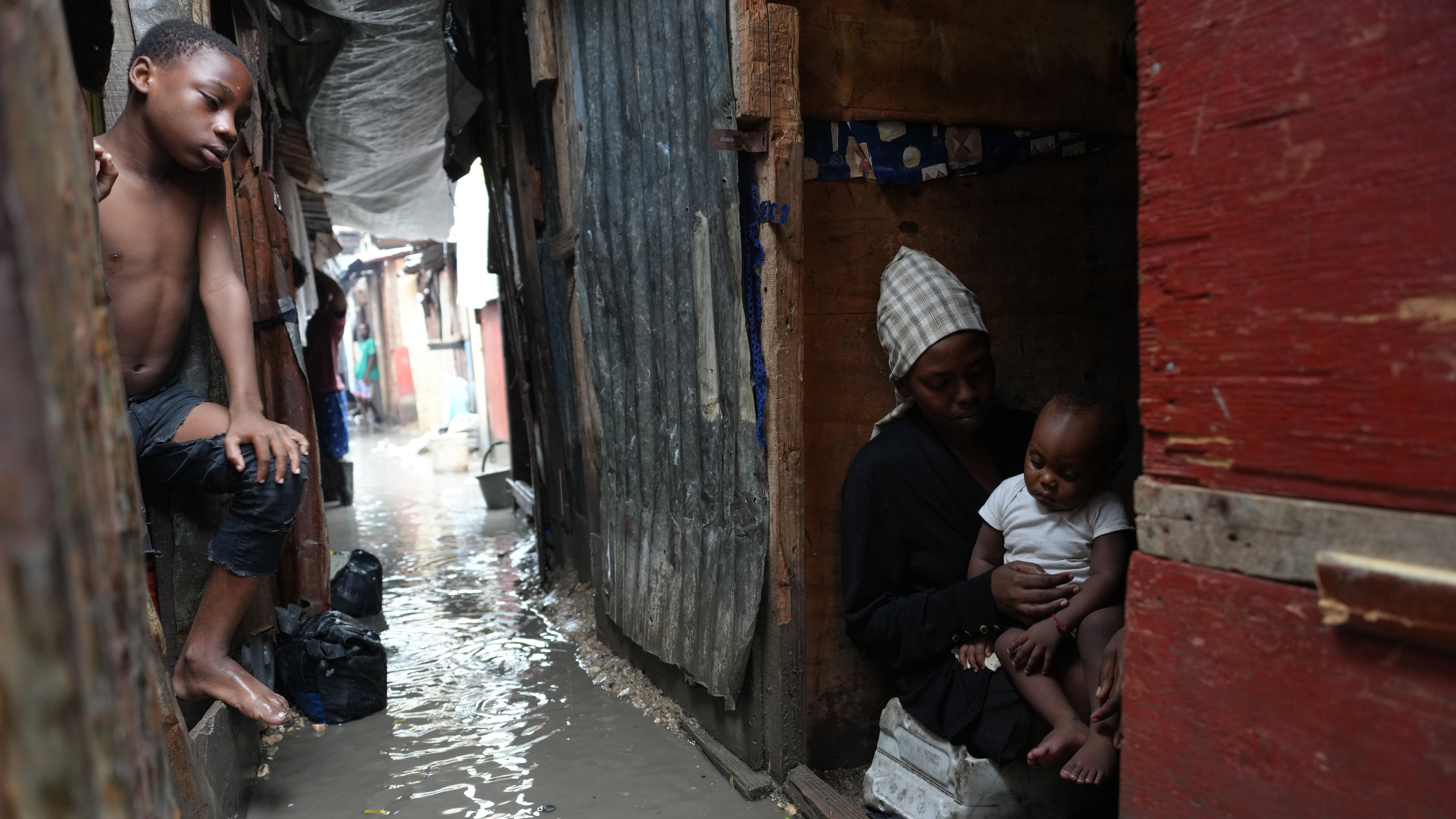
People stay inside a shelter for families displaced by gang violence, soaked by rain from Hurricane Melissa, in Port-au-Prince, Haiti, Wednesday, October 29, 2025.
AP Photo/Odilyn Joseph
“We are cleaning the streets, paving the road,” said Yaima Almenares, a physical education teacher from Santiago, as she and other neighbors cleared branches and debris from sidewalks and roads, cut down fallen tree trunks and removed accumulated trash.
In rural areas outside the city of Santiago de Cuba, water remained accumulating in vulnerable homes on Wednesday evening, as residents returned from their shelters to salvage beds, mattresses, chairs, tables and fans they had raised before the storm.
A televised civil defense meeting chaired by President Miguel Díaz-Canel did not provide an official damage estimate. However, officials from the affected provinces – Santiago, Granma, Holguin, Guantánamo, and Las Tunas – reported losses to roofs, power lines, fiber-optic telecommunications cables, road cuts, isolated communities, and losses to banana, cassava, and coffee plantations.
Officials said the rains were beneficial for reservoirs and to alleviate severe drought in eastern Cuba.
Many communities are still without electricity, internet and phone services due to fallen transformers and power lines.
Historical storm
When Melissa came ashore in Jamaica as a Category 5 hurricane with winds of 185 mph (295 kph) on Tuesday, she tied records for the strength of Atlantic hurricanes making landfall, both in terms of wind speed and barometric pressure. It was still a Category 3 hurricane when it made landfall again in eastern Cuba early Wednesday.
A hurricane warning remained in effect Thursday for Bermuda. A previous warning was lifted for the central and southeastern Bahamas, but the US Weather Service warned of up to 10 inches (254 mm) of additional rain.
Hurricane conditions are expected to continue into the morning in the southeastern Bahamas, where dozens of people have been evacuated.
Melissa was a Category 2 storm with maximum winds of about 105 mph (169 km/h) Thursday morning and was moving from the northeast at 21 mph (33 km/h), according to the U.S. National Hurricane Center in Miami.
The hurricane’s center was about 215 miles (345 kilometers) northeast of central Bahamas and about 685 miles (1,105 kilometers) southwest of Bermuda.
Melissa is expected to pass near or west of Bermuda late Thursday and may strengthen before weakening on Friday.
Copyright © 2025 The Associated Press. All rights reserved.