The biggest 2027 offseason storyline for the Bucs has been surrounding Baker Mayfield entering the final year of his contract and the negotiations between him and the team regarding a new deal. Mayfield has publicly stated that he does not want to continue negotiations past the start of training camp, instead wanting to focus on the field at that point. If the two sides remain at an impasse come that time, discussions will get pushed until after the 2026 season concludes.
This has led many to look at his contract void date and at least begin to wonder what happens if the two sides have not come to terms on an extension at that point. Evan Winter of AtoZ Sports recently discussed that possibility in a recent YouTube Video. In the video Winter states that the franchise tag is off the table for the Bucs if they let his contract void on February 20, 2027. With a ton of respect for Winter, I disagree.
Baker Mayfield’s Contract Void Date Has Nothing To Do With Franchise Tag, Dead Money
There seem to be a few misconceptions surrounding Baker Mayfield’s contract void date and the franchise tag. Let’s get a few of them out of the way. Before we dispel those, let’s talk about the remainder of Mayfield’s current contract.
From the moment Mayfield signed his current contract there was going to be dead money in 2027. His original signing bonus of $28.875 million was prorated over five years rather than the three years the actual contract is for. That means assistant general manager Mike Greenberg was prepared to take an $11.55 million dead cap hit.
Greenberg increased that potential dead cap charge in 2025 when he converted $31 million of Mayfield’s base salary to a prorated bonus, pushing another $18.6 million beyond 2026. That’s an unavoidable $30.115 dead cap hit staring the team in the face.
If the team is able to extend Mayfield, those cap hits prorate to $11.975 million in 2027 and 2028, respectively and $6.2 million in 2029. This brings us to misconception No. 1.
Misconception No. 1 – Franchise Tag Date Is Feb. 21 And Bucs Have to Absorb Baker Mayfield’s Full Dead Cap Hit
Let’s start with the tag date. There seems to be a misunderstanding that the franchise tag date is February 21, and since Mayfield’s void date is February 20, it is a masterstroke by his agent to force the team to forego the franchise tag so as not to take on an $80 million or more cap hit in 2027. This just isn’t true for two reasons.
First, the franchise tag exercise date isn’t a date at all. It’s a window. And that window opens prior to Mayfield’s contract void date. Per the NFL Football Operations Calendar, the franchise tag window runs from February 17 to March 3. Does this mean if the Bucs announce they are exercising the tag from February 17-19 they can at least push some of the dead money to 2028?
Misconception No. 2 – If Franchise Tag Is Announced Prior To Void Date, Dead Money Can Continue To Be Prorated
No. The franchise tag is a tender and can’t absorb prior dead cap from a previous contract. Mayfield’s void date could be February 20, March 3 or March 10 (the last day of the 2026 league year). It doesn’t matter. A franchise tag means all prior dead money gets absorbed in 2027.
The Franchise Tag Is Still On The Table
Evan Winter believes that between the $30 million dead cap hit and the projected $50.3 million franchise tag the team would find the total cap charge untenable. I disagree for a couple of reasons. First, the two cap charges are not combined. They are two different transactions. And the dead cap charge isn’t something new to the Bucs.
Currently, the Bucs are facing just over $35 million in dead cap in 2027. That may seem like a large number, but it will account for just under 11% of the $325 million salary cap that I am estimating. But go back just one year to 2025 and Tampa Bay absorbed more than that $35 million in dead cap on a salary cap of $279.2 million. In 2024, the Bucs took on $62.5 million in dead cap on a $255.4 million cap.
And let’s not forget 2023 when the team took on over $80 million in dead cap on a $224.8 million cap. All this to say Mike Greenberg and general manager Jason Licht are familiar and comfortable with managing large dead cap charges. History tells us not only are they comfortable with the modern reality of dead cap hits, but they will also often lean into it.
The Bucs have shown they often prefer to absorb dead cap earlier rather than later. They showed this when they forewent the opportunity to spread out Tom Brady’s dead cap charge following his retirement in 2023. They showed it again over the past several years with both Lavonte David and Mike Evans, not rushing to complete negotiations on extensions before a past contract voided just to prevent the acceleration of dead cap.
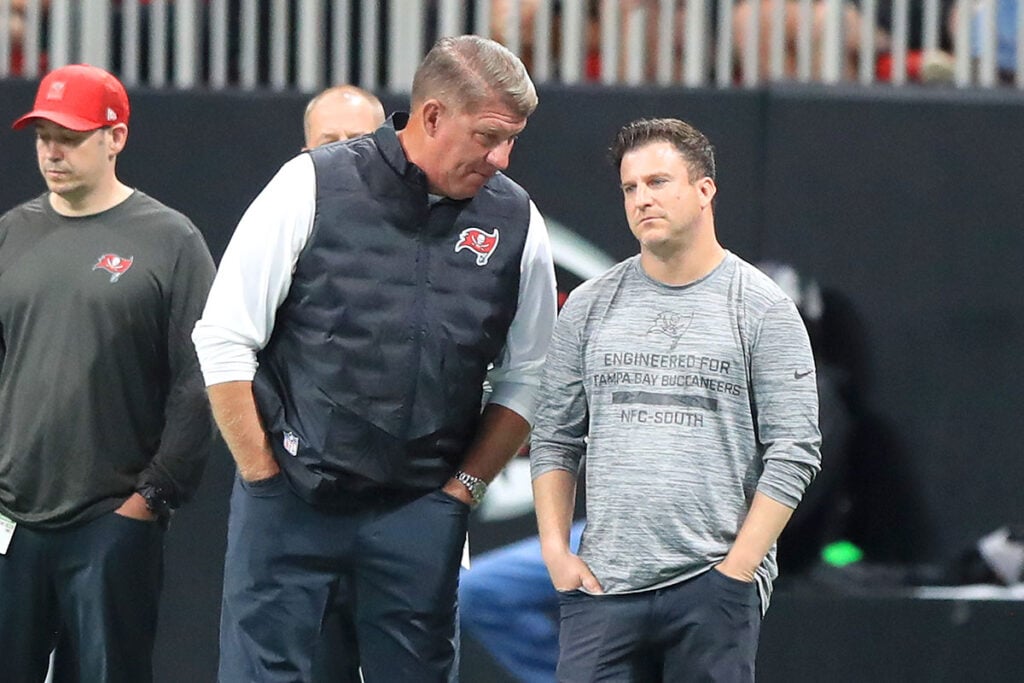
Bucs GM Jason Licht and assistant GM Mike Greenberg – Photo by: Cliff Welch/PR
Greenberg’s history has shown he values future flexibility over present unless the team is 100% all-in on a Super Bowl window. Operating a team that doesn’t maximize cash spending means they can absorb larger dead cap hits to keep the future more adaptable.
Winter also brings up in his video that the Bucs have limited cap space which will prevent them from supporting a tag charge. Again, I’ll disagree.
Using OverTheCap.com’s effective cap space tracker, Tampa Bay has just under $40 million in cap space in 2027. He then notes that Mayfield’s dead cap charge will eat up 75% of that number. Except, that effective cap space is already accounting for that charge.
Admittedly though, it doesn’t account for his franchise tag charge. They don’t currently have enough to afford the quarterback franchise tag. But this is before any cap maneuvering. The team has several triggers it can use to open up cap space. Here are a few restructures and cuts, along with how much cap space those moves could create:
Restructures
Tristan Wirfs – $16,493,333
Chris Godwin Jr. – $13,770,000
Luke Goedeke – $13,486,667
Antoine Winfield Jr. – $12,226,667
Zyon McCollum – $10,227,000
Cade Otton – $4,370,000
Ben Bredeson – $3,826,667
Total Potential Cap Savings – $74,400,334
Cuts
Chris Godwin Jr. – $22,000,000
Antoine Winfield Jr. – $19,600,000
Zyon McCollum – $8,006,000
Total Potential Cap Savings – $49,606,000
Now obviously, these transactions cross over, but the point is these seven players could give the team up to $92 million in cap savings on top of the almost $40 million in cap space they already have. The Bucs can afford to take on the franchise tag for Mayfield.
Franchise Tag Is A Means Of Last Resort
Do the Bucs want to use the tag on Baker Mayfield? Of course not. It means the two sides cannot agree on his value and it sets up a contentious relationship. No one wants that. But that doesn’t mean the tool is out of the team’s belt. While one could cast it as an $80 million decision that is beyond the pale, that’s just not how the team sees it.
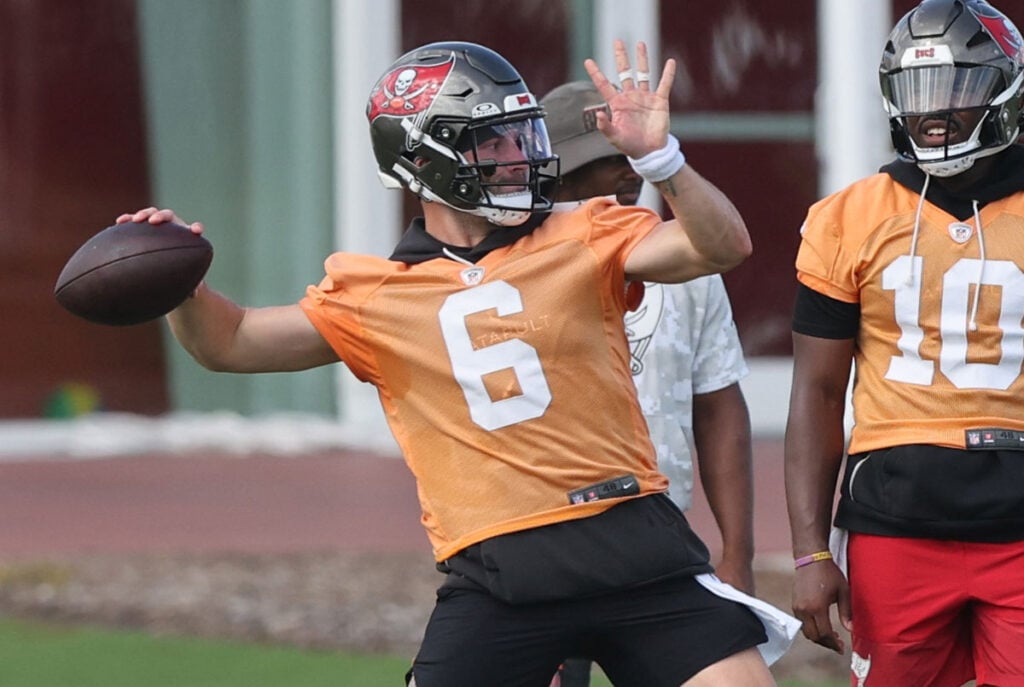
Bucs QB Baker Mayfield – Photo by: Cliff Welch/PR
What it really comes down to is whether the Bucs truly believe Mayfield is a franchise quarterback worthy of $50 million per year. And I believe they do feel that way about him.
How much more, and how that compares to how Mayfield sees himself, is still a mystery. But at almost $50 million even, Mayfield is worth the tag, leaving it as a viable option if necessary in 2027.