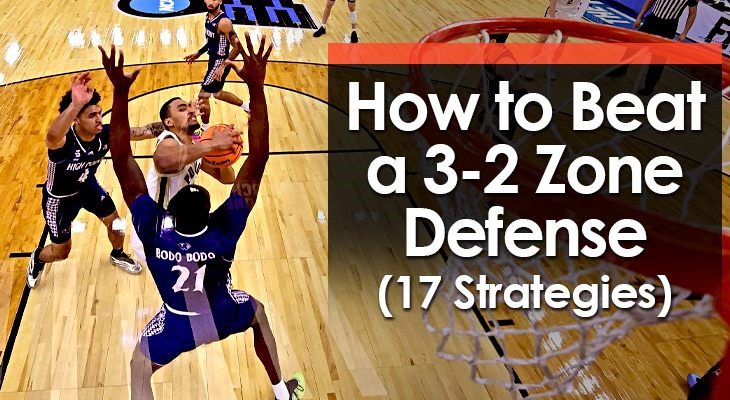
The 3-2 zone defense is becoming an increasingly popular defense in the half court at all levels of basketball, from the youth level to the NBA.
With so many offenses perimeter-focused these days, the 3-2 zone does a better job of contesting outside shots and limiting dribble penetration than a typical 2-3 zone.
Instead of forcing your players to memorize another offense to attack this defense, here are 17 strategies you can discuss with your team during a game to attack a 3-2 zone.
How to Beat a 3-2 Zone Defense
1. Set up in a 2-1-2
An effective offensive strategy against a zone defense is to line up where the defense isn’t.
In other words, start out in an “even front” offensively if the zone is in an odd front.
This works because the offensive players set up in the GAPS of the defense, creating open passing lanes to move the ball around and force the defense to shift.
The 2-1-2 setup is ideal against a 3-2 defense because the top defenders are forced to chase the ball around as it is moved, which will likely lead to the high post being open.
Teams tend to put their two best guards up top to help swing the ball from side to side effectively, but putting shooters in the two low spots is also a good way to attack the 3-2 zone.
We will discuss this in more detail later, but you have a variety of options for who you put at the high post position. Just make sure it is a player who can be a threat from that spot.

2. Attack the Corners
It is very effective to get the basketball to the corner when attacking any zone because when the ball is there, all zones become a 2-3.
Typically, the person responsible for covering the corner is a post player, which means a guard catching the ball in the corner should have an athleticism advantage.
If the post is late in closing out, it creates an open outside shot. And if the closeout does occur, the guard should be able to drive to the rim.
A baseline drive is a difficult action to handle in a 3-2 zone because it shifts the defense to the strong side of the floor to contain the drive. This opens up a drift pass to the weak corner for an open 3-pointer.
3. Attack the Gaps
A tried-and-true way to beat any zone is by attacking gaps. When a player catches the basketball, they should look to drive in the space between the defenders.
Either the defense will be late in recovering, and the offensive player will have an opening driving lane to the basket. Or both of the gap defenders will slide over to stop the ball, and there will be an open opportunity to kick the ball out to a teammate for an open shot or another drive.
Again, by moving the basketball with either the pass or the dribble, the defense is forced to shift and move, creating bigger gaps for the offense to exploit.
4. Get the Ball to the High Post
No matter what the zone is, the high post is a prime spot for the offense to get the ball to. Once it’s here, the defense is forced to collapse, creating passing lanes to teammates and open shots.
There are a variety of strategies to get the ball to the high post. Whether you put a post player there who has the height to receive passes over the top of the zone, or if you cut a wing player to the free throw area from behind the defense so they can do so without being detected.
Offenses must realize that it becomes easier to get the ball to the high post once they pass the ball around and force the defense to move.
By doing this, the defense gets more spread out, and the high post becomes much more open, no matter which approach a team takes in putting a player there.

5. Quick Ball Movement
One of the best things you can do against a zone is to move the ball quickly from side to side.
This forces the defense to constantly be on the move and try to not only get to the proper position, but also keep track of who is in their area.
If the ball sticks and doesn’t move, it allows the defensive players to easily get to their zone spots and be able to survey the offense, making it very difficult for the offense to score because they aren’t working to create any advantage.
A common way coaches encourage their players to keep the ball moving is by stressing that they demonstrate “zero-second decisions.” This means that players either shoot, pass, or drive immediately once they catch the basketball.
Against a zone, the gaps and open shot opportunities increase the more the ball gets reversed from side to side. Not only will defenders get tired from having to chase the ball, the ball will always move faster than players can if it’s kept moving.
6. Incorporate Pass Fakes
A common saying that many coaches use for their teams when going against a zone defense is to “Fake a pass to make a pass.” This emphasizes the need for the offense to utilize some pass fakes in their offensive attack against a 3-2 zone.
And there’s good reason for this…
Defenders in the zone are responsible for guarding an AREA on the floor instead of a specific player. So getting them to move in the wrong direction because of a pass fake can really create some open opportunities for the offense.
Pass fakes are also essential against a 3-2 zone because, typically, most zone offenses are fairly stationary. So getting defenders to move or at least move their hands is very beneficial when passing the ball to a post player at the high post or short corner.
Pass fakes are generally one of the simplest offensive skills a player can master, but also one of the most effective when used in the right situations.
7. Use Skip Passes
While pass fakes are crucial in attacking a zone, skip passes are also every bit as important.
Yes, we highlighted the importance of reversing the ball around the perimeter earlier…
But sometimes a skip pass is necessary to really exploit a zone defense.
The defenders in a 3-2 zone will shift toward the ball to get all 5 players on the strong side of the floor. That means that a skip pass to the weak side of the floor will likely lead to an open shot as the closest defender would have a long way to recover.
Skip passes will also often lead to great driving opportunities for the offensive player making the catch. Because the defender is so concerned with giving up an open shot, they will tend to close out in an out-of-control manner, which can allow the offensive player an easy drive by them to the basket for an inside shot or kick-out to an open teammate.
8. Penetrate the Zone
As we just discussed, being able to drive into the lane against a 3-2 zone defense is very important for an effective zone offensive attack.
First of all, keeping an attacking mentality against a zone is very important. Instead of being content with merely passing the ball around the perimeter, it’s essential that teams continue to try to get to the basket for easy shots and to potentially draw fouls.
In addition, drives to the paint will force the defense to help to stop the ball.
While drawing this help against man defense is effective, doing so against a 3-2 zone is even more productive because typically all 5 defenders collapse into the lane, meaning there are multiple opportunities to kick the ball out to a shooter for an open look.
9. Overload the Zone
A proven method of getting good shots against a zone is to overload one side of the floor with more offensive players than defensive ones.
As each defender in a 3-2 zone is responsible for a specific area, positioning more offensive players than the defense can account for will create a 2-on-1 situation for the offense as the ball moves to this area of the floor.
The key to overloading the zone being effective is that the offensive players continue to keep good spacing so that 1 defender can’t guard multiple players easily.
With good spacing, 1 defender will find it nearly impossible to guard the ball and then the next pass without giving up an open shot or drive to the basket.

10. Put a Playmaker at the Free Throw Line
Getting the ball to the high post area, regardless of what zone a team is facing, is always an effective offensive strategy against a zone.
But to truly maximize getting the ball to this area of the floor, you must make sure you put the right player there.
First of all, this player needs to be an offensive threat from the free throw line. Being able to knock down that mid-range jumper consistently or drive to the basket and finish.
But they must also be a very capable passer so that if the defense collapses. This is a very common reaction when the ball gets to this area of the floor, they can dump the ball down to a teammate at the rim or kick it out to a shooter on the perimeter.
11. Use a Baseline Cutter
A baseline cutter moving from corner to corner, particularly if that player is a shooter, can have a major effect on a 3-2 zone defense.
If a shooter is running from corner to corner, their gravity will force the low defenders to cheat towards them to potentially contest a shot, even if they doesn’t have the ball yet.
This creates openings in the paint as the low defenders move out toward a shooter.
Baseline cutters can also often get lost by the defense because of a variety of factors.
If the shooter cuts behind the defense and remains unseen during the cut, the defense may not recognize where he is until it’s too late, leading to an advantage for the offense.
12. Screen the Zone
An often underutilized tactic against a zone is to screen it.
While setting screens is a common offensive action against man defenses, it’s not something that most coaches usually employ against zones.
Some parts of screening against a zone have the same effect against a zone as it does against man.
A solid ball screen will give the ball handler an advantage to get to the paint for a floater or drawing help from the weak side to open up a pass to a teammate for a shot. And a simple down screen will tend to open up a shooter on the perimeter.
However, the aspect of screening against a zone that often gets overlooked is the screener slipping toward the ball after making contact with the defender.
Because defenders are typically taught to fight through screens, there is usually a gap inside of them that a screener can slip into and receive a pass for a shot. This is an easy and very effective way to get the ball to the high post.

13. Make Shots
A common reason teams go to a zone defense is if the team they are playing doesn’t shoot well from the outside. By playing a zone, they can pack all their defenders in the lane and prevent the ball from ever reaching the paint.
Therefore, there’s a very simple way to defeat a 3-2 zone:
Make outside shots.
While making outside shots won’t necessarily force the defense to change what they are running, it will force them to close out on your shooters on the outside. And by doing this, it will create more passing and driving lanes for your team to exploit.
Because making outside shots is almost a requirement if your team is going to beat a 3-2 zone, it is essential that you are working on your outside shooting consistently in practice with game-like shooting drills to simulate what your players will see.
14. Get the Ball Inside
While making shots is usually essential to beating a zone, relying only on outside shots can be a recipe for disaster if your team isn’t hitting at a high enough percentage.
So it’s still important to get the ball inside, even if the zone makes it difficult to do so.
Again, it will likely require some ball movement first to shift the zone and create space inside to feed the ball to a post.
Getting the ball to the high post against a 3-2 zone is a great way to create a high-low opportunity as well.
One of the low defenders will likely have to come up to take the ball once it gets to the free throw line area, allowing a post player to seal the remaining low defender in the paint for a great low post look.
15. Attack the Offensive Glass
One of the biggest difficulties in running a 3-2 zone is that since the players are guarding a part of the floor, they don’t necessarily know who they are boxing out.
On shot attempts, they have to first turn and find a player before boxing out, which most players struggle to do on a consistent basis.
This gives a huge advantage to the offensive team, especially for players who are on the weak side of the floor or the perimeter. The farther offensive players are away from the basket when a shot goes up, the less likely they will be identified and boxed out.
Therefore, offensive players must make sure they are actually crashing the boards on a shot attempt instead of merely watching.
Yes, there are times when a missed shot will bounce all the way out to the 3-point line, but it’s much more likely to grab an offensive rebound if players are moving toward the basket on the miss.
The only exception would be if their job is to get back in transition and prevent fast break layups.
16. Keep your Players Moving
One reason teams struggle against a 3-2 zone is that their zone offense is very stationary, and their players just stand around in a designated spot. This allows the zone defenders to match up with them easily since they are continually in the same spot.
One way to fix this is by having your players continue moving during possessions instead of staying in a set spot. Cutting through the lane and to the opposite side of the floor is a great way to re-locate and get lost by the defense.
Another way players can create movement is by dribbling at a teammate and having them cut away or loop to the top of the key. This shifts the defense and can open up players on the weak side of the floor.

17. Score in Transition
Many times, the best way to beat a zone defense is by simply scoring in transition before they can ever get the zone set up.
Because many teams will have assigned spots for their players in the 3-2 zone, they will often run down the floor focused on where they are headed and not where the ball is. This can lead to big driving lanes and open passes ahead for layups.
Even if the defense is able to get all 5 players somewhat into place, it’s unlikely they will be in good position relative to the ball, meaning the offense can still score quickly, even if it is 5 on 5.
Conclusion
Utilize these 17 strategies to teach your team how to beat a 3-2 zone defense.
Spend some time looking through the full list to see which of them best fit your team, as some of these ideas will work better with specific types of teams.
On top of these strategies, make sure you have an understanding of the 3-2 zone defense.
Too often, coaches don’t actually understand the defense they are up against, which makes it very difficult for them to come up with an effective plan to defeat it.
But if you develop that understanding of the 3-2, practice some of these strategies with your team, and have a couple set plays in your back pocket just in case, your team will be ready the next time they face the 3-2 zone.