Jannik Sinner’s third‑round victory over Eliot Spizzirri at the 2026 Australian Open has quickly turned into one of the most argued moments of the tournament. The match on Rod Laver Arena was paused as the roof was closed, and momentum shifted just as the defending champion was struggling with full‑body cramps. Following the massive debates on the internet, the former American tennis player Christopher Eubanks has cleared the doubts, explaining the rules and regulations.
Jannik Sinner’s Third-Round Match Against Eliot Spizzirri
The two-time defending champion was pushed into deep trouble in brutal conditions on Saturday afternoon by World No. 85 Spizzirri. The American took the opening set 6‑4, snapping Sinner’s long streak of sets won, before the Italian drew level by taking the second set 6‑3. Early in the third set, with on‑court temperatures approaching 40°C, Sinner’s body began to give up. He struggled to move as Spizzirri broke serve for a 3‑1 lead.
Around 2:35 p.m. local time, the Heat Stress Scale, which measures air temperature, radiant heat, humidity, and wind, hit its maximum reading of 5.0. Under the Australian Open’s Extreme Heat Protocol, a reading of 5 requires immediate action across the grounds. On the three arena courts – Rod Laver Arena, Margaret Court Arena, and John Cain Arena – any match already in progress continues only until both players have served an equal number of games, after which the roof is closed for the remainder of the match.
MORE: Jannik Sinner, Eliot Spizzirri’s Australian Open Match Suspension: All About the Extreme Heat Rule Enforced
While the protocol was followed, offering relief to the players, spectators, and ball kids alike, the timing of the Heat Stress Scale’s maximum reading coincided with Sinner’s physical struggles. The incident, however, sparked polarizing reactions from fans online.
Addressing the incident, Christopher Eubanks, who was courtside, strongly rejected the idea that the pause was improvised. “It’s not as sketchy as you might think. Once that happens, play is immediately stopped on the outer courts, and they immediately close the roofs on all 3 of the show courts. This rule has been in place for the last couple of years,” Eubanks explained.
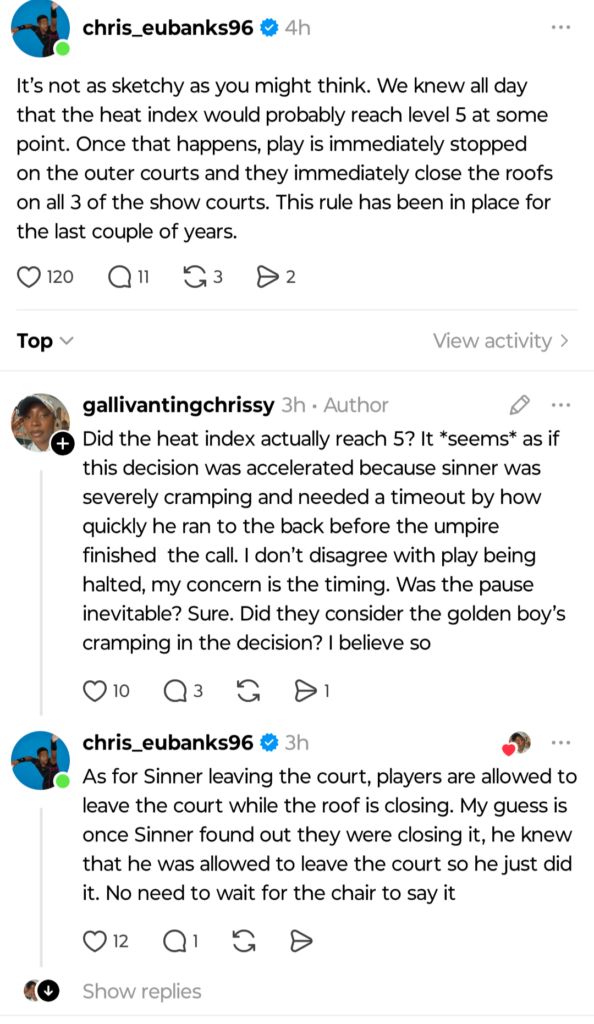
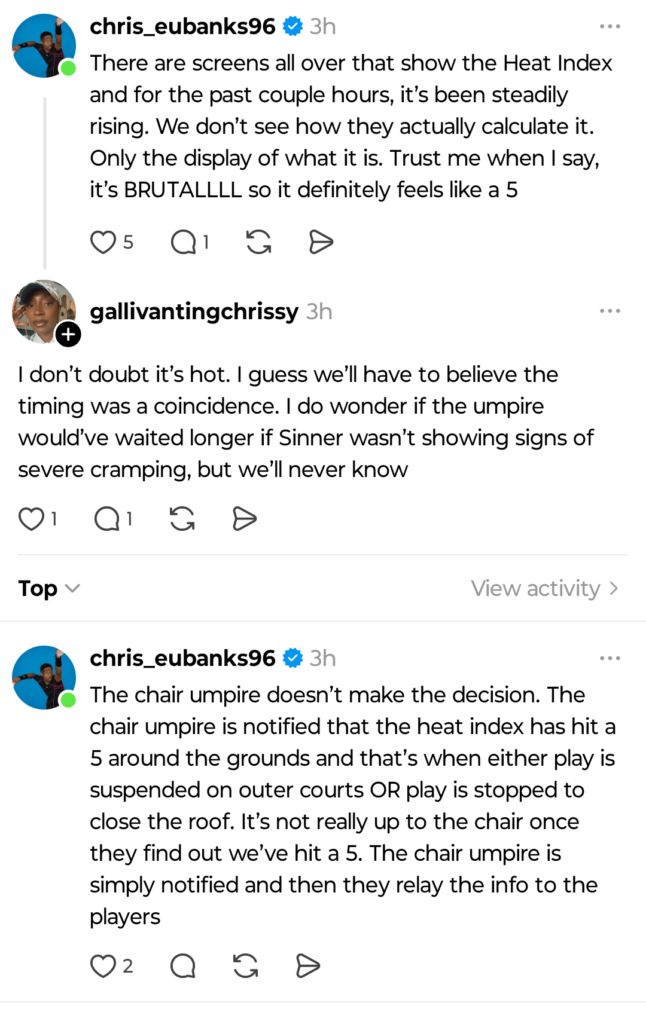
He also clarified two points: Firstly, he noted that players are allowed to leave the court while the roof is closing, suggesting Sinner simply used that option rather than waiting for an instruction. Secondly, he stressed that the chair umpire is not the one who chooses the moment to halt play.
According to Eubanks, the chair “doesn’t make the decision” but is informed once the Heat Stress Scale reaches 5 and then passes that information to the players, while the overall call belongs to the referee and officials monitoring the readings.
MORE: Following Jannik Sinner’s Retirement and Novak Djokovic’s Complaints, ATP Approves Implementation of New Rule Set
Sinner Survives Spizzirri Battle to Head to Fourth Round
Once the play resumed, Sinner faced a serious test. Spizzirri continued to attack, but the Italian recovered his break in the third set before steadying himself and securing another decisive break to win the third set. The fourth set started after a mandatory 10-minute break, courtesy of the heat rule.
Across the match, Spizzirri broke Sinner’s serve six times and created 16 break‑point chances, a statistic that shows how close the contest was despite the final score. After three hours and 42 minutes of play, the defending champion finally completed a 4‑6, 6‑3, 6‑4, 6‑4 comeback win, extending his unbeaten run at Melbourne Park.
The victory moved Sinner into the fourth round, where he faces his compatriot, No. 22 seed Luciano Darderi. The 23‑year‑old earned his place in the all-Italian clash by upsetting 15th seed Karen Khachanov 7‑6(5), 3‑6, 6‑3, 6‑4.
With Sinner, Darderi, and Lorenzo Musetti reaching the last 16, Italy has three men in the second week of the Australian Open for the first time. Sinner has a 98% chance of beating Darderi and advancing to the quarterfinals, according to PFSN’s exclusive interactive simulator.